
Smart Sleep Tech for Indian Homes: Better Rest, Automated
A grounded look at the smart-home tech that genuinely helps you sleep in India — circadian lighting that dims warm at night, sunrise wake lights, white noise, cool-enough AC and fan schedules through hot months, sleep trackers and rings, blackout curtains and bedroom air quality — plus an honest note on what really moves the needle.
Sleep is the one thing a smart home can help with that you spend a third of your life doing. In India that third is often fought against a stack of small obstacles — a bedroom that stays warm long after midnight, streetlight leaking past thin curtains, the neighbour's generator, a phone that keeps you scrolling past one o'clock. None of these needs a gadget to fix. But a few well-chosen smart devices, set up once and then forgotten, can quietly remove the friction between you and a good night's rest. This guide is the honest version: what genuinely helps, what is pleasant but optional, and what is expensive theatre.
Good sleep tech is invisible. The best set-up is one you configure once and never touch again — lights that warm and dim on their own, a room that is cool before you lie down, and a wake-up that feels like dawn rather than an alarm. If a device demands attention at bedtime, it is working against you.
If you are still assembling the bigger picture, read this alongside the ultimate guide to smart homes in India and the smart home planning guide. Much of the value below is really lighting and climate control pointed at one goal, so the smart lighting guide and smart HVAC and climate guide are close companions.
Start with light, because your body reads it as a clock
The single most useful sleep intervention is not a mattress or an app — it is getting your bedroom light right. Human bodies treat bright bluish light as "be awake" and warm dim light as "wind down." A bright cool bulb blazing at 6500K over your bed at eleven at night is telling your brain it is noon. Fix that and much else follows.
Tunable-white bulbs (Philips Hue White Ambiance, Wipro Garnet, Syska, Havells Glamax) slide from warm 2200K amber to cool 5000K daylight on command. For the bedroom you want them warm and dim in the evening. A circadian automation does this without you thinking about it: cool and bright through the day, gently warming and dimming after sunset, down to a faint amber by bedtime. You can build this in the Philips Hue app's "Natural light" mode, in Home Assistant with the Adaptive Lighting add-on, or as a simple set of scheduled scenes in Alexa or Google Home. The scenes and automations guide walks through the mechanics.
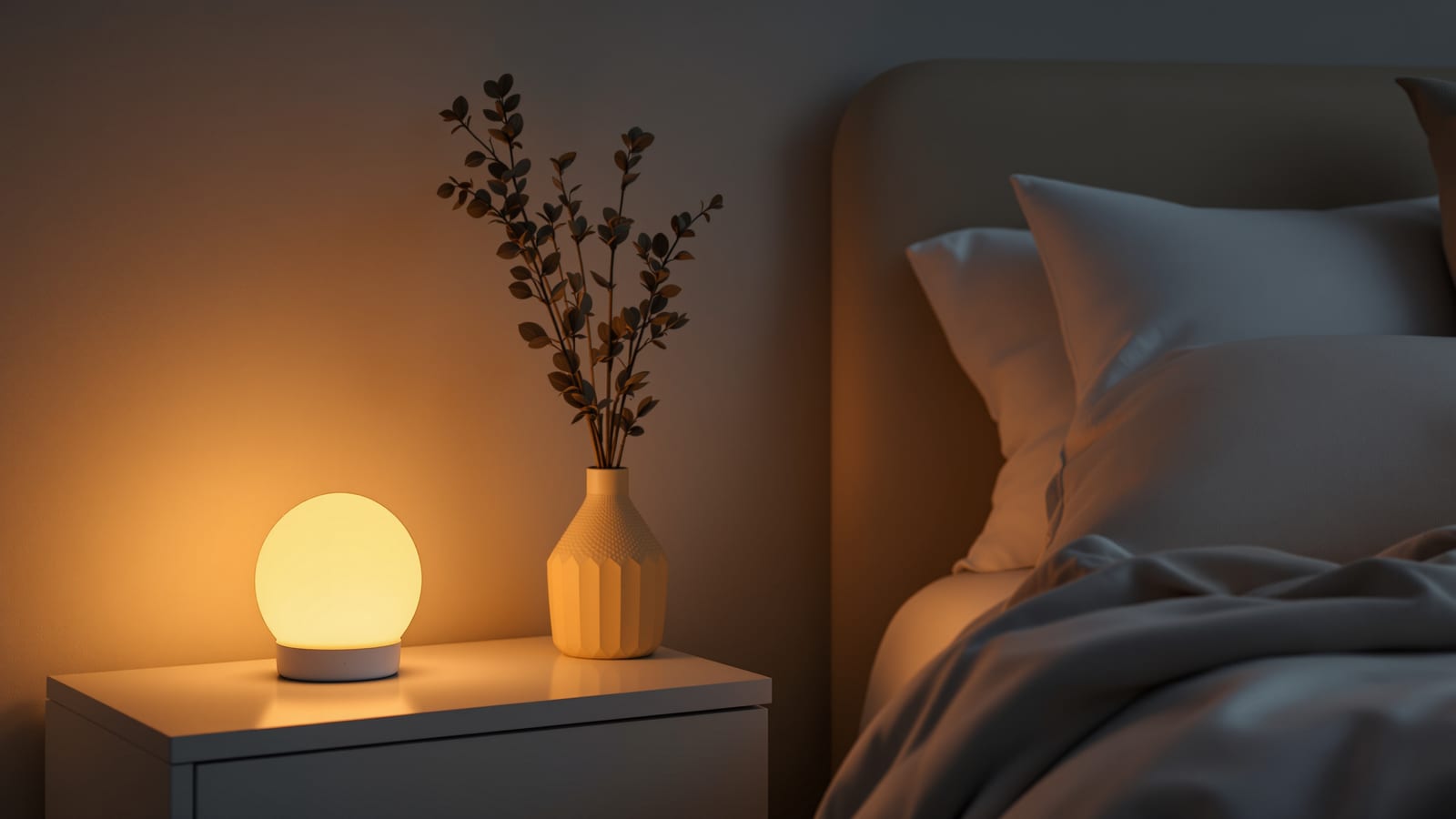
Even if you never touch colour, one habit matters most: the last hour before bed should be warm and dim. A single tunable bedside lamp set to 2200K at 15 to 20 percent brightness does more for sleep than a whole ceiling of colour bulbs left at daylight.
Waking up: sunrise lights beat blaring alarms
A jarring alarm yanks you out of whatever sleep stage you were in. A wake-up light instead brightens the room slowly over 20 to 30 minutes before your alarm time, mimicking dawn so you surface gently. Philips sells dedicated sunrise lamps (the Wake-Up Light range), but you do not need one — any smart bulb can do it. Alexa and Google Home both have a "sunrise" or gradual-brightness routine, and Philips Hue has a built-in wake-up that ramps the bedroom lights from amber to bright cool white. Pair it with a soft sound rather than a klaxon.
| Wake method | What it does | India reality |
|---|---|---|
| Dedicated sunrise lamp (Philips) | Ramps light, birdsong, radio | Works standalone, ₹6,000 to ₹12,000, no hub needed |
| Smart bulb + routine | Same dawn effect using bulbs you own | Cheapest if you already have Hue or Wipro |
| Smart speaker alarm | Gentle chimes, gradual volume | Free with an Echo or Nest you already own |
| Phone smart alarm app | Vibration, gradual tone, sleep-cycle timing | No hardware, but the phone stays in the bedroom — a trade-off |
The honest catch for India: a wake-up light only helps if the room is genuinely dark to begin with, which brings us to curtains.
Cool enough to sleep: AC and fans for Indian nights
For most of India, temperature is the real enemy of sleep for a good part of the year. The body needs to shed heat to fall asleep, and a bedroom sitting at 31 degrees at midnight fights that. A smart AC controller (Sensibo, Cielo Breez, or the app on an inverter split from LG, Daikin or Voltas) lets you schedule the room to cool before you lie down and then drift warmer through the night so you are not shivering by 4 a.m. and not burning power all night either.
- Pre-cool, then ease off. Set the AC to reach a comfortable 24 to 26 degrees by your usual bedtime, then step up by a degree or two after you are asleep. This mirrors the natural night-time dip and cut in cooling.
- Use "sleep" or "eco" modes. Most inverter ACs have a built-in sleep curve; a smart controller can enforce it and add a hard off-time.
- Let fans do the night shift. A smart ceiling fan (Atomberg, Havells with BLDC motors) sipping 25 to 30 watts can hold comfort for hours after the AC switches off, at a fraction of the running cost.
Getting the climate side right is a guide in itself — see smart HVAC and climate for India. One warning: do not chase a fixed temperature blindly. Humidity matters as much as the number; a slightly higher set point with a fan moving air often feels better and costs far less than a cold, still room.
Quiet a noisy night: white noise and smart speakers
Indian bedrooms are rarely silent — traffic, generators, a wedding two streets away. A steady white or brown noise masks the sudden sounds that wake you. You almost certainly already own the hardware: an Amazon Echo or Google Nest speaker plays ambient sound on a spoken command ("play rain sounds," "play white noise") and can be set to stop after a timer. Dedicated machines (Hatch, LectroFan) exist but are hard to buy in India and rarely worth it over a speaker you have. The smart speakers guide covers picking one.
Trackers and rings: measure, but do not obsess
Sleep tracking is where the money and the hype collect. A smartwatch (Apple Watch, Samsung Galaxy Watch, Noise, boAt, Fire-Boltt) or a smart ring (Oura, Ultrahuman Ring AIR — an Indian brand, Pi Ring) records how long and how well you slept, stages, heart rate and morning readiness.
| Device type | Rough India price | Strength | Honest limitation |
|---|---|---|---|
| Budget smartwatch (Noise, boAt) | ₹2,000 to ₹6,000 | Cheap, all-day wear | Sleep-stage accuracy is rough |
| Premium smartwatch (Apple, Samsung) | ₹25,000+ | Good data, wide health app | Bulky to sleep in, nightly charging |
| Smart ring (Ultrahuman, Oura) | ₹18,000 to ₹40,000 | Comfortable overnight, strong readiness metrics | Subscription on some, replace yearly-ish battery wear |
The useful part of tracking is the trend, not the nightly score. Seeing that late caffeine or a hot room consistently wrecks your deep sleep is actionable; agonising over a single 68 percent score can itself cause "orthosomnia" — anxiety about sleep data that harms sleep. Wear it, look weekly, and let the numbers confirm habits rather than rule you. For the wider health picture, see home health monitoring in India.
Smart mattresses and toppers: mostly not yet, in India
Abroad, smart mattresses that heat, cool and track sleep (Eight Sleep, Sleep Number) are a category. In India they are barely available, cost more than a small car, and depend on cloud services and support that may not exist here. Skip them. The honest Indian answer is a good ordinary mattress and getting the room temperature right with the AC and fan set-up above — far cheaper and more reliable. A few local brands sell app-connected adjustable bed bases; treat those as a comfort feature, not sleep tech.
Darkness and air: the unglamorous essentials
Blackout smart curtains. Streetlight and early Indian dawns both steal sleep. Motorised curtain tracks (SwitchBot Curtain, Zemismart, or wired motors from Somfy and local blind makers) close on a schedule or a voice command and open at your wake time to let real daylight finish the job the wake-up light started. Pair blackout fabric with the motor and a "good night" routine draws them shut for you.
Bedroom air quality. Poor air fragments sleep quietly. In cities with dusty or smoky seasons, a smart air purifier running on a low, quiet night setting keeps particulate down; many report deeper sleep in high-AQI months. Keep it on the auto or sleep mode so it does not roar. A cracked window for fresh air, where the outside air is clean enough, matters just as much.
Two automations that do most of the work
You do not need dozens of rules. Two routines carry the whole system.
- Good Night (one voice command or a bedside button): dim all lights to warm and off after a delay, set the AC to its sleep curve, draw the blackout curtains, start white noise on a 45-minute timer, arm the door lock, and switch the phone to do-not-disturb. Build it once in Alexa, Google Home or Home Assistant.
- Wake Up (at your alarm time): begin the sunrise light 25 minutes early, open the curtains at wake time, raise the AC set point or switch to fan, and gently start the day's news or music.
The scenes and automations guide has step-by-step builds for both. Everything here is also captured, phase by phase, in the complete smart home checklist if you want a buying and setup list.
The honest note: what actually improves sleep
No device beats the basics. If you do only three things, make them these: keep the last hour warm and dim, keep the room cool and dark, and keep the phone out of the bed. Smart tech is worth it precisely because it makes those basics automatic — a room that dims and cools itself so you do not have to rely on willpower at midnight. But a ₹40,000 ring will not fix a bright, hot, noisy bedroom, and no automation replaces a regular sleep and wake time. Buy the light and climate control first; treat trackers as feedback, not medicine; and if sleep problems persist despite a well-set room, see a doctor rather than a gadget catalogue.
To size the spend, run the smart home cost calculator and check whether your home is ready with the smart home readiness score.
References
- Philips Hue — Natural light and wake-up routines
- Sleep Foundation — Light and sleep, circadian rhythm
- ICMR / National Institute of Nutrition — healthy lifestyle and sleep guidance
- Bureau of Energy Efficiency — Star Labelling for air conditioners and fans
- Bureau of Indian Standards — product safety and marking
- Sleep Foundation — the risks of orthosomnia and over-tracking sleep
Export this guide
Related Guides — Deep-dive reading
Smart Lighting for Indian Homes: Switches, Scenes, Circadian & Sensors
The one honest decision that shapes your whole system (switch or bulb), plus dimming, tunable white, circadian light, motion sensors and the automations that actually earn their keep — with real Indian brands and rupee costs.
Smart HomeCircadian Lighting & Smart Curtains: Light for Better Sleep (India 2026)
How morning daylight and evening darkness set your body clock — and how sheers, blackout and motorised curtains scheduled to open at dawn and close at dusk can support healthier sleep in Indian bedrooms, kids' rooms and shift-worker homes.
Window TreatmentsSmart Ceiling Fans in India: BLDC, Remote & Voice Control
The ceiling fan is the hardest-working appliance in an Indian home — running eight months a year, often all night. A smart BLDC fan cuts its power draw by two-thirds, adds a remote and app, and answers to Alexa and Google. Here is what actually matters when you buy one.
Smart HomeRelated Tools — Try Free
Circadian Light Meter
Patient-centric circadian lighting visualizer for Indian healthcare design — time-of-day × intensity → CCT, melanopic lux (EML / mEDI), melatonin suppression, and an alertness curve. Calibrated against WELL v2 L03 Circadian Lighting Design, CIE S 026:2018, Brainard 2001, and Lucas et al. 2014.
Circadian ToolCross-Ventilation Analyzer
Estimate airflow and air changes per hour (ACH) from room size, window areas, layout, and local wind — with NBC 2016 Part 8 compliance check.
Ventilation CalculatorMotorized Curtain Cost Calculator
Estimate the all-in cost to motorise curtains — motors, tracks, hub and installation.
Cost Calculator