
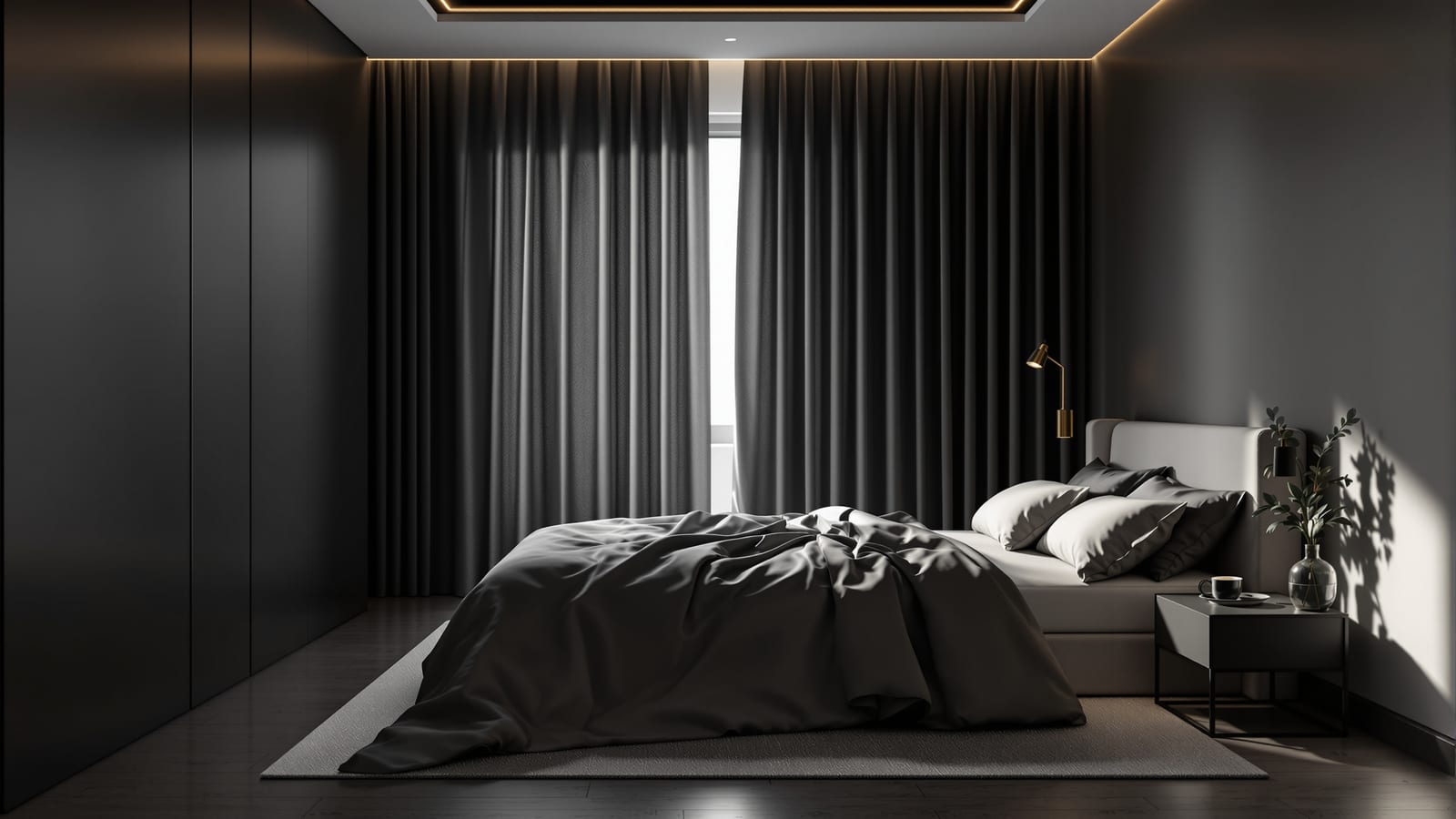
Circadian Lighting & Smart Curtains: Light for Better Sleep (India 2026)
How morning daylight and evening darkness set your body clock — and how sheers, blackout and motorised curtains scheduled to open at dawn and close at dusk can support healthier sleep in Indian bedrooms, kids' rooms and shift-worker homes.
Your body has run on light for far longer than it has run on clocks. Deep in the brain sits a tiny cluster of cells — the master clock — that reads the light hitting your eyes and uses it to set everything from when you feel sleepy to when your body temperature dips and rises. That internal day-night cycle is your circadian rhythm, and the single strongest signal that keeps it on time is light: bright light in the morning, darkness at night. Modern Indian homes quietly sabotage both. We sleep in rooms that glow at 5:45 dawn and stay lit by screens past midnight, and we wonder why sleep feels broken.
Curtains turn out to be one of the most direct, low-tech levers you have over that light signal. Not a cure, not a medical device — but a genuinely useful tool. This guide explains how morning daylight and evening darkness set the body clock, and how to use sheers, blackout and motorised curtains — scheduled to open at dawn and close at dusk — to work with your rhythm instead of against it.
Light is the body's clock-setter. A curtain decides, hour by hour, how much of that signal reaches you. Used well it is the cheapest piece of sleep hygiene in the house; used badly it is a daily alarm clock you never set.
The evidence, honestly stated
The link between light exposure and the body clock is one of the better-established findings in sleep science, and it earned a Nobel Prize for the underlying circadian biology. The practical, well-supported points:
- Morning light advances and stabilises the clock. Bright daylight within an hour or so of waking helps you feel alert sooner, sleep better the next night, and stay on a regular schedule.
- Evening light, especially bright and blue-rich light, delays the clock and suppresses melatonin, the hormone that signals "time for sleep". Darkness lets melatonin rise.
- Daytime sleepers and disrupted schedules suffer most. When the light signal and the sleep schedule disagree — as for shift workers — the clock drifts, and sleep quality and mood often suffer with it.
Now the honest caveats, because this matters. Curtains support good sleep; they do not fix insomnia, sleep apnoea, anxiety or a disordered schedule. Light is one input among many — caffeine, stress, screen habits and meal timing all pull on the same clock. If you have a genuine sleep disorder, see a doctor, not a curtain shop. What curtains do well is the one job that is squarely theirs: controlling how much light reaches you, and when.
The two signals a curtain controls
A circadian-friendly bedroom needs to deliver two opposite things on a daily cycle, and a single curtain cannot do both. This is why almost every well-set-up Indian bedroom runs two layers.
- The sheer is the morning-light layer. A light, translucent fabric lets soft daylight into the room while you wake, giving your eyes the bright signal that starts the day — without the full glare or full exposure of bare glass. By day it also softens harsh sun and gives privacy. The sheer curtains guide covers fabrics and the day-versus-night privacy trap in detail.
- The blackout is the darkness layer. Drawn for sleep, it protects the dark window your melatonin needs — crucial in India, where the sun is up and bright by 5:45 for months and rises in the east, exactly where many bedrooms face. The blackout curtains guide explains what genuine blackout means and where dawn light actually leaks (it is almost never through the cloth — it is the gaps around it).
Run independently — sheer drawn and blackout open by day, both closed for sleep — these two layers let the same window deliver bright mornings and dark nights. That is circadian lighting in physical form. The dedicated bedroom curtains guide covers layering and the centre-overlap leaks in depth.
A day in the life of a circadian curtain
Here is what an ideal light-aware schedule looks like across a single day, and what the curtain should be doing at each point.
| Time of day | What your body clock wants | Curtain action |
|---|---|---|
| Around dawn / wake time | Bright light to start the day | Open the sheer (or blackout) gradually so daylight floods in |
| Mid-morning to afternoon | Plenty of daylight, glare and heat controlled | Sheer drawn on bright windows; blackout open |
| Late afternoon (hot west sun) | Comfort, not a darkness signal yet | Partially close blackout against heat and glare only |
| Early evening / sunset | Begin winding down; less bright light | Draw curtains as dusk falls; dim and warm the room lights |
| Night / sleep | Darkness for melatonin and deep sleep | Blackout fully closed, centre overlapped, room sealed dark |
The two anchor moments are the ones to get right: a gentle, bright opening near your wake time, and a dark, sealed window for sleep. Everything in between is comfort and heat management. This is exactly the schedule that motorisation automates — which is the next section.
Why motorised curtains make this practical
You can run this rhythm by hand, but in real life nobody gets up at 5:50 a.m. to open the curtain so that dawn light can wake them gently — by then the jolting alarm has already done the unkind version of the job. This is where motorised curtains stop being a luxury and start being a genuinely useful sleep tool. The body of the work is the schedule:
- The dawn-open. Set the blackout (or sheer) to glide open a little before your wake time, so natural light builds in the room and wakes you gradually rather than an alarm yanking you out of deep sleep. This is the single most valuable circadian feature in the home.
- The dusk-close. Set the curtains to draw as the sun sets, sealing the room and cueing the wind-down — useful even on the evenings you forget.
- The afternoon heat-close. A west bedroom that closes itself against the 3 p.m. sun stays cooler for the night's sleep — comfort and a small energy saving, not a gimmick.
To do any of this you need motors that speak a schedule. Battery/rechargeable motors retrofit any bedroom without breaking walls and recharge every few months; wired motors are maintenance-free but need cabling planned during construction. Quiet operation matters more in a bedroom than anywhere — you are running it where someone is sleeping. The smart curtains guide covers ecosystems and quiet motors, and the smart-home curtain automation guide walks through building the actual dawn-and-dusk schedules and scenes.
The killer setup, stated plainly: a motorised blackout that opens to a slice of dawn light at your wake time, plus a tunable bedside light that comes up warm and gentle, replaces the jarring alarm with a sunrise. That pairing — curtain plus light — is far more effective than either alone.
Pairing curtains with tunable lighting
Curtains control daylight; tunable lighting controls the artificial light that fills the gap, and the two work as a team. Modern tunable (or "warm-to-cool") bulbs let you shift colour temperature through the day, and the goal is to mimic what the sun is already doing outside your curtain:
- Morning: cooler, brighter artificial light supports the daylight the open sheer is letting in.
- Evening: warm, dim light after sunset, so your indoor light does not undo the darkness signal the closed curtains are creating.
- Night / bathroom trips: very dim, warm light only — bright white light at 2 a.m. resets the clock you are trying to protect.
The principle is simple: the curtain manages the sun, the bulb manages the room, and both should agree on the time of day. A blackout-sealed bedroom flooded with cool white ceiling light at 11 p.m. is working against itself. For the broader picture of how curtains fit the whole home's light plan, start from The Complete Home Curtain & Window Treatment Guide.
Special cases: kids and shift workers
Two groups get disproportionate value from a light-aware setup.
- Children and babies live and die by daytime naps, which means daytime darkness. A nursery that goes properly dark for the afternoon nap — blackout, centre overlapped, dropped to the floor — is one of the highest-value curtains in the house. Critically, choose cordless or motorised operation: long cords and chains are a real strangulation hazard for small children. A gentle motorised dawn-open also helps settle older kids into a regular wake time.
- Shift and odd-hour workers — IT, healthcare, aviation, BPO — are the hardest case, because they must sleep when the sun is up and their body clock is screaming "daytime". A dim-out curtain that is "good enough" for a night sleeper is useless for a day sleeper. Here the brief is total, uncompromising blackout plus a scheduled bright opening for their wake time, whenever that falls. Light cannot fully fix a clashing schedule, but maximising darkness during sleep and brightness on waking is the strongest non-medical help available.
Care, climate and the honest bottom line
Indian conditions are hard on circadian curtains specifically. Direct sun fades and weakens the very fabrics doing this work; dust settles into heavy blackout weaves; and a track that drifts out of alignment stops overlapping at the centre — re-opening the dawn leak you spent money to seal. Keep tracks and motor rails clean and aligned, choose fade-resistant face fabrics on bright east and west windows, and air heavy curtains in the monsoon.
Two caveats to close on, plainly. First, this is support, not medicine: well-managed light genuinely helps most people sleep and wake better, but it will not override a sleep disorder, chronic stress or a chaotic schedule — see a doctor for those. Second, every figure and timing here is a starting point; your sunrise, your window orientation and your own rhythm are what matter — observe your room for a few days before you automate it. To find the right layer combination for your window, weigh the cost, and choose, the tools below do the work.
The circadian curtain, in five moves
1. Run two layers — a sheer for morning light, a blackout for night darkness — operated independently.
2. Make the bedroom go genuinely dark for sleep: overlap the centre, run the track wider and higher, drop to the floor.
3. Motorise the schedule — a gentle dawn-open at wake time, a dusk-close at sunset, an afternoon heat-close on hot windows.
4. Pair with tunable lighting so your bulbs agree with your curtains about the time of day.
5. Treat it as support, not a cure — observe your own rhythm, and see a doctor for real sleep problems.
Get those right and your windows stop fighting your body clock and start setting it.
Build a light-aware bedroom with Studio Matrx. Find the right sheer-plus-blackout combination for your window with the Window Treatment Selector, price the fabric and motors with the Curtain Cost Calculator, and start from the full picture in The Complete Home Curtain & Window Treatment Guide. For the wider cluster, browse all window treatments.
Export this guide
Related Guides — Deep-dive reading
Smart Sleep Tech for Indian Homes: Better Rest, Automated
A grounded look at the smart-home tech that genuinely helps you sleep in India — circadian lighting that dims warm at night, sunrise wake lights, white noise, cool-enough AC and fan schedules through hot months, sleep trackers and rings, blackout curtains and bedroom air quality — plus an honest note on what really moves the needle.
Smart HomeCircadian Lighting for Homes
Light is the master cue for your body clock. Here is how to design a home's electric lighting — colour temperature, brightness and layers through the day — so it supports sleep, mood and energy instead of quietly wrecking them.
Healthy HomesSmart Home Curtain Automation: Schedules, Scenes & Sensors (India 2026)
The automation playbook for motorised curtains — the routines, scenes, sensors and geofencing that genuinely add comfort and cut cooling load, separated honestly from the gimmicks.
Window TreatmentsRelated Tools — Try Free
Circadian Light Meter
Patient-centric circadian lighting visualizer for Indian healthcare design — time-of-day × intensity → CCT, melanopic lux (EML / mEDI), melatonin suppression, and an alertness curve. Calibrated against WELL v2 L03 Circadian Lighting Design, CIE S 026:2018, Brainard 2001, and Lucas et al. 2014.
Circadian ToolCross-Ventilation Analyzer
Estimate airflow and air changes per hour (ACH) from room size, window areas, layout, and local wind — with NBC 2016 Part 8 compliance check.
Ventilation CalculatorCurtain Cost Calculator
Get the fabric metres you need plus the total curtain cost by window size, fabric, pleat, lining and hardware.
Curtain Calculator