
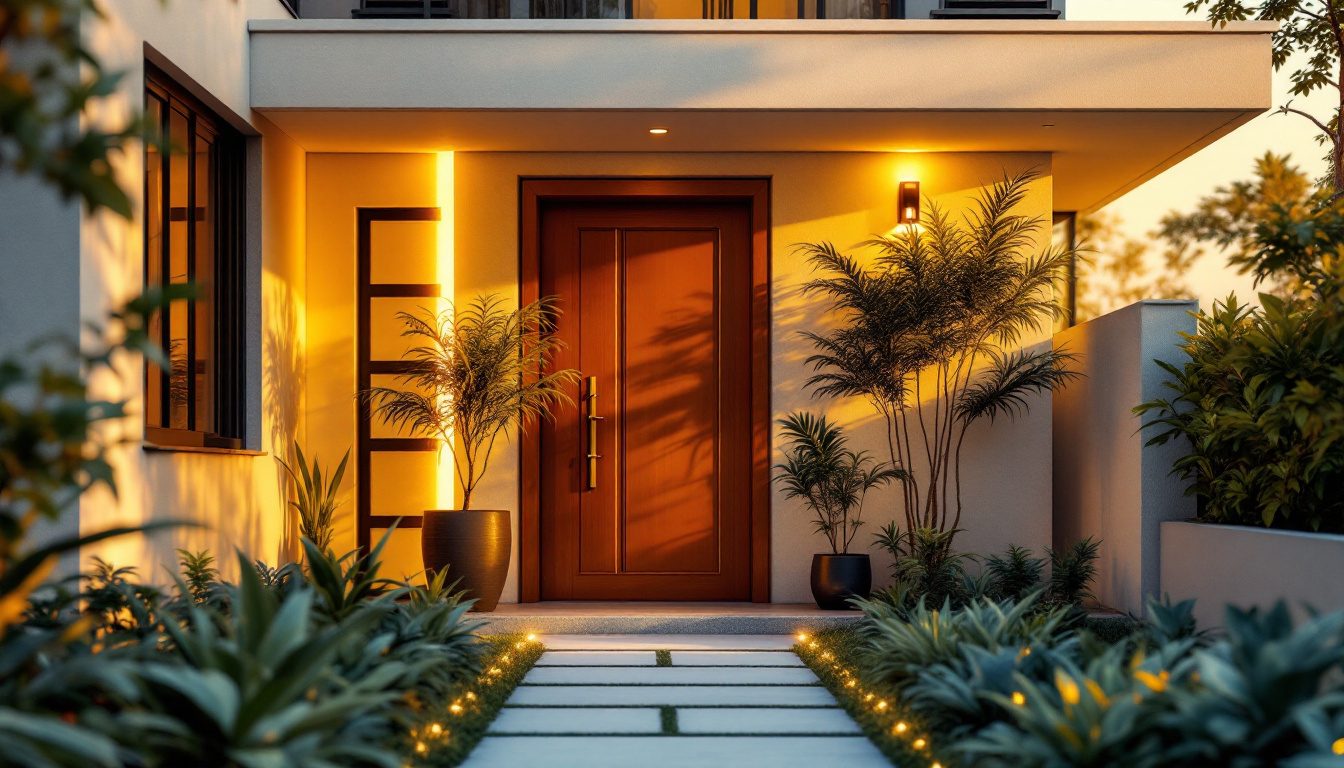
Creating a Sense of Arrival
How the approach from gate or lift lobby to the threshold — the path, the pause, the framed and lit front door — decompresses a guest and signals a home that was cared for, before a word is spoken.
There is a moment, just before you reach a house, when it tells you what it thinks of you. The gate you push open, the few steps you take across the compound, the pause at the door, the breath you draw as it swings in — none of these are rooms, none of them appear on the floor plan, and yet they decide how you feel about everything that follows. A guest who has been gently slowed, sheltered for a second under a porch, and met by a warm light at the threshold walks in already softened. A guest who steps straight off a hot street through a flush metal door into a corridor of shoes walks in braced.
This guide is about that overture — the choreography of arriving, from the gate or the lift lobby to the instant you cross the threshold and the first three seconds inside. It is deliberately narrow. It is not about the journey through your home's spaces once you are in, and it is not about the foyer's storage and function. It is about the single transition that the rest of the home depends on: the move from the outside world to "you have arrived somewhere cared-for."
A sense of arrival is not decoration at the door — it is a designed transition that decompresses a guest from the noise of the street and signals, before a word is spoken, that this is a home that was thought about. Choreograph the approach and the threshold on purpose, and an ordinary front door becomes an event.
Why arrival is a transition, not a door
Every home sits inside a louder world. The street outside an Indian house is heat, horns, dust, vendors, the glare of afternoon. The inside is meant to be its opposite — cool, quiet, ordered, yours. The problem is that the human nervous system does not switch states instantly. We need a buffer, a few seconds and a few metres in which the outside drains away and the inside takes over. Arrival is that buffer made physical.
Environmental psychologists call this transitional space — a zone that belongs fully to neither inside nor out, whose job is to let us change register. Christopher Alexander gave it one of the most quietly important patterns in "A Pattern Language": pattern 112, "Entrance Transition," argues that "buildings, and especially houses, with a graceful transition between the street and the inside, are more tranquil than those which open directly off the street." His prescription is almost choreographic — change of light, change of sound, change of direction, a change of level or surface underfoot — so that by the time you reach the door you have already let go of the street.
This is also why arrival reaches us below thought. Jay Appleton's prospect-refuge theory holds that humans instinctively read a place for two things at once: prospect (can I see what is coming) and refuge (am I sheltered). A good approach offers both — an open view of the path ahead and a sheltering porch at its end — which is the configuration that feels, without our knowing why, like welcome. The arrival sequence continues the moment you are inside; we trace that full interior journey in sequential progression of spaces. This guide stops at the threshold, because the threshold is where the hardest work is done.
The approach: what the path is for
The path from gate to door is the most under-used design element in the Indian home. Most plots treat it as the shortest line between the gate and the grille. But the path has a job, and the job is to manage time and revelation — to slow you down and to show you the home gradually rather than all at once.
Slowing the body slows the mind. A straight, fast path delivers you to the door in the same hurried state you arrived in. A path that bends, narrows, changes surface or rises a step asks the body to pay attention, and attention is the beginning of calm. This is why a short stretch of stone slabs set in grass, a turn around a tulsi planter, or two steps up to an otla does more for arrival than the most expensive door. The traditional courtyard home understood this perfectly — you rarely saw the inner sanctum from the gate; the plan made you turn.
Revealing the home gradually builds anticipation. A house seen whole from the road has nothing left to offer at the door. A house revealed in stages — first a wall and a glimpse of roof, then the garden, then the porch framing the entrance — keeps unfolding, and each reveal is a small pleasure. The bend in a path is not a defect of the plot; it is the device that lets the home arrive in chapters.
| Element of the approach | What it does to the visitor | Indian expression |
|---|---|---|
| The gate and compound wall | Marks the edge of your world; the first threshold | Compound gate, often with a name and a small light |
| A bend or turn in the path | Slows the pace, screens a full view, builds anticipation | Path around a tulsi, a turn past the parking |
| Change of surface underfoot | Signals "you are leaving the street" to the feet | Kota or cuddapah slabs, gravel, a step up |
| A sheltered pause before the door | Refuge; a place to set down bags, shake off rain | The otla, the verandah, the porch |
| The framed, lit door at the end | Prospect resolved; the destination is clear | Carved frame, toran, a glowing nameplate light |
If you are laying out a plot or reworking a forecourt, the approach is worth planning with the same care as a room — sketch the gate, the path, the pause and the door as a sequence, not as leftovers, using the layout planner to test where a bend or a pause point can sit before the walls are fixed.
The threshold as an event
The front door is the climax of the approach, and it should feel like one. Yet in most homes it is an afterthought — a flush flush-bolted leaf in a bare frame, lit by whatever the streetlight spills. The difference between a door and an arrival is a handful of decisions, none of them expensive.
Scale and framing. A door reads as significant when it is framed — by a deeper reveal, a contrasting band of stone or wood, a porch that surrounds it, a change in the wall plane. The frame says "this is the place," the way a picture frame says "look here." A taller door, or a door with a transom light above it, lends a touch of occasion without grandeur. The principle is the same one we explore in focal points and intentional rooms: the eye needs to be told where to rest, and at the entrance that place is the door.
A pause and a shelter. The single most welcoming move at any threshold is a place to stop. A porch, a verandah, a recessed entry, even a deep overhang gives the visitor refuge — shelter from sun and rain, a second to set down a bag, ring the bell, slip off shoes. Without it, the door is a cliff edge: you are exposed until the instant it opens. With it, you are already half-inside, already held.
Light as welcome. A warm light at the door, lit at dusk, is the oldest signal of welcome there is. It resolves the prospect — you can see where you are going — and it says someone is expecting you. A single warm wall light beside the door, or a soft downlight in the porch soffit, transforms the threshold after dark far more than any daytime detail. The diya at the doorstep and the festival string of lights are the same instinct, formalised.
The doorstep and the level change. A raised threshold — the few inches you step over — is both practical and symbolic. It keeps out rainwater, dust and insects, and marks the boundary you cross into a different order of space. The small effort of stepping up is itself part of the transition.
A door is a hole you walk through. A threshold is a moment you cross. The whole craft of arrival is turning the first into the second.
The Indian markers of welcome
India has, over centuries, built an entire vocabulary of arrival — small, daily, free, and far more eloquent than imported hardware. These are not nostalgia; they are functioning signals that a guest reads instantly.
The rangoli and the kolam. The pattern drawn at the doorstep each morning is a renewable act of welcome and auspiciousness. It says the household has risen, ordered itself, and prepared the threshold for whoever comes. Even a stylised permanent version — an inlay, a painted motif — carries the message.
The toran and the bandanwar. The string of mango leaves, marigold or beaded hangings across the top of the doorway frames the entrance and marks it as a site of blessing. It does the framing work of architecture with the lightness of a gesture.
The nameplate. Often dismissed, the nameplate is the single most personal arrival marker — it turns an anonymous door into a specific family's home. A well-made, well-lit nameplate (and a working doorbell beside it) is the difference between "a flat" and "the Sharmas' home."
The footwear transition. Removing shoes at the door is, in design terms, a transition ritual — a small, embodied act that says the outside stops here. It needs a place to happen: a low bench or ledge, a shoe rack just inside or in the porch, a clean dry spot to stand. Designing for it gracefully (rather than leaving a heap of slippers on the landing) is one of the highest-value arrival details. The storage logistics of this belong to the interior foyer, covered in entry and foyer design; the choreography — where you pause, where you bend, what you see while you do — belongs to arrival.
The diya and the threshold lamp. Light at the doorstep at dusk, whether a literal diya or a warm electric lamp, is the welcome made visible. It is the detail that, more than any other, says a home is lived in and cared for — a theme we follow more widely in the small details that define a home.
| Indian arrival marker | What it signals | The design need behind it |
|---|---|---|
| Rangoli / kolam | Order, auspiciousness, a prepared threshold | A defined, clean doorstep zone |
| Toran / bandanwar | Blessing; the doorway framed as special | A door head worth dressing |
| Nameplate + doorbell | Identity; "this specific family's home" | Eye-level placement, light, legibility |
| Footwear removal | The outside stops here | A bench, a ledge, a dry place to stand |
| Diya / doorstep lamp | Welcome, a home that is lived in | Warm light at the threshold at dusk |
| Raised threshold (otla edge) | A boundary to cross; keeps out dust and water | A deliberate step, not a trip hazard |
Security versus welcome — resolving the tension
Every Indian entrance carries a contradiction: it must welcome the wanted and resist the unwanted. The grille gate, the safety door, the CCTV dome, the high compound wall — these are facts of urban life, and they pull directly against the warmth arrival needs. The skill is not to choose one over the other but to layer them so security sits behind welcome rather than in front of it.
The principle is defence in depth, welcome in front. Put the hard security where the eye does not land first — the compound gate, a video doorbell, a quiet safety door behind the main door. Keep the layer the guest actually reads — the porch, the light, the nameplate, the planting — warm. A double-door arrangement, an ornamental main leaf with a discreet grille behind it, lets you welcome at the threshold while the security works unobtrusively. The mistake is to lead with the cage: a forbidding grille as the only face of the home tells every guest that they are a suspect.
| Security need | Cold solution that kills welcome | Warm solution that preserves it |
|---|---|---|
| Perimeter | High blank wall, spikes at eye level | Wall with a planted edge, spikes set high and out of view |
| Identifying callers | Forbidding grille as the main face | Video doorbell + a quiet safety door behind a warm main door |
| Night safety | A single harsh floodlight | Layered warm porch light + motion light for the dark corners |
| Package / delivery | Everything kept locked out | A sheltered ledge or niche at the gate for drop-offs |
Making an arrival moment in an apartment
Most Indian homeowners do not have a gate and a garden path. They have a lift, a shared lobby, and a front door on a corridor — and they assume arrival is therefore impossible. It is not. The sequence is shorter and the canvas is smaller, but the same psychology applies, and the apartment door can absolutely become an event.
Treat the lift lobby as your gate. The few seconds between the lift doors opening and reaching your flat are your approach. You usually cannot rebuild a shared corridor, but you can claim the stretch immediately around your own door. A clean, well-lit run reads as cared-for; a flickering tube and a damp patch read as the opposite, and that reading transfers to your home before you open it.
Make the door itself the whole arrival. When the path is only two metres of corridor, the door must do the work the path would have done. This is where every threshold move concentrates: a warm light (a battery or hardwired wall light beside the door where the builder gave you a bare fitting), a real nameplate at eye level, a doormat that defines the threshold, a small rangoli decal or a brass motif, a toran at the head. A narrow console or a slim ledge just inside the door recreates the "pause and set down" that a porch would have offered.
Engineer the first three seconds inside. In a corridor-fed flat the door often opens straight into the living space, so the inside has no buffer of its own. Build a small one: a screen, a half-height shoe cabinet, a console with a mirror and light, or a change of flooring — anything that gives the eye a place to land and the body a place to shed the outside. This is not the foyer's storage problem; it is the arrival's emotional one — the decompression the gate-to-door sequence would otherwise have provided.
| Standalone-home arrival element | Its apartment equivalent | The shared purpose |
|---|---|---|
| Gate and compound | Lift lobby and corridor | The first edge crossed |
| Bend in the path | The walk from lift to door | A few seconds to slow down |
| Porch / verandah pause | A ledge or console at the door | Refuge; a place to pause and set down |
| Framed, lit main door | A warm-lit, framed flat door | The destination made an event |
| Otla / raised threshold | A defined doormat and floor change | The boundary you cross |
| Entry hall buffer | A screen, console or rug inside | Decompression in the first 3 seconds |
What this means for your home
1. Design the approach as a sequence, not a leftover. Walk it as a guest would — gate, path, pause, door — and ask at each step what slows you, what shelters you, what you can see. Fix the dead, fast, exposed stretches first.
2. Give the path a reason to bend. Even a small turn or a change of surface underfoot does more for arrival than expensive hardware. Plan it at the layout stage with the layout planner, before the boundary wall is poured.
3. Make the door an event. Frame it, shelter it, and light it warmly at dusk. A porch overhang, a deeper reveal and one warm wall light transform a threshold for very little money.
4. Build in a pause. A place to stop, set down bags and remove shoes — a verandah, a ledge, a bench — is the most welcoming single move at any entrance, in a bungalow or a flat.
5. Keep the Indian markers. A clean doorstep for rangoli, a head for the toran, a lit nameplate and a working bell, a graceful place for footwear. These read as welcome instantly and cost almost nothing.
6. Layer security behind welcome. Lead with the porch and the light, not the grille. Put the hard measures — gate, video doorbell, safety door — where the eye does not land first.
7. Apartment dwellers: concentrate everything at the door. When you have no path, the door and the first metre inside carry the whole arrival. Light it, name it, mat it, and build a small buffer just inside so the first three seconds let your guest exhale.
The arrival sequence ends where the interior journey begins — what happens once a guest is inside, room by room, is the subject of sequential progression of spaces, and the foyer's practical life of storage and function is covered in entry and foyer design. All three sit under the broader argument that homes feel right because of designed principles, not borrowed pictures — the case made in why design principles beat magazine examples.
How Studio Matrx helps
When you are imagining an approach you cannot yet build — a porch over a bare door, a bend in a straight path, a warm-lit threshold in place of a dim corridor — it is hard to feel the difference from a sketch. DesignAI lets you visualise your own gate, path and entrance at different framings, lighting schemes and materials, so you can stand at your future threshold and feel the welcome before a single stone is laid. Arrival is the first thing every guest experiences and the easiest to overlook; seeing it before you commit is the surest way to get it right.
References
1. Alexander, C., Ishikawa, S. & Silverstein, M. (1977). A Pattern Language — pattern 112, "Entrance Transition," and pattern 110, "Main Entrance," on the graceful transition between street and inside.
2. Appleton, J. (1975). The Experience of Landscape — prospect-refuge theory, on the instinctive human reading of openness and shelter.
3. Ching, F. D. K. Architecture: Form, Space, and Order — on approach, the path of movement, and the sequence of arrival.
4. Hall, E. T. (1966). The Hidden Dimension — proxemics and the psychology of transitional and threshold space.
5. Kaplan, R. & Kaplan, S. (1989). The Experience of Nature: A Psychological Perspective — environmental psychology of restorative settings and gradual reveal.
6. Bureau of Indian Standards. National Building Code of India 2016 (NBC 2016), Part 3 — entrance, approach and circulation requirements for dwellings.
Part of the Studio Matrx Design Principles series. Continue with sequential progression of spaces, entry and foyer design, and the small details that define a home.
Export this guide
Related Guides — Deep-dive reading
Sequential Progressions: Why the Order of Spaces Matters
A home is experienced as a journey in time, not a plan seen all at once — and arranging that journey, with compression, release and thresholds from public street to private inner room, is what makes a house feel right.
Design PrinciplesMudrooms for Indian Homes
The threshold where the outside is left behind — designing a real shoes, dust and wet-weather drop-zone, from a slim niche in a flat to a proper mudroom in a house.
StorageThe Architectural Psychology of Comfortable Spaces
Why some rooms feel right and others never do — the science of space and the human mind
Design EducationRelated Tools — Try Free
Apartment Video Door System Planner
Enter flats, entrances, floors and guard desk for a first-pass building intercom plan — door stations, indoor monitors, guard station, the right architecture and an indicative cost band.
Building PlannerApartment vs Villa Interior Planning Guide
Compare ceiling height, structural flexibility, lighting, storage, and services between apartments and villas.
Planning GuideCCTV Placement Planner
Pick your property and zones to get a prioritised, zone-by-zone checklist of which camera goes where and how to mount it.
Placement Planner