
Security Siren Testing in India (2026): Make Sure the Alarm Can Actually Be Heard
The panel can detect a break-in perfectly and the whole system still fails if the siren does not sound. A homeowner's routine for testing indoor sounders, the outdoor bell-box, its backup battery and tamper, wireless sirens and the strobe — loudly, safely and without upsetting the neighbours.
Here is the uncomfortable truth about a home alarm: every sensor can work flawlessly, the panel can register the break-in the instant the door opens, and the whole system can still fail completely — because the one part that turns a detection into a deterrent, the siren, never made a sound. A silent alarm changes nothing. It does not wake you, it does not scare off the intruder, it does not bring a neighbour to the window. The siren is the entire point of the system going off, and it is the part homeowners test least.
Sirens fail quietly, which is the danger. The sounder speaker degrades, an outdoor bell-box's own backup battery dies after a few years so it stays silent the moment mains or panel power is cut, a wireless siren's cells run flat, the strobe stops flashing, or the unit ends up muffled behind a shrub or a coat of paint. None of this shows up in daily life. You only discover it the one night it matters — which is exactly the night you cannot afford to.
This guide is about testing the thing that actually raises the alarm. It is mostly safe, do-it-yourself work you run from your own alarm panel: trigger the siren on purpose, confirm it is genuinely loud both indoors and out, confirm the strobe flashes, and — the check almost everyone skips — confirm the outdoor siren still sounds on its own backup battery when the power is cut, and screams if someone tries to prise it off the wall.
Scope & safety. This is an upkeep guide for homeowners, not an installation manual. The tests here are DIY-safe because you run them from the panel and by observation. What is NOT DIY: reaching a dead outdoor bell-box mounted high on a wall, any mains wiring, or opening a sealed sounder — that is work for your installer or annual maintenance contract (AMC) technician, because it means working at height and near mains electricity. This is not a price guide or a buying guide; for choosing a system, see the buying library, and for the wider routine, the security system maintenance guide. A note on courtesy and the law: a loud outdoor siren test genuinely alarms neighbours and can trigger a nuisance-alarm complaint, so always tell your neighbours and your monitoring provider first and keep the test short.
Know your sirens: the parts that make the noise
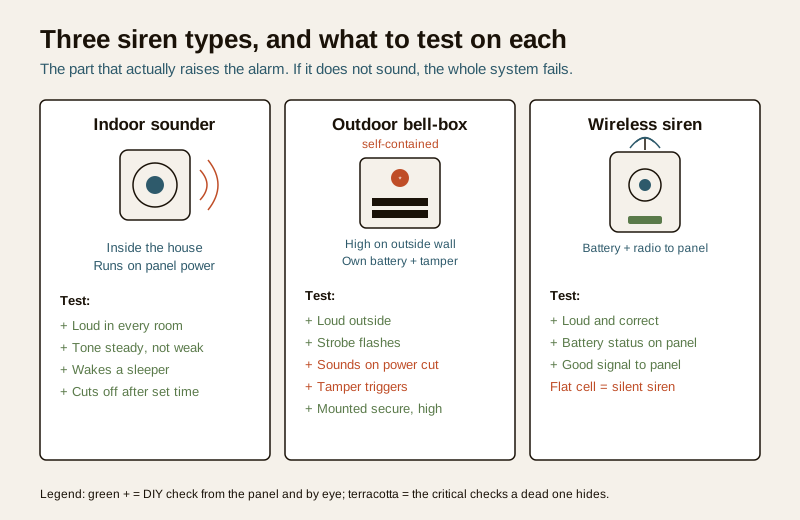
Before testing, know what you actually have. A typical Indian home alarm has one or more of these, and each needs a slightly different check.
- Indoor sounder. A speaker or piezo sounder inside the house, driven by the panel. Its job is to be unbearable inside — to wake sleepers and drive an intruder out. It usually has no battery of its own; it runs on panel power.
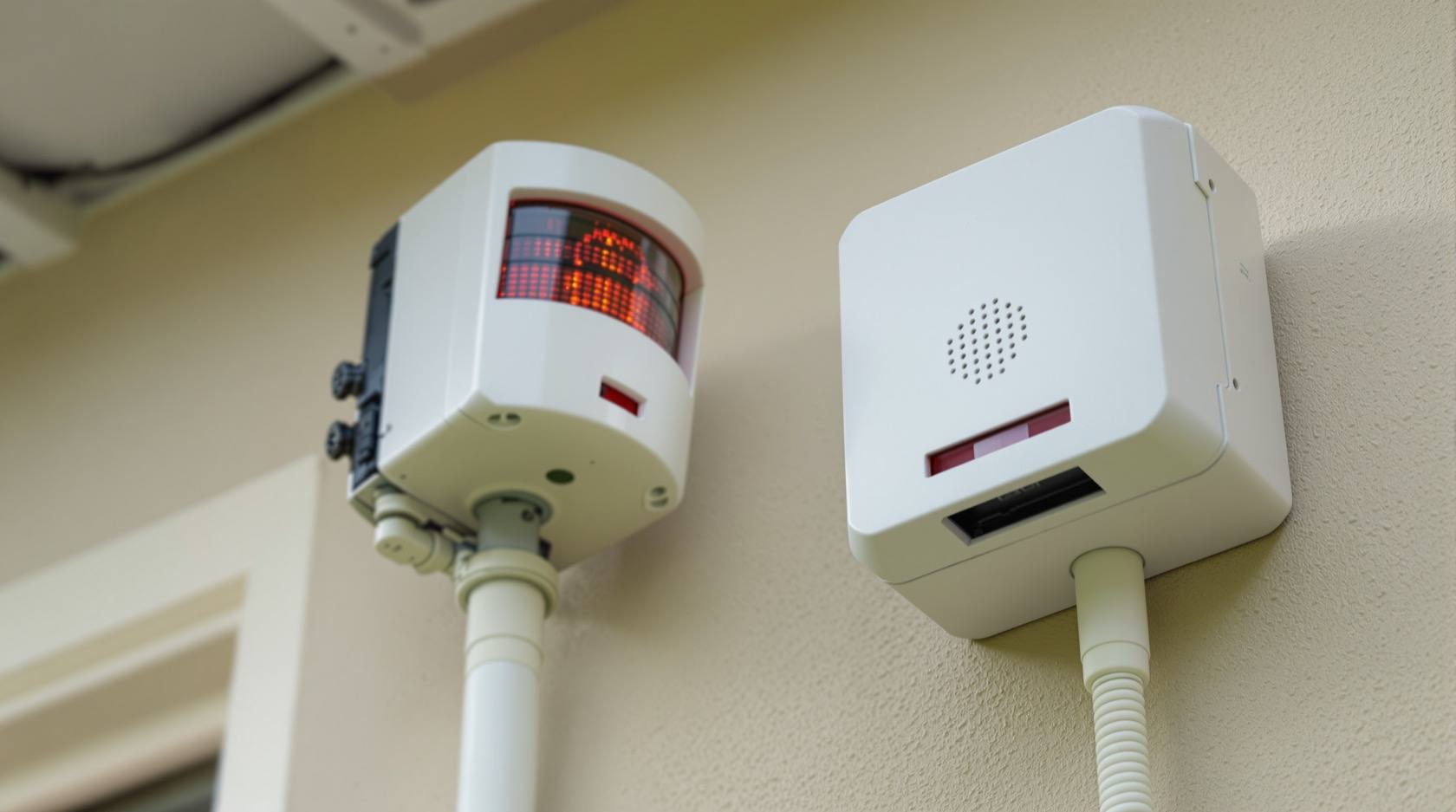
- Outdoor self-contained siren (the bell-box). The box high on your outside wall, often with a flashing strobe. This is the deterrent the street sees and hears. The important word is self-contained: a proper outdoor bell-box has its OWN backup battery and a tamper switch inside it. That means it can keep sounding even if an intruder cuts the mains or rips out the panel, and it screams if anyone tries to open or lever it off the wall. This backup battery is the part that quietly dies — and the part almost nobody tests.
- Wireless siren. A battery-powered sounder that talks to the panel over radio, common in wireless and add-on systems. No wires to cut, but it depends entirely on its batteries and a good radio signal to the panel.
- Strobe / flasher. The visual alarm, usually built into the bell-box. At night, and for anyone hard of hearing, the flash matters as much as the sound. It has to be tested by eye — a working siren with a dead strobe is only half an alarm.
How to test each siren
Almost every panel has a siren or bell test function in its menu or engineer mode — the whole reason it exists is so you can sound the alarm on purpose without a real break-in. Learn where it is in your system (or ask your installer to show you once). If your panel has no dedicated siren test, you can trigger the bell by arming the system and deliberately walking an entry zone during a short test window — but the menu test is cleaner and shorter, which your neighbours will thank you for.
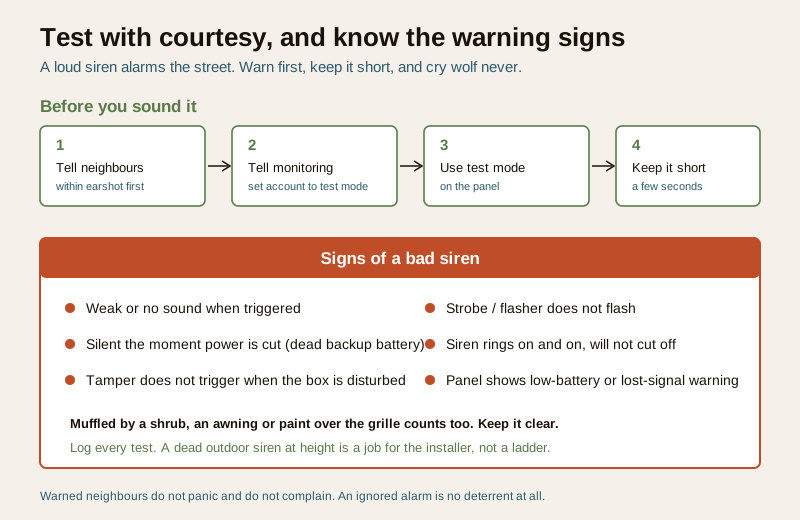
Before you press anything: tell the household, tell any neighbours within earshot, and if your system is monitored, phone your monitoring provider and ask them to put your account into test mode so a real dispatch is not triggered. Keep every test short — a few seconds of full-volume siren proves it works; a minute does not prove more and only annoys everyone.
Testing the indoor sounder
1. Put the system in test mode from the panel.
2. Trigger the sounder. Confirm it is genuinely LOUD inside — uncomfortable, the kind of noise you cannot sleep through — and that the tone sounds correct and steady, not weak, crackly or intermittent.
3. Walk to the far rooms and confirm it is clearly audible everywhere someone might be sleeping. A sounder that is loud in the hall but faint in a back bedroom is not doing its job.
Testing the outdoor bell-box (loudness and strobe)
1. With neighbours and monitoring warned, sound the outdoor siren from the panel.
2. Step outside and confirm it is LOUD and carries down the street — this is the sound meant to bring people to their windows.
3. Look up at the box and confirm the strobe is flashing brightly. Do this by eye; the flash is a separate function and can fail on its own.
4. Keep it brief, then silence it.
Testing the outdoor siren's BACKUP BATTERY — the check that matters most
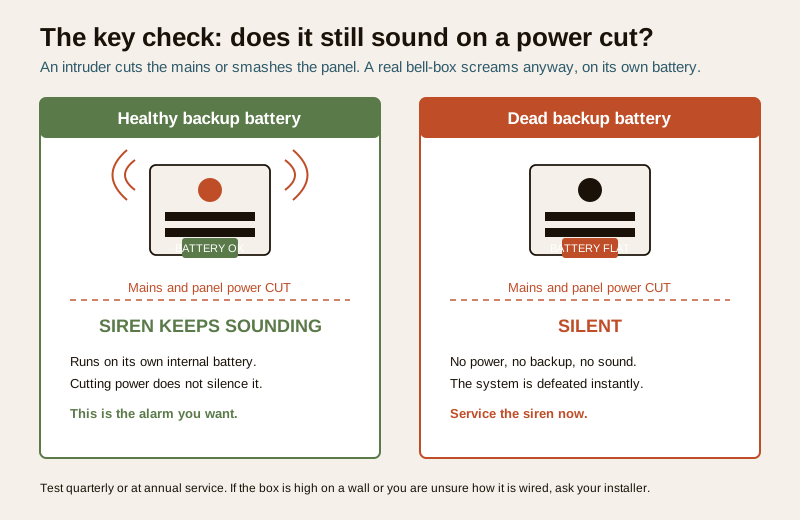
This is the test that separates a real alarm from a decorative one, and it is the one homeowners almost never do. An intruder's first move can be to cut your mains or smash the panel. A self-contained bell-box is supposed to keep screaming anyway, on its own internal battery. If that battery is flat, the box goes silent the instant power is lost — exactly when you need it.
To confirm it works, with the system in test mode and your installer's guidance if you are unsure, the principle is simple: the outdoor siren must still sound when panel or mains power to it is removed. On many systems, disarming or cutting the panel connection while the box is triggered will make a healthy bell-box sound on its own backup battery (this is called the tamper or "SAB" behaviour). If the box falls silent the moment power is cut, its backup battery is dead and the siren must be serviced. Because getting this exactly right depends on how your specific box is wired, and because a dead box is usually high on a wall, this is the point to involve your installer if you are not certain.
Testing the outdoor siren's TAMPER
The bell-box also has a tamper switch that should make it sound if someone opens the lid or levers it off the wall. Confirm this works: with the system set so a tamper will register (test mode or armed, per your panel), the box should react to being opened or disturbed. If a technician is doing your annual service, this is a standard part of their check. Do not climb a ladder to test it yourself — a tamper that does not trigger is a job for the installer.
Testing a wireless siren
1. Sound it from the panel like any other and confirm it is loud and correct.
2. Check the battery status — most panels show low-battery warnings for wireless devices; act on any warning before it becomes a dead siren.
3. Confirm signal: a wireless siren too far from the panel, or blocked by walls, can drop out. If the panel reports a weak or missing signal from the siren, have it repositioned or a repeater added. A wireless siren with flat batteries or no signal is a silent siren.
How often to test
Testing takes minutes and prevents the one failure that makes the whole system pointless. Build it into a simple rhythm — and log every test.
| Task | How often | Who |
|---|---|---|
| Sound indoor sounder, confirm loud in every room | Monthly | Homeowner (DIY) |
| Sound outdoor siren, confirm loud outside | Monthly | Homeowner (DIY) |
| Confirm strobe / flasher flashes | Monthly | Homeowner (DIY) |
| Confirm siren cuts off after the correct time | Monthly (during test) | Homeowner (DIY) |
| Check wireless siren battery and signal status | Monthly | Homeowner (DIY) |
| Test outdoor siren BACKUP BATTERY sounds on power cut | Quarterly / at annual service | Homeowner with care, or installer |
| Test outdoor bell-box TAMPER triggers | Annually | Installer / AMC technician |
| Replace outdoor siren backup battery | Per maker's life (typically every few years) | Installer / AMC technician |
| Reach, service or replace a dead outdoor siren at height | As needed | Installer / AMC technician |
A monthly siren sound is the single most valuable habit; align it with your wider security maintenance calendar so it never gets forgotten. For the whole alarm's routine, the burglar alarm maintenance guide puts the siren check in context, and testing the siren pairs naturally with testing your sensors — do both in one session.
The courtesy and the law: don't cry wolf
A loud outdoor siren is designed to disturb, and a test disturbs just as effectively as a real alarm. Get this wrong repeatedly and you become the house whose alarm everyone learns to ignore — which defeats the deterrent — or, worse, you draw a nuisance-alarm complaint. A little courtesy keeps the siren credible.
- Tell your neighbours first. A quick message that you will briefly sound the alarm at a set time turns a fright into a non-event. People who are warned do not panic and do not complain.
- Tell your monitoring provider first. If your alarm is monitored, always put the account into test mode before you sound the siren, so you do not trigger a real response or a keyholder call-out. Take it out of test mode after.
- Use the panel's test mode and keep it short. A few seconds proves the siren works. There is nothing to gain from a long blast and much goodwill to lose.
- Pick a sensible time. Mid-morning or early evening, never late at night, and not repeatedly.
- Never let a siren run forever. A siren that does not cut off after its set time (in India, sounders are expected to self-silence after a bounded period rather than ring endlessly) is itself a nuisance — confirm the cut-off during your test.
Check the siren is fit to be heard
Sounding the siren is only half the check. Also confirm the physical conditions that let it be heard and stay tamper-proof:
- Not obstructed or muffled. Over time a shrub grows across the box, a new awning covers it, or a well-meaning painter paints over the sounder grille. Any of these muffle the very sound you depend on. Keep the siren clear.
- Mounted secure and high. An outdoor bell-box belongs high on the wall, out of easy reach, firmly fixed — both so it carries and so it cannot be quietly ripped down. Confirm the mounting is still solid (by eye from the ground; do not climb).
- Cuts off after the correct time. Confirm during your test that the siren silences itself after its set duration and does not ring on and on.
DIY-safe versus call the installer
Do it yourself, safely. Sounding the siren from the panel; confirming loudness indoors and out; watching the strobe flash; checking wireless siren battery and signal on the panel; confirming the cut-off time; keeping the box clear of shrubs and clutter; a ground-level look at the mounting; telling neighbours and monitoring; and logging every test. This is observation and button-pressing — safe, and the whole point of a test function.
Call the installer or AMC technician. Reaching a dead outdoor bell-box mounted high on a wall; replacing the outdoor siren's backup battery; any mains wiring; opening a sealed sounder; and the annual tamper test at height. Working at height and near mains is not homeowner territory — a fall or a shock is a far worse outcome than a faulty siren. If your outdoor siren is silent, weak, or dead on a power cut, and it is out of safe reach, that is a service call, not a ladder.
Signs your siren needs attention
- Weak, crackly or intermittent sound — the sounder is failing; it will not do its job.
- No sound at all when triggered — the most urgent fault; the alarm is effectively silent.
- Silent the moment power is cut — the outdoor siren's backup battery is dead; an intruder cutting power now defeats the whole system.
- Tamper does not trigger when the box is disturbed — the deterrent against ripping the box down is gone.
- Strobe does not flash — the visual half of the alarm is dead; a problem at night and for anyone hard of hearing.
- Siren rings on and on and will not cut off — a nuisance that invites complaints and gets your alarm ignored.
- Panel shows a low-battery or lost-signal warning for a wireless siren — act before it goes silent.
Any of these means the siren cannot be relied on. Weak, dead or muffled sirens are the commonest reason a "working" alarm achieves nothing.
Write it down
Every siren test goes in your alarm's logbook: the date, what you tested (indoor, outdoor, backup battery, tamper, strobe), whether it passed, and anything you asked the installer to fix. A logbook turns a vague "I think it works" into evidence, shows patterns (a backup battery weakening year on year), and proves your system was maintained. Use the security maintenance logbook to record it.
Your monthly siren checklist
- [ ] Tell the household; warn neighbours within earshot; set a sensible time.
- [ ] If monitored, put the account into test mode with your provider.
- [ ] Sound the indoor sounder — loud and clear in every room, correct tone.
- [ ] Sound the outdoor siren — loud outside, carries down the street.
- [ ] Watch the strobe flash brightly.
- [ ] Confirm the siren cuts off after its set time.
- [ ] Check wireless siren battery and signal on the panel; act on any warning.
- [ ] Quarterly / at service: confirm the outdoor siren sounds on its backup battery with power cut.
- [ ] Confirm the box is clear of shrubs, paint and clutter, and mounted secure and high.
- [ ] Take the account out of test mode; log the test in the logbook.
The bottom line
Detection is worthless if nobody hears the alarm. The siren is the one part of your system whose whole job is to be heard, and it fails silently — a degraded sounder, a dead outdoor backup battery, a flat wireless cell, a stopped strobe. A few minutes a month, run from your own panel, confirms the thing that actually raises the alarm can still do it. Sound it, listen, watch the strobe, prove the backup battery, warn the neighbours first, and write it down. A maintained cheap siren that screams on the night beats an expensive one that stays silent.
Where to go next
- Security system maintenance guide — the pillar that ties every upkeep task together.
- Burglar alarm maintenance and security sensor testing — the rest of the alarm's routine; test sensors and siren in one session.
- Security maintenance calendar and security maintenance logbook — schedule the siren test and record every result.
- The maintenance sub-hub, the burglar alarms sub-hub, and the main security hub.
References
- National Building Code of India (SP 7), Bureau of Indian Standards — life-safety, alarm and warning provisions for buildings; a security siren is a warning device and must never obstruct or be confused with statutory fire-alarm sounders. Verify the current edition (SP 7:2026) via the BIS catalogue: https://www.services.bis.gov.in/
- Digital Personal Data Protection Act, 2023 — where a siren is part of a monitored or camera-linked system, the associated footage and account records hold personal data; handle them accordingly during any test or service.
- Manufacturer and installer documentation — the correct siren test procedure, backup-battery life, tamper behaviour and cut-off duration are specific to your model; follow your maker's and installer's instructions, and involve the installer for anything at height or on mains.
This is an educational upkeep overview for homeowners, not an installation manual or legal advice. Run only the DIY-safe checks described here from your panel; engage a licensed installer or your AMC technician for any work at height, any mains wiring, a dead outdoor siren, or opening sealed equipment, and verify any standard's current status via the BIS catalogue before relying on it.
Export this guide
Related Guides — Deep-dive reading
Alarm Siren Not Working (2026): Why It Triggers but Stays Silent in India
Your burglar alarm detects and the panel reacts, but the siren does not sound, or sounds weak and thin. A calm, ordered diagnostic for Indian homes: the settings, power, backup battery, wiring and hardware faults that leave an alarm that cannot be heard, what you can safely check yourself, and when to call your installer.
SecuritySecurity Sensor Testing in India (2026): A Homeowner's Monthly Walk-Test
How to regularly test the detectors your alarm depends on — PIR motion, door and window contacts, glass-break and vibration, and perimeter beams — safely and without setting off a real monitored alarm, so an untested sensor never becomes a silent gap the night it matters.
SecuritySecurity for People Living Alone in India (2026): Calm, Practical Habits When There Is No Second Person to Notice
Living alone is an ordinary and growing part of Indian life - the student in a new city, the working single, the elder whose children are abroad, the person after a separation. It does not call for fear. It calls for a few deliberate habits, because there is no second person in the home to notice trouble, raise the alarm, or catch an accident. This is calm self-reliance, layer by layer.
SecurityRelated Tools — Try Free
Window Grill Design Selector
Pick a window grille style and material by priority — security, looks, budget, view — and estimate cost.
Window ToolInterior Contract Clause Checklist
16 sections and 98 checkboxes covering scope, BOQ, milestones, penalties, warranty, and disputes.
Contract ChecklistAnnual Interior Maintenance Checklist
Seasonal maintenance checklist for woodwork, paint, plumbing, electrical, and appliances.
Maintenance