
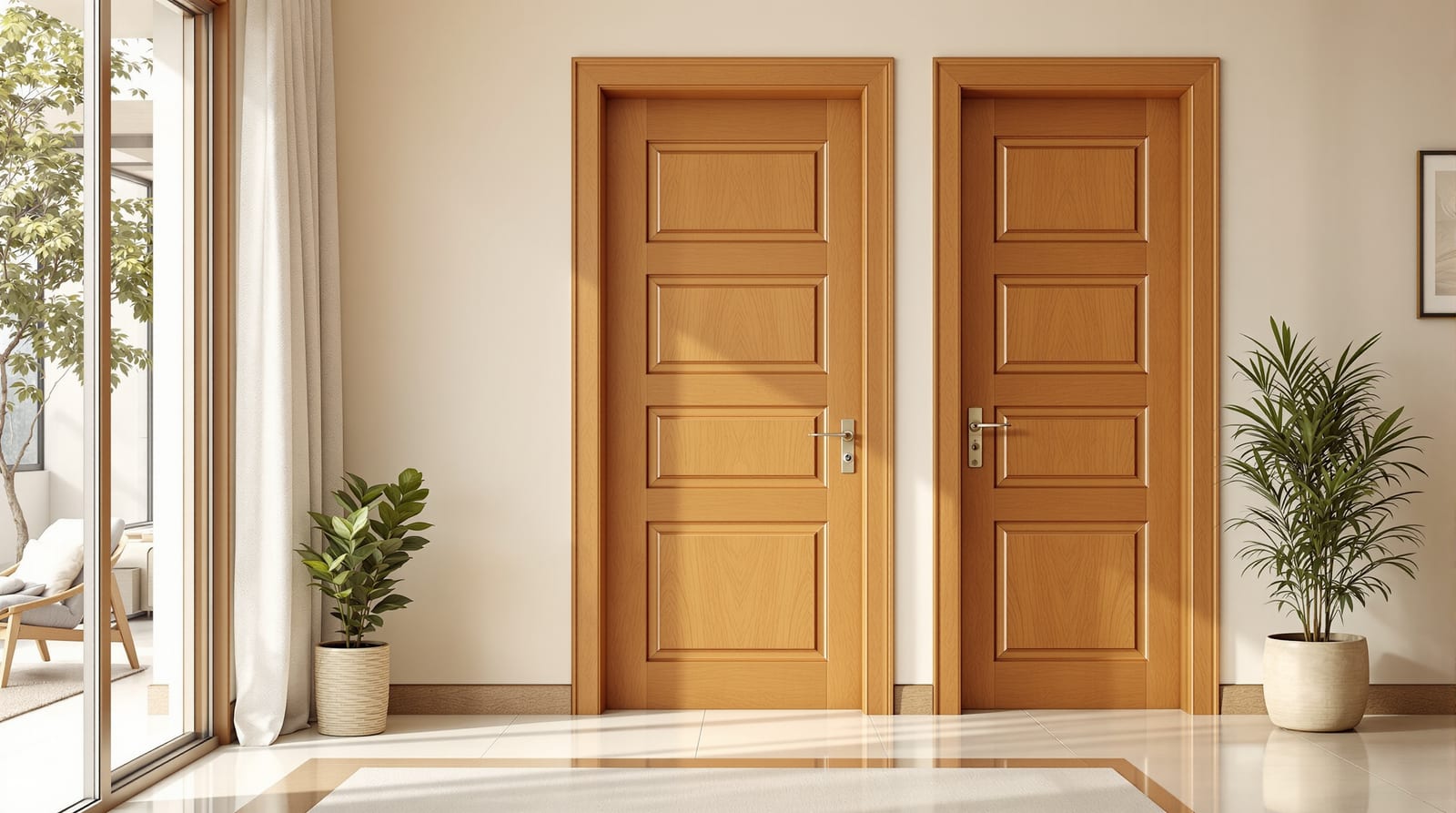
Rubberwood Doors in India: Sustainable Hardwood (India 2026)
Why plantation rubberwood — a by-product of latex farming — makes a genuinely sustainable, affordable hardwood door, and how to treat and buy it well.
Few timbers carry as honest a green story as rubberwood, yet it remains under-rated in Indian homes. Rubberwood doors in India are made from Hevea brasiliensis — the same rubber tree that is tapped for latex for roughly 25–30 years on plantations across Kerala, Tamil Nadu, Tripura and the North-East. When a tree's latex yield falls, it is felled and replanted; the timber that would once have been burnt as plantation waste is instead seasoned into a pale, even-grained hardwood. That single fact — the wood is a by-product of an existing farming cycle, not a forest felled for furniture — is what makes rubberwood one of the genuinely sustainable, affordable solid-wood choices on the market, and a sensible middle ground between a cheap hollow flush door and a costly teak leaf.
This Studio Matrx guide explains what rubberwood actually is, how it behaves as a door, why treatment matters more than for almost any other timber, what finger-jointing buys you, how it looks and costs against teak, and exactly where it suits an Indian home. It sits inside the cluster pillar, the complete door guide, and is part of the sustainable-materials story told in eco-friendly door materials and timber door sustainability.
What is rubberwood, and why is it sustainable?
Rubberwood (also sold as parawood or Malaysian oak, though it is no relation to oak) is a medium-density hardwood with a creamy, pale-honey colour and a fine, mostly straight grain. Its sustainability case rests on three pillars:
- It is a by-product, not a primary crop. The tree is grown for latex; the timber is harvested only at the end of its tapping life. No additional land is cleared to produce the wood.
- The plantations are renewable and managed. Felled trees are replanted in a continuous cycle, and a growing rubber tree stores biogenic carbon over its decades-long tapping life.
- It diverts waste. Historically this wood was burnt; turning it into doors and furniture keeps the carbon locked up in a long-lived product rather than released to the air.
Be honest about the caveats. "Sustainable" is only credible when backed by third-party proof: look for FSC or PEFC chain-of-custody certification, and bear in mind that much rubberwood is imported from Malaysia, Thailand and Vietnam, which adds transport carbon. And no green claim survives a door that fails in five years — as with all timber, durability is itself sustainability. A well-treated, well-finished rubberwood door that lasts 20-plus years easily out-performs a cheap flush door replaced twice in the same period.
Properties: how rubberwood behaves as a door
Rubberwood is a true hardwood but a moderate one — it is not in teak's class for hardness or natural durability, and it must not be sold as if it were. The table below sets its key properties against the timbers it competes with.
| Property | Rubberwood (Hevea) | Teak | Sheesham (Indian rosewood) | Pine |
|---|---|---|---|---|
| Density (kg/m³) | ~600–640 (medium) | ~650–750 | ~750–850 | ~450–550 (soft) |
| Natural durability | Low — needs treatment | Very high | High | Low |
| Borer / fungus risk | High if untreated | Very low | Low | Moderate |
| Colour | Pale cream / honey | Golden-brown | Rich reddish-brown | Pale yellow |
| Grain | Fine, straight, even | Straight, oily | Interlocked, decorative | Knotty |
| Workability / finish | Excellent — takes stain & lacquer well | Excellent | Good but hard | Easy |
| Indicative cost vs teak | ~30–45% of teak | Benchmark (highest) | ~55–70% of teak | Cheapest solid |
The headline trade-off: rubberwood machines, sands, stains and lacquers beautifully and is dimensionally stable once kiln-dried, but it has little natural resistance to insects and fungus. Untreated rubberwood is a known target for powder-post borer (lyctus beetle) and, in humid conditions, mould and fungal stain. This is not a fatal flaw — it is simply why treatment is non-negotiable, which is the heart of buying one well.
Treatment: the step that makes or breaks the door
Because raw rubberwood is so vulnerable, reputable mills put it through a controlled treatment-and-drying sequence. The diagram traces that journey from felled plantation log to finished, protected door.
What good treatment looks like
- Anti-borer / anti-fungal soaking or pressure treatment with an approved wood preservative (boron-based borate treatments are common and relatively low-toxicity), applied before drying so it penetrates the sapwood.
- Kiln drying to roughly 10–12% moisture content, which both kills any borer larvae and stabilises the wood against later warping and shrinkage in our climate swings.
- A sealed, fully finished surface — primer/sealer plus stain and lacquer or a water-based PU — so moisture and insects cannot re-enter. For a healthier home, favour low-VOC, water-based finishes; see low-VOC door finishes.
The practical rule for buyers: ask the seller to confirm the wood is kiln-dried and chemically treated against borer, and get it in writing on the invoice. A bargain rubberwood door with no treatment record is the classic false economy.
Finger-jointed panels: why they are a feature, not a flaw
Rubberwood trees yield relatively short, narrow boards, so solid rubberwood panels are almost always finger-jointed — short lengths machined with interlocking "fingers" and glued end-to-end, then edge-glued into a wide panel. Indian buyers sometimes worry this is a cost-cut, but for rubberwood it is the sensible, even superior, engineering:
- It uses the timber efficiently, cutting waste and keeping the sustainability story intact.
- The many short joints actually make a panel more dimensionally stable than one wide solid board, which is more prone to cupping.
- A quality finger-joint, properly glued and pressed, is stronger than the surrounding wood; failures come from poor glue or pressing, not the joint type.
Under a clear or light finish the finger pattern is visible; under a darker stain or a paint-grade finish it disappears. This is closely related to how all engineered timber works — see timber door sustainability for the wider efficient-use argument.
Look, finish and cost versus teak
Rubberwood's pale, even tone is a designer's friend: it takes stains uniformly, so it can be finished to read as light Scandinavian oak, mid walnut, or even a teak-alike honey. Its even grain suits clean, contemporary leaves and painted shaker panels better than a heavily figured timber would.
The cost story is its biggest draw. As a rule of thumb in 2026, a solid rubberwood door costs roughly 30–45% of an equivalent solid teak leaf, while still being a real hardwood you can plane, fix and re-finish. The table below frames the value decision.
| Factor | Rubberwood door | Solid teak door |
|---|---|---|
| Indicative leaf cost (standard size) | ₹4,000–12,000 | ₹15,000–40,000+ |
| Sustainability | Excellent (plantation by-product) | Good only if certified plantation |
| Natural durability | Low — relies on treatment | Very high (naturally oily, rot-resistant) |
| Best for | Internal doors, dry interiors, painted & stained leaves | External / main doors, wet zones, heritage looks |
| Re-finishing | Easy, repaintable | Easy, ages gracefully |
| Weight / feel | Solid, reassuring | Heaviest, premium |
GST at 18% applies to finished doors. For a like-for-like rupee comparison across materials, run the door material comparison tool, and to weigh the green credentials objectively use the door sustainability scorer.
Where rubberwood doors suit an Indian home
Match the material to the location and you will be delighted; ignore its limits and you will not.
- Best: internal doors throughout the home — bedrooms, studies, drawing-room and wardrobe doors — in dry, conditioned or naturally ventilated interiors. It is an excellent affordable upgrade from a hollow flush door.
- Acceptable with care: an internal door near a bathroom or kitchen, provided the leaf is fully sealed on all six edges and the bottom edge is finished, not bare.
- Avoid: external main doors, gate-side or balcony doors, and anything exposed to rain, direct sun or the warm-humid coastal climate of Kerala, Goa or the Konkan — rubberwood swells, stains and is attacked far sooner than teak or a rot-proof option. For those positions, look at naturally durable timber, reclaimed wood doors in seasoned teak, or moisture-proof materials covered in eco-friendly door materials.
If low embodied carbon is your priority across the whole door, see door embodied carbon; rubberwood's biogenic carbon store and waste-diversion give it a strong profile among solid timbers. And because durability decides true lifetime impact, door lifespan and durability is worth reading before you commit. For the broader green-certification picture, the Act pillar on sustainable doors ties it all together.
Frequently asked questions
Are rubberwood doors durable enough for a home?
Yes, for internal use in dry interiors, provided they are properly kiln-dried, borer-treated and fully sealed. A well-made, well-finished rubberwood internal door comfortably lasts 15–25 years. Its weakness is moisture and insects when untreated or unsealed, which is why treatment and a sound finish matter more than for almost any other timber.
Is rubberwood really eco-friendly, or is that greenwashing?
The core claim is genuine: the wood is a by-product of latex farming, harvested only after the tree's tapping life, so no forest is felled to produce it. That said, "eco-friendly" should still be backed by FSC or PEFC certification, and you should account for transport carbon if it is imported. Durability is part of the green case too — a door that lasts has lower lifetime impact.
Is rubberwood the same as teak or as good?
No. Rubberwood is a medium-density hardwood; teak is denser, naturally oily and far more resistant to rot and borer. Teak is the better choice for external and wet-zone doors and costs two to three times more. Rubberwood's appeal is being a real, sustainable, affordable solid hardwood for internal doors.
Why is my rubberwood door made of small joined pieces?
That is finger-jointing, and it is normal and good. Rubberwood comes in short boards, so they are machined with interlocking fingers and glued into wide panels. A quality finger-joint is dimensionally stable and stronger than the surrounding wood; the pattern shows under clear finishes and vanishes under stain or paint.
Can I use a rubberwood door near a bathroom?
As an adjacent internal door, yes — but only if it is fully sealed on every edge, including the bottom, and not left bare anywhere. Never use it as a door that gets directly wet or sits in a constantly humid, splashing position; choose a moisture-proof material there instead.
How do I know a rubberwood door is properly treated?
Ask the seller to confirm in writing on the invoice that the wood is kiln-dried to about 10–12% moisture and chemically treated against borer (boron-based treatments are common). Inspect for a fully finished, sealed surface with no bare end-grain, and prefer low-VOC water-based finishes for indoor air quality.
Export this guide
Related Guides — Deep-dive reading
The Complete Home Door Guide for Indian Homes (2026): Types, Materials, Cost, Security & Vastu
Everything an Indian homeowner needs to specify the right door for every opening — from main entrance to bathroom — with real 2026 prices, IS/NBC standards and Vastu sense.
Home Doors & EntrancesBest Door Material in India (2026): The Right Choice for Every Room & Climate
A situation-by-situation verdict on the best door material for Indian homes - teak or steel for the main entrance, WPC or uPVC for bathrooms and coasts, engineered flush for bedrooms - with a by-location decision table and budget-vs-premium picks.
Home Doors & EntrancesVeneer Doors in India (2026): Natural Wood Looks, Finishing, Cost & Care
Why a thin slice of real wood over a flush door gives the warmest premium internal-door look in Indian homes — and what it takes to keep it that way.
Home Doors & EntrancesRelated Tools — Try Free
Material Decision Framework (M-Score)
Score 30+ Indian construction materials across cost, durability, climate fit, maintenance, and sustainability.
MaterialsDoor Cost Calculator
Estimate the all-in cost of a door — leaf, frame, hardware, fitting and GST — by type, material and size.
Door CalculatorDoor Material Comparison Tool
Compare 2–4 door materials on cost, durability, maintenance, security and moisture resistance.
Comparison Tool