
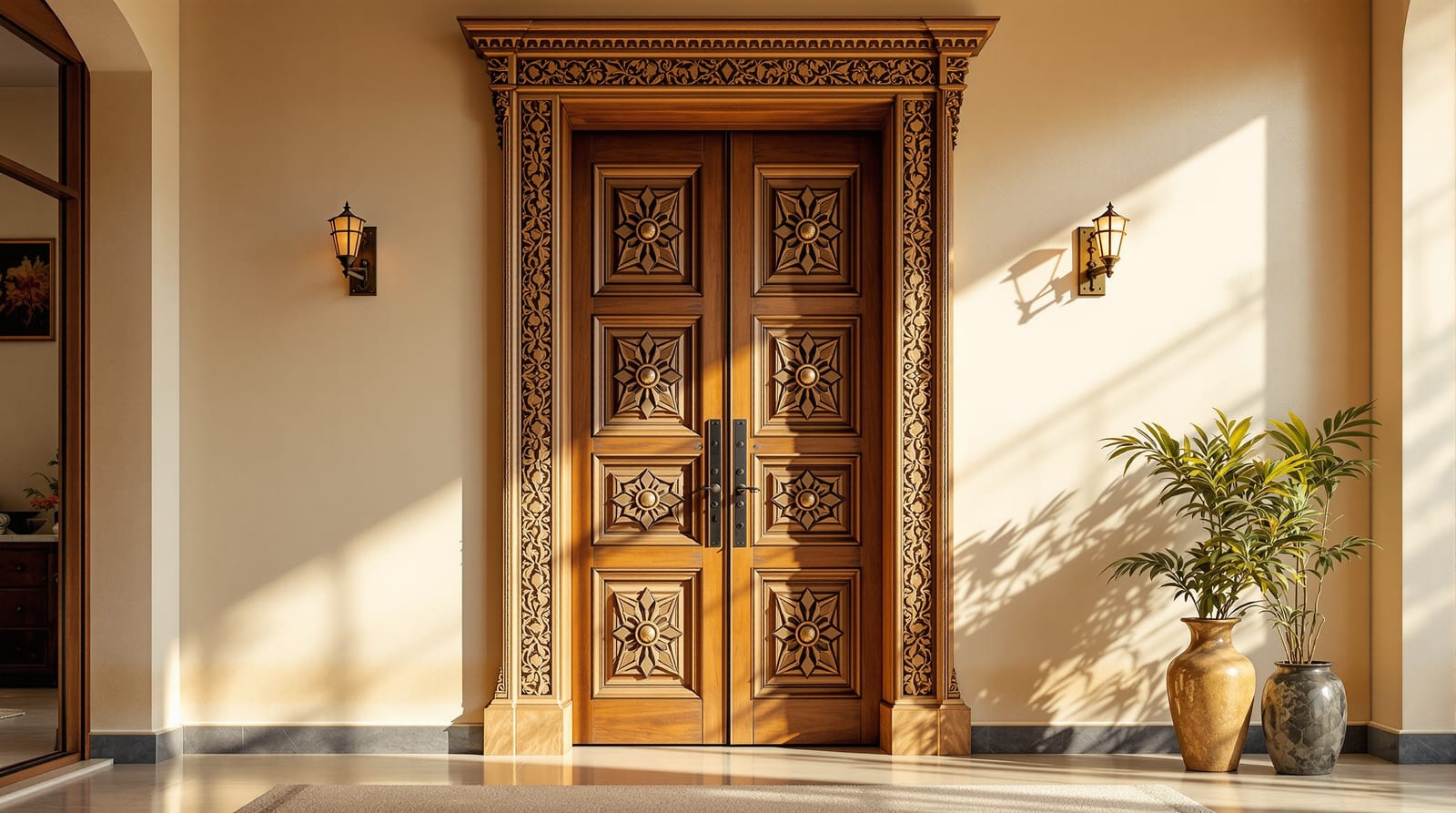
Reclaimed Wood Doors: Salvaged Teak & Antique Reuse India 2026
Why old salvaged teak and rosewood doors from demolished homes and havelis are the lowest-carbon, most characterful doors you can buy in India.
The greenest door is the one already cut from a tree decades ago. Reclaimed wood doors — old teak, rosewood (sheesham), Burma teak and country-hardwood doors salvaged from demolished havelis, bungalows and ancestral homes — carry no fresh felling, almost no new manufacturing energy, and a depth of grain and craft that no factory flush door can imitate. The timber in a 60-year-old Chettinad or Rajasthani door was slow-grown, air-seasoned for years, and has already proved it can outlast a generation. Reusing it keeps that stored carbon locked away, diverts a heavy item from the demolition skip, and gives you a one-of-a-kind door for the price of restoration rather than rare new hardwood. This guide is the homeowner's path to buying salvaged timber doors well: why reclaimed is genuinely low-carbon, where to find it across India, the structural and pest checks that separate a treasure from a money-pit, how to restore it, and how the rupee maths compares with a new door. For the bigger picture, start with the complete door guide and the sustainable doors pillar.
Why reclaimed timber is low-carbon and character-rich
Wood is the only common door material that stores carbon rather than emitting it. A solid timber door holds biogenic carbon captured while the tree grew; reusing an existing door avoids the felling, sawing, kilning, transport and finishing impacts of making a new one almost entirely. In life-cycle terms the salvaged door sits near the bottom of the embodied-carbon scale, far below aluminium or steel — a point developed in door embodied carbon and door life-cycle assessment. It is the purest example of the reuse-first hierarchy (reuse before refurbish before recycle) explained in circular economy doors: no new resource is consumed at all.
There is a quality argument too. The teak and rosewood in old Indian doors was largely slow-grown, old-growth or estate timber, air-dried over years to a stability that today's fast-kilned plantation stock rarely matches. That is why salvaged leaves are dense, dimensionally stable and often free of the warping that plagues cheap new doors. Durability is itself sustainability — a reclaimed teak door that serves another 40 years beats two cheap flush doors landfilled in the same span. The character — hand-carved panels, brass studs, patina, honest age — is a bonus you cannot buy new at any reasonable price. For how reclaimed fits the wider sustainable-timber story, see timber door sustainability and the longevity case in door lifespan and durability.
| Door route | Indicative embodied carbon | New timber felled? | Character | Where it sits |
|---|---|---|---|---|
| Reclaimed solid teak/rosewood | very low (reuse only) | none | unique, aged | lowest impact |
| New FSC-certified solid timber | low (biogenic store) | yes, certified | new, clean | good |
| New engineered-wood flush | low–moderate | partial | plain | mainstream |
| New uPVC / WPC | moderate | none | factory | synthetic |
| New aluminium / steel | high–highest | none | industrial | most energy-intensive |
Where to source reclaimed doors in India
Salvaged doors flow from a handful of channels, each with its own trade-offs. Demolition and salvage yards ("kabadi" / antique-timber dealers in cities such as Jodhpur, Ahmedabad, Chennai, Pune, Kochi and Delhi) hold the largest stock, including grand carved haveli doors. Antique and heritage dealers curate the best pieces at a premium and often restore before sale. Online marketplaces and reclaimed-furniture studios ship across India but add freight on a heavy item. Family and demolition sites directly — your own ancestral home, a relative's, or a building coming down nearby — are the cheapest and most meaningful source, but you must arrange careful removal so the leaf and frame are not split.
When you source, confirm three things: that the timber is genuinely old solid hardwood (not a veneered or painted-over flush door dressed up), that the species and grade are as claimed (true Burma teak commands far more than country hardwood), and that the door's size and configuration can be made to fit your opening — antique doors are frequently shorter or non-standard, so plan for an adapted frame rather than forcing a modern opening to match. Avoid anything that may have come from protected old-growth felling without provenance; reuse is the ethical case, fresh illegal logging is not.
Structural and pest checks before you buy
A reclaimed door is a second-hand structural item, and a beautiful face can hide rot, borer or a tired joint. Inspect methodically before money changes hands. Look first for termite and powder-post borer — fine sawdust (frass), pin-holes, or a hollow tap-tone signal active or past infestation; a door with live borer should be fumigated and treated before it enters your home, never installed as-is. Probe the bottom rail and lower stiles with a bradawl: this is where doors sit in moisture and rot first. Check the mortise-and-tenon joints for looseness or splitting, the panels for cracks (some shrinkage cracking is normal and acceptable on old solid timber), and the overall leaf for bow or twist beyond a few millimetres. Finally, weigh up embedded fixings and lead paint — old hardware, nails and pre-1990 paint layers may need careful removal and safe disposal.
| Check | What you are looking for | Verdict |
|---|---|---|
| Borer / termite | frass, pin-holes, hollow tap | treat & fumigate before use; reject if structurally eaten |
| Bottom rail rot | soft, spongy timber to a bradawl | repairable if local; reject if widespread |
| Joints (mortise-tenon) | loose, open, split | re-glue/re-wedge; reject if shattered |
| Panel cracks | shrinkage splits | minor cracks acceptable; fill |
| Bow / twist | leaf not flat | <3mm ok; heavy twist hard to fix |
| Old paint / fixings | lead paint, embedded nails | strip & dispose safely |
| Species & grade | true teak vs country hardwood | confirm before paying teak prices |
Restoring a salvaged door
Most reclaimed doors need work, and budgeting for restoration is part of buying one honestly. A typical revival runs: treat and fumigate for borer/termite first; strip old paint, varnish and grime back to bare timber; repair — re-glue and wedge loose joints, splice in matching timber at rotted rails, fill panel cracks, plug old hardware holes; re-machine the edges square and, if needed, add a lipping or pack to suit your frame; then re-finish. For finish, favour a breathable, low-VOC penetrating oil or water-based PU that lets the grain and patina show — the healthy, low-emission choices are covered in low-VOC door finishes. Because antique doors are often non-standard sizes, plan for a custom or adapted frame rather than trimming a precious leaf to death. A good carpenter or heritage-door restorer is worth the fee; clumsy stripping or over-sanding destroys the very character you paid for.
Cost versus a new door, honestly
Reclaimed is not automatically cheap. A plain salvaged country-hardwood leaf from a yard can undercut a new flush door, but a grand carved teak or rosewood haveli door — restored and fitted with a custom frame — can cost as much as, or more than, a premium new solid-teak door. The value is in the irreplaceable character and the near-zero embodied carbon, not always in saving money. As a rule of thumb, expect the leaf to be the smaller part of the spend and restoration plus a bespoke frame and fitting to be the larger. Add GST and freight on a heavy item. Compare like-for-like against new solid timber using the door cost guide, and weigh the carbon side with the door embodied carbon calculator and the door sustainability scorer. Where the maths matters most is durability: a sound reclaimed teak door amortised over another 40 years is excellent value per year of service. For where reclaimed wins or loses against alternatives, see eco-friendly door materials.
Where reclaimed doors fit best
Salvaged doors shine as statement main doors, pooja-room and study doors, and feature internal doors where their carving and patina are seen and celebrated. They suit heritage renovations, courtyard homes, farmhouses and any interior reaching for warmth and provenance. They are a weaker fit where you need modern weather and fire performance to a tested spec — an old leaf carries no current fire rating and may not meet a coastal home's weather demands without significant adaptation; for those, lean on purpose-made products instead. Used in the right place, a reclaimed door is the rare choice that is simultaneously the most beautiful, the most personal and the lowest-impact option on the project.
Frequently asked questions
Are reclaimed wood doors actually more sustainable than new ones?
Yes, almost always. Reusing an existing door avoids fresh felling and nearly all the manufacturing energy of a new door, while keeping the timber's stored biogenic carbon locked in. In life-cycle terms it sits at the bottom of the embodied-carbon scale, below new timber and far below aluminium or steel. Reuse-first is the top of the circularity hierarchy, and a long-lived reclaimed teak door is sustainable precisely because it lasts.
How do I check a salvaged door is structurally sound before buying?
Inspect for termite and powder-post borer (frass, pin-holes, a hollow tap-tone), probe the bottom rail and lower stiles for rot, check the mortise-and-tenon joints for looseness or splitting, and look along the leaf for bow or twist beyond a few millimetres. Minor shrinkage cracks in old solid timber are normal; live borer, widespread rot or shattered joints are reasons to walk away or budget heavily for repair.
Is a reclaimed teak door cheaper than a new one?
Not necessarily. A plain salvaged hardwood leaf can undercut a new flush door, but a grand carved teak or rosewood haveli door — once restored and fitted with a custom frame — can cost as much as, or more than, a premium new solid-teak door. You buy reclaimed for the irreplaceable character and near-zero embodied carbon, and for excellent value over a long second life, rather than for a low sticker price.
Can an antique door be made to fit a modern opening?
Usually yes, but plan for it. Antique doors are often shorter or non-standard in size, so the right approach is a custom or adapted frame built to suit the leaf, rather than trimming a precious carved door down to a modern size. A heritage-door carpenter can also splice, repair and re-machine the edges square so the door hangs and latches properly without losing its character.
Will a reclaimed door meet fire or coastal weather requirements?
Not on its own. An old salvaged leaf carries no current fire rating and may not meet a coastal or cyclone-prone home's weather demands without significant adaptation. Use reclaimed doors for statement main doors and feature internal openings, and rely on purpose-made tested products where you need certified fire performance or marine-grade weather resistance.
Export this guide
Related Guides — Deep-dive reading
Custom vs Ready-Made Doors: Buyer's Guide India 2026
Factory ready-made, made-to-order from a brand, or carpenter-built on site — costs, lead times, fit and warranty compared for Indian homes.
Home Doors & EntrancesDoor Lifespan and Durability: The Greenest Door (India 2026)
Why a long-lived door is the most sustainable door — typical service life by material, what shortens it, and cost-per-year thinking for Indian homes.
Home Doors & EntrancesTimber Door Sustainability in India: Is Wood Green? (India 2026)
Whether a wooden door is genuinely sustainable — legal sourcing, biogenic carbon storage, plantation versus old-growth species, and how timber compares to uPVC and aluminium.
Home Doors & EntrancesRelated Tools — Try Free
Door Cost Calculator
Estimate the all-in cost of a door — leaf, frame, hardware, fitting and GST — by type, material and size.
Door CalculatorDoor Material Comparison Tool
Compare 2–4 door materials on cost, durability, maintenance, security and moisture resistance.
Comparison ToolApartment Furniture Size Chart
Standard furniture dimensions for Indian apartments — sofas, beds, tables, dining, storage.
Reference Chart