
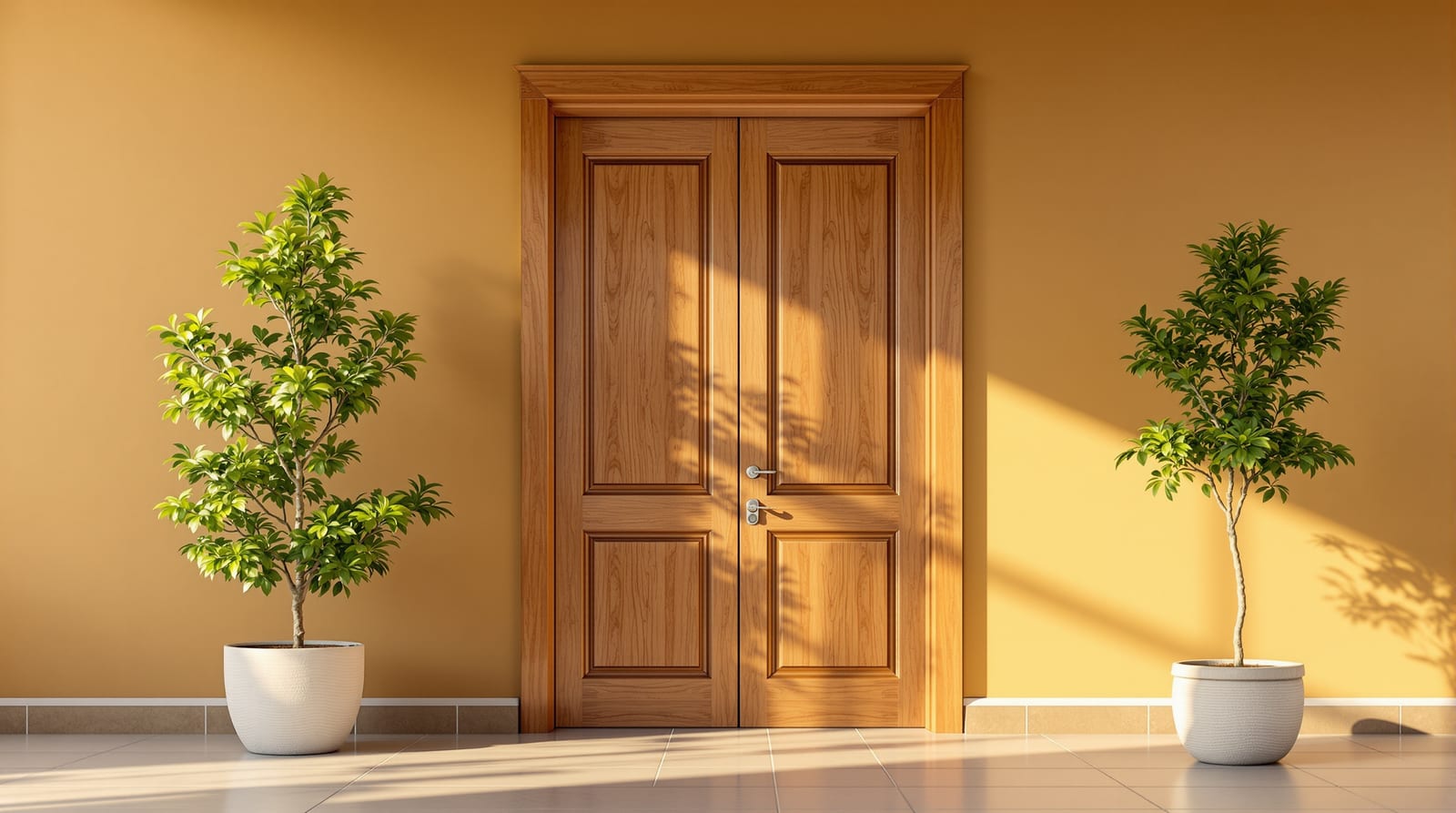
Timber Door Sustainability in India: Is Wood Green? (India 2026)
Whether a wooden door is genuinely sustainable — legal sourcing, biogenic carbon storage, plantation versus old-growth species, and how timber compares to uPVC and aluminium.
Wood feels like the natural, green choice for a door — but is it really? Timber door sustainability in India is not automatic; a wooden door is only as green as the forest it came from and the years it lasts. Done right, timber is arguably the most sustainable door material available: it is renewable, it stores carbon pulled from the air, it is biodegradable at end of life, and a well-made hardwood leaf can serve a home for thirty years or more. Done wrong — old-growth or illegally logged hardwood, felled to make a cheap door replaced in a decade — it is one of the least defensible. This Studio Matrx guide separates the genuine green case from the greenwash, so you can buy a wooden door that is honestly sustainable.
We cover legal and certified sourcing, the biogenic carbon stored inside wood, the crucial difference between plantation and old-growth species, real deforestation concerns, why responsibly-sourced durable timber is a low-carbon material, and how timber's footprint compares with uPVC and aluminium. It sits inside the cluster pillar, the complete door guide, and the Act pillar on sustainable doors.
Is a wooden door actually green?
The honest answer is: it depends entirely on the source and the lifespan. Timber's sustainability rests on four real advantages — but each carries a condition.
- Renewable — a growing tree regrows; but only if it comes from a managed plantation or sustainably harvested forest, not an irreplaceable old-growth stand.
- Carbon-storing — wood locks up carbon the tree absorbed from the atmosphere; but only if the wood is kept in a long-lived product, not burnt soon after.
- Low embodied energy — sawing and seasoning timber uses far less energy than smelting aluminium or polymerising uPVC; but transport and over-processing erode that advantage.
- Biodegradable / compostable — untreated wood returns to the soil or burns as clean biomass; but heavy preservatives and glues complicate that.
So a wooden door is potentially the greenest option — and frequently the worst — depending on choices you can actually check. The single most important green claim, legal and certified sourcing, is also the easiest to verify on paper, which is where we start.
Legal and certified sourcing
In India, much timber circulates informally and a wooden door rarely arrives with a paper trail. The green buyer's job is to demand one. The two international gold standards are FSC (Forest Stewardship Council) and PEFC chain-of-custody certification, which trace wood from a responsibly managed forest through every processor to the finished door. Indian-certified supply is still limited and most teak is imported, so genuine FSC/PEFC stock carries a premium — see FSC certified doors for how to verify a claim and avoid fake labels.
| Sourcing tier | What it means | Sustainability | How to verify |
|---|---|---|---|
| FSC / PEFC certified | Chain-of-custody from managed forest | Best — documented | Certificate number, on-product label |
| Plantation (uncertified) | Farmed timber, e.g. plantation teak, rubberwood, poplar | Good | Seller/mill declaration on invoice |
| Reclaimed / salvaged | Reused old timber, no new felling | Excellent (zero new harvest) | Provenance, age of stock |
| Domestic legal (forest dept) | Felled under state permits | Acceptable | Transit pass / permit |
| Old-growth / unverified hardwood | Slow-growing forest species, no trail | Poor — avoid | Cannot verify; treat as red flag |
As a rule of thumb: if a seller cannot tell you the species and where it was grown, treat the green claim as unproven. "Eco" only counts when a credible third party — FSC, PEFC, or a recognised label like GreenPro (CII-IGBC) or ECOMARK (BIS) — stands behind it. Reclaimed wood doors sidestep the whole sourcing question, since no new tree is felled at all.
Carbon storage in wood: the biogenic advantage
The quiet superpower of timber is biogenic carbon. As a tree grows it pulls carbon dioxide from the air and locks the carbon into its wood — roughly half the dry weight of timber is stored carbon. When that wood becomes a door rather than firewood, the carbon stays locked up for the life of the product, effectively keeping it out of the atmosphere. This is why solid timber doors often show a low or even net-negative embodied carbon figure cradle-to-gate, while energy-intensive materials show large positive numbers.
The diagram below traces that carbon from the growing tree to the door and on to end of life.
The caveat: this carbon-store benefit only holds if the forest is re-grown (so the absorbed carbon is replaced) and the wood stays in service. Cut an old-growth tree that took 150 years to grow and you cannot regrow it in any meaningful timeframe — which is exactly why the species and source matter as much as the carbon arithmetic. For the full accounting method, see door embodied carbon.
Plantation versus old-growth species
Not all wood is equal. The dividing line is whether the species comes from a fast, farmed cycle or a slow, irreplaceable forest.
- Plantation / fast-renewable (green): rubberwood (a by-product of latex farming — see rubberwood doors), plantation teak, poplar, eucalyptus, and rapidly renewable bamboo. These regrow in years to a couple of decades and can be farmed continuously.
- Slow-grown but defensible if certified: plantation-grown teak and sustainably managed hardwoods, with FSC/PEFC proof.
- Old-growth / at-risk (avoid): wild-harvested rosewood, Burma teak from unverified sources, sandalwood, and any tropical hardwood without a chain-of-custody. These come from slow-growing forests that cannot be replaced within a human lifetime, and many are restricted under CITES.
The practical takeaway: a plantation rubberwood or certified-teak door is a sustainable choice; an uncertified "premium" tropical hardwood door is not, however beautiful. If you want maximum efficiency from a given tree, engineered and finger-jointed timber uses short, narrow boards that solid leaves would waste.
Deforestation concerns — and the durability answer
Deforestation is the real risk that makes "is wood green?" a fair question. Illegal and unsustainable logging degrades forests, releases stored carbon and destroys habitat. India's domestic forests are protected and most decorative hardwood is imported, so the buyer's leverage is simple: insist on legal, certified or plantation timber, or choose reclaimed wood, and the deforestation objection largely falls away.
The second, under-appreciated answer is durability. A door's true environmental cost is its impact divided by its years of service. A well-seasoned, well-maintained hardwood door lasting 30 years stores carbon for three decades and is built — not bought — once. A cheap door replaced twice in the same period triples the manufacturing and transport impact. This is why durability is itself sustainability, and why a quality timber door, responsibly sourced, beats almost everything on lifetime footprint. Read more in door lifespan and durability.
Timber versus uPVC and aluminium: the footprint comparison
How does a responsibly-sourced timber door stack up against the two main alternatives? The table gives indicative cradle-to-gate embodied carbon bands and the wider picture — not precise figures, which vary by product, so treat them as relative bands.
| Material | Embodied carbon (cradle-to-gate, indicative) | Renewable? | End of life | Notes |
|---|---|---|---|---|
| Solid timber (certified/plantation) | Very low — can be net-negative (biogenic store) | Yes, if regrown | Reuse, compost, clean biomass | Greenest if sourced + durable |
| Engineered wood / flush | Low–moderate (resin + glue) | Partly | Recyclable if low-resin | Watch formaldehyde — pick E1/E0 |
| uPVC | Moderate (fossil-derived polymer) | No | Recyclable, but limited streams in India | Good insulator; not biodegradable |
| Aluminium | Highest (very energy-intensive to smelt) | No | ~100% recyclable | Recycled aluminium drops impact sharply; needs thermal break |
| Steel | High | No | Highly recyclable | Durable but energy-heavy to make |
The headline: a responsibly-sourced, durable timber door is the lowest-carbon door material at the point of manufacture, thanks to its stored biogenic carbon and low processing energy. uPVC sits in the middle — a decent insulator but a fossil-derived plastic that is hard to recycle in India. Aluminium has the highest making-energy but is endlessly recyclable, so recycled-content aluminium narrows the gap considerably. For a like-for-like number on your exact door, run the door embodied carbon calculator, and to weigh the whole green picture objectively use the door sustainability scorer.
One honest qualifier: this comparison is about embodied (making) carbon. Over a door's life, operational impact — how much it leaks conditioned air — also matters, and an insulated uPVC or thermally-broken aluminium external door can save AC energy in hot India. A solid timber door is naturally a fair insulator and, sourced well, still wins on the whole. The deeper environmental accounting lives in eco-friendly door materials.
So, is wood green? The verdict
Yes — conditionally. A wooden door is genuinely one of the most sustainable choices when, and only when, it is (1) legally and ideally FSC/PEFC certified or plantation-grown, (2) a fast-renewable or certified species rather than old-growth hardwood, and (3) built to last, sealed and maintained so it serves for decades. Get those three right and timber's renewable, carbon-storing, biodegradable nature makes it hard to beat. Skip them and a wooden door can be the least sustainable thing in your home. The proof, as always, is third-party certification — never the seller's word alone.
Frequently asked questions
Is a wooden door really more eco-friendly than uPVC or aluminium?
In terms of making-energy and stored carbon, yes — a responsibly-sourced, durable timber door is typically the lowest embodied-carbon door material, because wood stores biogenic carbon and needs little processing, while aluminium is very energy-intensive to smelt and uPVC is a fossil-derived plastic. The crucial conditions are legal/certified sourcing and a long service life.
What makes a timber door sustainable rather than just "natural"?
Three things: certified or plantation sourcing (FSC, PEFC, or reclaimed), a fast-renewable or sustainably managed species rather than old-growth hardwood, and durability so it lasts decades. "Natural" alone means nothing if the tree was illegally logged or the door fails in five years.
Does buying a wooden door cause deforestation?
Only if it is made from old-growth or illegally logged timber with no chain-of-custody. Choosing FSC/PEFC certified, plantation (rubberwood, plantation teak, bamboo) or reclaimed wood avoids that risk. India's forests are protected and most decorative hardwood is imported, so demanding proof of legal source is your main lever.
How does wood store carbon?
As a tree grows it absorbs carbon dioxide and locks the carbon into its wood — roughly half the dry weight is stored carbon. When that wood becomes a long-lived door instead of firewood, the carbon stays out of the atmosphere for the life of the product, which is why timber can show low or even net-negative embodied carbon if the forest is regrown.
Is plantation teak or rubberwood as sustainable as it claims?
Plantation rubberwood is genuinely sustainable — it is a by-product of latex farming, harvested only at the end of the tree's tapping life. Plantation teak is defensible if certified. Both still benefit from FSC/PEFC proof and account for transport carbon if imported. Avoid uncertified "premium" tropical hardwood, which is often slow-growing old-growth.
How do I verify a sustainability claim on a wooden door?
Ask for the species and where it was grown, and look for an FSC or PEFC certificate number, or a recognised label like GreenPro (CII-IGBC) or ECOMARK (BIS). Get it in writing on the invoice. If the seller cannot tell you the source, treat the green claim as unproven.
Export this guide
Related Guides — Deep-dive reading
FSC Certified Doors in India: Verify & Buy (India 2026)
What FSC and PEFC chain-of-custody certification means for a door, why Indian supply is thin, and how to verify a claim before you pay.
Home Doors & EntrancesEco-Friendly Door Materials: A Sustainability Guide (India 2026)
Rubberwood, bamboo, agri-fibre board, reclaimed timber, FSC plywood and recycled WPC scored on renewability, carbon, emissions, durability and recyclability.
Home Doors & EntrancesSustainable Doors Guide: Eco-Friendly Doors (India 2026)
What makes a door genuinely sustainable in India — certified renewable material, low emissions, low embodied carbon, durability and recyclability.
Home Doors & EntrancesRelated Tools — Try Free
Door Material Comparison Tool
Compare 2–4 door materials on cost, durability, maintenance, security and moisture resistance.
Comparison ToolWindow Material Comparison Tool
Compare uPVC, aluminium, wood, steel and composite windows on cost, life, upkeep and insulation.
CompareFalse Ceiling Cost Estimator
Live ₹/sqft across 8 ceiling types — POP, gypsum, designer, metal, PVC, wooden — with cove and spot lighting for 20 Indian cities.
Cost Calculator