

How to Read a Construction Quotation in India: Compare Contractor Quotes Without Getting Trapped (2026)
A homeowner's guide to reading and comparing contractor quotations - the parts of a quote, why the cheapest one is often a trap, how to make three quotes truly comparable, and the exclusions and extras that quietly inflate the final bill.
A construction quotation turns a vague idea of "building a house" into numbers you are asked to sign against. It is also the easiest place to be taken advantage of, because a quote can be made to look cheap without actually being cheap - by leaving items out, by using words like "as per market" instead of a real specification, or by quoting a low headline rate and recovering the difference later through "extras". Reading a quotation well is a skill you can learn in an afternoon. This guide teaches a homeowner how to read a single quote line by line, how to line up three quotes so they compare fairly, and how to spot the traps before they cost you.
None of this assumes your contractor is dishonest. Most good builders quote honestly and want a clear scope as much as you do - a vague quote invites disputes that hurt them too. The goal is a quote both sides understand the same way, so the price you agree is the price you pay. Reading a quote is the step between choosing a contractor and signing an agreement; it sits alongside the contract-type decision and feeds straight into your construction agreement.
Scope and a plain disclaimer. This guide explains how to read and compare quotations so you can ask better questions - it is not a substitute for professional advice. It does not price your project: every rate, percentage, tax figure and payment stage mentioned is indicative and varies by city, project scale, material choice and the individual contractor. Get actual, itemised quotations from real local contractors for your own drawings. Defer the binding wording of any contract to a lawyer, structural and technical decisions to your architect or engineer, and tax specifics to a qualified professional. Confirm everything before you commit.
Key takeaways
- A quotation is only as good as its scope and specifications - a low number against a vague scope is not a low price, it is an unfinished sentence.
- The cheapest quote is often the most expensive one finished, because the gap is recovered later through extras, variations and "as per market" substitutions.
- Three quotes can only be compared if they price the same scope, the same quantities and the same specifications - otherwise you are comparing different buildings.
- Read the exclusions as carefully as the inclusions; what is left out is where the surprise bills come from.
- A per-square-foot quote is a quick estimate, not a contract - insist on an itemised bill of quantities before you sign anything binding.
What a construction quotation actually is
A quotation is a contractor's priced offer to do a defined piece of work. At its most basic it says: here is what I will build (the scope), here is what it is made of (the specifications), here is how much of each thing (the quantities), here is my rate for each, and here is the total. Around that core sit the commercial terms - what is excluded, what taxes apply, how long the price holds, and when you pay.
The trouble is that "quotation" covers everything from a one-line message ("full house, Rs 1,800 per square foot, ready to move") to a twenty-page itemised document. The one-liner is a fine first filter for who is in your budget range, but dangerous as the basis for a contract: almost every important question - quality of tiles, whose sanitaryware, foundation depth, is the compound wall included - is left unanswered, and every unanswered question is a future argument you will probably lose. The more detail a quote carries, the fewer surprises it hides.
The anatomy of a quotation
Before you can judge a quote, you need to know its parts and what each one is for. A complete quotation has a predictable skeleton, and once you can name the bones you can check whether any are missing.
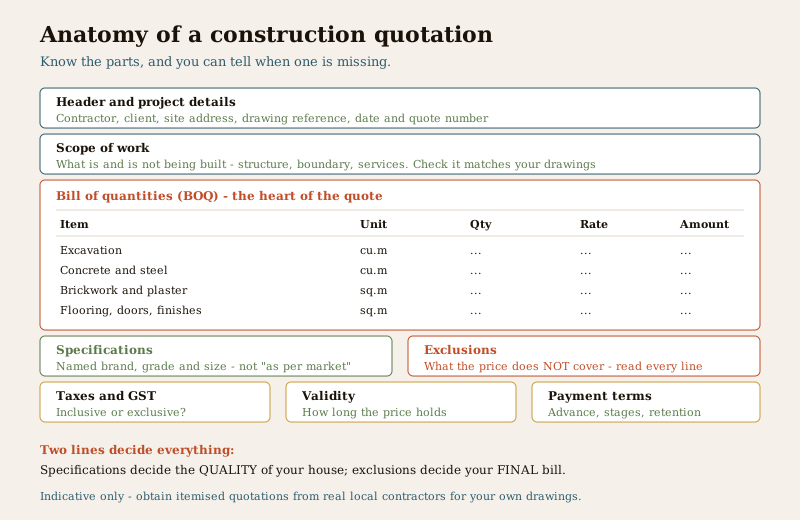
The heart of a serious quote is the bill of quantities, or BOQ - the itemised list where each element of work becomes a line with a unit, a quantity and a rate. If you have not met the BOQ before, read BOQ explained first; it is the language every itemised quote is written in. The table below walks each part of a quotation and gives you the one thing to check against it.
| Part of the quotation | What it should contain | What to check |
|---|---|---|
| Scope of work | A clear statement of what is and is not being built - the structure, floors, boundary, services | Does it match your drawings exactly? Are compound wall, sump, gate, parking, staircase named or assumed away? |
| BOQ line items | Each element of work listed separately - excavation, concrete, brickwork, plaster, flooring, and so on | Is the list complete? A missing line is a missing cost that reappears later as an extra |
| Quantities | The measured amount of each item, in its proper unit (cubic metre, square metre, running metre, number) | Are the quantities realistic for your plan area? A quantity set too low makes the total look small |
| Rates | The price per unit for each line, ideally split into material and labour where relevant | Are rates in line with the other quotes? A rate far below the rest signals a cut corner or a later claim |
| Specifications | The exact make, grade, size and brand of materials - cement grade, steel, tile size, brand of fittings | Are brands and grades named, or is it "as per market", "standard", "good quality"? Vague specs are a blank cheque |
| Exclusions | What the price does NOT cover - work you must pay for separately | Read every exclusion. This is where the real surprises live |
| Taxes and GST | Whether the price includes GST, and at what rate, and any other statutory charges | Is the quote inclusive or exclusive of GST? An "exclusive" quote is not as cheap as it looks |
| Validity | How long the quoted price holds before rates are revised | Is the validity long enough to compare quotes and sign? Short validity is a pressure tactic |
| Payment terms | The schedule of payments - advance, stage payments, retention, final payment | Is the advance reasonable and are payments tied to work completed, not to a calendar? |
Two lines deserve extra weight. The specifications decide the actual quality of your house - two quotes at the same rate can build very different homes depending on the grade of steel, the brand of waterproofing and the quality of tiles. And the exclusions decide your final bill - a headline number that excludes the compound wall, sump and tank, electrical fittings, paint and plumbing fixtures can grow by a large fraction once those are added back in.
Per-square-foot versus itemised quotes
Most homeowners first meet construction pricing as a single per-square-foot rate. It is a useful tool and a trap at the same time, and the difference is worth understanding.
A per-square-foot quote multiplies your built-up area by one all-in rate. It is quick, lets you compare contractors at a glance, and is fine for early budgeting - sanity-check the number against the house construction cost calculator. But that single rate hides every specification and assumption: two contractors quoting the same rate may assume completely different tile budgets, steel quantities and finishing levels. It tells you almost nothing about what you actually get, and gives you no line to check when a dispute arises.
An itemised quote built on a BOQ prices each element separately. It is more work to read, but it is the only kind you can genuinely compare, verify and hold someone to - when a rate looks wrong you can point to the line, and when you want to upgrade a finish you can see exactly what it adds. You can even build your own reference BOQ with the BOQ calculator to interrogate what the contractors send back. The rule is simple: use a per-square-foot rate to shortlist, but never sign a binding agreement on anything less than an itemised quotation.
Why the cheapest quote is often the trap
When three quotes land and one is visibly lower, the instinct is relief - usually misplaced. A price is the sum of scope, specification, quantity and rate. If one quote is much lower, one of those four has been shaved, and you need to find out which before you celebrate.
The most common mechanism is under-quoting to win, then charging extras. A contractor quotes a low headline number knowing the scope is incomplete, wins on price, then recovers the margin through a stream of "variations" once you are committed and too late to switch. The compound wall quietly excluded, the "premium" tiles you assumed were included, the extra foundation depth the soil "turned out to need" - each arrives as a supplementary bill, until the cheapest quote has become the most expensive.
The second mechanism is vague specifications. "Flooring - as per market" lets the contractor fit the cheapest tile that satisfies the word, or bill you extra for anything better; "standard fittings" means whatever is cheapest today. Every vague word hands a decision to the person you are paying, made in their interest not yours. The third is simply missing items - lines that should be in the BOQ but are not, so the total is smaller than the real job. None of these make the low quote a good deal; they make it an incomplete one. A fuller list is in the red flags when hiring a contractor guide.
Making three quotes comparable
The single most valuable thing you can do is force every contractor to quote the same thing. If each prices a slightly different scope with different assumptions, the totals are not comparable and the lowest number wins for the wrong reason. The fix is to control the inputs so that only the price varies.
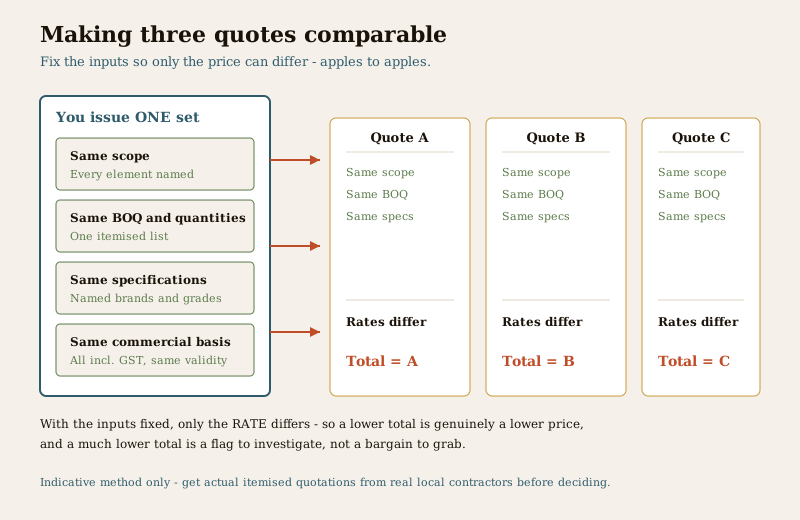
Do it in three moves. First, give everyone the same scope and drawings - do not let each contractor decide what is included; hand them one written scope naming every element (structure, boundary wall, sump and tank, staircase, parking, and which services are in). Second, give everyone the same BOQ and specifications - ideally you or your architect issue a single itemised list with quantities and named specifications ("vitrified tiles, 600 by 600 mm, from a named brand list" rather than "good tiles"), so every contractor prices identical material against identical quantity. Third, insist on the same commercial basis - all quotes inclusive of GST or all exclusive, with the same validity and a comparable payment structure - so you are not misreading the gap between an inclusive quote and an exclusive one.
Once the inputs are fixed, comparison becomes honest: the only thing left to differ is the rate each contractor charges for the same defined work. Now a lower number really is a lower price, and a much lower number is a flag to investigate rather than a bargain to grab. This levelled BOQ is also what you carry into the agreement - see how to hire a building contractor for where quote comparison sits in the wider hiring sequence.
Red flags in a quote
Some warning signs are visible on the page before you ever meet the contractor again. Learn to see them at a glance.
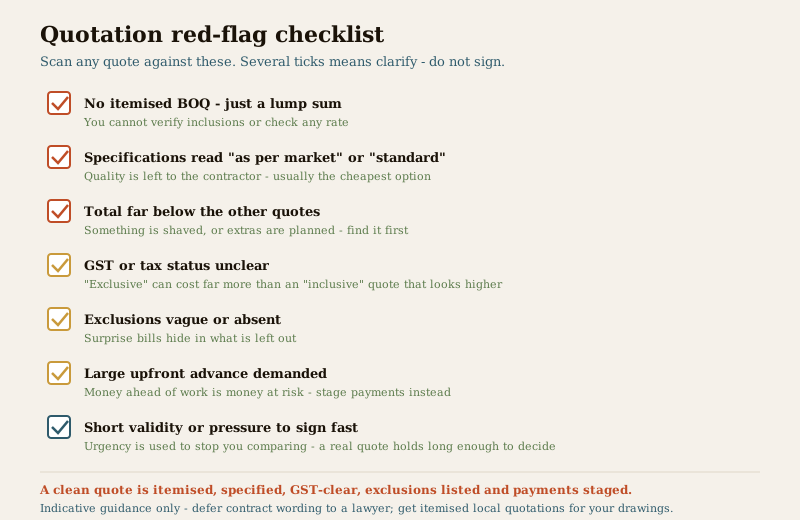
The table below is the scan to run over any quote you receive. If several boxes tick, the quote is not ready to sign - it needs to go back for clarification, not straight into a contract.
| Red flag in the quote | Why it should worry you | What to do about it |
|---|---|---|
| No itemised BOQ, just a lump sum | You cannot verify what is included or check any rate; disputes have no reference point | Ask for a full itemised quotation before comparing or signing |
| Specifications read "as per market" or "standard" | Quality is left to the contractor's discretion, usually the cheapest option or a later extra | Insist on named brands, grades and sizes for every finishing item |
| Total far below the other quotes | Something has been shaved - scope, quantity or specification - or extras are planned | Do not assume a bargain; find the missing item or the low quantity before proceeding |
| GST or tax status unclear | An "exclusive" quote can be much dearer than an "inclusive" one that looks higher | Confirm whether the total includes GST and at what rate, in writing |
| Exclusions vague or absent | The surprise bills hide in what is left out; no exclusions listed usually means many | Ask for a written exclusions list and price the excluded items in |
| Large upfront advance demanded | Money paid ahead of work is money at risk and weakens your leverage | Tie payments to completed stages; keep the advance modest and defined |
| Very short validity or pressure to sign fast | Urgency is used to stop you comparing quotes or reading the fine print | Take the time to compare; a genuine quote holds long enough to decide |
| Quantities that look too low for the plan | A total made small by understated quantities balloons when the real quantity is billed | Cross-check key quantities against your area and the other quotes |
A quote that survives this scan cleanly - itemised, specified, GST clear, exclusions listed, quantities sensible, payments staged - is one you can compare with confidence and carry into an agreement.
Before you sign
Reading the quote is the step that makes the next one safe. Once you have a clean, itemised, comparable quote you are happy with, its numbers and specifications must flow into a written contract, because a quotation on its own is an offer, not an enforceable agreement. What is priced in the quote becomes the scope in the construction agreement, and the quote's payment terms become the schedule you and the lawyer finalise. Decide, too, whether you are contracting on a labour, item-rate or turnkey basis, because that shapes how the quote is structured - the labour vs item-rate vs turnkey guide walks the trade-offs. Sanity-check the bottom line once more against the house construction cost calculator, and keep the whole hiring picture in view from the hiring professionals hub. The quote you can read is the quote you cannot be trapped by.
References
- Bill of quantities (BOQ) - the standard itemised basis for pricing and comparing construction work; concepts named generally, see the BOQ explainer.
- Goods and Services Tax (GST) on construction and works contracts - rates and applicability are set by statute and change over time; confirm the current position and whether a quote is inclusive or exclusive with a qualified professional.
- Standard construction contract and agreement concepts, named generally - the binding wording of any contract should be settled with a lawyer, not copied from a quotation.
- All rates, percentages, tax figures, payment stages and quantities in this guide are indicative and vary by city, project scale, material choice and individual contractor - obtain actual itemised quotations from real local contractors for your own drawings before deciding.
Export this guide
Related Guides — Deep-dive reading
Contractor Red Flags: Warning Signs When Hiring in India (2026)
A homeowner's plain-language guide to the warning signs before you sign and while work is on site - and the practical safeguard for each. Even-handed: most contractors are honest, and these habits protect you against the minority who are not.
Hiring ProfessionalsHow to Hire a Building Contractor in India: Find, Shortlist, Compare Quotes and Vet the Right Builder (2026)
A homeowner's guide to choosing the main civil contractor who will build your house - where to find them, how to shortlist and evaluate on experience and finances, how to get comparable quotes on one scope, which contract type suits you, what to verify, and how to set clear expectations - with an evaluation scorecard and a questions-to-ask table.
Hiring ProfessionalsThe Truth About Cost Per Square Foot
Why a ₹/sqft interior quote is the most misleading number in Indian home costing — and how to convert it into a real BOQ
Cost & MoneyRelated Tools — Try Free
AI BOQ Generator
AI generates detailed Bill of Quantities with city-specific rates and labour breakdown.
ArchitectAIFlooring Cost Calculator
Estimate the all-in cost of a floor — material, laying, wastage, skirting and GST — by area and material.
Flooring CalculatorInterior Contract Clause Checklist
16 sections and 98 checkboxes covering scope, BOQ, milestones, penalties, warranty, and disputes.
Contract Checklist