
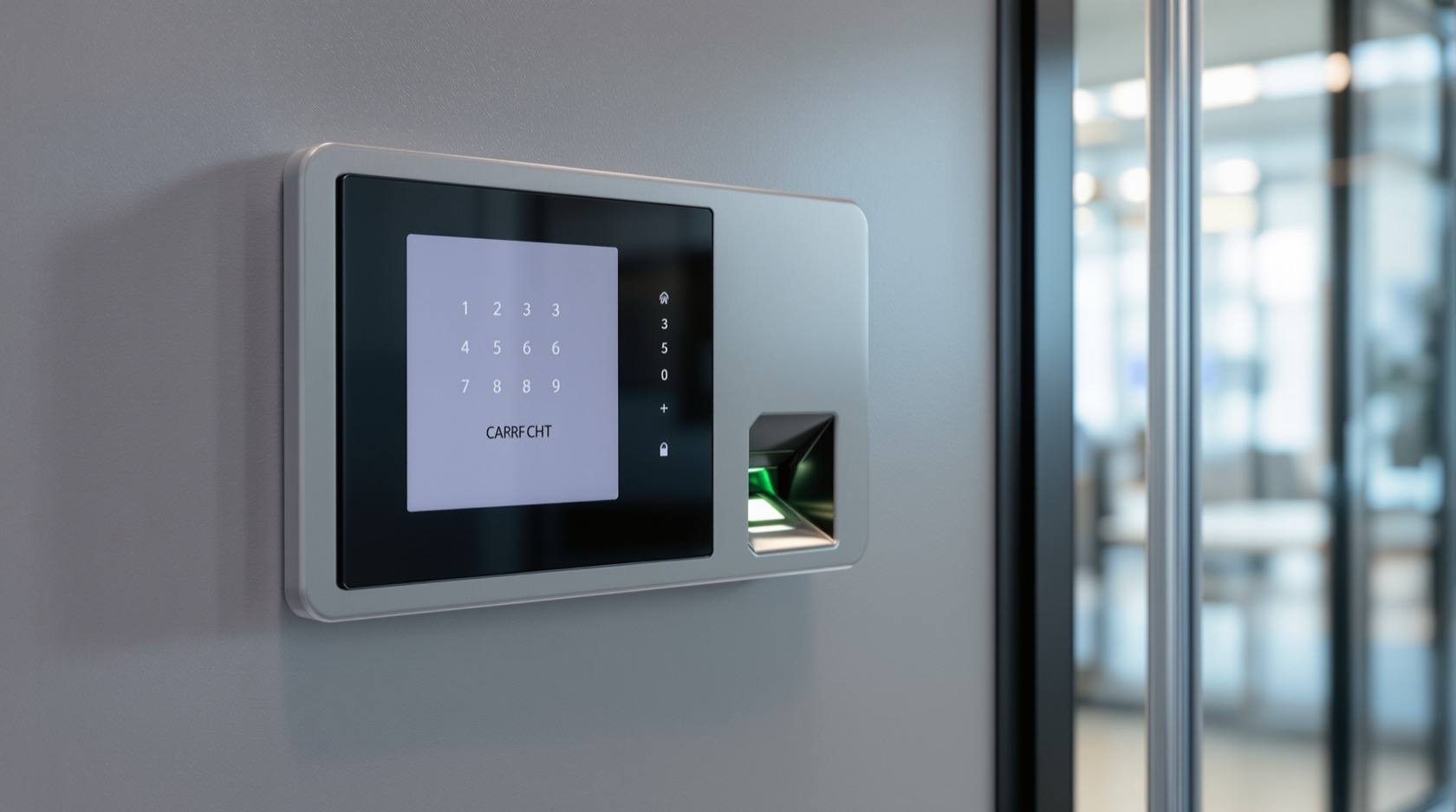
RFID vs Biometric Access Control (2026): Which Suits Your Building in India
A neutral, head-to-head decision guide for facility and security teams choosing between an RFID card or fob and a biometric (fingerprint or face) reader for apartment, office and factory doors in India — covering throughput, sharing and tailgating, reliability, cost, fail-safe egress and the serious DPDP duties biometrics bring.
Stand at any controlled door in India and you are really choosing between two ideas. The first says: carry something — a card, a fob, a tag — and present it to a reader. The second says: carry nothing — your fingerprint or your face is the credential, read straight off your body. That is the whole of the RFID-versus-biometric question, and both answers are right somewhere. The honest one-liner: RFID wins where you want fast, easy-to-issue, easy-to-revoke access and card logistics are no burden; biometrics win where access must be bound to the actual person — and the moment you choose biometrics you take on real data-protection duties you did not have before.
This guide is a neutral head-to-head for a facility manager, security consultant or building committee weighing the two for an apartment lobby, an office floor or a factory gate. Neither is "the modern one" and the other obsolete — most well-run sites in India end up using both, in different places, for good reasons. For the money and product depth this sits above, see the access control cost guide; for the wider selection method, how to choose access control.
Scope and how to read this. This is a planning and decision guide, not an installation manual or a price list. Both technologies are legitimate; the goal is to match one (or both) to your building, traffic and risk — never to crown a universal winner. Because biometrics capture fingerprint and face data, they are sensitive personal data under the Digital Personal Data Protection (DPDP) Act 2023, and that shapes the choice as much as speed or cost does — treat it as a first-order factor, not a footnote. Whatever you pick, every access-controlled door must fail safe and release on fire or power loss per the National Building Code (NBC = SP 7:2026); security must never trap a person. Engage a licensed installer and, for biometrics, take a considered view on consent and storage.
What each one actually is
RFID access control means the credential is a thing you carry. A card, key-fob or sticker holds a chip; you present it to a reader over radio, and the reader checks the ID against a list of who may open which door, when. It is the familiar office lanyard and hotel keycard. The important nuance: not all RFID is equal. Cheap low-frequency (125 kHz) cards are trivially cloneable; modern encrypted high-frequency cards are far harder to copy. The card knows nothing about who is holding it — only that a valid card was presented. For the device-level view, see the smart locks and access control sub-hub.
Biometric access control means the credential is a trait of the person — a fingerprint or a face. There is nothing to carry, lose or hand over. The reader captures the trait, converts it to a stored mathematical template, and matches a live read against it. Face readers are touchless and fast; fingerprint readers need a clean, present finger on a sensor. Crucially, the credential cannot be issued, borrowed or returned like a card — it is the person, which is exactly its strength and exactly its compliance burden.
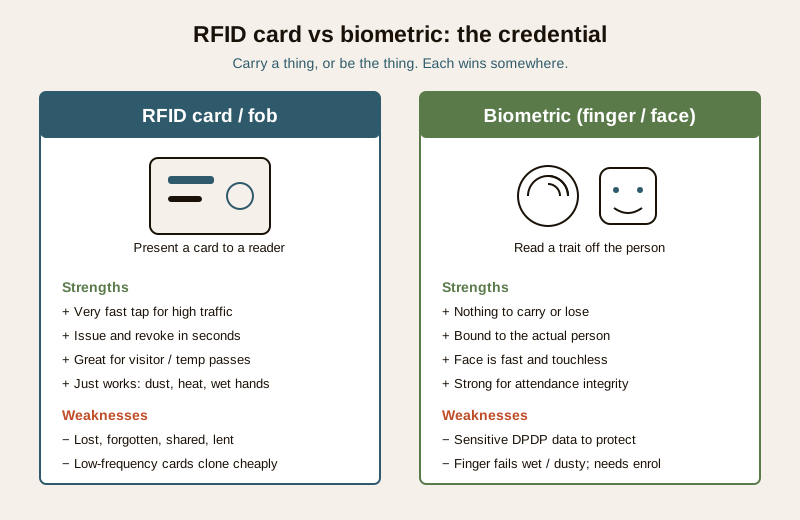
The head-to-head
The two differ across a set of dimensions that a real site actually feels. Read each row for the trade-off, not for a scoreboard — each technology genuinely wins some.
| Dimension | RFID card / fob | Biometric (fingerprint / face) |
|---|---|---|
| What you carry | A card or fob — can be lost, forgotten, shared or cloned | Nothing — the credential is always with the person |
| Throughput / speed | Very fast tap; excellent for high-traffic gates and turnstiles | Face is fast and touchless; fingerprint is slower and can misread |
| Hygiene | Card touches only the holder's reader | Face is fully touchless; a shared fingerprint sensor is a common-touch surface |
| Sharing / tailgating | A card can be handed over — buddy-punching is easy | Bound to the actual person — strong for attendance and non-repudiation |
| Cloning / spoofing | Low-frequency cards clone cheaply; use encrypted secure cards | Cheap sensors can be spoofed; quality readers add liveness detection |
| Enrolment and admin | Issue or revoke a card in seconds; card stock to manage | No card logistics, but each person must be enrolled once |
| Reliability in India | Just works — dust, heat, wet hands do not matter | Fingerprint fails on wet, worn, dusty fingers; face struggles with harsh light or masks |
| Privacy / DPDP | Access logs are personal data, but not biometric | Fingerprint and face are sensitive personal data — the heaviest duty |
| Indicative cost | Reader plus recurring card stock; generally lower entry cost | Reader generally dearer; no card stock, but enrolment and compliance effort |
| Fail-safe egress | Must release on fire and power loss | Must release on fire and power loss — identical duty |
A few rows deserve a caveat rather than a cell. On cloning and spoofing, neither is defenceless: the RFID answer is to specify encrypted secure cards rather than the cheapest 125 kHz stock, and the biometric answer is to buy quality readers with liveness detection rather than the bargain sensor. On reliability, India is unkind to fingerprints specifically — a labourer's worn or wet fingertips, a dusty factory gate, summer heat — where a card simply taps and works; face readers sidestep the finger problem but bring their own sensitivity to backlight and masks. The related fingerprint vs PIN lock guide covers the fingerprint failure modes in more detail.
The DPDP question — the one that changes the decision
This is where a comparison that looks like a tie stops being one. A biometric system stores fingerprint or face data, and under the DPDP Act 2023 that is sensitive personal data. An RFID system stores who tapped where and when — that is personal data too, and deserves care — but it is not biometric, and biometric data carries a heavier obligation and a heavier consequence if it leaks. A card can be re-issued after a breach; a person cannot be issued a new fingerprint.
That single fact should shape the buy:
- Consent and notice. Enrolling someone's fingerprint or face needs a clear, informed basis — especially for staff, tenants and domestic workers who may feel unable to refuse. Offer a non-biometric alternative where you reasonably can.
- Where the template is held. On-device (the template never leaves the reader) is materially safer than a central server or a vendor's cloud. Ask, and prefer on-device storage for biometrics.
- Minimise and retain honestly. Keep only what the purpose needs, state a retention period, and delete on exit. This is doubly true for biometric templates.
- RFID is not exempt. Access logs reveal movement and presence; agree in writing who may read them, for how long, and why. But the ceiling of harm is lower.
The honest verdict on privacy. If two options would serve your door equally well and one is biometric, the non-biometric option is usually the lighter, safer compliance choice. Choose biometrics when their identity-binding is the actual thing you need — attendance integrity, non-repudiation, a sensitive room — not merely because they feel advanced. The convenience of "no card to carry" is real, but it is bought with a lasting data duty.
Sharing, tailgating and attendance — where biometrics earn their keep
The clearest scenario for biometrics is anywhere access must mean this specific person was here. A card can be lent to a colleague, propped by a door, or clocked in by a friend — buddy-punching — which quietly corrupts a time-attendance record and weakens any after-the-fact investigation. A fingerprint or face cannot be handed over. That non-repudiation is why factories and offices that pay by attendance, or that need a defensible log of who entered a sensitive area, lean biometric for those specific doors.
RFID has the opposite failure and the opposite strength: because a card is a detachable token, it is effortless to issue a visitor pass, a contractor day-card or a temporary tenant fob, and to kill it the moment it is handed back or lost. No enrolment appointment, no biometric on file for someone who will never return. For churn, visitors and temporary access, the card is simply the better tool.
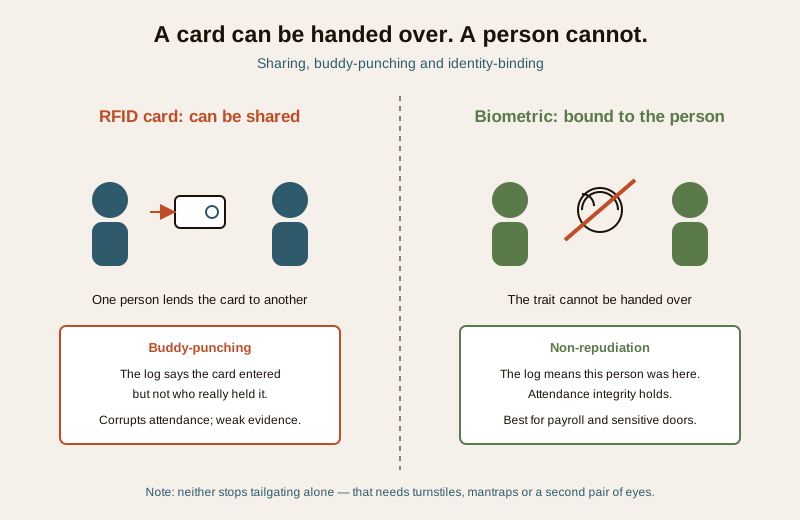
Note that neither technology stops tailgating on its own — a person following another through an open door defeats any credential. Tailgating is solved by the door hardware and discipline (turnstiles, mantraps, a second pair of eyes), not by choosing card over biometric.
Which suits whom — the verdict by scenario
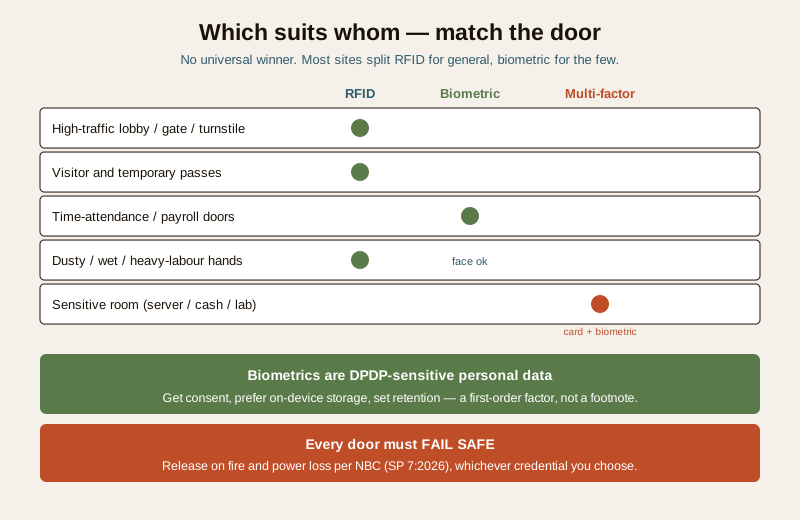
There is no universal winner, so match the tool to the door:
- High-traffic lobby, gate or turnstile (offices, apartments). RFID. A fast tap keeps a crowd moving; issuing and revoking cards for residents, staff and visitors is simple. Face readers can work here too if touchless flow matters, but at higher cost.
- Visitor, contractor and temporary access. RFID, every time. Day-cards issue and revoke in seconds with no biometric enrolled on a person who will not return. Pair with a visitor management discipline.
- Time-attendance and payroll doors (factories, back-of-house). Biometric, for the attendance integrity — with the DPDP duties handled properly and, ideally, on-device templates.
- A single sensitive room — server room, cash room, records, lab. Biometric, or better, multi-factor: card plus fingerprint (or card plus PIN). Two factors mean a lost card alone, or a spoofed trait alone, does not open the door. See multi-factor access control principles.
- Dusty, wet or heavy-labour environments (factory floor, site gate). RFID, because fingerprints fail exactly here; if you need identity-binding, prefer a face reader over a fingerprint sensor.
- A mixed building. The common, sensible pattern: RFID for general access and circulation, biometric only on the few doors that truly need identity-binding. Most Indian sites land here.
Life-safety is not part of the trade-off. Whichever you fit, an access-controlled door on an escape route must fail safe — release automatically on a fire alarm and on power failure — under NBC (SP 7:2026). A biometric or card lock that holds a door shut in a fire is a fatal error, not a security win. Design egress first, then layer the credential on top.
How to decide — a short framework
Work down these questions and the answer usually falls out:
1. Does this door need to know who, not just a valid credential? If attendance integrity or non-repudiation matters, biometric; if not, RFID is enough.
2. How much churn is there? High visitor and temporary traffic favours RFID's instant issue-and-revoke; a stable population tolerates biometric enrolment.
3. What are the physical conditions? Wet, dusty, heavy-labour hands break fingerprints — prefer RFID or face there.
4. Can you carry the DPDP duty well? If you cannot handle consent, on-device storage and retention properly, do not deploy biometrics — the risk outlives the convenience.
5. Is this a genuinely high-security door? Then neither alone — go multi-factor (card plus biometric, or card plus PIN).
6. Have you fixed egress first? Every door fails safe on fire and power, regardless of credential.
The realistic outcome for most Indian buildings is not a winner but a split: RFID doing the everyday, high-traffic, visitor-heavy work, and biometrics reserved for the handful of doors where being sure of the person is worth the data responsibility. Keep the chosen system maintained — readers, cards, templates and door hardware all age (see access control maintenance) — and revisit the split as your building changes.
Key takeaways
- The core split: RFID means carrying a card that can be lost, shared, forgotten or cloned; biometric means the credential is the person — nothing to carry, but sensitive data to protect.
- RFID wins on speed for high traffic, on instant issue-and-revoke for visitors and temporary access, and on reliability in dust, heat and wet-hand conditions.
- Biometric wins where access must be bound to the actual person — attendance integrity, non-repudiation, a sensitive room — and face readers add touchless hygiene.
- DPDP is decisive: biometrics are sensitive personal data under the DPDP Act 2023 — treat consent, on-device storage and retention as a first-order buying factor, not a footnote; RFID logs are personal data too, but the harm ceiling is lower.
- Cloning and spoofing are manageable: specify encrypted secure RFID cards, and quality biometric readers with liveness detection — do not buy the cheapest of either.
- For high security, use both — multi-factor card plus biometric (or card plus PIN) so one lost or spoofed credential is not enough.
- Egress is non-negotiable: every access-controlled door must fail safe and release on fire and power loss per NBC (SP 7:2026), whichever credential you choose.
Where to go next
- How to choose access control and the access control cost guide — the wider selection method and the money.
- Fingerprint vs PIN lock — the device-level detail on the fingerprint credential.
- Access control maintenance — keeping readers, cards, templates and door hardware working.
- The security comparison guide pillar and the comparisons sub-hub — other head-to-head decisions.
- The smart locks and access control sub-hub and the main security hub.
References
- Digital Personal Data Protection Act, 2023 — fingerprint and face templates are sensitive personal data; agree consent, lawful basis, on-device versus server storage, retention and deletion in writing. RFID access logs are personal data too. Verify current rules and notifications before relying on them.
- National Building Code of India (SP 7), Bureau of Indian Standards — means of egress and fail-safe release of access-controlled doors on fire and power loss. Verify the current edition (SP 7:2026) via the BIS catalogue: https://www.services.bis.gov.in/
- Private Security Agencies (Regulation) Act, 2005 (PSARA) — where guards support a controlled entrance, deploy them through a registered agency.
This is an educational, neutral head-to-head for facility managers, security consultants and building committees — not legal advice or an installation manual. Both technologies are legitimate; match them to your building, traffic and data-protection capacity. Life-safety and fail-safe egress take priority over any credential; engage a licensed installer, handle biometric data under the DPDP Act with care, and verify any standard's current status via the BIS catalogue before relying on it.
Export this guide
Related Guides — Deep-dive reading
Fingerprint vs PIN Lock (2026): Which Keyless Entry Suits Your Indian Home?
A neutral head-to-head between the two most common keyless ways to open a smart lock in India — a fingerprint (biometric) and a PIN (code) — across convenience, everyday reliability in Indian conditions, who can use each, security, and privacy, ending in the honest verdict that you rarely have to choose.
SecurityFingerprint Locks in India (2026): How Biometric Door Locks Really Work, and Their Honest Limits
How a fingerprint sensor reads a finger and matches it to enrolled templates, the genuine appeal of nothing to carry, and the wet-finger, elderly, privacy and backup realities every Indian buyer must weigh before choosing one.
SecurityAccess Control Maintenance in India (2026): Readers, Locks and Fail-Safe Egress
How to keep a card, keypad, fingerprint or face access-control system reading reliably and locking securely — and, above everything, how to test that its doors still release on a fire alarm and on power loss, so an access-controlled door never becomes a life-safety trap.
SecurityRelated Tools — Try Free
Biometric-Capacity Calculator
Whether a biometric reader can hold all the enrolments and how many devices you need, with a 1:N speed note.
Biometric CapacitySecurity System Cost Estimator
Estimate the all-in capex with GST, annual running cost and 5-year total cost of ownership of a home or building security system.
Cost EstimatorVisitor Access Planner
Size visitor handling at a gate or reception — lanes needed at peak and the temporary-pass pool.
Visitor Flow