
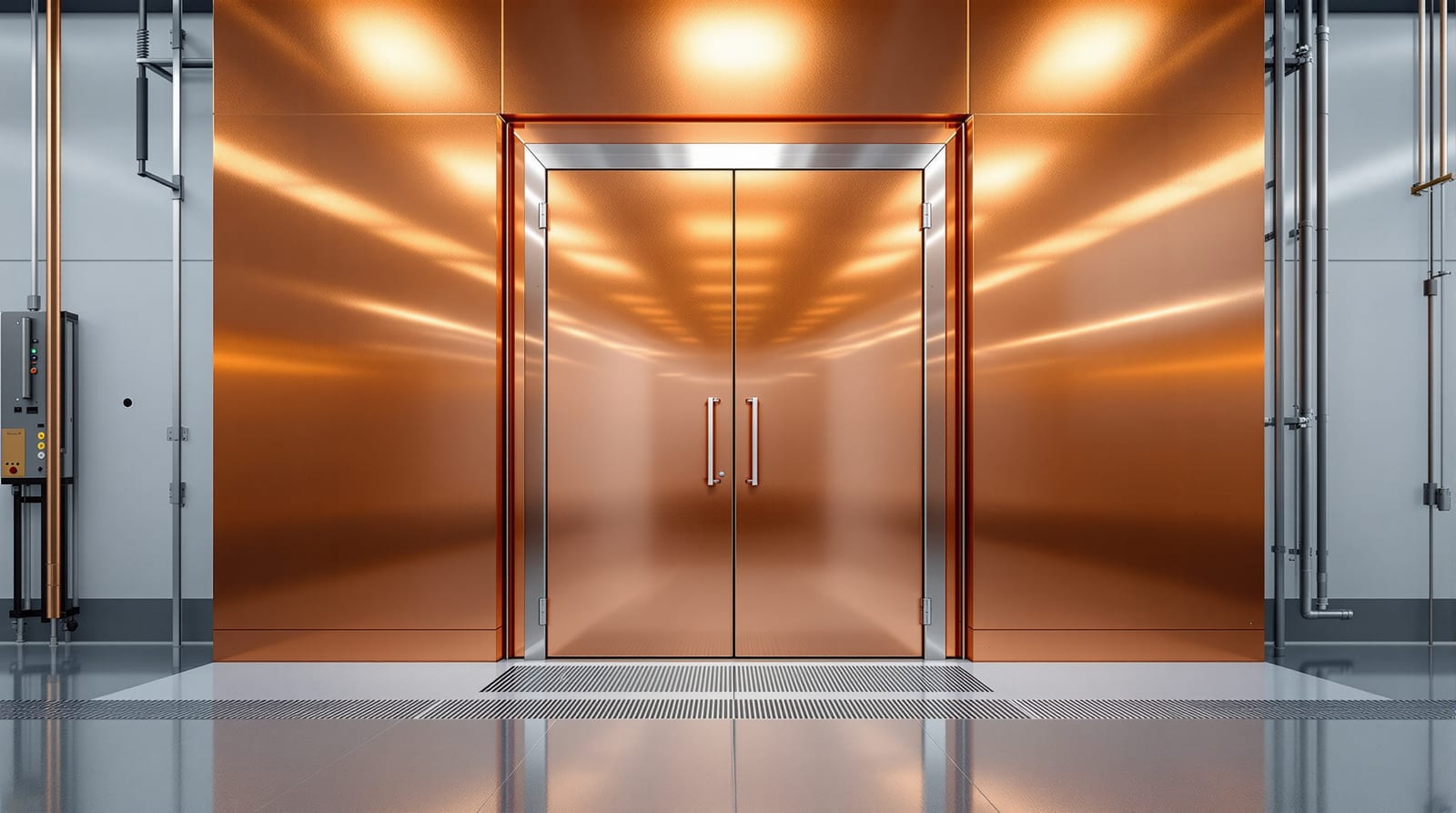
RF Shielded Doors: Faraday EMI Screened-Room Guide India 2026
How copper and galvanised-steel RF doors seal screened rooms, EMC labs, SCIFs and data rooms — dB shielding, gaskets and IEEE 299 testing.
When an electromagnetic field meets a wall, the door is almost always the weak point — and RF shielded doors are the engineered answer for any space that must keep radio-frequency energy out or in. Unlike a lead door, which stops X-ray and gamma photons by mass, an RF (radio-frequency) shielded door works as a continuous conductive membrane: a Faraday surface that reflects and absorbs electromagnetic waves so that emissions cannot leak past the leaf-to-frame joint. You will specify these for EMC (electromagnetic compatibility) test labs, MRI scanner rooms, defence communications and SCIFs (Sensitive Compartmented Information Facilities), TEMPEST-rated areas, secure data rooms, and shielded enclosures around sensitive electronics. This guide explains how RF shielding differs from radiation shielding, how shielding effectiveness is measured in decibels, the gasket and waveguide details that make or break performance, and how the finished room is verified to IEEE Std 299.
RF shielding is not radiation shielding
The single most common specification error is treating an RF door like a lead door. They solve different physics. Radiation-shielded doors — covered in our X-ray room lead doors and radiation shielded doors guides — use the mass of lead (rated in mm Pb equivalence under AERB rules) to attenuate ionising X-ray and gamma photons. An RF door uses electrical continuity: a thin, unbroken layer of high-conductivity metal (copper or galvanised steel) that reflects and absorbs non-ionising electromagnetic waves across a frequency band, rated in decibels of shielding effectiveness (SE).
The practical consequences:
- A 2 mm lead door can be a terrible RF door if its perimeter joint leaks — RF energy escapes through a 1 mm slot the way water escapes a cracked pipe.
- A copper RF door offers almost no X-ray protection — it has negligible mass.
- An MRI room needs both in different measure: heavy RF (copper/Faraday) shielding to keep external radio noise out of the scanner's receive band, and structural/door details addressed in our MRI room doors guide. It does not need lead.
The table below contrasts the two technologies a specifier will most often confuse.
| Attribute | RF/EMI shielded door | Lead radiation door |
|---|---|---|
| Threat blocked | Electromagnetic waves (RF, microwave, EMP) | Ionising X-ray / gamma photons |
| Shielding mechanism | Conductive Faraday surface — reflect + absorb | Mass attenuation by high-Z lead |
| Rated in | Shielding effectiveness, decibels (dB) vs frequency | mm Pb equivalence |
| Critical detail | Continuous perimeter contact (gaskets) | Leaf coverage + glass match, overlap |
| Governing body (India) | EMC/MIL standards, IEEE 299, client security spec | AERB layout approval + RSO sign-off |
| Typical user | EMC lab, SCIF, MRI, secure data room | Radiology, CT, cath lab, NDT |
How shielding effectiveness is rated (the dB scale)
Shielding effectiveness is the ratio, in decibels, of field strength without the shield to field strength with it, measured at a stated frequency. Because RF behaviour changes dramatically with frequency, a credible RF shielded doors specification is never a single number — it is an SE curve across a band, typically from kilohertz magnetic fields up to several gigahertz plane waves.
Remember the logarithm: every 20 dB is a factor of ten in field strength. So 60 dB is 1,000x and 100 dB is 100,000x attenuation. A door that delivers 100 dB at 1 GHz but collapses to 40 dB at 10 kHz (low-frequency magnetic fields are the hardest to shield) may be fine for a data room and useless for a SCIF spec that demands magnetic-field performance.
| Performance tier | Typical SE band | Frequency focus | Common application |
|---|---|---|---|
| Light EMI control | 40-60 dB | 1 MHz - 1 GHz | Secure data room, equipment enclosure |
| EMC test grade | 80-100 dB | 14 kHz - 18 GHz | EMC/EMI test lab, anechoic chamber |
| High-security / TEMPEST | 100-120 dB | 10 kHz - 10 GHz+ | SCIF, defence comms, government |
| MRI screened room | 90-100 dB | 1 - 100 MHz (Larmor band) | MRI scanner suite |
Note that the door must at least match the surrounding shielded envelope; a 100 dB room with an 80 dB door is an 80 dB room. The weakest aperture sets the result.
What makes an RF door perform: the perimeter seal
The leaf is the easy part. Performance lives in the leaf-to-frame contact every time the door closes, across tens of thousands of cycles. Two gasket philosophies dominate.
Finger-stock (beryllium-copper) gaskets
Rows of springy beryllium-copper finger-stock wipe against a mating conductive surface as the door shuts, making hundreds of low-resistance contact points around the perimeter. Finger-stock is forgiving of slight misalignment, gives high SE into the GHz range, and is the workhorse for EMC labs and SCIFs. Its weakness is wear — fingers fatigue and corrode, so they are a scheduled replacement item.
Knife-edge (compression) gaskets
A hardened knife-edge on the leaf bites into a soft conductive gasket (often beryllium-copper mesh or a conductive elastomer) in the frame, compressed by latching. Knife-edge designs give very high, repeatable SE and excellent low-frequency magnetic performance, which is why they appear in the highest-security screened rooms. They demand precise, rigid framing and firm multi-point latching to seat the edge evenly.
Many doors use double rows of gasket and a heavy cam-action or multi-point latch to drive consistent compression. Whichever system is used, the same rule governs everything: electrical continuity must be unbroken from leaf, through gasket, into frame, and onward into the room's shielded skin.
Continuity with the shielded envelope and waveguide vents
An RF door is only as good as its bond to the wall. The frame must be electrically continuous with the room's shielded panels (welded, soldered, or gasketed and screwed at close pitch), with no painted or anodised insulating film breaking the path at the joint. Cabling, water, gas and air all have to cross the boundary without punching an RF hole.
- Air and ventilation crosses through honeycomb waveguide vents — arrays of small conductive tubes whose diameter cuts off the frequencies of concern (a waveguide below its cut-off frequency attenuates strongly). They let air pass while maintaining SE.
- Power and signal lines pass through filtered penetration panels (feed-through capacitors / EMI filters), never as bare wires.
- Pipes use waveguide-below-cutoff sleeves.
The SVG below shows where the energy tries to leak and how each detail closes the path.
Materials, configurations and cost in India
Leaves are built around a high-conductivity skin. Copper gives the best broadband SE (especially at higher frequency) and is favoured for MRI and top-tier EMC work; galvanised steel (zinc-coated) is robust, cheaper, and strong on magnetic-field performance, common in defence and data-room enclosures. Both can be single-leaf hinged, double-leaf, or sliding/automatic for heavy SCIF and MRI doors where the leaf mass and gasket compression make manual operation tiring. Vision panels, where allowed by the security spec, use fine copper mesh or conductive coating laminated in glass so the window keeps the SE band.
These are project-engineered, custom products — there is no off-the-shelf price. Treat the bands below as planning rules of thumb only; the real figure comes from a vendor quoting against your dB spec, opening size, and operation type. GST is 18%, and you must distinguish supply-only from installed (frame bonding to the room skin is skilled work that drives a large share of cost). Lead times typically run weeks because gaskets, vents and filters are made to order.
| Door class | SE target (typical) | Indicative band (₹/door) | Notes |
|---|---|---|---|
| Data-room / equipment EMI | 40-60 dB | 1,50,000 - 4,00,000 | Single leaf, galvanised steel |
| EMC test-lab grade | 80-100 dB | 4,00,000 - 12,00,000 | Finger-stock double seal, copper option |
| MRI screened-room door | 90-100 dB | 3,50,000 - 9,00,000 | Often sliding; matched RF window |
| SCIF / TEMPEST high-security | 100-120 dB | 8,00,000 - 25,00,000+ | Knife-edge, multi-point, client-spec |
Bands are planning estimates, supply-and-install, before site-specific bonding; confirm against a vendor spec. Indian and global suppliers active in this space include ETS-Lindgren-type integrators, Comtest, Hörmann/ASSA ABLOY for the door mechanism, and specialist shielded-enclosure contractors.
Testing and acceptance: IEEE Std 299
A shielded room — door included — is not accepted on a datasheet. It is measured on site to IEEE Std 299 (Standard Method for Measuring the Effectiveness of Electromagnetic Shielding Enclosures). A transmit antenna outside and a receive antenna inside log attenuation across the specified band, with extra scrutiny at known weak points: the door perimeter, gaskets, waveguide vents and penetrations. For MRI suites the OEM also runs its own RF (and field) acceptance criteria before warranty.
Acceptance practicalities the specifier should write into the contract:
- Specify the frequency points and minimum dB at each, not just a headline number.
- Require the door tested in its installed, latched condition, including the vision panel and any vents.
- Include gasket inspection and re-test cadence — finger-stock wears, and SE degrades silently long before the door looks worn.
- Keep the door's SE at or above the room rating; for ongoing facilities, fold gasket checks into the maintenance plan, much as you would for fire doors in our fire door maintenance and inspection guide.
For the wider engineered-door picture, see the cluster's specialty doors overview and the master complete door guide; for the secure-facility neighbours, our data centre door and server room door guides cover the surrounding envelope, while vault and strongroom doors address the physical-security layer that often shares the same room.
To sanity-check budget against your dB target and opening before you brief a vendor, our specialty door cost estimator and specialty door selector give a quick first-pass figure — then engineer the real specification with a shielded-enclosure consultant.
Frequently asked questions
Does an RF shielded door also stop X-rays?
No. RF/EMI doors block electromagnetic waves using a continuous conductive Faraday surface, rated in dB of shielding effectiveness. They have negligible mass, so they offer essentially no protection against ionising X-ray or gamma radiation. For that you need a lead door specified in mm Pb equivalence under AERB rules — a separate product entirely.
Why is the gasket so important?
Because RF energy escapes through any break in electrical continuity, even a sub-millimetre gap at the leaf-to-frame joint can drop a 100 dB door to a fraction of its rating. Finger-stock (beryllium-copper) and knife-edge compression gaskets maintain hundreds of low-resistance contact points so the Faraday surface stays unbroken every time the door closes.
How is shielding effectiveness measured?
In decibels across a frequency band — every 20 dB is a 10x reduction in field strength. A credible spec states minimum dB at multiple frequencies (low-frequency magnetic fields are hardest to shield), and the finished room is verified on site to IEEE Std 299 with transmit and receive antennas, scrutinising the door and its vents.
Can ventilation cross a shielded door?
Yes, through honeycomb waveguide vents — arrays of small conductive tubes that let air pass while attenuating RF below a cut-off frequency. Power and signal lines cross through EMI-filtered penetration panels, never as bare wires. All of these must bond electrically to the room's shielded skin.
What does an RF shielded door cost in India?
There is no standard price — these are custom, project-engineered products. As a planning rule of thumb, expect roughly ₹1,50,000-4,00,000 for a data-room EMI door, ₹4,00,000-12,00,000 for EMC test-lab grade, and ₹8,00,000-25,00,000+ for SCIF/TEMPEST high-security doors, plus 18% GST. Distinguish supply-only from installed, and get a vendor spec against your dB target.
Does an MRI room use RF or lead shielding?
RF (copper/Faraday) shielding, not lead. The Faraday enclosure keeps external radio noise out of the scanner's sensitive receive band. The door must match the room's RF rating; lead is not required for MRI. See our MRI room doors guide for the specific door-engineering details.
Export this guide
Related Guides — Deep-dive reading
MRI Room Doors in India 2026: RF-Shielded & Non-Magnetic
Why MRI suite doors must be copper-Faraday RF-shielded yet wholly non-ferromagnetic — and how that differs from lead X-ray doors.
Home Doors & EntrancesRadiation-Shielded Doors in India: Lead-Lined Guide 2026
How lead thickness, AERB approval and vision panels are engineered for X-ray, CT, cath-lab and radiotherapy doors.
Home Doors & EntrancesRecording Studio Door in India: Sound-Lock Airlock, STC/Rw Ratings and Costs (2026)
The highest acoustic-isolation door in any building - a very heavy lead-loaded or solid acoustic leaf with full perimeter gaskets, an automatic drop seal, a multi-pane vision window and, for true isolation, the double-door sound-lock with a dead-air vestibule.
Home Doors & EntrancesRelated Tools — Try Free
Window Cleaning Cost Calculator
Estimate professional window cleaning cost per visit and per year by access and frequency.
Window CalculatorInterior Budget Planner
Live room-wise and component-wise cost breakdown in ₹ with contingency, GST, and PDF summary.
Budget CalculatorSecurity System Cost Estimator
Estimate the all-in capex with GST, annual running cost and 5-year total cost of ownership of a home or building security system.
Cost Estimator