
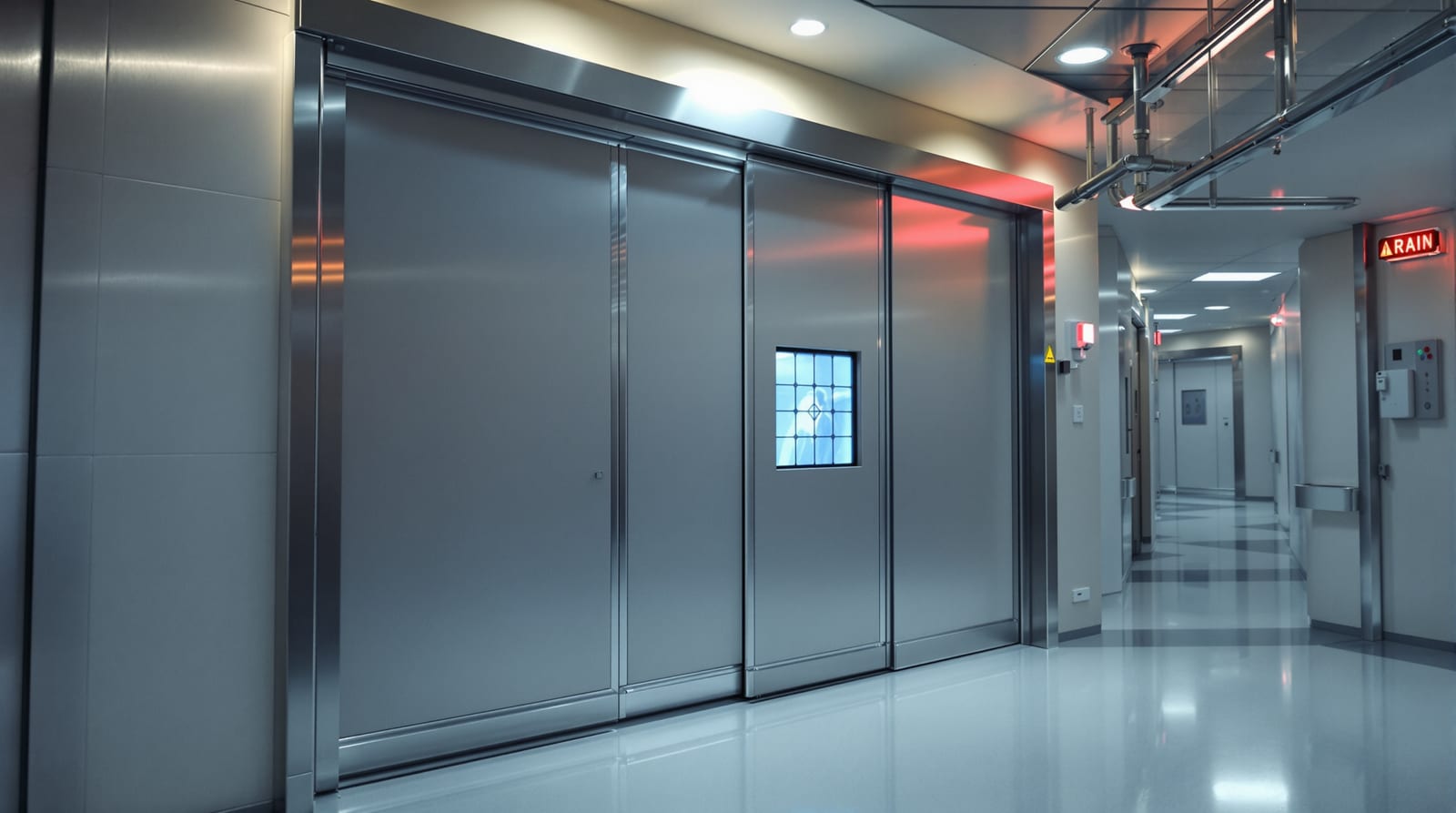
Radiation-Shielded Doors in India: Lead-Lined Guide 2026
How lead thickness, AERB approval and vision panels are engineered for X-ray, CT, cath-lab and radiotherapy doors.
Radiation-shielded doors are the moving weak point in an otherwise solid shielding envelope: every X-ray room, CT suite, cath lab, mammography unit and radiotherapy bunker has walls of barytes plaster or poured concrete, but the door is where staff and the public actually pass through. In India these doors are not an off-the-shelf product — they are project-engineered to a shielding calculation, installed only after Atomic Energy Regulatory Board (AERB) layout approval, and signed off in practice by a Radiological Safety Officer (RSO). This guide explains how lead thickness is derived, what an assembly must include, sliding versus hinged choices, and realistic Indian cost bands. It sits within the specialty doors family and the cluster complete door guide.
Why radiation-shielded doors are regulated, not just specified
Unlike a fire or acoustic door, a lead-lined door is part of a licensed radiation installation. You cannot simply order "a 2 mm lead door" — the leaf, frame, vision panel and surrounding wall must form a continuous barrier that attenuates radiation to a dose the regulator accepts. In India the controlling authority is the AERB, which reviews the room layout (the shielding plan) before construction and issues approval through its eLORA portal. A qualified RSO or an AERB-recognised shielding consultant prepares the calculation; the hospital cannot self-certify the door thickness.
The practical consequence: the door's lead equivalence is an output of a calculation, not a catalogue choice. If you under-spec, you fail commissioning; if you over-spec, you pay for unusable mass and a heavier, costlier operator. Treat the door spec as a deliverable from the shielding report, exactly as you would treat a fire-door rating as a deliverable from the fire-door ratings assembly logic.
How lead thickness (mm Pb) is derived
The shielding requirement for a diagnostic room is computed for each barrier — including the door — from four variables, broadly following NCRP Report 147 methodology as adopted in AERB practice:
- kVp (tube potential): higher peak kilovoltage produces more penetrating photons, demanding more lead. A 70 kVp dental unit needs far less than a 125 kVp CT or a 150 kVp general radiography room.
- Workload (W): total tube output per week (mA-min/week), reflecting how busy the room is.
- Occupancy factor (T): how continuously the area on the far side of the door is occupied — a corridor (T≈1/8 to 1/5) needs less than an adjacent control room or office (T=1).
- Distance (d): metres from the X-ray source to the occupied point beyond the door; attenuation falls with the inverse square of distance.
From these, the consultant calculates the barrier transmission needed to bring weekly dose below the design limit (typically 0.3 mGy/week for controlled areas and 0.02 mGy/week for uncontrolled public areas), then reads the required mm Pb equivalence off transmission curves for that kVp. The door's lead must equal or exceed the wall it interrupts, with overlap at edges so radiation cannot leak around the leaf.
Typical lead equivalence by room type
These are indicative ranges only — your value comes from the room-specific calculation, never from this table.
| Room / modality | Typical kVp | Indicative door lead equivalence |
|---|---|---|
| Dental / OPG | 60-70 | 0.5-1.0 mm Pb |
| General radiography (X-ray) | 100-150 | 1.5-2.0 mm Pb |
| Mammography | 25-49 | ~0.5-1.0 mm Pb (low kVp, soft beam) |
| CT scan | 120-140 | 2.0-3.0 mm Pb |
| Cardiac cath lab / interventional | 70-125 (high workload) | 2.0-3.0 mm Pb |
| Radiotherapy (linac bunker) | MV-range | Concrete/steel maze + heavy shielded door (lead/steel laminate, often tonnes) |
Note the radiotherapy outlier: megavoltage rooms are shielded by concrete mazes, and the "door" is a massive motorised steel-and-lead slab on a track — a different engineering problem from diagnostic lead-lined doors. For megavoltage suites the bunker design dominates and the door follows the maze geometry. For everything diagnostic, the lead-lined door covered here is the norm, and it routes directly to X-ray room lead doors.
You can sanity-check the order of magnitude with the radiation shielding lead calculator, but the binding number is always the RSO's report.
What a shielded-door assembly actually contains
A compliant lead-lined door is a system, much like a fire door — mixing components voids the protection:
The shielding stack
- Lead sheet bonded into the leaf: continuous lead, lapped at all joints, sandwiched between steel or steel-faced ply skins. No fixings may pierce the lead without a backing patch.
- Lead glass vision panel: an optically clear lead glass (or lead acrylic) lite whose lead equivalence matches the leaf. A 2 mm Pb door needs a 2 mm Pb-equivalent panel; an under-rated panel is a hole in the barrier.
- Lead-lined frame and overlap: the frame carries its own lead and the leaf overlaps it (rebate or astragal) so there is no straight-line gap for photons. The threshold and head are detailed the same way.
- Hardware and seals: handles, locks and any louvres are avoided or specially detailed; cabling and conduits entering the room are routed to avoid creating a shine path.
Because every penetration is a potential leak, shielded doors are commissioned with a radiation survey (Geiger/ion-chamber sweep around the closed door) before the room is licensed.
Sliding vs hinged shielded doors
Lead is heavy — roughly 11.3 g/cm³ — so a clear-opening diagnostic door can weigh well over 100 kg even at 2 mm Pb. That weight drives the operating choice:
| Factor | Hinged (swing) | Sliding (manual or motorised) |
|---|---|---|
| Typical use | Smaller dental/X-ray openings | CT, cath lab, wide stretcher/trolley openings |
| Weight handling | Heavy-duty hinges; door can sag over time | Track carries load; easier on a heavy leaf |
| Floor space | Needs swing clearance | No swing; suits tight corridors |
| Throughput | Slower for trolleys | Fast, can be automatic with sensors |
| Cost | Lower | Higher (operator, track, edge seals) |
| Edge shielding | Rebated overlap | Generous overlap + end stops to kill the gap |
For wide, high-traffic modalities (CT, interventional), motorised sliding leaf is common, often paired with a wall-mounted warning light and interlock so the door state and the beam-on status are linked — comparable in spirit to the interlocked airlocks used in pharma cleanroom doors. For low-throughput dental and small X-ray rooms, a hinged lead-lined door is usually adequate and cheaper.
Interlocks, warning lights and the RSO's role
AERB practice expects a "radiation on" warning light at the entrance and, for higher-energy or interventional rooms, door interlocks that prevent or signal beam exposure when the door is open. The RSO defines what is required for the specific installation, supervises the commissioning survey, maintains the radiation safety programme and is the named person accountable to AERB. The architect and door vendor must coordinate the door's electricals (light, interlock, indicator) with the modality supplier. For the hospital-wide door context this sits alongside operation theatre door and hospital doors planning.
Cost bands (India 2026)
Lead-lined doors are custom, lead-time products; prices are project-engineered and quoted against the shielding spec. GST on doors is 18%. Use these as planning bands, supply-only unless noted:
| Door type | Indicative price band | Notes |
|---|---|---|
| Dental / small X-ray, hinged, ~1 mm Pb | ₹40,000-70,000 | Smallest openings, single lite |
| General X-ray room, hinged, 1.5-2 mm Pb | ₹60,000-1,10,000 | With matched lead glass panel |
| CT / cath lab, motorised sliding, 2-3 mm Pb | ₹1,20,000-2,50,000+ | Operator, interlock, warning light extra |
| Lead glass vision panel (per lite) | ₹15,000-60,000+ | Scales with size and mm Pb |
| Radiotherapy bunker door | Project-specific (lakhs) | Heavy motorised slab; maze-dependent |
Add installation, electricals (interlock/warning light), the shielding consultant's fee and the commissioning survey. Always confirm the final figure with a vendor against the AERB-approved layout. For a cluster-wide view of how this compares to other engineered doors, see specialty door cost, and budget the lead glass with the radiation shielding lead calculator.
Related and adjacent door types
Shielded doors are part of a broader healthcare and protection door set. MRI rooms are a common point of confusion: they need RF (copper/Faraday) shielding, not lead, because the hazard is electromagnetic, not ionising — see MRI room doors and the wider RF-shielded doors. For the detailed X-ray case, route to X-ray room lead doors.
Frequently asked questions
How is the lead thickness for a shielded door decided?
A shielding consultant or RSO calculates it from kVp, weekly workload, occupancy of the area beyond the door and the source-to-occupant distance, following NCRP/AERB methodology, then reads the required mm Pb equivalence off transmission curves. The door must match or exceed the wall it interrupts. Never pick the thickness from a catalogue.
Do I need AERB approval before installing a lead-lined door?
Yes. AERB approves the room layout (shielding plan) before construction, and the installation is licensed only after a commissioning radiation survey. An RSO is responsible for the safety programme and sign-off. The door is one component of that approved barrier.
Will a lead door work for an MRI room?
No. MRI hazards are radiofrequency and magnetic, not ionising radiation, so MRI suites need copper RF (Faraday) shielding and an RF-shielded door, not lead. Using a lead door there solves nothing — see the MRI and RF-shielded door guides.
Should the door be sliding or hinged?
Weight and throughput decide. Small dental and X-ray rooms usually take a hinged lead-lined door; CT, cath lab and other wide, busy openings favour motorised sliding leaves that handle the heavy lead and pass trolleys quickly, often with an interlock and warning light.
Why does the vision panel matter so much?
The lead glass lite must have the same lead equivalence as the leaf. An under-rated or mismatched panel is effectively a hole in the shielding and will fail the commissioning survey. Specify the panel's mm Pb to match the door, not just "lead glass".
Are these prices fixed?
No. Shielded doors are custom, project-engineered products with lead times; the bands here are for planning only. Get a vendor quotation against the AERB-approved shielding spec, and remember supply-only prices exclude installation, electricals, consultant fees and the survey.
Export this guide
Related Guides — Deep-dive reading
AERB Compliance for Radiology & Imaging Rooms: Architect's Working Reference
Atomic Energy Regulatory Board Codes for Diagnostic Radiology, Mammography, CT, Cathlab, MRI, Nuclear Medicine, and Radiotherapy — Barrier Calculation Principles, Lead-Equivalent Specification, Door & Viewing Window Design, RSO Appointment, Layout Approval Process, and Per-Room Architectural Detail
Healthcare ArchitectureX-Ray Room Lead Doors: AERB Specs & Cost (India 2026)
How to specify lead-lined doors for diagnostic X-ray and CT rooms in India — Pb thickness, AERB sign-off, lead glass windows, interlocks and cost.
Home Doors & EntrancesSoundproof Doors in India: How Doors Leak Sound, STC Ratings, Seals & Real Costs
A door is the weakest acoustic link in any wall - and it usually leaks through the gaps, not the panel - so here is how to actually quieten a bedroom, home theatre or street-facing room, from a 1,500-rupee seal kit to a proper acoustic door.
Home Doors & EntrancesRelated Tools — Try Free
Acoustic Privacy (STC) Visualizer
Indian healthcare acoustic visualizer — compare wall assemblies and noise sources, see received SPL after STC attenuation, and check FGI 2018 / IS 1950 / NABH speech-privacy compliance with live dual-canvas waveform.
Acoustic ToolWindow Hardware Cost Calculator
Estimate window hardware cost — hinges, handles, locks, rollers and multipoint gears.
Window CalculatorBrise-Soleil Visualizer
Interactive horizontal-louvre cut-off angle calculator — sun altitude, louvre depth, and spacing inputs with a live shadow preview. Computes θ = arctan(spacing/depth) for façade shading, ECBC envelope compliance, hospital daylight design, and tropical sun-control detailing.
Sun Shading Tool