
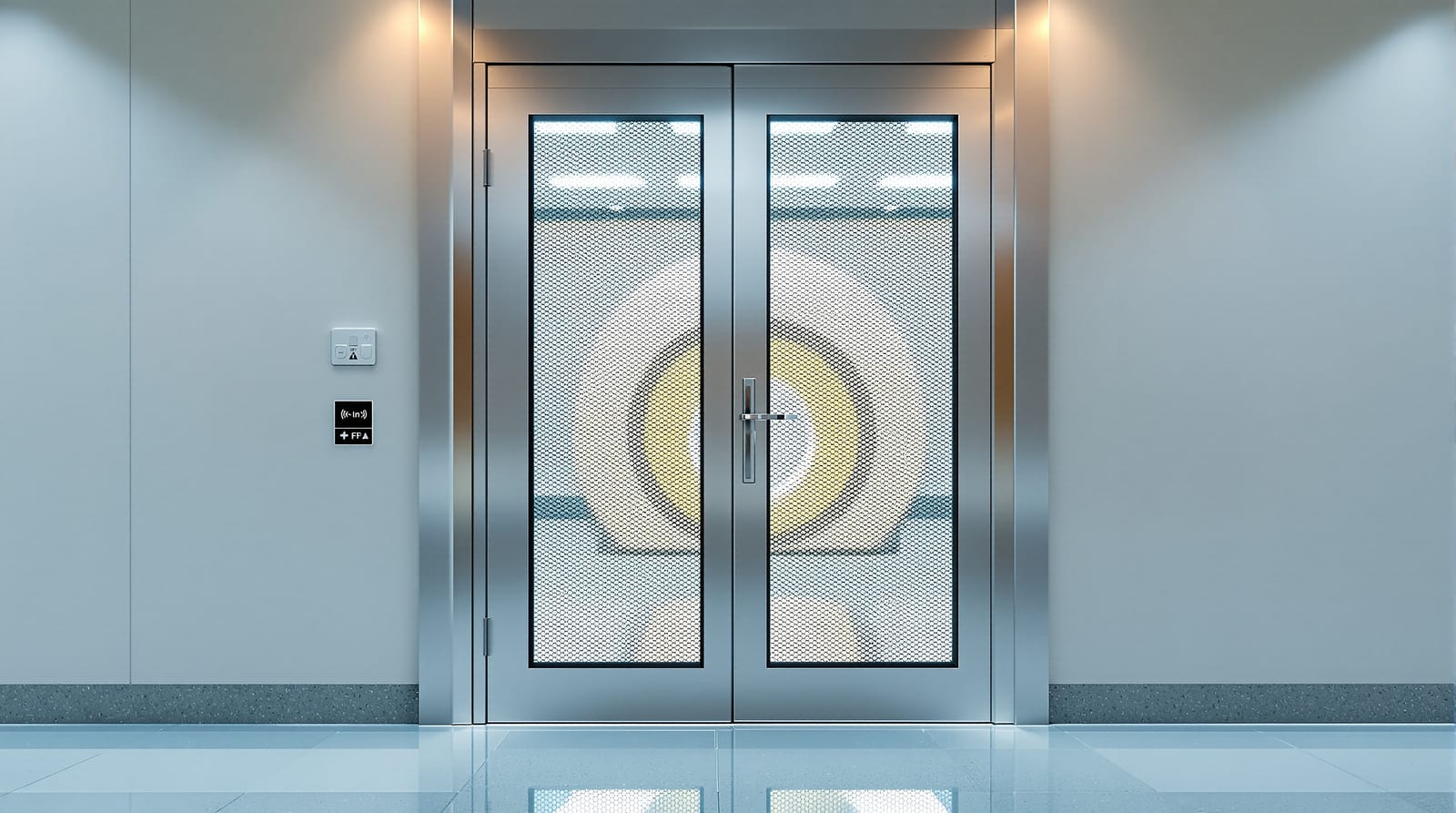
MRI Room Doors in India 2026: RF-Shielded & Non-Magnetic
Why MRI suite doors must be copper-Faraday RF-shielded yet wholly non-ferromagnetic — and how that differs from lead X-ray doors.
An MRI room door has to perform a contradiction that no other opening in a building faces. It must be the tight, conductive lid on a copper Faraday cage — sealing the scanner room against stray radio-frequency (RF) energy — while at the same time containing almost no ferromagnetic steel, because the magnet's static field will turn an ordinary steel door leaf into a projectile or a service nightmare. MRI room doors are therefore RF-shielded and non-magnetic, and that dual brief makes them a distinct specialty product, engineered project by project against the scanner OEM's site-planning manual rather than off a catalogue. Unlike the lead doors next door in the X-ray suite, there is no ionising radiation here, so the Atomic Energy Regulatory Board (AERB) is not the licensing authority — the drivers are magnet safety and RF integrity.
This Studio Matrx guide is written for architects, hospital project managers and shielding specifiers in India. For the wider family of protective openings see the cluster complete door guide and the specialty doors overview; for the closely related but fundamentally different lead-lined route, read x-ray room lead doors.
Why MRI room doors do two jobs: RF integrity vs magnet safety
MRI imaging works by exciting hydrogen nuclei with precisely tuned RF pulses (around 64 MHz at 1.5T, ~128 MHz at 3T) inside a very strong, very stable static magnetic field. Both halves of that sentence dictate the door.
RF integrity. The faint signal coming back from the patient is millions of times weaker than the RF noise floor of a normal hospital — pagers, lifts, mobile phones, switching power supplies. To get a clean image the entire scan room is built as a Faraday cage: continuous copper (occasionally galvanised steel or aluminium) sheet on walls, floor and ceiling, all joints soldered or clamped, every penetration filtered. The door is the one large, moving seam in that cage. It must restore electrical continuity every time it closes, typically to an attenuation of 90–100 dB or more across the relevant band. That is the whole reason the door exists in this form.
Magnet safety. The superconducting magnet is always on, even when the scanner is "off". Its field decays with distance but a swinging steel door, hinges, lock or even the wrong screw becomes a hazard inside the inner fringe field. So the leaf, frame, hardware and vision-panel mesh must be non-ferromagnetic — aluminium, copper, brass, austenitic (300-series) stainless, or non-metallic. This is the opposite constraint to a blast or vault door, which is all about mass and steel.
These demands pull in different directions, and reconciling them is the engineering of the door.
Anatomy of an RF-shielded, non-magnetic MRI door
| Element | What it does | Typical material / detail |
|---|---|---|
| Leaf shield | Carries RF continuity across the opening | Copper sheet bonded to a non-magnetic core (aluminium honeycomb / phenolic), faced for hygiene |
| Frame / jamb | Bonded to the cage; receives the contact strips | Copper or copper-clad, electrically welded into the room shield |
| RF contact fingers | Make the moving seal — the critical part | Beryllium-copper finger-stock ("knife-edge") on 2–4 edges; some use spring-pressure plus a sweep |
| Closer & seal pressure | Forces consistent contact every close | Hydraulic/pneumatic non-magnetic closer; some powered sliding |
| Vision window | Lets staff see the patient | Laminated glass with fine copper/bronze RF mesh (~100+ wires/inch) bonded to the cage |
| Hardware | Latch, hinge, handle | Brass / austenitic SS / aluminium — no ferrous parts near the magnet |
| Waveguide / penetrations | Pass air, gases, cables without leaking RF | Honeycomb waveguide vents and filtered penetration panels (see below) |
The knife-edge finger-stock is where most of the dB are won or lost. As the leaf closes, a continuous strip of springy beryllium-copper fingers wipes against the mating surface, bridging the gap with hundreds of fresh metal-to-metal contacts. It is consumable: bent, corroded or dirty fingers leak RF, which is why MRI door maintenance is mostly about contact-strip condition and closing force.
The waveguide and penetration panel
No cage is solid. Air, medical gases, chilled water, fibre and the magnet's quench pipe all cross the shield — and at RF, a simple hole is an antenna. So the room uses a honeycomb waveguide (a dense array of small tubes, long relative to their width, that attenuate RF "below cutoff") for airflow, and a filtered penetration panel for electrical and signal lines. These must be coordinated with the door so the whole envelope hits its dB target; a perfect door in a leaky penetration panel is wasted money.
The 5-gauss line and how it shapes the door
The magnet's fringe field is mapped in gauss (1 mT = 10 G). The 5-gauss line is the safety contour beyond which the field is considered safe for the general public and for most cardiac pacemakers of older design; inside it, access is controlled. The scanner OEM's site plan shows this contour, and it usually constrains room layout so the door — and anyone passing through it — sits at a managed field level.
Where the door falls relative to that contour decides where ferrous items can be tolerated. A door opening into Zone IV (the scan room) is fully inside the controlled fringe field; its hinges and closer must be certified non-magnetic. Specifiers normally keep the entire assembly non-ferrous regardless, to avoid mistakes during install and AMC.
Door interlocks: the magnet, the quench and access control
MRI doors are routinely wired into a small safety logic that has no parallel in a lead X-ray door.
- Access / RF interlock: the scan console can be inhibited (or warned) if the door is open, because an open door breaks the Faraday seal and floods the image with noise. The interlock protects image quality and helps enforce zone control.
- Quench / pressure relief: a superconducting magnet can quench — lose superconductivity and boil off its liquid-helium cryogen as a large, fast volume of cold gas. The room is fitted with a dedicated quench vent, but the door is part of the pressure-relief story: if the vent under-performs and room pressure rises, an inward-opening door can be forced shut and trap staff. Site planning therefore favours doors that can still be opened during a quench (outward swing or specified relief), and some suites add a pressure-equalisation louvre or panic release. This must follow the scanner OEM site-planning manual and the shielding vendor's design.
- Oxygen / patient-monitoring tie-ins: many suites link the door logic to room oxygen monitors (helium displaces O2 in a quench) and to the magnet-stop / emergency-rundown unit location, so the door, the O2 alarm and the emergency controls form one coherent safety set.
None of this is AERB-driven. It is magnet and life-safety engineering, coordinated between the hospital, the MRI OEM and the RF-shielding contractor.
Why MRI doors are NOT lead X-ray doors
The two doors sit metres apart in a diagnostic-imaging block and are constantly confused on drawings. They are opposites.
| Aspect | MRI room door | Lead-lined X-ray door |
|---|---|---|
| Hazard controlled | RF noise in + magnet safety | Ionising X-radiation out |
| Regulator | MRI OEM site plan; magnet/RF safety, hospital | AERB layout approval + RSO sign-off |
| Shielding material | Copper / aluminium (conductive, non-magnetic) | Lead (1–3 mm Pb equivalence, ferrous frame OK) |
| Steel content | Must avoid ferromagnetic steel near magnet | Steel frame/leaf perfectly fine |
| Seal logic | Knife-edge RF finger-stock, electrical continuity | Lead overlap / baffle, no electrical seal needed |
| Vision panel | Laminated glass + copper RF mesh | Lead glass matched to Pb equivalence |
| Performance metric | Attenuation in dB | Pb equivalence in mm vs kVp/workload |
| Sized by | RF spec + fringe-field zone | NCRP/AERB shielding calc by RSO |
Put simply: the X-ray door keeps radiation in; the MRI door keeps RF out while keeping iron away. A lead door inside an MRI room would be a hazard — the lead is harmless, but its steel frame and ferrous hardware are not, and lead does nothing for RF. For the lead route see x-ray room lead doors and radiation shielded doors; for the broader RF family see rf shielded doors. MRI doors also share DNA with other ultra-controlled openings such as the hermetic doors used in operation theatres and the airtight sets in data centre builds, but the magnet constraint is unique.
Cost, lead time and procurement in India
MRI doors are never bought alone — they are part of an RF shielding package (cage, penetration panel, waveguides, filters, door) supplied and certified by a shielding contractor against the OEM's manual. Treat the figures below as supply-and-install bands for the door element; final pricing comes from a vendor spec.
| Item | Indicative band (₹) | Notes |
|---|---|---|
| RF-shielded swing MRI door (1.5T suite) | 3,50,000 – 8,00,000 | Copper leaf, finger-stock, RF vision panel; supply + install in package |
| Powered / automatic RF door (3T, heavy use) | 8,00,000 – 18,00,000+ | Non-magnetic operator, interlocks, larger panel |
| RF vision window (separate / oversize) | 60,000 – 2,50,000 | Mesh + laminated glass, sized to view |
| Honeycomb waveguide vent / penetration coordination | quoted in package | Part of cage scope, not stand-alone |
| Whole-room RF cage + door + filters (1.5T) | 25,00,000 – 60,00,000+ | Indicative shell figure; varies hugely by room and OEM |
GST on doors and shielding works is 18%. Lead times run several weeks to a few months because leaves, finger-stock and meshes are made to order and the cage is commissioned and dB-tested on site before handover. As a rule of thumb, budget for a post-install shielding-effectiveness test and a periodic re-test as part of AMC, since finger-stock wear and a sagging closer silently erode attenuation.
For early budgeting use the specialty door cost estimator and narrow the product with the specialty door selector; both are planning aids, not a substitute for a vendor quote. Indian and global names active in RF/medical shielding and specialty doors — quoted generically — include ASSA ABLOY, GMP Technical, Envirotech and other dedicated MRI-shielding contractors; always procure against the scanner OEM's current site-planning manual.
Specification checklist for designers
- Get the scanner OEM site-planning manual first; field strength (1.5T vs 3T) and the 5-gauss contour drive everything.
- Confirm the target attenuation (dB) and that the door, vision panel, waveguides and penetration panel are one coordinated package.
- Specify fully non-ferromagnetic leaf, frame, hardware and mesh; call it out explicitly on the door schedule.
- Decide door swing/operation and quench behaviour with the OEM — escape must remain possible during a quench.
- Require a factory + on-site dB test and write contact-strip inspection into the AMC.
- Coordinate interlocks (RF/console, O2 alarm, magnet-stop location) with the hospital's MRI safety officer.
Frequently asked questions
Does an MRI room door need AERB approval like an X-ray door?
No. MRI uses no ionising radiation, so AERB layout approval and RSO sign-off — mandatory for X-ray and CT suites — do not apply to the door. The governing references are the scanner OEM's site-planning manual plus magnet-safety and RF-integrity requirements, coordinated with the hospital and the shielding contractor.
Why can't I use a normal steel or lead-lined door in the MRI room?
Because the magnet is always energised. Ferromagnetic steel inside the fringe field is a projectile and a service hazard, and steel hardware can be ripped toward the bore. Lead itself is not magnetic, but lead doors come with steel frames and ferrous fittings, and lead provides zero RF shielding. MRI doors are copper/aluminium and entirely non-ferromagnetic.
What does the vision window look like and why the mesh?
It is laminated safety glass with a very fine copper or bronze RF mesh bonded into the cage. The mesh is what blocks RF passing through the glass; without it the window would be a large hole in the Faraday cage. The mesh is fine enough to see through clearly while staying electrically continuous with the door and room shield.
What happens to the door during a magnet quench?
A quench dumps cold helium gas fast and can raise room pressure. The room's quench vent handles most of this, but the door is part of pressure relief: it should remain openable so staff can escape. That is why suites often use outward-swinging or pressure-relieving doors and tie the door logic to room oxygen monitoring, all per the OEM site plan.
How is MRI door performance measured and maintained?
By RF attenuation in decibels (often 90–100+ dB) across the scanner's frequency band, verified by an on-site shielding-effectiveness test at handover. Maintenance centres on the beryllium-copper finger-stock and closing force — worn or dirty contacts leak RF — so contact-strip inspection and periodic re-testing belong in the AMC.
Are MRI doors a standard product I can order from a catalogue?
No. They are project-engineered as part of an RF shielding package, made to order against the specific scanner, field strength, room geometry and the 5-gauss contour. Final specification and price always come from a qualified shielding vendor working to the OEM's manual — budget bands here are for planning only.
Export this guide
Related Guides — Deep-dive reading
Radiation-Shielded Doors in India: Lead-Lined Guide 2026
How lead thickness, AERB approval and vision panels are engineered for X-ray, CT, cath-lab and radiotherapy doors.
Home Doors & EntrancesAccess Control Maintenance in India (2026): Readers, Locks and Fail-Safe Egress
How to keep a card, keypad, fingerprint or face access-control system reading reliably and locking securely — and, above everything, how to test that its doors still release on a fire alarm and on power loss, so an access-controlled door never becomes a life-safety trap.
SecurityRF Shielded Doors: Faraday EMI Screened-Room Guide India 2026
How copper and galvanised-steel RF doors seal screened rooms, EMC labs, SCIFs and data rooms — dB shielding, gaskets and IEEE 299 testing.
Home Doors & EntrancesRelated Tools — Try Free
Window Hardware Cost Calculator
Estimate window hardware cost — hinges, handles, locks, rollers and multipoint gears.
Window CalculatorWindow Cleaning Cost Calculator
Estimate professional window cleaning cost per visit and per year by access and frequency.
Window CalculatorAcoustic Privacy (STC) Visualizer
Indian healthcare acoustic visualizer — compare wall assemblies and noise sources, see received SPL after STC attenuation, and check FGI 2018 / IS 1950 / NABH speech-privacy compliance with live dual-canvas waveform.
Acoustic Tool