
Resident Security Awareness and Watch in India (2026): Alert Neighbours, Not Vigilantes
How residents of an Indian society or gated community become their community's biggest security asset — as alert, considerate neighbours who notice and report through proper channels, run a fair and inclusive watch, use the community group calmly and lawfully, and never confront, chase, profile or shame anyone.
The single biggest security asset a housing society or gated community has is not a camera or a boom barrier — it is a few hundred residents who know their neighbours, notice when something is off, and report it calmly to the people trained to act. Technology and guards do a lot, but they cannot be everywhere, and they change with contracts. Residents are the standing "eyes and ears" of the place. The whole point of this guide is to turn that instinct into something useful and fair: an alert neighbour who notices and reports, and never a vigilante who confronts, chases, profiles or shames.
That distinction matters more than anything else here. A resident who spots something wrong and quietly tells the guard, the committee or the police has done exactly the right thing. A resident who blocks someone at the gate, corners a delivery rider, forwards a rumour to five groups, or posts a stranger's photo "to warn everyone" has made the community less safe and possibly broken the law. This guide sits alongside the society's shared measures — the security setup for a gated community run by the housing society security committee, grounded in a fair and lawful approach to community security and a clear-eyed neighbourhood risk assessment. This page is the resident's own part of that: awareness, habits and how to report well.
Scope & how to read this. This is educational guidance for residents and committees on awareness, a fair watch programme and good reporting — not legal advice, and nothing here authorises any resident to detain, investigate, confront or publicly name anyone. Confrontation, chasing, "citizen justice" and posting people's images are for professionals and the police, not neighbours. Verify local rules with your society's legal advisor and the police, and route anything serious to them.
The eyes-and-ears principle: notice, then report
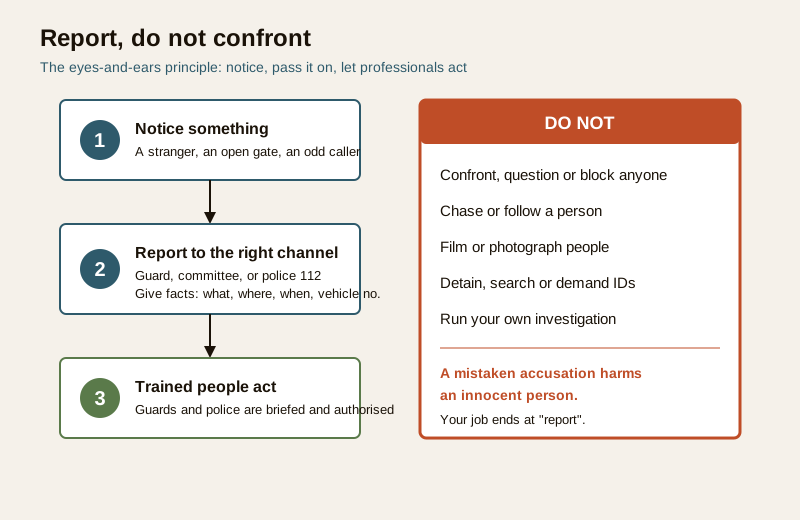
An alert resident is valuable precisely because they know what "normal" looks like on their floor, their lane or their gate — and can quietly flag what isn't. The skill is not catching anyone; it is noticing and passing it on. The chain is simple: notice something -> report to the guard, the committee or the police through the proper channel -> let the trained people act. The resident's job ends at "report".
What "report, do not confront" actually means
- Do tell the gate guard, the committee point of contact or, for anything that looks like a crime or an emergency, the police (dial 112).
- Do give facts — what, where, when, how many, any vehicle number — calmly and once, to the right person.
- Do not confront, question, block, chase or detain anyone. You are not trained for it, it can turn dangerous fast, and a mistaken accusation against an innocent visitor or worker is a serious harm.
- Do not appoint yourself investigator, take "statements", search bags or demand IDs from people going about their work.
A resident who confronts turns a manageable situation into a risky one — for themselves, for bystanders and for a person who may well be entirely innocent. The guard is on duty, insured and briefed; the police have the authority. Your alert, given early and accurately, is worth more than any heroics.
Who you report what to
| Situation | Report to | How | What NOT to do |
|---|---|---|---|
| Crime in progress, injury, fire, immediate danger | Police / emergency | Dial 112 (police), 101 (fire), 108 (ambulance); then tell the guard | Do not confront, enter or "handle it" yourself |
| A stranger loitering, an unverified "serviceman", a propped-open gate | Gate guard / security supervisor | In person or the guard's number; give a calm description | Do not follow, film or question the person |
| A pattern (repeated tailgating, a broken camera, a dark stairwell) | Managing committee | Committee email / register, or raise at the meeting | Do not start a "campaign" in the group |
| A dispute with a neighbour, worker or vendor | Committee / appropriate forum; police only if a crime | Proper channel, in writing where useful | Do not shame anyone publicly or online |
| Something you are unsure about | Guard first; they escalate | Ask the guard to note and watch | Do not post "is anyone else seeing this?" panic |
A neighbourhood watch that is fair, simple and coordinated
"Neighbourhood watch" in the Indian context is best understood as organised neighbourliness, coordinated with the guards and the committee — not a uniformed patrol and definitely not a posse. Done well it is inclusive, low-effort and builds the one thing cameras cannot: neighbours who recognise each other and look out for one another.
What a good programme looks like
- Coordinated, not freelance. It runs under the committee and alongside the professional guards, so residents and guards reinforce each other instead of tripping over each other. The security committee owns it.
- Inclusive by design. Every block, every tower, tenants as much as owners, new residents as much as old — a watch that quietly excludes tenants, "bachelors" or particular communities is not a watch, it is discrimination, and it is both wrong and unlawful.
- Awareness, not authority. The programme gives residents information (who to call, what to look for, how to report) and simple habits. It gives them no power to stop, question or detain anyone — that stays with the guards and the police.
- Light and sustainable. A short orientation for new residents, a floor or block contact, a quarterly reminder and a calm group. Elaborate rosters and "night patrols" by residents usually fade, and can be dangerous; leave patrolling to the paid, trained guards.
A fair watch versus a vigilante group
| A fair neighbourhood watch | A vigilante group (avoid) |
|---|---|
| Notices and reports to guard / committee / police | Confronts, chases, detains, "punishes" |
| Treats workers, tenants and visitors as neighbours and guests | Profiles by community, dress, region or job |
| Shares verified facts calmly, through the committee | Spreads rumours, forwards panic, names people |
| Coordinates with guards and the police | Acts alone, bypasses or overrides the guards |
| Applies the same courtesy to everyone | Singles out the vulnerable and the unfamiliar |
| Protects people's dignity and data | Posts photos and CCTV of identifiable people |
The test is simple: a good watch makes the place feel more welcoming and better looked-after; a vigilante impulse makes it feel suspicious and hostile, and it targets exactly the delivery workers, domestic staff and tenants who keep the community running.
The community group, done well
Almost every society now runs a WhatsApp or app group, and it is one of the most useful — and most misused — security tools a community has. Used well it spreads verified information fast. Used badly it becomes an engine for rumour, panic, profiling and public shaming, and it can drag the whole society into a data-protection and defamation problem.
The rules that keep a group safe and lawful
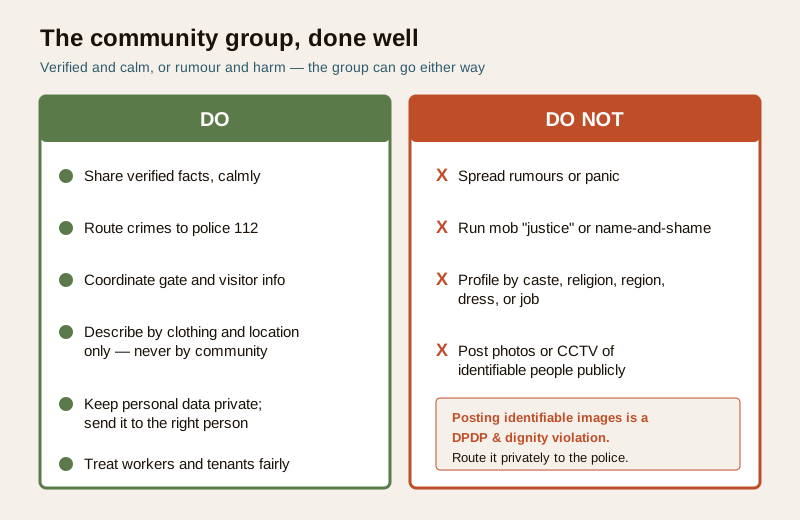
- Share verified information, calmly. "The east gate barrier is not working, use the main gate" is useful. "Heard there are thieves in the area!!!" is rumour. If you cannot confirm it, do not forward it.
- Route the serious stuff to the police, not the group. A suspected crime goes to 112 and the committee. The group is for coordination and awareness, not for solving crimes.
- Do not run "justice" in the group. No naming and shaming, no polls on whether to ban someone, no mob call-outs. Accusations belong in proper forums; punishment belongs to the law.
- Never profile. Do not describe or flag people by caste, religion, region, language, dress or the fact that they are a worker, tenant or "bachelor". A description for the guard is "person in a red jacket near B-block stairs at 9pm", never a community label.
- Do not post photos or CCTV of identifiable people. Publicly circulating a stranger's, a worker's or a neighbour's image or camera footage to "warn everyone" is a dignity violation and, under the Digital Personal Data Protection Act, 2023, a misuse of personal data — quite apart from the defamation risk if you are wrong. Footage identifying a person is personal data; it goes to the guard, the committee custodian or the police, privately — never to the group or social media.
DPDP and the community group
A society, and by extension its official group, handles a lot of personal data — names, flat numbers, phone numbers, vehicle numbers, visitor logs, sometimes CCTV. That makes the society a data fiduciary under the DPDP Act, 2023, expected to collect the least it needs, use it only for the stated purpose, keep it secure and not retain or share it loosely. A resident who dumps a neighbour's details, a worker's photo or a CCTV clip into a group is working directly against that. When in doubt, keep personal data out of the group and send it privately to the right person.
Everyday resident habits that actually prevent problems
Most security in a residential community comes down to unremarkable daily habits by residents — the doors that get locked, the strangers who are politely verified, the deliveries that are handled sensibly. None of this requires confronting anyone; all of it is just being a careful, considerate neighbour.
The core habits
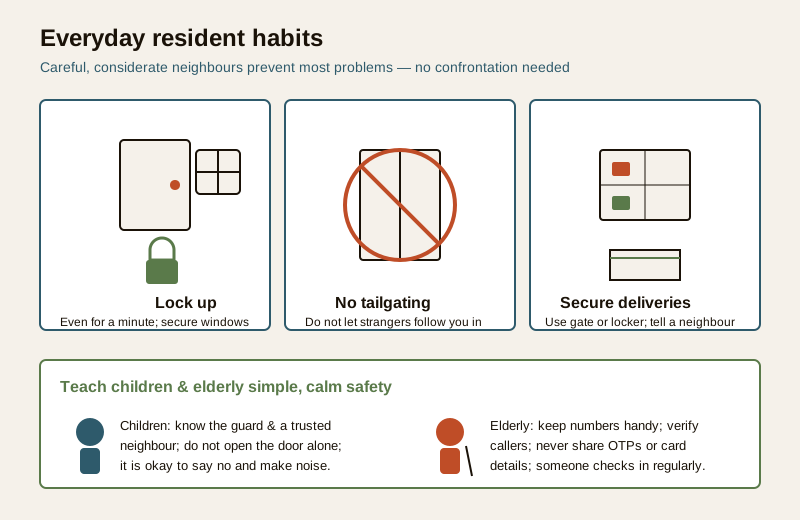
- Lock up. Lock your door even for a quick errand; secure ground-floor and stilt-level windows; do not leave the flat "on the latch". Most opportunistic theft meets an unlocked door.
- Do not tailgate, and do not let others tailgate. Let the gate and lobby do their job — do not hold a controlled door for someone you do not know, and do not slip in behind a resident to skip the entry process. A polite "please check in at the gate" is normal and fair, applied to everyone.
- Verify callers and unexpected "servicemen". If someone arrives claiming to be from a utility, the management, a courier or for a repair you did not book, verify through the guard or the official number before letting them in. Genuine workers expect this; it is a courtesy, not an accusation, so keep it respectful.
- Handle deliveries sensibly. Prefer the gate, a locker or a collection point over strangers at your door; do not leave parcels advertising an empty flat; be considerate to delivery workers who are doing a hard job on tight timelines.
- Tell a neighbour when you are away. A trusted neighbour who collects your post, notices an odd visitor and has your number does more than any gadget. Do not broadcast your travel on the group or social media.
- Keep shared security working. Report a broken gate, a dead camera, a burnt-out stair light or a jammed barrier to the committee — a resident who flags a fault is doing real security work.
Simple safety for children and the elderly
Awareness has to include the people least able to shout for help. Keep it calm and non-frightening.
- Children: know a couple of trusted neighbours and the guard; do not open the main door to strangers when alone; if lost or scared, go to the gate/guard or a known neighbour; memorise a parent's phone number; it is always okay to say no and to make noise.
- Elderly residents: keep the guard's and a neighbour's number by the phone; verify callers and "servicemen" the same way; do not share OTPs, bank or card details with anyone at the door or on a call; have someone check in regularly; keep pathways and stairwells lit and clear (a safety issue as much as a security one).
| Habit | Why it helps | The fair way to do it |
|---|---|---|
| Lock the door, even briefly | Removes the easiest opportunity | Just do it; no one else involved |
| No tailgating (yours or others') | Keeps entry controlled for all | Apply politely and equally to everyone |
| Verify unexpected servicemen | Stops impersonation at your door | Check via the guard; stay respectful |
| Secure deliveries | Avoids theft and signalling an empty flat | Use gate/locker; be kind to riders |
| Tell a neighbour when away | Human watch beats gadgets | Trusted neighbour, privately — not the group |
| Teach children & elderly | Protects the most vulnerable | Simple, calm, non-frightening |
How to report well
A good report is what makes the whole "eyes and ears" idea work. The trained people can only act on what you give them, so give them facts, fast, to the right channel — and then step back.
- Facts, not conclusions. Report what you saw, not who you assume did it. "A silver hatchback, part-number ending 4-7, parked at the fire exit since about 8pm" beats "some suspicious guy is up to something".
- Time and place. When and exactly where — block, floor, gate, lane — so the guard or police can respond to the right spot.
- The right channel. Emergency or crime -> police 112 and tell the guard. A safety pattern or fault -> the committee. Something odd but not urgent -> the guard, who watches and escalates.
- Once, calmly. Report it once to the right person; do not spray it across every group. Panic spreads faster than facts and is much harder to correct.
- No labels. Describe clothing, location, vehicle and behaviour — never community, religion, region or "type of person".
A note on fairness. The people most often wrongly "reported", stopped or shamed in Indian societies are domestic workers, delivery riders, drivers, tenants and gig workers — the people the community depends on every day. An awareness culture that makes their lives harder has failed, however "secure" it feels. Apply the same courtesy, verification and benefit of the doubt to everyone, and route real concerns to professionals rather than acting on them yourself.
How it connects
Resident awareness is the human layer that sits on top of the society's shared, professional measures. It works best when it plugs into the security setup for a gated community, runs under the housing society security committee, stays inside a fair and lawful approach to community security, and is aimed at the real risks identified in the neighbourhood risk assessment. For the full picture, browse the Community & RWA Security library.
Key takeaways
- Residents are a community's biggest security asset — as alert, considerate neighbours who notice and report, never as vigilantes who confront, chase or detain.
- The chain is always: notice -> report to guard / committee / police -> let the trained people act. Your job ends at reporting; dial 112 for anything urgent.
- A good neighbourhood watch is organised neighbourliness: inclusive, coordinated with guards and committee, with awareness but no authority. It never profiles or excludes tenants, workers or "bachelors".
- Run the community group on verified, calm information. No rumours, no mob "justice", no profiling, and never post photos or CCTV of identifiable people — that is a DPDP and dignity violation; route it privately to the police.
- Everyday habits do the heavy lifting: lock up, do not tailgate, verify unexpected callers, secure deliveries, tell a trusted neighbour when away, and report faults in shared security.
- Teach children and the elderly simple, calm safety, and treat the workers the community depends on with the same courtesy and benefit of the doubt as everyone else.
References
- Digital Personal Data Protection Act, 2023 — a society and its official group handling names, phone and vehicle numbers, visitor logs and CCTV is a data fiduciary; collect the least needed, keep it secure and never post identifiable images or footage publicly. Verify current rules with the society's legal advisor.
- Private Security Agencies (Regulation) Act, 2005 (PSARA) — the framework for engaging licensed, fair-wage guards; residents' awareness supports the professional guards, it does not replace or override them.
- The relevant state Apartment Ownership / Cooperative Societies Act and the Model Bye-laws — the lawful basis for what a committee (and its watch programme) may and may not do; an awareness programme cannot override residents' rights or the law. Verify with the registrar or the society's legal advisor.
- National / state police public-safety and community-policing advisories, and the emergency numbers 112 (police), 101 (fire), 108 (ambulance) — the authoritative channels for reporting and response; confirm the numbers active in your area.
- Your society's own safety guidance, bye-laws and committee — the specific channels, contacts and rules for your community; follow them over any generic template.
This is educational guidance for residents and committees, not legal advice, and it authorises no resident to confront, detain, investigate or publicly name anyone — that is for the police and professionals. Apply security fairly and respectfully to everyone, keep personal data private under the DPDP Act, 2023, and verify local rules and reporting channels with your society's legal advisor and the police.
Export this guide
Related Guides — Deep-dive reading
Security for People Living Alone in India (2026): Calm, Practical Habits When There Is No Second Person to Notice
Living alone is an ordinary and growing part of Indian life - the student in a new city, the working single, the elder whose children are abroad, the person after a separation. It does not call for fear. It calls for a few deliberate habits, because there is no second person in the home to notice trouble, raise the alarm, or catch an accident. This is calm self-reliance, layer by layer.
SecurityVisitor Vehicle Management in India: A Professional Guide
The everyday weak point of every society and office gate is not the resident's car — it is the visitor, the cab, the delivery rider and the contractor who must be let in without opening the whole park to anyone. This is the process, not just the hardware: verify at the gate before the boom lifts, park visitors away from resident bays, and never jam the gate a fire tender needs.
SecurityFair and Lawful Community Security in India (2026): Dignity, Data and Governance Done Right
How a housing society can run security that is fair, dignified and within the law — rejecting discriminatory practices, respecting domestic, delivery and gig workers, honouring the DPDP Act as a data fiduciary, and governing within its bye-laws and residents' rights — and why that makes it better security, not weaker.
SecurityRelated Tools — Try Free
Cross-Ventilation Analyzer
Estimate airflow and air changes per hour (ACH) from room size, window areas, layout, and local wind — with NBC 2016 Part 8 compliance check.
Ventilation CalculatorInterior Risk Index
Score project risks across scope, budget, vendor, timeline, and quality dimensions.
Risk AssessmentWindow Orientation Planner
Pick the best window type, glass and shading by wall direction — north, east, south and west.
Window Tool