
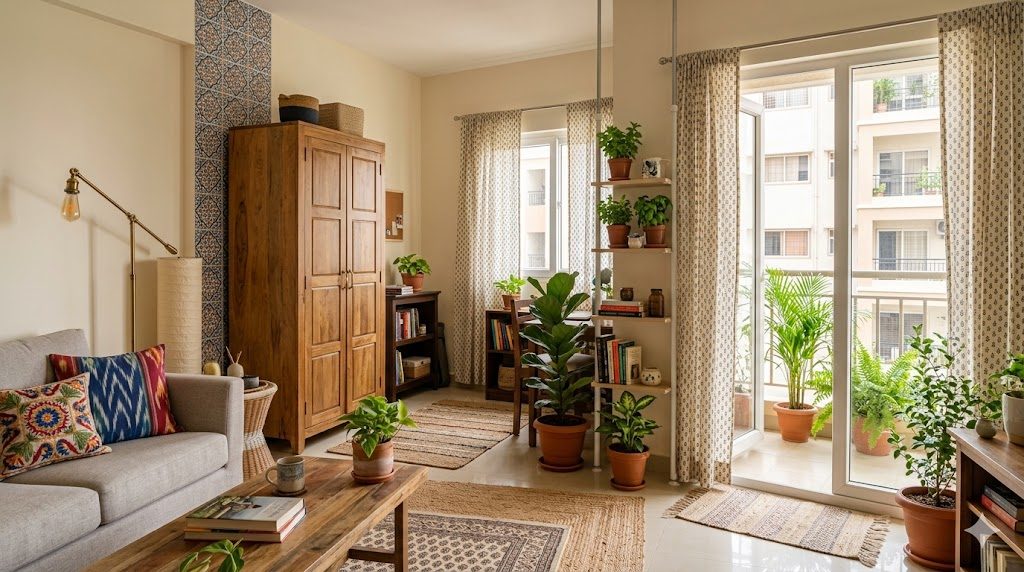
Rental Apartment Interior Planning
The renter's playbook for making a rented flat feel like home without losing your deposit
Renting in India often means living for years in a flat you are told not to touch. The walls are a colour you would never choose, the lighting is one harsh tube per room, and the landlord's agreement warns that any change risks the deposit. So most renters do nothing — and spend years in a space that never feels like theirs. That is the wrong trade. You can make a rented flat genuinely feel like home, and you can do it without losing a rupee of your deposit, if you plan the difference between what is reversible and what is permanent before you buy anything.
The mistake renters make is treating a rental like a place they cannot improve, or treating it like one they own and over-investing in fixtures they will leave behind. The right answer sits in between: invest heavily in portable comfort that moves with you to the next flat, and treat everything bolted to the building as the landlord's responsibility. This guide is a planning framework, not a list of decor ideas — it is about which decisions to make, in what order, so that the flat improves and the deposit stays safe.
It is a deep-dive companion to our apartment interior planning checklist, and a planning counterpart to our rental apartment interiors guide, which covers the design ideas themselves. This one is the playbook for the decisions behind them.
The one decision that governs everything: reversible or permanent?
Before any purchase, sort every idea into one of two buckets. Reversible changes leave no trace when you remove them — a rug, a freestanding wardrobe, a tension rod, peel-and-stick tiles. Permanent changes alter the building — drilling, tiling, re-painting, built-in joinery, false ceilings. Reversible is your money. Permanent is the landlord's, and you should only touch it with written permission and ideally a cost-share.
The cleanest way to see this is to plot every upgrade on two axes — how much it costs against how easily it can be undone. Spend freely in the low-cost, easily-reversed quadrant. Be cautious in the medium quadrants. Stay out of the high-cost, permanent quadrant entirely.
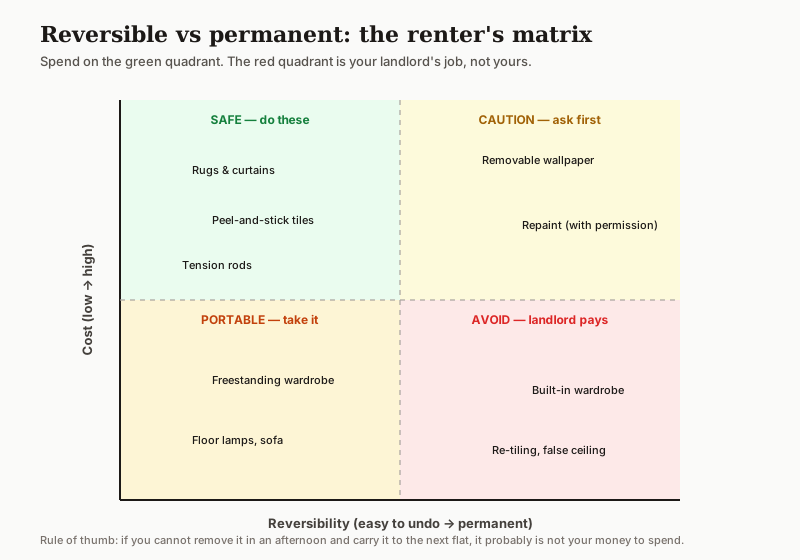
If you cannot remove it in an afternoon and carry it to the next flat, it is probably not your money to spend.
What is worth investing in — and what is not
A renter's budget should follow you out the door. The test for every spend is simple: will this come with me? A good mattress, a freestanding wardrobe, lamps, a sofa and rugs all move to the next flat. Re-tiling the bathroom, building a TV unit into the wall, or installing a false ceiling all stay behind as a gift to your landlord. The first list deserves real money; the second deserves none.
| Spend on this (it moves with you) | Skip this (it stays behind) |
|---|---|
| Quality mattress and bed frame | Built-in wardrobe or loft |
| Freestanding modular storage | Re-tiling floors or bathroom |
| Floor and table lamps | Hardwired ceiling fixtures, false ceiling |
| Sofa, chairs, dining set | Permanent wall panelling |
| Rugs, curtains, tension rods | Replacing windows or grilles |
| Peel-and-stick surfaces (cheap, removable) | Plumbing or major electrical changes |
Notice that lighting appears on the keep side as lamps, not fixtures. One of the highest-impact, fully portable upgrades a renter can make is to ignore the harsh tube light entirely and build layered light from plug-in floor and table lamps — every one of which packs into a box on moving day.

Protecting the deposit
The security deposit in Indian rentals is large — often two to ten months of rent — and disputes over it are common. The single biggest factor in getting it back is not how careful you are at move-out; it is what you document on move-in. A renter who can prove the flat came with that crack, that stain, that scratch has already won half the argument.
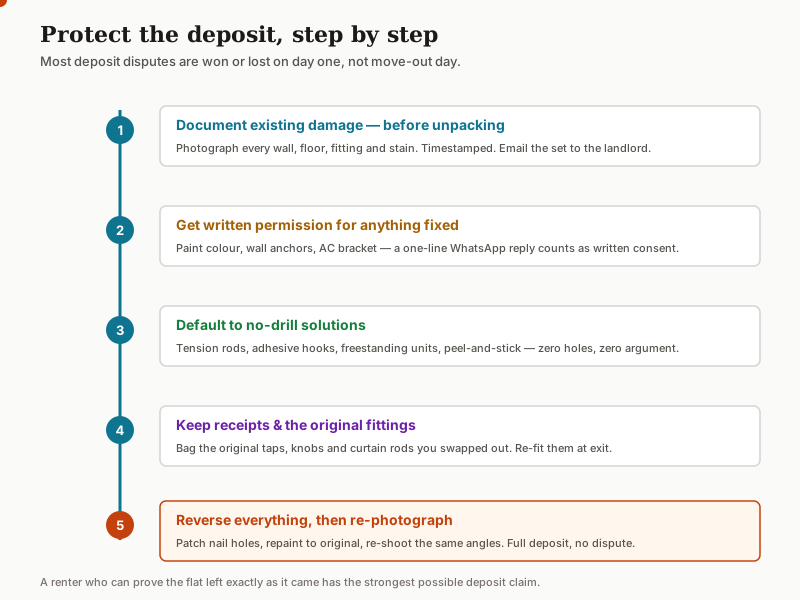
Document existing damage first
Before you unpack a single box, walk the flat with your phone and photograph every wall, floor, fitting, tap, switch plate and existing mark. Make the photos timestamped and email the full set to the landlord on day one, so there is a dated record neither side can dispute. This five-minute habit is worth more than any clever repair trick later.
Get permission in writing — and keep it simple
Anything that touches the building needs the landlord's written consent. In practice a one-line WhatsApp reply saying yes is enough, and far better than a verbal nod you cannot prove. Ask specifically: may I paint this wall this colour, may I fit two wall anchors here, may I install an AC bracket. Keep the replies.
Default to no-drill, no-trace solutions
| Job | Permanent way (avoid) | Reversible way (use) |
|---|---|---|
| Hang art / coats | Wall plugs and screws | Adhesive command hooks |
| Curtains | Drilled brackets | Tension rod inside reveal |
| Backsplash / accent wall | Tiling, paint | Peel-and-stick tiles or wallpaper |
| Extra storage | Built-in shelving | Freestanding or tension-pole units |
| Room division | Stud partition | Freestanding screen or curtain |
| Better lighting | Rewiring fixtures | Plug-in floor and table lamps |
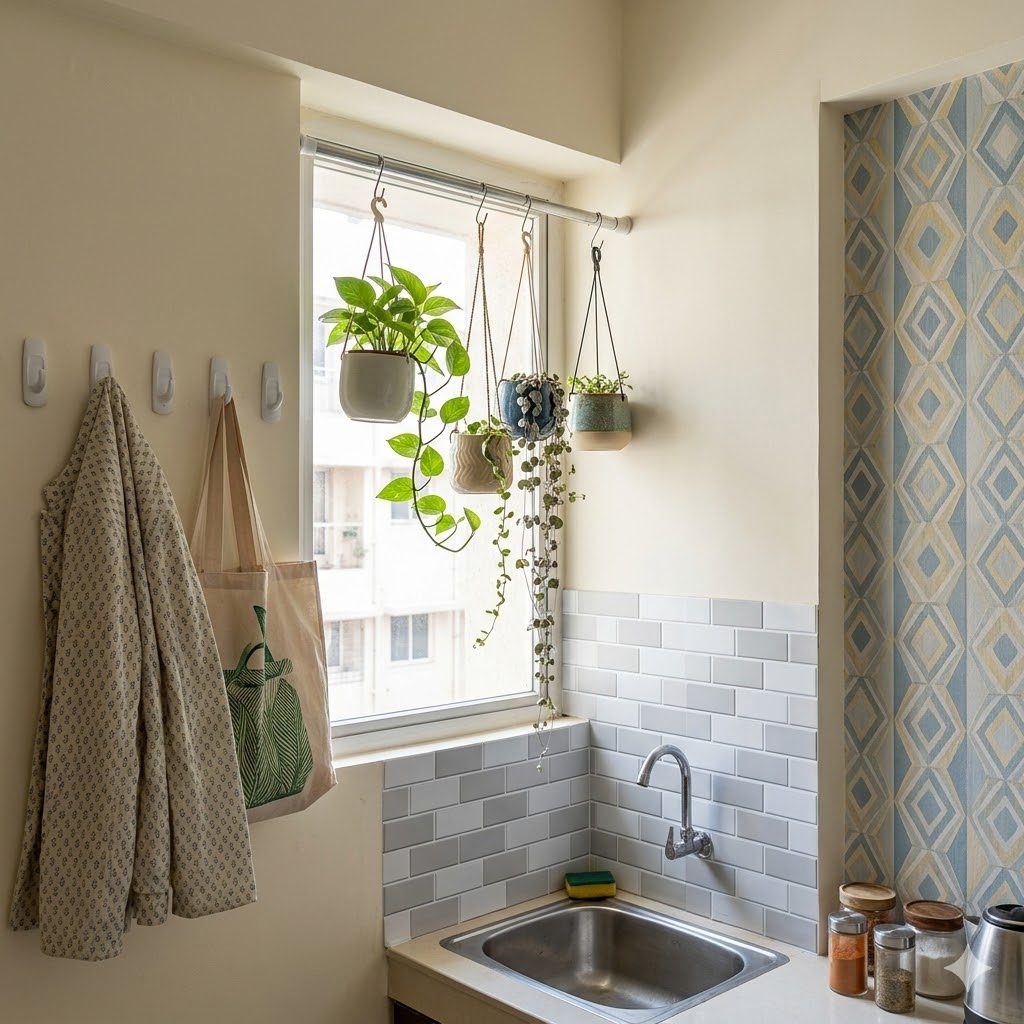
Keep the originals you swap out
If you replace a curtain rod, a tap aerator, a cabinet knob or a shower head, bag the original and store it. At move-out you re-fit the original and take your upgrade with you. The flat returns to exactly how it came, and your improvement leaves with you.
Portable upgrades you take to the next flat
The happiest renters treat their belongings, not the building, as their home. Modular freestanding storage, a good rug, blackout curtains on tension rods, a set of warm lamps and a few large plants will transform any flat and then transform the next one too. Size these to standard room dimensions, not to this specific flat, so they fit wherever you move. Our space-saving furniture and smart storage ideas for Indian homes guides cover pieces that work hardest in compact rentals and pack down for moving.
The fix, in order
1. Sort every idea into reversible or permanent before you buy anything.
2. Photograph the whole flat on day one and email the dated set to the landlord.
3. Get written permission for anything that touches the building.
4. Spend the budget on portable comfort that moves with you — bed, storage, seating, lamps.
5. Use no-drill solutions by default: tension rods, adhesive hooks, freestanding units, peel-and-stick.
6. Keep the originals you swap out, and at move-out reverse everything and re-photograph the same angles.
Plan it: Set a renter's budget that follows you with the budget allocation tool, size freestanding pieces against the furniture size chart, and read the rental apartment interiors guide for the design ideas, plus space-saving furniture and smart storage ideas for India for pieces that pack down and move on.
References
- Panero, J. and Zelnik, M. (1979) Human Dimension and Interior Space. New York: Whitney Library of Design.
- Ching, F.D.K. and Binggeli, C. (2018) Interior Design Illustrated. 4th edn. Hoboken, NJ: John Wiley & Sons.
- Neufert, E. and Neufert, P. (2019) Architects' Data. 5th edn. Oxford: Wiley-Blackwell.
- Susanka, S. (2001) The Not So Big House: A Blueprint for the Way We Really Live. Newtown, CT: Taunton Press.
Part of the Studio Matrx Apartment Living series.
Export this guide
Related Guides — Deep-dive reading
Renter-Friendly Curtains: No-Drill, Removable Solutions (India 2026)
Hang curtains in a rented flat without touching the walls — tension rods, adhesive hooks within their weight limits, magnetic rods on metal grilles, removable brackets and lightweight fabrics you can take to the next place.
Window TreatmentsSmart Home for Renters in India: Automate Without Losing Your Deposit
Damage-free, removable, take-it-with-you devices — smart plugs, bulbs, wireless cameras and reversible switch modules — that make a rented flat smart and leave the walls exactly as you found them.
Smart HomeSecurity for Tenants in India (2026): Protect Your Rented Home and Your Privacy Without Losing the Deposit
Renting is home too. This guide covers a tenant's twin needs - securing a rented home with reversible, take-it-with-you measures the lease allows, and standing on your privacy rights so a landlord cannot surveil you inside your own walls. Practical, India-real, and firmly on the renter's side.
SecurityRelated Tools — Try Free
Apartment Interior Planning Checklist
51-item checklist across structural, ceiling, lighting, furniture, storage, electrical, kitchen, bathroom.
ChecklistApartment Furniture Size Chart
Standard furniture dimensions for Indian apartments — sofas, beds, tables, dining, storage.
Reference ChartFull-Room BOQ — Living, Bedroom, Kitchen, Bath
Room-wise BOQ across living, bedrooms, kitchen, utility, and bathrooms with line-item pricing.
Full-Room BOQ