
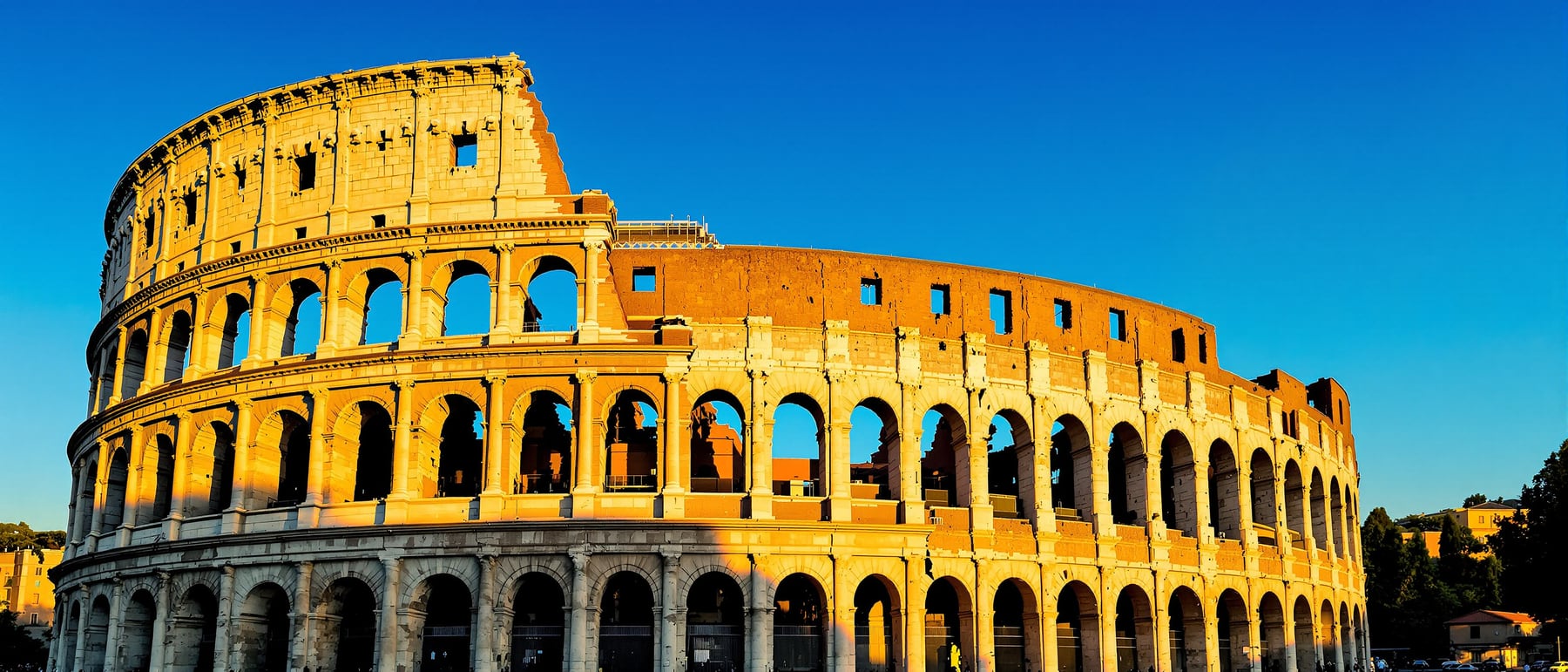
The Colosseum: The Machine That Fed a City Its Pleasures
Rome's greatest emperors built palaces for themselves; the Flavian emperors did something shrewder — they drained a fallen tyrant's private lake and raised, on the spot, a stupendous arena for fifty thousand ordinary citizens. The largest amphitheatre ever built is a masterpiece of crowd engineering, a hidden stage-machine of lifts and trapdoors, and a place of real, organised killing — all at once. The fourth article in our chapter on the palaces and pleasures of worldly power, and the first on pleasure.
For three articles we have walked through palaces — Knossos, Nineveh, Persepolis — the private houses of kings, where power lived and displayed itself. Now the chapter turns from power to pleasure, and from the private to the public; and there is no better place to make that turn than the most famous building the Romans ever raised. Because the genius of the Colosseum begins with exactly that idea: it is a pleasure-ground taken away from an emperor and given to the people.
This is the sixty-seventh article in our Architectural Wonders series, the fourth in our chapter on the great palaces and pleasures of worldly power — and the first devoted to pleasure.
The Colosseum is, of course, the great icon of ancient Rome, and one of the most recognisable buildings on Earth. But it repays looking at freshly, because it is really three wonders in one. It is a structural wonder — the largest arena ever built, a mountain of seating standing free on flat ground. It is a wonder of crowd engineering — a machine for moving fifty thousand people, whose logic underlies every stadium you have ever entered. And it is a wonder of spectacle and its machinery — with a hidden underground world of lifts and trapdoors beneath the sand. It is also, we must never forget, a place built for killing. To understand it honestly, we have to hold all four of those things at once.
1. The people's pleasure
The Colosseum's story begins not with the Flavians who built it, but with the tyrant whose ruin it was built to erase.
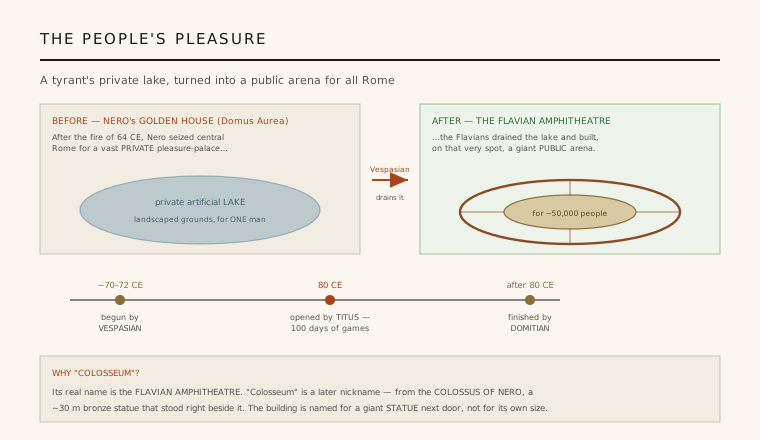
After the great fire of 64 CE, the emperor Nero seized a vast swathe of the burnt city centre to build himself an outrageous private pleasure-palace, the Golden House (Domus Aurea), complete with landscaped parkland and a private artificial lake. Rome never forgave him for it. So when the Flavian dynasty came to power after Nero's fall, the new emperor Vespasian made a brilliant piece of political theatre: he drained Nero's private lake, and on that very spot he began, around 70–72 CE, an enormous public amphitheatre — handing back to the people, as shared pleasure, the ground a tyrant had stolen for his private delight. It was opened in 80 CE by his son Titus with a hundred days of inaugural games, and finished under the third Flavian, Domitian. Its true name is the Flavian Amphitheatre. The nickname "Colosseum," by the way, has nothing to do with its own bulk: it comes from the Colossus of Nero, a roughly thirty-metre bronze statue that stood right beside it — a giant of the same family as the Colossus of Rhodes. The most colossal building in Rome is named after the statue next door.
2. A mountain of arches
To grasp what the Romans achieved here, compare it with how the Greeks built their theatres.
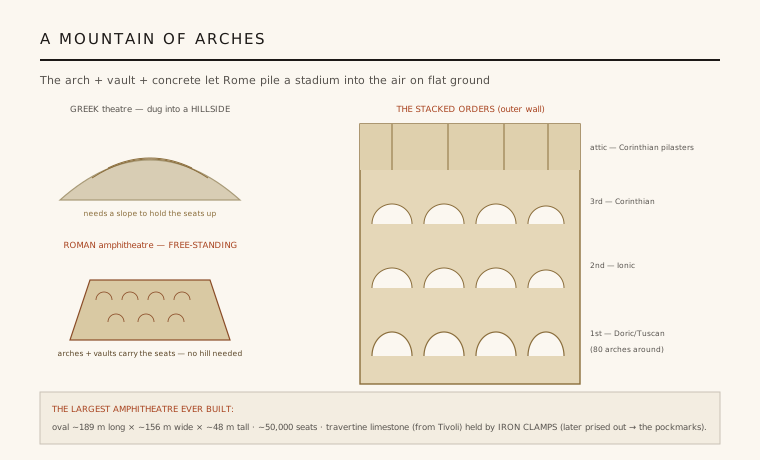
A Greek theatre had to be scooped out of a hillside, because the slope was what held the banked seating up. The Romans needed no hill. Armed with their three great structural gifts — the arch, the vault, and concrete — they could pile a whole mountain of seating into the air on flat ground, as a completely free-standing building. The result is the largest amphitheatre ever built: an oval roughly 189 metres long, 156 wide and 48 tall, holding around fifty thousand spectators. Its outer wall is a textbook of the classical language of architecture — the famous stacking of the orders, tier on tier: sturdy Doric (Tuscan) half-columns on the ground floor, more slender Ionic above, ornate Corinthian on the third level, and a solid attic storey crowned with Corinthian pilasters, growing lighter and more decorative as it rises. Eighty arched openings ring the base. It was built mainly of travertine limestone (quarried near Tivoli), its blocks locked together not with mortar but with iron clamps — and when, centuries later, people pried those clamps out for their metal, they left the pockmarks that still freckle its walls today. (This same Roman mastery of the arch and concrete raised, across the city, the great dome of the Pantheon — the two buildings are cousins in engineering, one hollowing out a vast interior, the other stacking a vast exterior.)
3. A machine for crowds
Here is the insight most visitors miss, and the one an architect should treasure: the Colosseum's true genius is not the spectacle. It is the circulation.
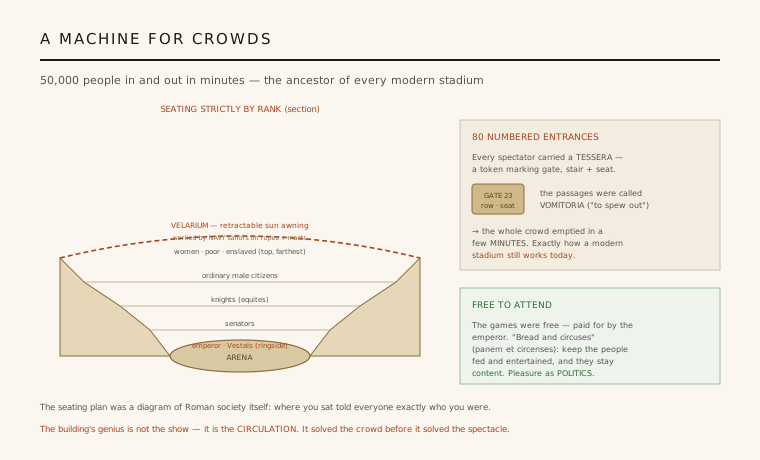
Fifty thousand people had to get in, be seated, and get out — safely, quickly, and in the right order. The Romans solved it so completely that we have barely improved on it in two thousand years. The eighty ground-floor arches were numbered; each spectator carried a tessera, a token marking his gate, stairway and seat; and the internal passages — still called vomitoria, from the Latin for "to spew forth" — let the entire crowd empty in minutes. Every modern sports stadium is, in its bones, a direct descendant of this system. And the seating was a perfect diagram of Roman society: the emperor and the Vestal Virgins in ringside boxes at the arena's edge, then a band for senators, then the knights, then ordinary male citizens — and, right at the top and farthest from the action, the women, the poor and the enslaved. Where you sat announced exactly who you were. Overhead, on the hottest days, a colossal retractable awning — the velarium — could be hauled out on masts and ropes to shade the crowd, worked by a detachment of sailors seconded from the imperial navy, the only men with the rigging skills to manage such a sail. And the whole show was free, paid for by the emperor: the very definition of "bread and circuses" (panem et circenses) — keep the people fed and entertained, and they will not turn on you. Pleasure, here, was politics by other means.
4. Beneath the sand
Then, under Domitian, the Romans added the most theatrical touch of all — and hid it completely from view.
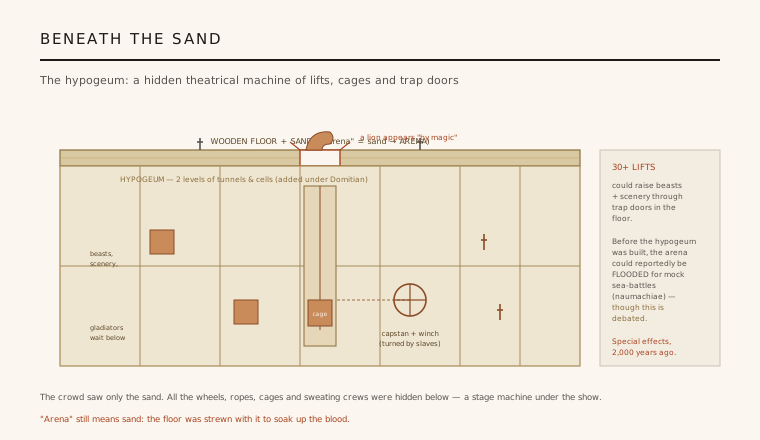
The floor of the arena was a wooden platform strewn with sand — and that sand gives us the very word arena, from the Latin harena, "sand," spread to soak up the blood. But beneath that floor lay a hidden two-storey labyrinth of brick tunnels, corridors and cells called the hypogeum. Down here, out of sight, waited the gladiators, the stage scenery, and the wild animals in their cages. More than thirty lifts, raised by capstans and winches turned by teams of slaves, could hoist a caged beast or a piece of scenery up a vertical shaft; a trapdoor would spring open in the sand, and a lion — or a fully grown stage-set of a forest — would appear as if by magic in front of the astonished crowd. It was, in the most literal sense, a theatrical machine: special effects, two thousand years ago, with all the sweating machinery hidden below the show. (In the arena's earliest years, before the hypogeum was dug, sources even claim it could be flooded for mock naval battles, naumachiae — though how, exactly, is much debated.) The crowd saw only the sand and the spectacle; the wonder was everything they could not see.
5. Blood — and honesty
We cannot admire this building's engineering without reckoning honestly with what that engineering was for. And here we must be careful in both directions — neither softening the real horror, nor repeating the myths.
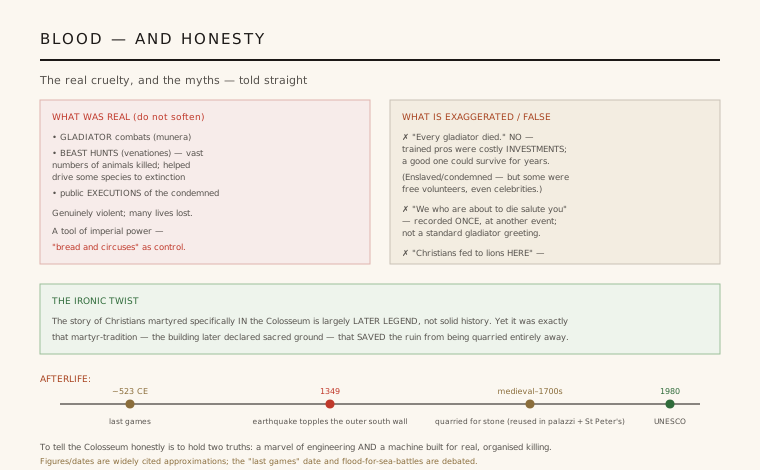
What happened here was genuinely brutal, and we should not sanitise it. The programme mixed gladiatorial combat (munera), wild-beast hunts (venationes) that slaughtered animals on an industrial scale — enough to help push some species toward regional extinction — and public executions of the condemned. Many thousands of people and countless animals died in this building for the entertainment of a crowd, deliberately, as a tool of imperial power. That is the true horror of the place, and no amount of admiration for the architecture should blur it.
But precisely because the reality is dark enough, we owe it accuracy, and several of the most familiar "facts" are myths. Most gladiators did not die in every fight: they were expensive, highly trained professionals, a serious investment for their owners, and a skilled fighter might survive for years and win his freedom — cruel, yes, but not the guaranteed slaughter of the movies. (Many were enslaved or condemned men, but some were free volunteers, and a few were celebrities.) The famous cry "we who are about to die salute you" (morituri te salutant) is recorded just once, at an entirely different event, and was never a standard gladiator greeting. And the vivid image of Christians thrown to the lions in the Colosseum specifically is largely later legend, not solid history — most documented Roman persecutions happened elsewhere. Here lies the final irony: it was exactly that Christian-martyr tradition — the building reconsecrated as sacred ground where saints were thought to have died — that later saved it, after earthquakes (notably in 1349) had toppled its south wall and centuries of Romans had quarried it for stone to build their palaces and even parts of St Peter's. The story that never quite happened rescued the building where it was supposed to have happened. Inscribed by UNESCO in 1980, the Colosseum stands today as it truly is: a supreme feat of engineering, and a monument to how a civilisation can turn even death into architecture and entertainment.
6. What a modern architect can learn from the Colosseum
- Solve the crowd before the spectacle. The Colosseum's deepest genius is circulation — getting fifty thousand people in and out safely and fast. Numbered gates, tokens, dedicated passages: unglamorous, invisible, and the thing that actually makes a mass-gathering building work. Movement is architecture's first problem, not its last.
- A great building can be a political act. The whole meaning of the Colosseum is where and for whom it was built — public pleasure raised on the ruin of private greed. Architecture is never neutral about power; ask always who a building is really for, and what it takes back or gives away.
- Master the structure and the form follows. The arch, the vault and concrete are what let Rome stand a stadium free on flat ground. Every expressive move — the soaring tiers, the free plan, the sheer scale — flows from that structural command. Know your structure and the architecture opens up.
- Hide the machinery, show the magic. The hypogeum is a lesson in stagecraft: put all the propaganda of effort — the winches, cages and crews — out of sight, so the audience experiences only wonder. Knowing what to conceal is as much a craft as knowing what to reveal.
- Design the experience of the ordinary user, not just the VIP. Rome mapped its whole social order onto the seating — but the true achievement was that even the citizen at the very top, on a free ticket, got shade, a clear sightline and a swift way home. A building is judged by how it treats the person in the cheapest seat.
- Reckon honestly with what you build. The hardest lesson: this masterpiece was a machine for killing. Brilliance of means does not sanctify the end. The honest architect — like the honest historian — holds the wonder and the horror together, and never lets the beauty of the how silence the question of the why.
References & further reading
1. UNESCO World Heritage Centre — Historic Centre of Rome (inscribed 1980; includes the Colosseum). https://whc.unesco.org/en/list/91/
2. World History Encyclopedia — Colosseum. https://www.worldhistory.org/Colosseum/
3. Encyclopaedia Britannica — Colosseum. https://www.britannica.com/topic/Colosseum
4. Keith Hopkins & Mary Beard — The Colosseum (Profile Books / Wonders of the World). https://www.worldcat.org/title/colosseum/oclc/57722618
5. Parco archeologico del Colosseo (official site) — The monument, the arena and the hypogeum. https://parcocolosseo.it/en/
6. The Metropolitan Museum of Art / Smarthistory — The Colosseum (Flavian Amphitheater). https://smarthistory.org/colosseum/
*Last verified 2026-07-05. Figures follow UNESCO, the World History Encyclopedia, Britannica, the Parco archeologico del Colosseo and standard scholarship (incl. Hopkins & Beard), and are given as widely cited approximations that vary by source. The Colosseum (properly the Flavian Amphitheatre, Amphitheatrum Flavium) is in Rome; built by the Flavian emperors on the drained site of the artificial lake of Nero's Domus Aurea — begun under Vespasian c. 70–72 CE, inaugurated by Titus in 80 CE with 100 days of games, completed under Domitian. It is the largest amphitheatre ever built: an ellipse ~189 × 156 m and ~48 m high, seating an estimated ~50,000 (estimates range widely, up to ~80,000). Structure: travertine (from Tivoli), tuff and brick-faced concrete, using arches and vaults to stand free on level ground; the outer facade superimposes the orders (Doric/Tuscan, Ionic, Corinthian, + Corinthian-pilaster attic) over 80 arcaded entrances; travertine blocks were pinned with iron clamps (later looted → pockmarks). Crowd management used numbered gates, tesserae (tokens) and vomitoria; seating was hierarchical by rank; a retractable velarium awning (worked by sailors) shaded spectators; games were free ("bread and circuses"). The hypogeum (added under Domitian) was a two-level underground network with 30+ lifts/winches and trapdoors for animals and scenery; the arena floor was wood covered with sand (Latin harena → "arena"). Early naumachiae (flooded mock sea-battles) are attested but debated. HONEST CAVEATS: the games (gladiatorial munera, venationes, executions) were genuinely lethal and a tool of power, and beast hunts contributed to regional animal extinctions — but popular myths are overstated: most trained gladiators did NOT die each bout (they were costly investments; some were free volunteers/celebrities); "Ave, morituri te salutant" is a single-source line from a different event, not a standard greeting; and Christians being martyred specifically in the Colosseum is largely later tradition, not well-documented — that very tradition (the site later consecrated) helped SAVE it from total quarrying after the 1349 earthquake and medieval stone-robbing (reused in palaces and St Peter's). UNESCO 1980; one of the "New 7 Wonders of the World" (2007). This is the fourth article in the "palaces and pleasures of worldly power" chapter of the Architectural Wonders series, and the first devoted to pleasure.
Export this guide
Related Guides — Deep-dive reading
The Baths of Caracalla: A Palace of Pleasure for Everyone
Rome's emperors gave the people spectacle in the Colosseum; here they gave them something they could enjoy every single day. The Baths of Caracalla were a free public pleasure-palace the size of a cathedral — a swimming pool, gym, library, art gallery and social club rolled into one, roofed by concrete vaults so magnificent they became the model for New York's Penn Station. The sixth article in our chapter on the palaces and pleasures of worldly power.
Architectural WondersHadrian's Villa at Tivoli: The Emperor Who Rebuilt the World He Loved
The Roman emperor Hadrian had travelled almost the whole of his vast empire — and then, in the hills outside Rome, he built himself a private pleasure-world the size of a city, where he recreated the places he had loved on his journeys. It is a memory-palace of an entire empire, a laboratory of daring curved concrete a millennium and a half ahead of its time, and a monument quietly shaped by grief. The fifth article in our chapter on the palaces and pleasures of worldly power.
Architectural WondersThe Palace of Knossos: Europe's First Palace and the Labyrinth of Myth
Nearly four thousand years ago on Crete, Europe's first great civilisation built a palace so vast and maze-like — over a thousand rooms on many floors, with running water, flushing toilets and light wells — that the Greeks who came after remembered it as the Labyrinth of the Minotaur. It is a genuine Bronze Age marvel; it is also, thanks to one archaeologist's concrete and imagination, a monument to how we rebuild the past in our own image. The first article in our chapter on the palaces of worldly power.
Architectural WondersRelated Tools — Try Free
False Ceiling Cost Estimator
Live ₹/sqft across 8 ceiling types — POP, gypsum, designer, metal, PVC, wooden — with cove and spot lighting for 20 Indian cities.
Cost CalculatorApartment Video Door System Planner
Enter flats, entrances, floors and guard desk for a first-pass building intercom plan — door stations, indoor monitors, guard station, the right architecture and an indicative cost band.
Building PlannerBefore vs After — Cost Reality Check
Compare what you expected to pay vs what you actually paid, category by category.
Reality Check