
Quartz vs Granite Countertops
Picking the right kitchen counter stone for Indian masala, oil and heat
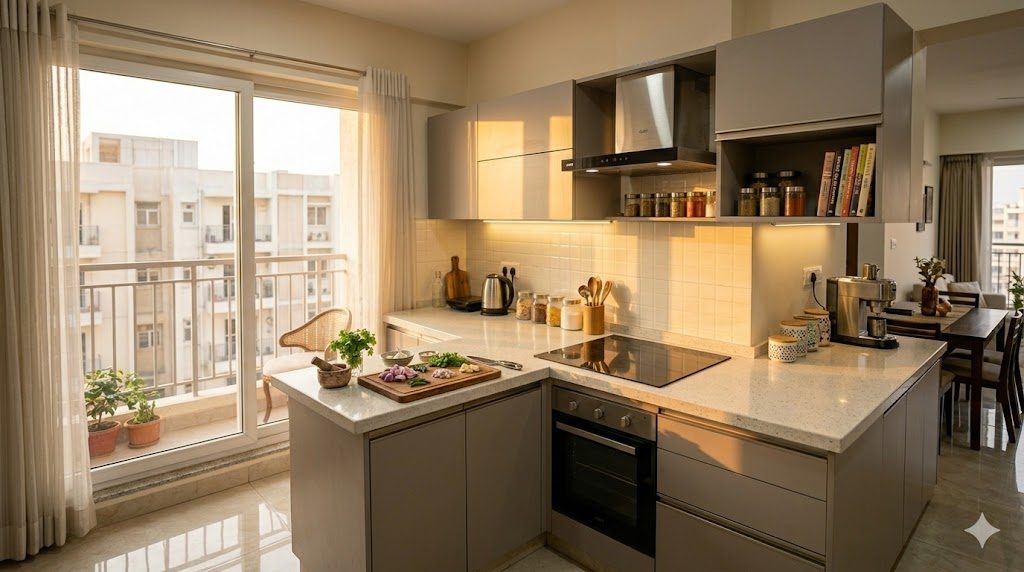
Walk into any Indian kitchen showroom in 2026 and the same question lands within the first ten minutes: granite, or quartz? It used to be a simple answer — granite, because India is the world's largest exporter of it and the local quarries make slab prices among the best on earth. But engineered quartz now sits on most premium quotes, often at 2× to 3× the cost, sold on the promise of a stone that never stains, never needs sealing, and looks the same in 20 years.
The trouble is that "never stains" and "never needs sealing" are both true and both irrelevant if the cook is going to plant a 280°C tawa straight off the burner onto the same counter. The Indian kitchen is a high-heat, high-oil, high-pigment cooking environment that asks two different things of the stone in two different places — and a single material almost never wins outright.
This guide is the property-by-property comparison, with Indian numbers, Indian cooking, and a decision framework that often lands on a mix.
It is a deep-dive companion to our best modular kitchen layout for Indian cooking pillar. Pair this with that one for the layout decision; this article is for the slab call.
What each material actually is
The names are misleading. "Granite" on a quote almost always is granite — a natural igneous rock quarried in Rajasthan, Karnataka, Andhra and Tamil Nadu, then cut and polished to a 20 mm or 30 mm slab. "Quartz" on a quote almost never is pure quartz. It is engineered quartz: roughly 93% crushed quartz crystal bound in about 7% polyester resin and pigment, vibro-compacted under vacuum into slabs. It is a manufactured composite — closer to a high-end resin terrazzo than to a natural stone.
That manufacturing distinction is the single most important fact for an Indian kitchen because it determines almost every difference that follows.
Composition and porosity
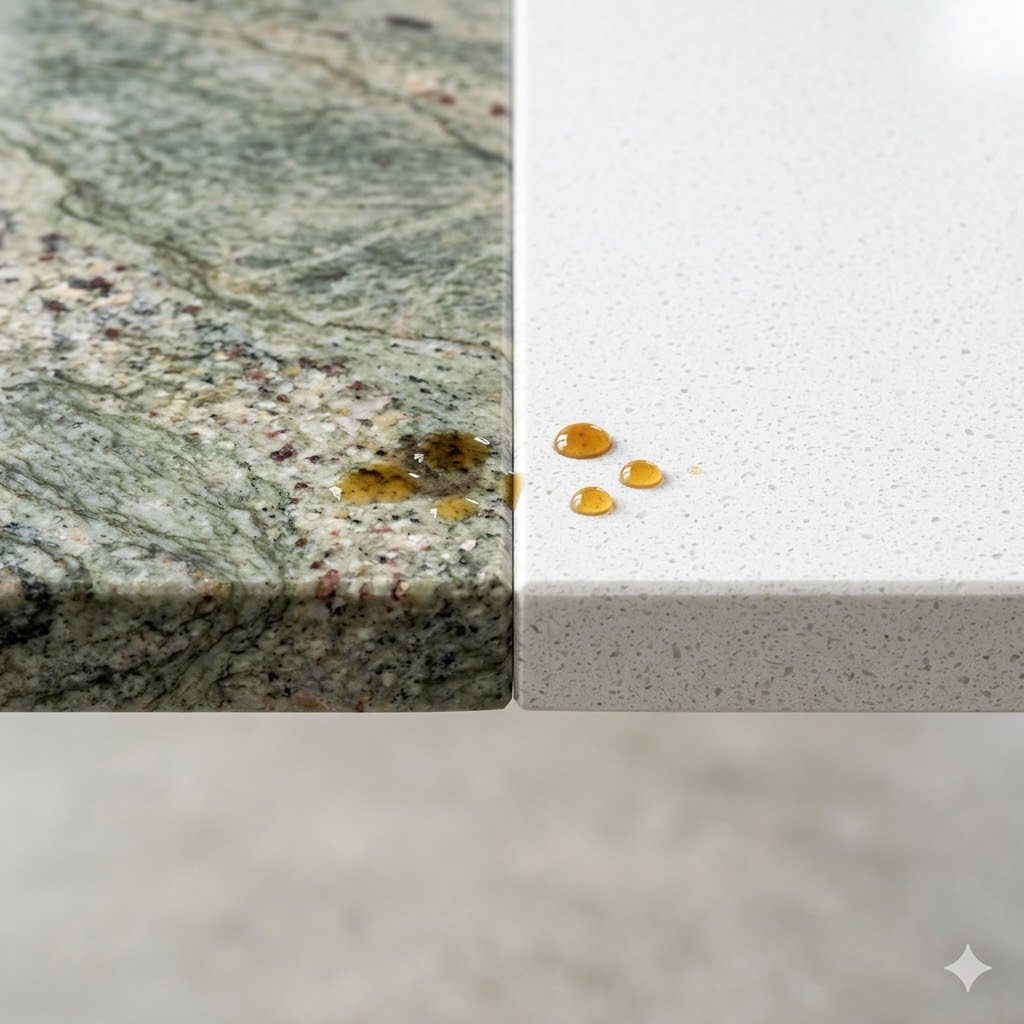
Granite is crystalline rock cooled from magma; under a microscope it is a tight interlock of quartz, feldspar and mica grains with microscopic pores between them. Those pores are why an unsealed granite counter slowly absorbs water, oil and pigment.
Engineered quartz has no pores — the polymer resin fills every gap between the crystals during compaction. The surface is closer in porosity to glass than to stone. That is the entire basis of the "non-staining" claim, and it is largely true.
| Property | Quartz | Granite |
|---|---|---|
| Composition | ~93% quartz + ~7% resin | 100% natural rock |
| Porosity | Effectively zero | 0.4–1.0% (high among countertop stones) |
| Sealing | Never required | Penetrating sealer every 12–18 months |
| Pattern | Consistent slab-to-slab | Unique per slab; vein-matching needed |
| Heat resistance | ~150°C resin softens, scorches | 300°C+ |
| Hardness (Mohs) | 7 | 6.5–7 |
| Density (kg/m³) | 2,300–2,400 | 2,650–2,750 |
| Stain resistance | High (no sealing) | Moderate (high when sealed) |
The sealing schedule matters more than most homeowners are told. A granite counter that has been sealed at install and then ignored for five years is genuinely vulnerable to turmeric and oil stains in the high-use prep zone. A granite counter that gets a 30-minute application of a penetrating sealer (Tenax Hydrex, Dr Fischer, Granquartz) every 12–18 months stays nearly stain-proof. The job is easy. It is just usually forgotten.
Behaviour under masala, oil, and a hot tawa
This is where the comparison turns most counter-intuitive.
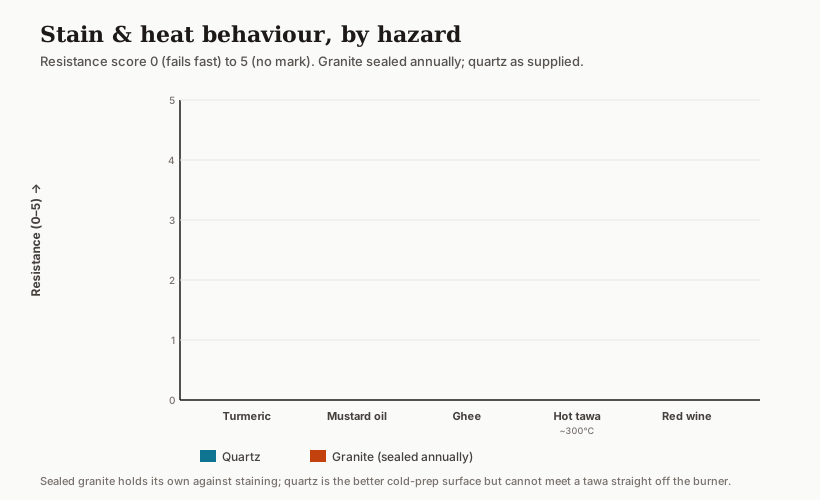
On cold-prep staining — turmeric, oil, mustard oil, ghee, red wine — quartz outperforms by a wide margin, and that margin holds even when granite is freshly sealed. The non-porous surface simply does not absorb pigment.
On heat, the comparison reverses. Engineered quartz contains polyester resin and that resin starts to soften at roughly 150°C and discolour above 180°C. A tawa pulled straight off a high flame easily exceeds 280°C on its underside. Plant that tawa onto a quartz counter and you get an irreversible yellow halo within 30 seconds. The damage is permanent — the stained area cannot be polished out because the discoloration is throughout the resin matrix.
Granite is an igneous rock formed at well over 600°C. A 280°C tawa does nothing to it.
For an Indian kitchen this matters because the hob run is the heat zone and the prep run is the stain zone — and they are in two different parts of the same counter.
Joint visibility, edges and slab availability
Indian quarry slabs of granite max out around 2.4 m × 1.2 m in usable size; engineered quartz slabs from Caesarstone, Silestone or Indian brands like Kalinga top out around 3.0 m × 1.4 m. Either way, an L-shaped 3.6 m run needs a joint somewhere.
| Detail | Quartz | Granite |
|---|---|---|
| Typical slab size | 3050 × 1440 mm | 2400 × 1200 mm |
| Joint visibility | Near invisible (pattern matches) | Visible — vein-match needed |
| Edge profile cost (per m, ogee) | ₹350–500 | ₹250–400 |
| Edge chipping risk on impact | Low (resin absorbs) | Higher at sharp corners |
| Repairable scratch | Buff and re-polish | Re-polish on site |
The single biggest aesthetic call after the stone is where to put the joint. Plan it to one side of the sink (the cutout itself absorbs the visual interruption), or place it under the hob run where the hood and cooktop draw the eye away. Never centre a joint on the prep area.
Real cost per square foot, 2026
Hard 2026 metro rates, including the slab, polishing, on-site cutting and edge finishing, but before the carcase upgrade:
| Tier | Quartz (₹/sqft) | Granite (₹/sqft) |
|---|---|---|
| Entry / domestic | 400–650 | 150–250 |
| Mid-range | 700–1,000 | 250–350 |
| Premium imported | 1,000–1,800 | 350–600 (rare imported) |
Indian engineered quartz from Kalinga, Pokarna and Specta sits in the 400–800 band. Caesarstone, Silestone and Cambria imported imports sit at 1,200–1,800. Indian granites — Black Galaxy, Steel Grey, Tan Brown, Kashmir White — start at ₹150 and climb to ₹450 for exotic patterns. The cost gap is real and is the most common driver of the granite choice in mid-budget kitchens.
A typical 3.6 m L-counter at 600 mm depth covers about 24 sqft. The all-in cost spread is therefore roughly:
| Stone | Per-sqft installed | 24 sqft installed |
|---|---|---|
| Indian granite, mid | ₹275 | ₹6,600 |
| Indian quartz, mid | ₹850 | ₹20,400 |
| Imported quartz | ₹1,500 | ₹36,000 |
For the same kitchen the quartz upgrade is roughly ₹14,000–30,000 — small relative to the total project, but a real number to consciously sign off.
The Indian brand landscape
Quartz — Indian: Kalinga Stone (Maharashtra), Pokarna Quartz (Hyderabad), Specta Quartz (Vadodara), Asian Granito (Ahmedabad). Strong domestic supply chain; warranties of 10–15 years. Imported: Caesarstone (Israel), Silestone (Spain), Cambria (US), Quartzforms (Italy). Premium pricing, larger slab sizes, wider colour palettes including bookmatched veining.
Granite — Indian quarries: Karnataka (Black Galaxy, Steel Grey, Kashmir White), Andhra (Tan Brown), Rajasthan (Imperial Red), Tamil Nadu (Paradiso). India is the world's largest granite exporter and the local market is the best granite market on earth in price and choice. Imported granite (Brazilian, Italian) is rare and is sold at 3× to 5× the Indian rate.
If the kitchen is one stone, sealed granite is the most pragmatic answer for an Indian cook. If the kitchen can be two stones, use quartz on the prep run and granite around the hob — and stop worrying.
When to choose which
A clean decision matrix for Indian kitchens:
| Scenario | Recommended counter |
|---|---|
| Budget-conscious 2 BHK, family cooks daily | Granite (Black Galaxy / Steel Grey), sealed |
| Show-kitchen island in open-plan home | Quartz (large slab, vein-matched) |
| Hob run + prep run as one continuous L | Quartz prep + granite hob (mitred join) |
| Heavy tawa user, daily roti / dosa | Granite anywhere a tawa lands |
| Allergic to sealing maintenance | Quartz |
| Coastal humidity + frequent guest hosting | Quartz (no efflorescence risk on light shades) |
| Small kitchen, single material only | Sealed granite — most forgiving |
The fix, in order
1. Map the counter into zones first — prep zone (cold), hob zone (hot), wet zone (sink). Each has its own ideal stone.
2. Default the hob run to granite, even if the rest of the counter is quartz. The mitred join between two stones is an easily-detailed move.
3. Pick granite by slab, not by name. Visit the yard and reserve the slab; do not let the contractor pick from a batch.
4. Pick quartz by brand and warranty. Demand the brand name in the quote — Kalinga, Pokarna, Caesarstone, Silestone — and a written 10-year stain warranty.
5. Pre-plan the joint. Place it to the side of the sink or under the hob, never centred.
6. Schedule the granite sealing — calendar reminders at 12 and 24 months. Penetrating sealer, not a topical wax.
7. Specify the edge profile in writing along with thickness — 20 mm eased square is the modern default, 30 mm full bullnose the traditional one.
Prevent it / Plan it: Compare stones with the Studio Matrx material decision framework, sanity-check the budget with the cost reality check, and read the material standards primer, expensive interior choices that age poorly, and the modular kitchen guide before signing the quote. Then take the choices back into the pillar layout for Indian cooking.
References
- Bureau of Indian Standards (2018) IS 14223 Part 1: Polished Building Stones — Granite — Specification. New Delhi: BIS.
- Bureau of Indian Standards (2021) IS 17572: Engineered Stone Slabs — Specification. New Delhi: BIS.
- Marble Institute of America (2016) Dimension Stone Design Manual, Version VIII. Oberlin, OH: MIA + BSI.
- Indian Bureau of Mines (2023) Indian Minerals Yearbook 2022: Dimension Stones — Granite. Nagpur: IBM, Ministry of Mines.
- European Quartz Surfaces Manufacturers Association (2022) Heat, Stain and Scratch Performance of Engineered Quartz Surfaces: Technical Bulletin 04/2022. Brussels: EQSMA.
Part of the Studio Matrx Kitchen Design series.
Export this guide
Related Guides — Deep-dive reading
Granite Bathroom Countertop India: Vanity Tops, Sealing, Finishes & Cost
A practical, India-first guide to granite vanity countertops for the bathroom — why granite is the durable, heat- and scratch-resistant budget favourite, how to seal a porous stone against hard water and staining, polished versus leather and honed finishes, edge profiles, basin cut-outs, thickness, and honest ₹ per sq ft versus quartz, marble and solid surface.
BathroomsQuartz Bathroom Countertop India: Engineered Quartz Vanity Tops, Cost & vs Granite/Marble
A practical, India-first guide to engineered quartz vanity tops for bathrooms — why the non-porous, no-seal surface beats granite and marble on a wet counter, plus thickness, seams, heat caution, brand quality and honest ₹ per sq ft costs.
BathroomsItalian Marble vs Quartz
The definitive luxury-surface decision — provenance, performance, maintenance and cost in India
Luxury InteriorsRelated Tools — Try Free
Before vs After — Cost Reality Check
Compare what you expected to pay vs what you actually paid, category by category.
Reality CheckModular Kitchen Budget Calculator
Live breakdown by running feet, countertop area, material tier and city — with wastage, design fee, GST.
Kitchen CalculatorMaterial Compare — Side by Side
Compare materials side-by-side: granite vs quartz vs marble, laminate vs acrylic vs PU, and more.
Comparison