
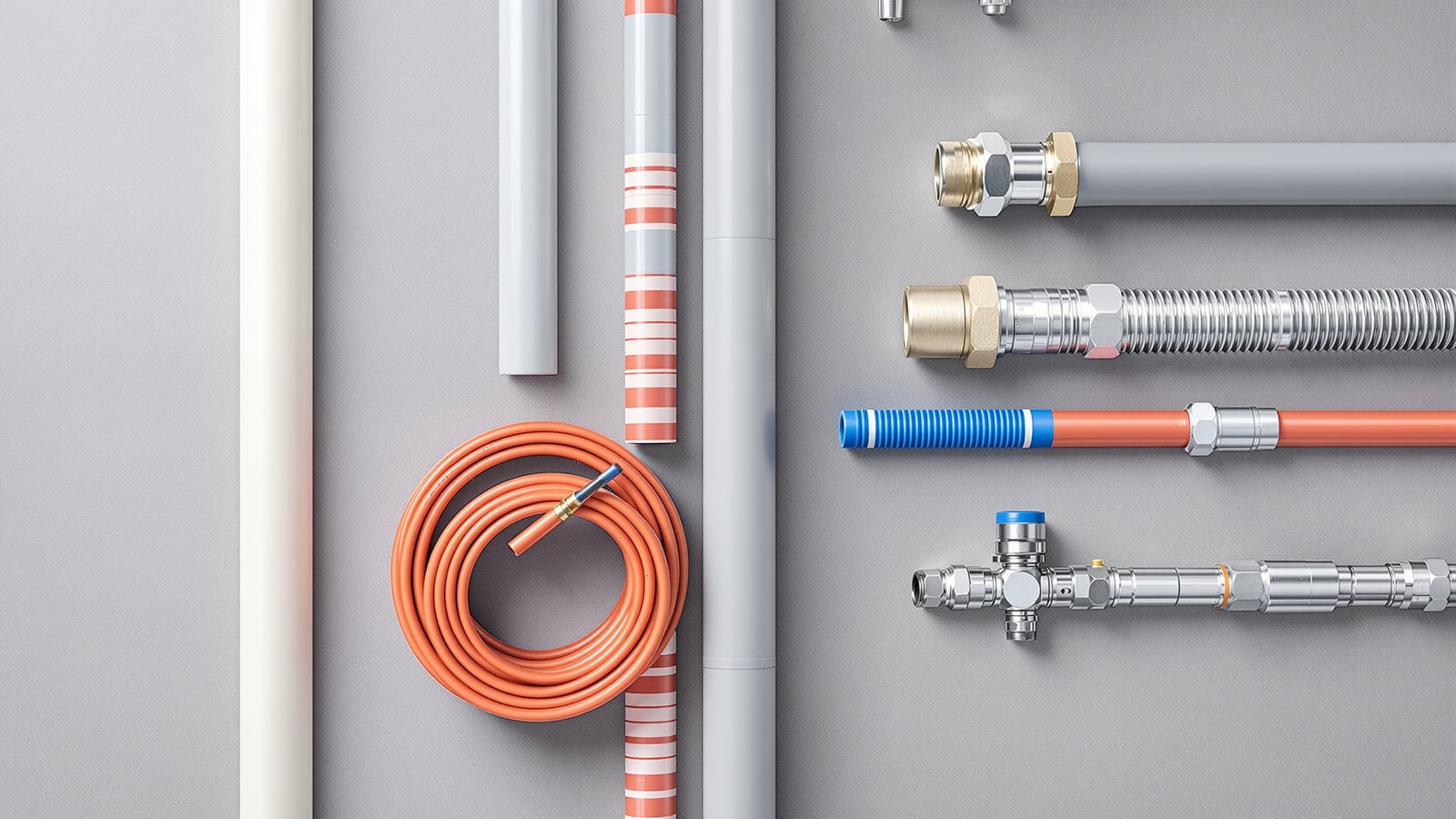
Bathroom Pipe Material in India: CPVC, UPVC, PEX, PPR & PVC Compared
A brand-neutral, India-first guide to choosing supply and drainage pipes for your bathroom — CPVC for hot and cold, UPVC and PEX for cold, PPR, why old GI corrodes and chokes, temperature ratings, jointing, IS/ASTM standards, a comparison table and ₹ cost.
The pipe buried in your bathroom wall is the single component you will never see again once the tiles go on — and the one most likely to force you to break those tiles open a decade later. Get the material wrong and you are choosing between a slow drip inside a concealed chase, a hot-water line that sags and warps, or the classic Indian failure: a galvanised iron pipe that has quietly rusted its bore shut until the shower is a dribble.
This guide is about picking the right pipe material for each job in an Indian bathroom — the pressurised supply lines that feed your taps and geyser, and the gravity drainage lines that carry waste away. It is brand-neutral: Astral, Supreme, Ashirvad, Finolex, Prince and Ori-Plast are named only as familiar examples so you know what to ask the plumber for.
For the whole system — layout, slopes, traps and testing — go up to the pillar Bathroom Plumbing Guide (India). For the two halves in detail, see Bathroom Water Supply (India) and Bathroom Drainage (India).
Two jobs, two families of pipe
Every bathroom pipe does one of two jobs, and the two must never be confused at the counter:
- Supply (pressurised): carries clean water under pressure — from the overhead tank or pump to your taps, health faucet, shower and geyser. Small bore (15–25 mm), must hold pressure, and half of it carries hot water.
- Drainage (gravity): carries used water and waste away with no pressure, running downhill in a trap-and-vent network. Large bore (32–110 mm), must resist chemicals and stay leak-tight at joints.
The costliest mistake is using a cold-only pipe on a hot line. That is the whole reason CPVC exists.
Supply pipes: CPVC, UPVC, PEX, PPR and old GI
CPVC — the default for hot and cold
Chlorinated PolyVinyl Chloride is the workhorse of modern Indian bathroom supply. Extra chlorine in the polymer lets it handle continuous hot water that ordinary PVC cannot.
- Temperature rating: rated for continuous service around 93 °C — comfortably above any geyser output (typically 55–65 °C). This is why CPVC, not UPVC, goes on every hot line.
- Sizes: measured by CTS (Copper Tube Size), commonly 15 mm (½"), 20 mm (¾") and 25 mm (1") for a home.
- Jointing: solvent weld — a special CPVC cement chemically fuses pipe and fitting into one mass. Use the correct CPVC solvent (not PVC or UPVC cement) and let it cure before pressurising.
- Standard: IS 15778 (India) / ASTM D2846 (the CTS system most Indian brands print on the pipe).
- ₹ cost: roughly ₹60–130 per metre for 15 mm; fittings ₹15–60 each.
CPVC is the safe specification for the entire supply run — you can plumb both hot and cold in it and keep one material, one solvent, one set of fittings on site.
UPVC — cold supply only
Unplasticised PVC is rigid, cheap and excellent — but only for cold water. Push warm water through it and it softens and sags.
- Temperature: cold supply and general water lines only; do not use on geyser or hot lines.
- Jointing: solvent weld (PVC/UPVC cement) or threaded/rubber-ring for larger bore.
- Standard: IS 4985 for UPVC pressure pipes.
- ₹ cost: typically ₹40–90 per metre for 20 mm — cheaper than CPVC.
Many Indian homes run UPVC for cold and CPVC for hot. It works, but you now stock two materials and two solvents; a single-material CPVC job is often tidier.
PEX — flexible cold and hot
Cross-linked polyethylene is a flexible tube that snakes through walls and floors with far fewer joints — ideal for concealed and manifold ("home-run") plumbing.
- Temperature: rated for hot and cold; a genuine alternative to CPVC on the hot line.
- Jointing: push-fit / crimp / compression mechanical fittings — no solvent, no cure time.
- Best for: long concealed runs, retrofits and manifold layouts where flexibility beats rigid pipe.
- ₹ cost: pipe is moderate but the brass push-fit fittings are dearer, so the installed cost can exceed CPVC.
Fewer buried joints means fewer buried failure points — PEX's real advantage in a concealed Indian wall.
PPR — heat-fusion supply
Polypropylene Random copolymer is common in overhead-tank and riser plumbing and some premium bathrooms. It is joined by heat fusion (a hot iron melts pipe and fitting together), giving very strong, homogeneous joints, but it needs a fusion machine and a trained hand — less common for small home bathrooms.
GI — why the old galvanised pipe fails
If your home is older, the supply is probably galvanised iron (GI), and it is almost certainly why the flow has weakened.
- It corrodes. The zinc galvanising eventually wears through and the steel underneath rusts, especially in India's hard water. Rust flakes discolour the water.
- It chokes. Scale and rust tuberculate on the inner wall, so the effective bore shrinks year on year — a 15 mm pipe can silt down to a few millimetres, throttling your shower.
- It leaks at threads. GI is threaded and jointed; the threads are the thinnest, first-to-rust point.
If you are renovating an older bathroom, replacing hidden GI supply lines with CPVC is the highest-value plumbing decision you can make. Never bury new GI. See Bathroom Renovation Guide (India).
Drainage pipes: PVC and UPVC soil, waste and vent
Drainage runs by gravity, so bore is large and joints must stay tight without pressure. Here plain PVC / UPVC rules — it is chemical-resistant, light, and never rusts.
- Waste pipes (basin, shower, floor trap) are typically 32–50 mm.
- Soil pipes (from the WC) and the main vertical stack are 75–110 mm.
- Jointing: solvent weld for smaller waste lines; larger soil pipes commonly use rubber ring (push-fit) sockets that allow thermal movement.
- Standard: IS 13592 for UPVC soil and waste pipes (Type A ventilation/rainwater, Type B soil/waste). Rainwater and low-load lines can use the lighter IS 4985 range.
- ₹ cost: roughly ₹120–260 per metre for 110 mm soil pipe; 75 mm and waste sizes proportionally less.
The old cast-iron soil stack of legacy buildings has largely given way to UPVC — lighter, non-corroding and far easier to cut and joint. For slopes, traps and anti-siphon venting, see Bathroom Drainage (India).
The at-a-glance comparison
| Material | Best job | Hot water? | Jointing | Standard | ₹/m (typical) |
|---|---|---|---|---|---|
| CPVC | Hot + cold supply | Yes (~93 °C) | Solvent weld (CPVC cement) | IS 15778 / ASTM D2846 | ₹60–130 (15 mm) |
| UPVC (pressure) | Cold supply | No | Solvent weld | IS 4985 | ₹40–90 (20 mm) |
| PEX | Hot + cold, concealed runs | Yes | Push-fit / crimp | ASTM/ISO PEX | Pipe cheap, fittings dear |
| PPR | Risers, tank lines | Yes | Heat fusion | IS 15801 | ₹70–150 |
| PVC/UPVC (drainage) | Soil, waste, vent | n/a | Solvent / rubber ring | IS 13592 | ₹120–260 (110 mm) |
| GI (legacy) | — avoid for new | Yes but corrodes | Threaded | IS 1239 | — replace |
What to insist on at the counter and on site
- Match pipe to temperature first. Hot line = CPVC (or PEX). If a plumber offers UPVC for the geyser line, stop — it will sag and fail.
- Use the right solvent cement. CPVC needs CPVC cement, not the yellow PVC tin. Wrong solvent = weak joints that weep inside the wall.
- Look for the IS mark. Insist on IS 15778 printed on supply pipe and IS 13592 on soil/waste. The marking is your only proof of grade and pressure class.
- Right pressure class. Supply pipe comes in pressure classes (e.g. SDR 11 / SDR 13.5). Overhead-tank homes and pumped/pressure systems need the higher class — tell your plumber which you have.
- Pressure-test before tiling. Cap the supply run and hold test pressure for the specified time before any concealed line is plastered. A joint that weeps on test is a ceiling stain in the flat below later.
- Keep hot and cold apart. Maintain spacing between CPVC hot and cold runs so heat does not transfer; clip pipes at correct intervals so hot lines do not sag.
- Never mix new GI into a fresh job. It is the one material to retire, not extend.
Choose the pipe as carefully as you choose the tap it feeds. The tap you can swap in an afternoon; the concealed pipe behind it you are married to until the next renovation. For the complete picture, return to the Bathroom Plumbing Guide (India).
References
- National Building Code of India (NBC) 2016, Part 9 — Plumbing Services (water supply, drainage and sanitation).
- IS 15778 — Chlorinated PolyVinyl Chloride (CPVC) Pipes for Potable Hot and Cold Water Supply — Specification.
- IS 4985 — Unplasticised PVC Pipes for Potable Water Supplies — Specification.
- IS 13592 — Unplasticised PVC Pipes for Soil and Waste Discharge Systems (inside and outside buildings) — Specification.
- ASTM D2846 — CPVC Plastic Hot- and Cold-Water Distribution Systems (Copper Tube Size).
- CPHEEO Manual on Water Supply & Treatment / Sewerage and CPWD Specifications, Government of India — plumbing material and installation practice.
Export this guide
Related Guides — Deep-dive reading
Bathroom Plumbing India: The Complete Guide to Water Supply, Drainage, Traps & Pipes
The whole plumbing picture for an Indian bathroom in one place — the two systems (cold and hot water supply, and waste/soil drainage with its vented SWV stack), traps and the floor trap, slopes and gradients, concealed vs exposed pipework, pipe materials (CPVC/UPVC/PEX/GI) and the overhead-tank pressure reality — with the coordination that must happen before any civil work starts.
BathroomsCPVC vs UPVC Pipe: Which Is Better for Bathroom Plumbing? (India)
A fair, India-first head-to-head: CPVC carries HOT water (geyser lines), UPVC is cold-only. Pressure and temperature ratings, cost, jointing, where each belongs, IS standards, and why confusing the two causes concealed-wall failures.
BathroomsBIS-Certified Plumbing Materials in India: ISI Marks, CPVC (IS 15778), UPVC & Soil-Pipe Standards (2026)
A professional reference to the BIS/ISI standards behind bathroom plumbing materials — CPVC (IS 15778), UPVC pressure pipe (IS 4985), PVC soil and waste (IS 13592), PEX, GI, solvent cements and pressure classes — plus how to read the marking printed on a pipe and why you must insist on the ISI mark.
BathroomsRelated Tools — Try Free
Bathroom Drainage Pipe Calculator
Recommended drain and waste pipe sizes, slopes and stack size for a bathroom's fixtures — indicative IS 1172 / NBC plumbing practice.
Bathroom CalculatorPlumbing Pressure-Test & Leak Checklist
Pre-closure pressure and leak test — 9 categories, 60+ checkpoints across water supply, drainage, fixtures, waterproofing, hot water, tanks.
Pre-Closure TestRainwater Tank Sizer
How big should your rainwater tank be? Computes annual harvest, recommended tank capacity in litres, water-bill savings, and payback — for 10 Indian cities.
RWH Calculator