

Net Metering Explained for Home Solar in India (2026)
How a grid-tied rooftop system settles energy with the grid: net metering (the meter runs both ways, you pay only the net), versus gross metering and net billing, plus year-end surplus, capacity caps and why net metering is what makes home solar pay.
Your rooftop panels make the most power at midday, when the house is often half-empty, and none at night, when everyone is home. So a grid-tied system is always trading with the grid: pushing surplus out when the sun is strong, pulling it back when it is not. Net metering is the billing arrangement that makes that trade fair. A single bidirectional meter counts both directions, and at the end of the cycle you pay only for the net units you actually drew. Get this right and rooftop solar pays for itself; get the wrong arrangement and the same panels can take years longer to break even.
This is the standalone explainer. For the step-by-step application flow, see the companion guide on rooftop solar approvals and net metering; for the subsidy, see PM Surya Ghar; and for the big system-type decision, grid-tied vs off-grid.
Scope and who does what. This guide helps you understand and specify the metering arrangement so you can plan your savings. The net-metering application itself is filed with your DISCOM (electricity distribution company) by your licensed solar installer, usually bundled into the PM Surya Ghar process, and the meter change and grid interconnection are their licensed work, never DIY (rooftop electrical work is a fall, shock and fire hazard). Metering rules, caps and tariffs are set state by state, change often, and differ between DISCOMs. Every rate and rule below is indicative only. Confirm the current terms with your DISCOM and on the national rooftop portal before you rely on them.
What net metering actually is
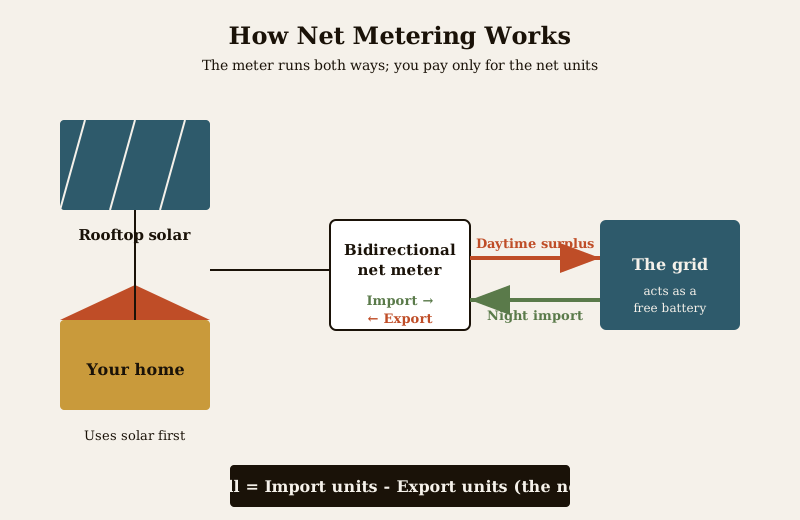
In a net metering arrangement, your home uses solar power directly. Any surplus your panels make beyond what the house is using at that instant flows out to the grid and is recorded as an export. When the panels fall short, at night or under cloud, you draw from the grid and that is recorded as an import. A bidirectional meter (also called a net meter) counts both.
At the end of the billing cycle the DISCOM subtracts the units you exported from the units you imported. You are billed for the difference, the net consumption. If you exported more than you imported, you build up a credit in units (kWh), which carries forward. In effect the grid behaves like a free battery that stores your midday surplus and gives it back in the evening, unit for unit.
That one-for-one, unit-against-unit offset is the whole point. Because a unit you export cancels a unit you would have bought at the full retail tariff, every unit your roof makes is worth the same as a unit you avoid buying. That is what gives grid-tied rooftop solar its strong payback.
Net metering vs gross metering vs net billing
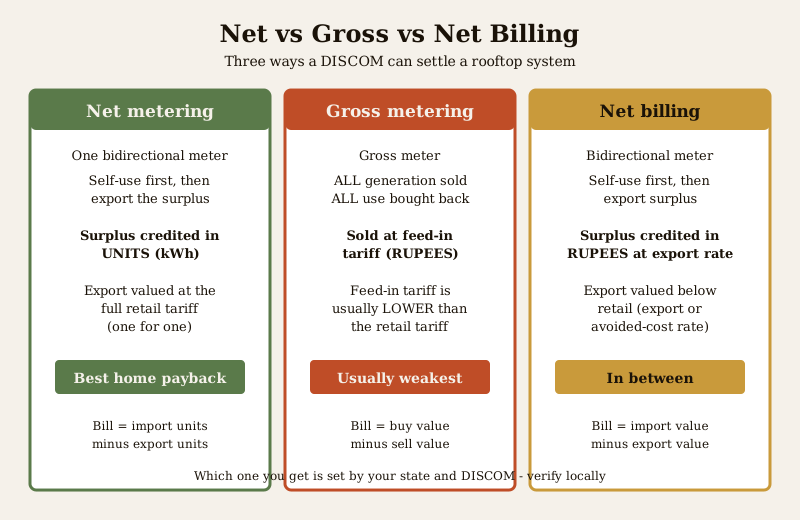
Net metering is not the only way a DISCOM can settle a rooftop system, and the alternative usually pays less for a home. It helps to see the three side by side.
- Net metering. The meter runs both ways. Your solar first serves the house; only the surplus is exported and it is netted, unit for unit, against your imports at the retail tariff. You pay for the net. Best for homes, because self-consumed units are valued at what you would otherwise pay.
- Gross metering. Two separate meters, or a gross meter, record things apart. All of your generation is sold to the DISCOM at a fixed feed-in tariff (FiT), and all of your consumption is bought back at the normal retail tariff. Nothing is self-consumed on paper. Because the feed-in tariff is typically lower than the retail tariff you pay, gross metering is usually less attractive for a home, though it can suit a site that exports almost everything.
- Net billing (behind the meter). A hybrid of the two. You self-consume what you can, but exported surplus is credited in rupees at an export rate (often the feed-in tariff or the DISCOM's avoided-cost rate), not in units at the retail tariff. Your bill is the value of imports minus the value of exports. Because export is valued below retail, net billing sits between net and gross metering in how well it pays.
| Feature | Net metering | Gross metering | Net billing |
|---|---|---|---|
| Meter | One bidirectional | Gross (all generation) | One bidirectional |
| Self-consumption counted | Yes, first priority | No, all sold | Yes, first priority |
| Surplus credited in | Units (kWh) | Rupees at feed-in tariff | Rupees at export rate |
| Export valued at | Retail tariff (one for one) | Feed-in tariff (usually lower) | Export or avoided-cost rate |
| Typical home outcome | Best payback | Usually weakest | In between |
| Best suited to | Most homes | Sites that export nearly all | Where net metering is capped or withdrawn |
Which of the three you are offered is not your choice alone, it is set by your state regulator and DISCOM, and some states apply different arrangements above and below a certain system size. This is the single biggest reason to verify local rules before you assume a payback.
How the bidirectional meter and the bill work
The bidirectional meter has two registers, one totalling import and one totalling export. On billing day the DISCOM reads both. Your energy charge is based on import minus export for the period. Note that certain fixed charges tied to your sanctioned load, and in some states additional levies, are generally billed regardless of how much you export, so a well-sized system can shrink your energy charge to almost nothing while a small fixed component remains. Always read a sample post-solar bill from your own DISCOM to see exactly which lines net off and which do not.
Monthly settlement, annual settlement and year-end surplus
Netting can happen over two horizons, and both usually apply.
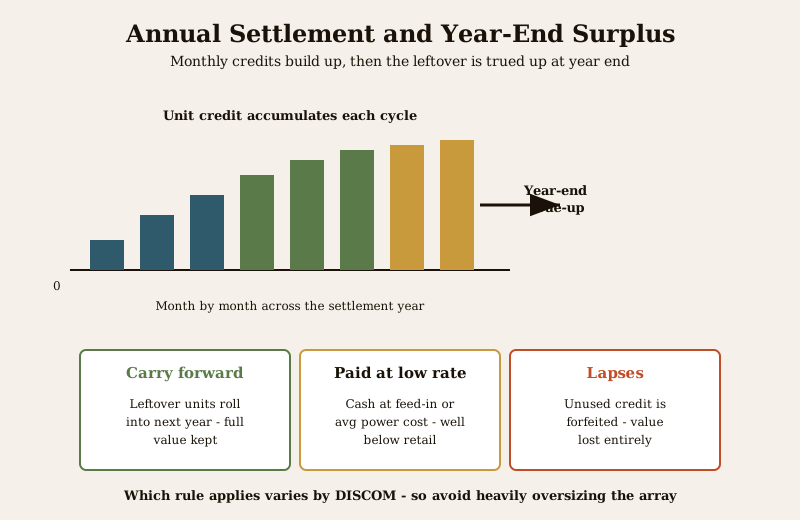
- Within each billing cycle (monthly or bi-monthly), exports offset imports directly. Excess export beyond your import for that cycle rolls forward as a unit credit to the next cycle.
- At the end of a longer settlement period (commonly a financial year, but the date and rule vary), any credit still unused is trued up. This is where states differ most:
- Many pay out the leftover surplus in cash, but at a low rate, often the average power purchase cost or feed-in tariff, well below the retail tariff.
- A few simply lapse unused credit at year end.
The practical lesson is to avoid heavily oversizing a net-metering system so that you generate far more than you use across the year. Those extra units are the ones most likely to be paid out at a low rate or lost, rather than offset at full retail value. Sizing the array close to your annual consumption keeps the most units working at the one-for-one rate. Model it before you commit with the solar payback and ROI calculator.
Capacity caps and sanctioned-load rules
DISCOMs limit how large a net-metered rooftop system you may connect, and the limit is usually tied to your sanctioned load or contract demand, sometimes expressed as a percentage of it. Two common shapes of rule are:
- A cap in kW for a category of consumer, or a cap set as a proportion of your sanctioned load, so your system cannot be larger than the grid connection is designed to absorb.
- A limit tied to the local transformer capacity, so the DISCOM can refuse or defer connection if the feeder is already carrying a lot of rooftop export.
If your desired system is bigger than the net-metering cap, states often push the excess onto net billing or gross metering instead. This is another reason to confirm the numbers locally: the cap decides how much of your roof can earn at the best rate. Your installer checks your sanctioned load and the feeder headroom as part of the approvals process.
Why net metering, not gross, is what makes home solar pay
Put the two together and the reason home buyers should care about which arrangement they get becomes clear. Under net metering, a unit your roof makes is worth a full retail unit, whether the house consumes it directly or exports it and pulls it back later. Under gross or net billing, the exported portion is worth only the feed-in or export rate, which is typically well below retail. For a normal home that self-consumes a good share of its generation, net metering therefore returns markedly more value per unit and shortens payback, often by years. That is why, when people say rooftop solar pays for itself, they are almost always assuming net metering.
What affects your savings
Two homes with identical panels can see very different bills. These are the levers.
| Factor | Effect on your savings |
|---|---|
| Metering type (net vs gross vs net billing) | Largest single lever; net metering values exports at full retail, the others below it |
| Your retail tariff and slab | Higher tariffs make each offset unit worth more |
| Self-consumption share | The more solar you use as it is made, the more you save even before export |
| System size vs annual use | Right-sizing avoids low-rate payout or lapse of surplus |
| Year-end settlement rule | Carry-forward preserves value; low-rate payout or lapse erodes it |
| Fixed charges and levies | These often remain on the bill regardless of export |
| Load pattern (day vs night) | Daytime-heavy homes self-consume more; night-heavy homes rely on netting |
| Meter and interconnection quality | A correctly configured bidirectional meter records exports accurately |
Applying for net metering
You do not file for net metering yourself. Your licensed solar installer submits the application to your DISCOM, and in the great majority of cases this is now folded into the PM Surya Ghar Muft Bijli Yojana flow on the national rooftop portal, alongside the subsidy claim. The DISCOM approves the connection, inspects the installation, and swaps your ordinary meter for a bidirectional one. Your job is to understand which arrangement you are being offered, check it against the caps for your sanctioned load, and confirm the settlement rule, so that the savings you were promised are the savings the tariff actually delivers.
Key takeaways
- Net metering runs the meter both ways and bills you on the net units, valuing exports one for one at the retail tariff. It is what makes home rooftop solar pay.
- Gross metering sells all generation at a lower feed-in tariff and buys all consumption at retail, usually the weakest deal for a home. Net billing credits surplus in rupees at an export rate, sitting in between.
- Netting happens each cycle and again at an annual true-up. Year-end surplus may be carried forward, paid out at a low rate, or lapse, so avoid heavily oversizing.
- Capacity caps are tied to your sanctioned load and the local feeder; the cap decides how much of your roof earns at the best rate.
- The arrangement, caps, tariffs and settlement rules vary by state and DISCOM and change. Verify locally before you count on a payback.
- The installer files the application with the DISCOM, usually within the PM Surya Ghar process; the meter change and interconnection are their licensed work.
Where to go next
- The full rooftop picture: Rooftop Solar Guide.
- The application flow, step by step: Rooftop Solar Approvals and Net Metering.
- The subsidy that usually rides alongside it: PM Surya Ghar Subsidy Guide.
- The system-type decision behind it all: Grid-Tied vs Off-Grid Solar.
- Model the numbers: Solar Payback and ROI Calculator.
- More on wiring and connections: the Electrical and Wiring hub.
References
- Ministry of New and Renewable Energy (MNRE), rooftop solar programme and PM Surya Ghar Muft Bijli Yojana: https://mnre.gov.in/
- National rooftop solar portal (PM Surya Ghar), application and net-metering guidance: https://pmsuryaghar.gov.in/
- Your State Electricity Regulatory Commission net-metering / net-billing regulations and your DISCOM tariff order (state-specific; check the current version).
Metering arrangements, capacity caps, feed-in and export rates, settlement periods and year-end surplus rules are set state by state, differ between DISCOMs, and change. Every figure and rule here is indicative only. The net-metering application is filed by a licensed installer with your DISCOM, and the meter change and grid interconnection are licensed work. Verify the current terms with your DISCOM and on the national rooftop portal before relying on them.
Export this guide
Related Guides — Deep-dive reading
Rooftop Solar Approvals & Net Metering in India: The Permissions You Actually Need
The approvals side of putting solar on an Indian roof — not how solar works, but the permissions: the DISCOM net-metering application and feasibility, an empanelled installer, the structural load check, the electrical safety inspection, the PM Surya Ghar subsidy, and metering and commissioning. These are DISCOM, state and MNRE rules — not one national IS code — so amounts and caps change; always confirm the current rule locally.
RoofingRooftop Solar for Indian Homes: The Complete Guide
How rooftop solar actually works and pays back — the panels, inverter and net meter, the on-grid, off-grid and hybrid choice, how much roof and money a system needs, the PM Surya Ghar subsidy and net metering, and how to judge a good installation.
Electrical & WiringPM Surya Ghar Subsidy: The Rooftop Solar Scheme Explained (2026)
What the PM Surya Ghar Muft Bijli Yojana pays for home rooftop solar, the slab-based subsidy by system size, who is eligible, and the step-by-step portal-to-bank application -- with every rate flagged as indicative and to be verified officially.
Solar & EnergyRelated Tools — Try Free
Solar CCTV Sizing Calculator
Enter cameras, sun-hours and backup days to get the solar panel wattage, battery Ah and an indicative kit cost for an off-grid camera.
Solar SizingSolar Sizing Calculator
Size a rooftop solar system from your monthly electricity use — the kW system, number of panels, roof area and yearly generation.
SolarElectrical Load Calculator
Estimate a home's connected load and realistic maximum demand from its appliances, whether it needs single or three-phase supply, and a suggested main switch rating.
Electrical