
Thread Sealant for Pipes in India: PTFE Tape, Liquid Thread Sealant, Pipe Paste and Hemp Explained
Threaded plumbing joints leak unless the threads are sealed. Here is what PTFE (Teflon) tape, anaerobic liquid thread sealant, pipe-joint compound and traditional hemp-and-paste actually do, which suits GI, brass and valve joints, how many wraps of tape and in which direction, and why threaded joints weep.
Every screwed plumbing joint in an Indian home — the GI riser, the brass tap connector, the valve on the tank line — depends on something you cannot see once it is tightened: a thread sealant for pipes. The threads themselves do not make a watertight seal. They are a spiral gap, and without a sealant filling it, the joint weeps. This guide explains the four sealants a homeowner actually meets, which one belongs on which joint, and the small technique — number of wraps, and which way to wind the tape — that decides whether a joint stays dry.
This is a jointing guide in the Studio Matrx Plumbing hub. It is about the consumable and the technique, not the pipe: for the pipes and fittings themselves see GI pipes, for the bigger picture of how pipes are joined see plumbing jointing methods, for the components you screw onto lines see plumbing valves, and if a joint is already weeping see plumbing leak detection.
Why threaded joints need a sealant at all
A threaded plumbing joint uses BSP threads — British Standard Pipe. The male thread on the pipe end is usually tapered (BSPT), so it wedges tighter as it screws into the fitting. That taper does most of the mechanical grip, but the crests and roots of the two threads never meet perfectly. Left dry, a fine helical channel spirals right through the joint, and water finds it.
The sealant does two jobs:
- Fills the helical gap so there is no continuous leak path through the threads.
- Lubricates the threads as you tighten, letting the taper pull up snug without galling, and lets you dismantle the joint later.
A thread sealant is not glue and it is not there to hold the joint together — the taper thread does that. The sealant only fills the spiral gap the threads leave behind.
This is a different job from solvent cement on CPVC/UPVC (which chemically welds plastic sockets) or compression and push-fit connections (which seal on a rubber ring). Thread sealants are only for screwed metal threads — GI, brass, gunmetal, stainless — and the plastic threaded adaptors that mate to them.
The four sealants you will meet
1. PTFE (Teflon) tape — the everyday default
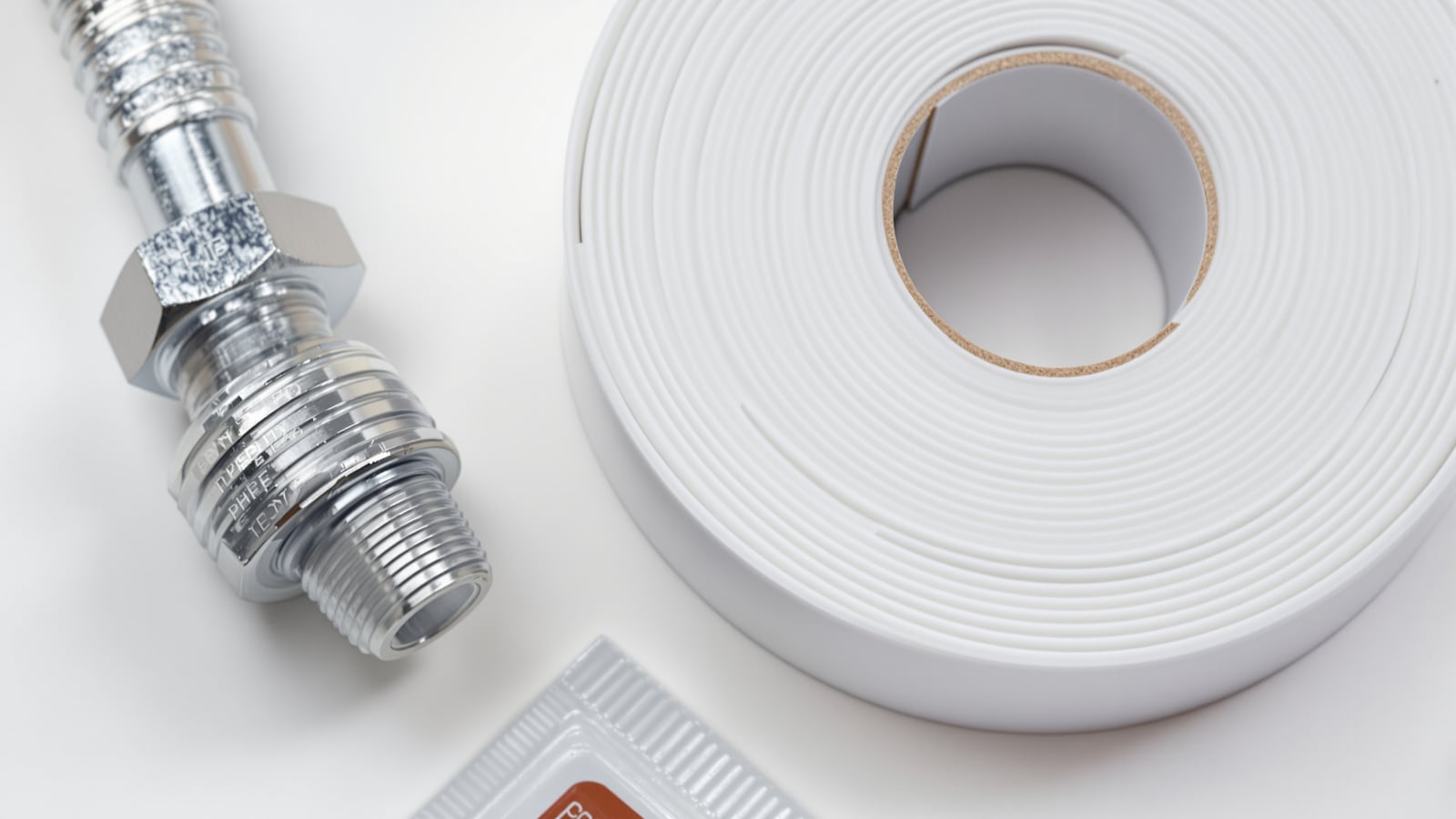
PTFE thread-seal tape is the thin white tape wound onto the male thread. PTFE (polytetrafluoroethylene, the "Teflon" family) is slick and chemically inert; the tape conforms into the thread gap and seals as the joint pulls up. It is cheap, clean, needs no cure time and dismantles easily — which is why it is the homeowner's default for water joints.
- Best for: general water connections — tap and mixer inlets, brass hose connectors, GI and brass fittings, small valves.
- Comes in grades. Ordinary white domestic tape is thin; a thicker "gas" grade (often yellow, PTFE for gas) exists for gas threads. Use the grade meant for the service.
- Limits: on a badly cut or worn thread the tape alone may not fill the gap, and over-wrapping can actually stop the taper pulling up.
2. Anaerobic liquid thread sealant — the thread-locker family
This is a paste or gel from a tube (the same anaerobic chemistry as a thread-locker). It is applied to the thread, stays workable in air, then cures to a tough seal only inside the joint where air is excluded, per the product's printed instructions. It resists vibration and gives a firmer, more permanent seal than tape.
- Best for: valves, pumps, appliance and metal fittings where you want a leak-proof, vibration-resistant joint and are happy for it to be semi-permanent.
- Match the grade to the pipe size and to whether you want it removable or high-strength — read the tube.
- Follow the printed cure guidance before pressurising; give it the time the maker specifies.
3. Pipe-joint compound (pipe dope / thread paste) — the brush-on paste
A soft non-setting paste, brushed onto the thread, that fills the gap and stays pliable. It never fully hardens, so joints come apart easily years later, and it doubles as thread lubricant. Many plumbers use it together with PTFE tape on larger metal joints.
- Best for: larger GI/metal threaded joints, unions, and jobs you may want to open again.
- Confirm the paste is rated for potable water before using it on a drinking-water line.
4. Hemp (jute yarn) and paste — the traditional method
The old-school seal: strands of jute/hemp yarn wound into the thread and smeared with a jointing paste (traditionally zinc-based). Wound the right way, it packs the gap solidly and is very reliable on big GI joints — but it is skilled, messy work and is steadily giving way to tape and liquid sealants.
- Best for: large-bore GI joints and borewell/riser work in the hands of an experienced plumber.
- On modern small brass fittings it is overkill; PTFE tape is cleaner and faster.
Which sealant for which joint
| Sealant type | Best for | Notes |
|---|---|---|
| PTFE (Teflon) tape | Taps, mixers, brass connectors, GI & brass water fittings, small valves | Cheap, clean, no cure time, dismantles easily; wrong wrap direction or too many wraps causes leaks; use gas-grade for gas |
| Anaerobic liquid thread sealant | Valves, pumps, appliance and metal fittings, vibrating joints | Cures inside the joint where air is excluded; strong and vibration-proof; semi-permanent; observe printed cure time |
| Pipe-joint compound (paste / dope) | Larger GI/metal joints, unions, joints you may reopen | Non-setting, stays pliable, easy to dismantle; often used with tape; check it is potable-water rated |
| Hemp / jute yarn + paste | Large-bore GI joints, borewell and riser work | Traditional, very reliable in skilled hands; messy and slow; overkill on small brass fittings |
A useful rule of thumb: water and dismantle-able → PTFE tape; valves and pumps that must not weep → anaerobic liquid; big metal and unions → paste (often with tape); gas → the correct gas-rated tape or a gas-approved sealant, never assume.
How to use PTFE tape: wraps and direction
This is where most DIY joints fail — not the material, the technique. Getting the tape right is simple once you know the two rules.
1. Clean and dry the male thread. Wipe off old tape, paste, grit and water. Fresh tape will not seal over a dirty or wet thread.
2. Start one or two threads back from the tip, not right at the end, so no tape frays into the pipe bore and into your water.
3. Wind in the same direction the fitting screws on. Hold the male end toward you: wrap the tape clockwise (to the right) around it. Because you screw the fitting on clockwise too, the tightening action pulls the tape tighter into the thread instead of peeling it off. Wrapping the wrong way unwinds the tape and the joint leaks.
4. Keep the tape taut and let it bed into the thread valleys. Stretch it slightly so it conforms to the thread profile.
5. Use enough wraps. For ordinary domestic white tape, roughly three to five wraps on a small water thread is the usual range — enough to fill the gap, not so much that the fitting will not pull up on its taper. Thicker gas-grade tape needs fewer. Feel it as you tighten.
6. Screw the fitting on by hand, then snug with a spanner or wrench. Do not crank it as hard as you can — see over-tightening below.
Water vs gas — do not mix them up
Water and gas are different jobs. Do not seal a gas thread with ordinary domestic water tape or a random paste. Gas work should use a gas-rated thread tape (the thicker grade) or a sealant explicitly approved for gas, and in India any LPG/PNG gas pipework should be handled by an authorised gas fitter, not treated as a DIY job. When in doubt on gas, stop and call the agency.
For drinking-water lines, use sealants rated as suitable for potable water — PTFE tape is inert and fine; confirm any paste or liquid on the label before it touches a supply line.
Why threaded joints leak — the common causes
Most weeping joints trace back to one of these, not to the choice of sealant:
- Wrong tape direction — wound anticlockwise, so tightening peels the tape off.
- Too few wraps on a coarse or worn thread — not enough material to fill the gap.
- Too many wraps — the fitting cannot seat on its taper; it feels tight but never truly seals, and the extra bulk can even crack a brass or plastic fitting.
- A damaged or over-cut thread — a die run too deep, or a cross-threaded start; no sealant fixes a wrecked thread.
- Dirt, water or old sealant left on the thread, so fresh tape cannot bed in.
- Under-tightening (hand-tight only, no spanner turn) or over-tightening (splitting the fitting or crushing the thread).
- Wrong sealant for the service — water tape on gas, a non-potable paste on a drinking line, or tape alone on a joint that needed paste too.
- Old tape reused — always cut off the old tape and re-wrap when you remake a joint.
| Common leak cause | What is happening | The fix |
|---|---|---|
| Tape wound the wrong way | Tightening peels the tape off the thread | Re-wrap clockwise, the way the fitting screws on |
| Too few wraps | Not enough material to fill a coarse or worn thread | Add a wrap or two, or add paste under the tape |
| Too many wraps | Taper cannot seat; fitting can crack | Strip back, use fewer wraps, seat on the taper |
| Damaged or cross-threaded thread | No sealant can bridge a wrecked thread | Replace the pipe end or fitting |
| Dirty or wet thread | Fresh sealant will not bed in | Clean and dry, remove old tape, re-do |
| Under- or over-tightened | Loose weeps; over-tight splits the fitting | Hand-tight then a controlled spanner turn |
If a joint keeps weeping after a proper re-wrap, the thread itself is probably damaged and the pipe end or fitting needs replacing — chasing it with more tape only wastes time. For finding a slow, hidden weep before it stains a ceiling, see plumbing leak detection.
The homeowner's takeaway
- Keep a roll of PTFE tape in the house — it handles almost every small water joint.
- Wind it clockwise, three to five wraps, on a clean, dry thread, starting a thread back from the tip.
- Reach for liquid thread sealant on valves and pumps that must not weep, paste on big GI and unions, and leave hemp-and-paste to an experienced plumber on large joints.
- Treat gas as a specialist job with the correct gas-rated sealant.
Get the material and the wrap direction right and a threaded joint stays dry for years. For how these joints sit among the other ways pipes are put together, read the plumbing jointing methods guide; for the pipe they most often seal, see GI pipes; and for the components you screw onto a line, the plumbing valves guide.
Export this guide
Related Guides — Deep-dive reading
Pipe Jointing Methods in India: Solvent, Threaded, Fusion, Soldered & Push-Fit
How every plumbing pipe material is actually joined — solvent cement for PVC/CPVC/uPVC, threaded joints for GI and metal, heat fusion for PPR and HDPE, soldering and brazing for copper, compression and push-fit for quick work, flanged connections for large bore, and rubber-ring socket-and-spigot for drains. Which method suits which material, how reliable each is, and the skill it demands.
PlumbingBathroom Leak Repair in India: Find & Fix Common Leaks (2026)
A practical, India-first guide to finding and fixing the everyday bathroom leaks — dripping taps, weeping traps and angle valves, a running cistern, failed silicone seals — plus how to tell a simple fixture leak from a waterproofing failure that needs a professional.
BathroomsSolvent Cement for Pipes: How PVC & CPVC Joints Are Welded, Not Glued
The milky 'glue' in the little tin is not glue at all — it chemically fuses two plastic pipes into one. Here is what solvent cement and primer actually do, the correct step-by-step for PVC, CPVC and uPVC, the CPVC vs PVC differences, the mistakes that cause weeping joints, and how to read the tin's set and cure times.
PlumbingRelated Tools — Try Free
Before & After Studio
Generate AI before-and-after renders to preview how your redesign could look.
DesignAIPlumbing Pressure-Test & Leak Checklist
Pre-closure pressure and leak test — 9 categories, 60+ checkpoints across water supply, drainage, fixtures, waterproofing, hot water, tanks.
Pre-Closure TestRainwater Tank Sizer
How big should your rainwater tank be? Computes annual harvest, recommended tank capacity in litres, water-bill savings, and payback — for 10 Indian cities.
RWH Calculator