
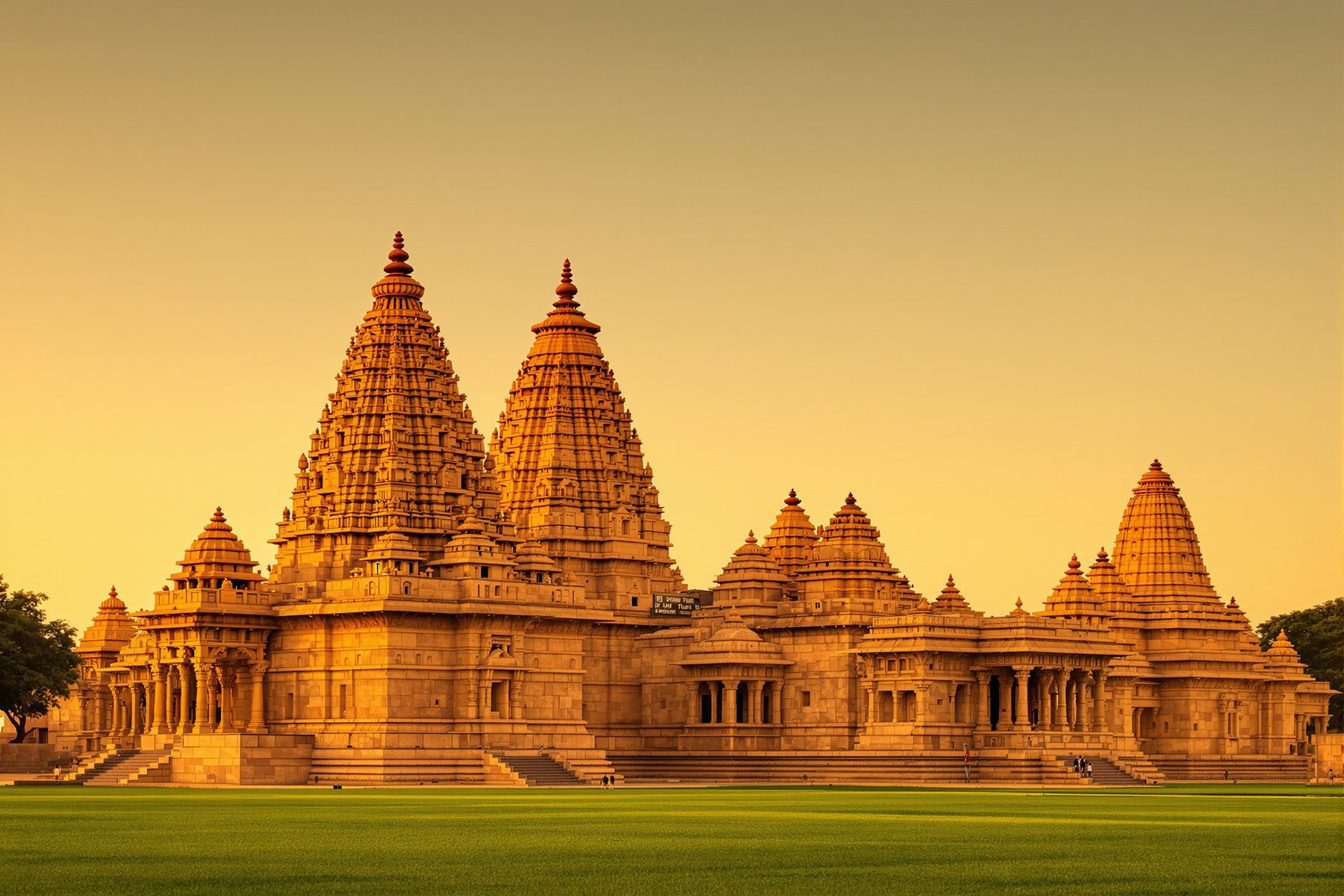
Pattadakal: Where India's Two Temple Grammars Meet
How the 8th-century Chalukyas built the temple at last in the open air — and set the curved spires of the North beside the stepped towers of the South, on one riverbank, as if in a single open-air showroom of styles. The site that crowned kings, named its architects, and gave Ellora its model.
In the last article we watched the South Indian temple being _invented_ in the rock at Badami. Walk a few kilometres along the Malaprabha river, and you reach the place where the Chalukyas took what they had learned in the cliff and finally built it in the open air — freestanding, in dressed stone, stone upon stone. That place is Pattadakal, and it is one of the most quietly extraordinary sites in the architectural world.
What makes it extraordinary is not a single great building. It is that, on one riverbank, the Chalukyas set the curved spires of the North directly beside the stepped towers of the South — the two great, separate grammars of the Indian temple, built side by side, by the same dynasty, in the same generation, as if someone had assembled a deliberate open-air showroom of styles. There is nowhere else quite like it.
This is the seventh article in our Architectural Wonders series, and it is the confluence of the Indian story so far — the place where the threads of Badami, Brihadeeswara and the next wonder we will visit, Ellora, all cross.
1. Ten temples on one riverbank
Pattadakal sits on the west bank of the Malaprabha, in the Bagalkot district of Karnataka, and it flourished as a royal centre of the Chalukyas in the 7th and 8th centuries. Clustered together on its grassy terrace stand about ten temples — nine Hindu (all dedicated to Shiva) and one Jain a little apart — inscribed together as the Group of Monuments at Pattadakal, a UNESCO World Heritage Site since 1987.
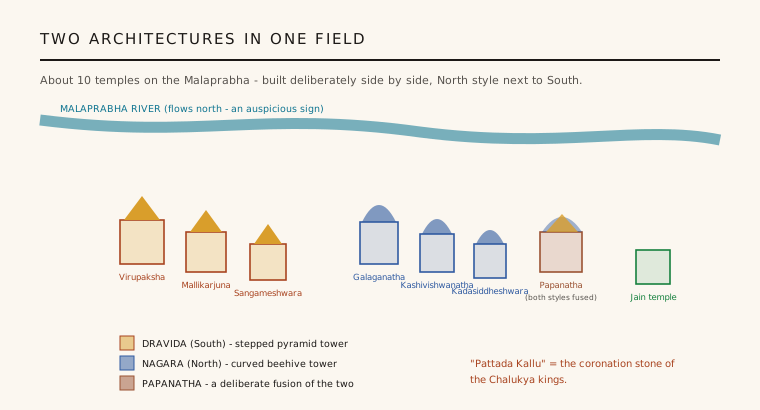
The grouping is the whole point. Four of the temples are built in the southern Dravida style, four in the northern Nagara style, the Papanatha temple deliberately fuses the two, and the Jain temple stands a little to one side. To stand in the middle of Pattadakal is to stand between two architectural civilisations at once.
2. The two grammars of the tower
If you learn only one thing at Pattadakal, learn to read the difference between the two towers — because that difference is the master-key to all of Indian temple architecture.
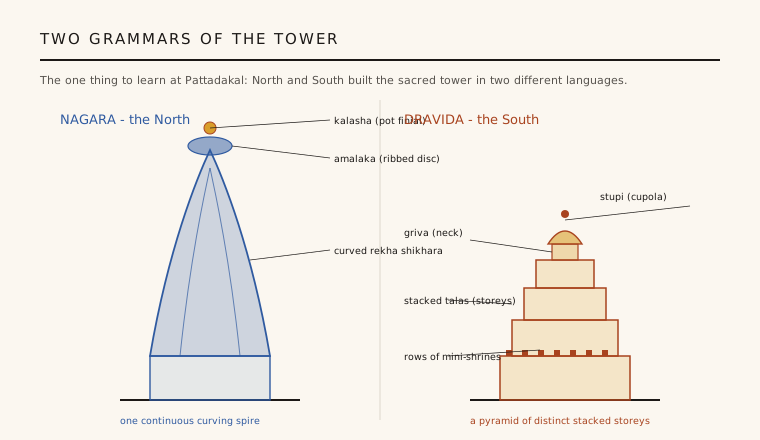
The northern Nagara tower — the _rekha-shikhara_ — is a single, continuous curving spire: a tall beehive or sugarloaf shape with gently bulging sides, ribbed by vertical bands, and crowned at the top by a ribbed cushion-like stone disc (the amalaka) and a pot finial (the kalasha). It reads as one soaring upward sweep.
The southern Dravida tower — the _vimana_ — is the opposite idea: a stepped pyramid of distinct, receding storeys (the _talas_), each storey edged with a parapet of tiny miniature shrines, the whole capped by a small octagonal neck (the _griva_) and a domed cupola (the _stupi_). It reads as a clear, countable stack.
One is a flowing curve; the other is an ordered pyramid. Once you can tell them apart, the whole of India's sacred skyline opens up — and Pattadakal is the one place built to teach you both in a single afternoon. The mature Dravida vimana here is the direct ancestor of the 216-foot tower at Brihadeeswara; the Nagara shikhara is the cousin of the great temples of the North.
3. The Virupaksha: a victory carved in stone
The largest and finest of the temples is the Virupaksha, and its story binds together politics, art and the whole sweep of this series.
It was commissioned around 740 CE by Queen Lokamahadevi to commemorate the victory of her husband, the Chalukya emperor Vikramaditya II, over the Pallavas of Kanchipuram — the Chalukyas' great southern rivals. It is a fully developed Dravida temple: a detached Nandi pavilion, a great pillared hall whose columns are carved with entire epics (the Ramayana and Mahabharata told in stone), and the sanctum beneath a stepped vimana.
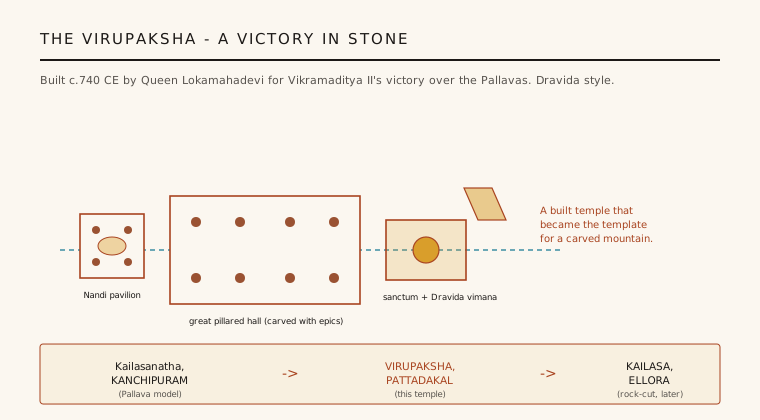
And here is the detail that makes the Virupaksha a true hinge of Indian architecture. In conquering the Pallavas, the Chalukyas had seen the great Kailasanatha temple at Kanchipuram — and the Virupaksha was consciously modelled on it, the victor borrowing the architecture of the vanquished. Then, a generation or two later and a long way north, the Virupaksha _itself_ became the model for the most astonishing building in India: the Kailasa temple at Ellora, an entire Dravida temple carved top-down out of a single mountain. A built temple at Kanchi became a built temple at Pattadakal became a _carved_ temple at Ellora. The idea travelled, and grew, and changed state from stone-assembled to rock-released — which is exactly where this series goes next.
4. Named builders, crowned kings
Two further things set Pattadakal apart, and both speak directly to anyone who makes buildings.
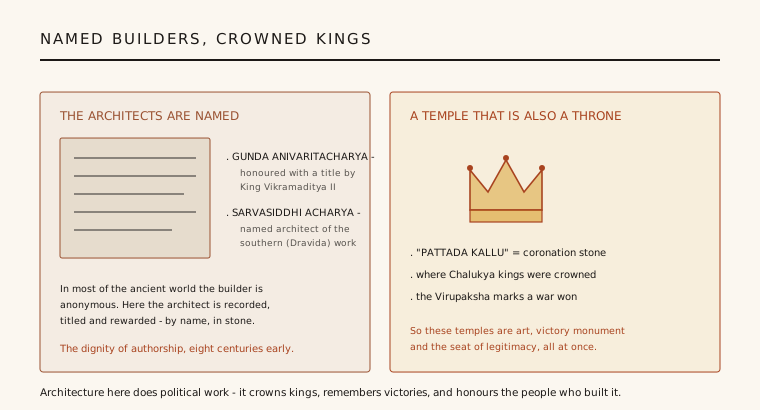
The first is that the temples name their architects. In most of the ancient world the builder is anonymous; the king is remembered and the genius who designed his monument is forgotten. Not here. Pattadakal's inscriptions record the master architects by name — Gunda Anivaritacharya, honoured with a special title by King Vikramaditya II himself, and Sarvasiddhi Acharya, credited with the southern (Dravida) work. To see an architect titled and rewarded _in the building's own inscription_, twelve hundred years ago, is one of the earliest and most moving assertions of the dignity of authorship in the history of the craft.
The second is in the name itself. Pattadakal comes from _Pattada Kallu_ — the "coronation stone." This was the place where Chalukya kings were ceremonially crowned. So these temples are not only works of art and not only a victory monument; they are the seat of royal legitimacy itself, the spot where power was made sacred. Architecture here is doing political work of the highest order — crowning kings, remembering wars, and, unusually, honouring the hands that built it.
5. The confluence
Step back, and Pattadakal reveals itself as a confluence — a meeting of waters, fittingly, for a site on a riverbank.
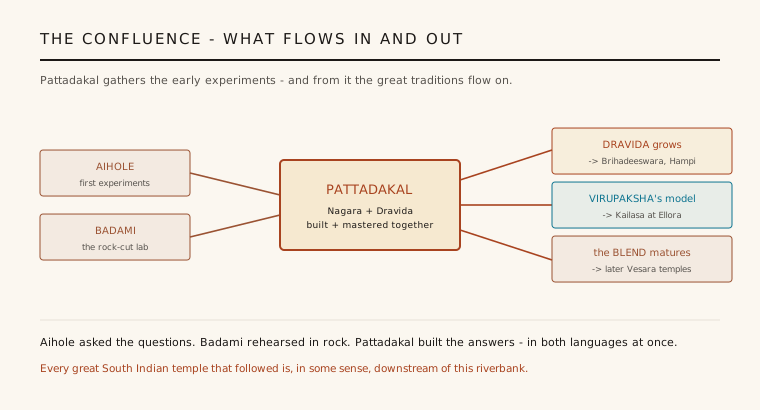
Into Pattadakal flow the early experiments at Aihole and the rock-cut rehearsals at Badami. At Pattadakal the two grammars are not just tried but mastered, side by side, in built stone. And out of Pattadakal the traditions flow onward: the Dravida line that swells, over the centuries, into Brihadeeswara and the temple-cities of Hampi; the Virupaksha that becomes the template for Kailasa at Ellora; and the deliberate blending of north and south that would one day mature into the ornate Vesara temples of the later Deccan. Aihole asked the questions. Badami rehearsed in rock. Pattadakal built the answers — in both languages at once. Nearly every great temple of South India that came after is, in some real sense, downstream of this riverbank.
6. What a modern architect can learn from Pattadakal
- Put the alternatives side by side. Pattadakal's deepest lesson is the value of building two answers next to each other and letting them be compared. The honest display of competing approaches — North beside South, curve beside pyramid — is how a discipline learns. Don't hide your alternatives; set them in the same field and look hard.
- Learn from your rivals. The Virupaksha is a victory monument that openly copies the architecture of the defeated enemy. Mastery has no pride about where a good idea comes from; the strongest traditions are magpies.
- Name the maker. That Pattadakal honoured its architects in stone is not a footnote — it is a statement about whose work matters. A culture that records its builders is a culture that takes building seriously. (It is the same respect for authorship our design education writing keeps insisting on.)
- Buildings carry power, not just function. A coronation stone, a victory temple: architecture here is doing political and civic work, shaping legitimacy and memory. The best public buildings still know they mean something beyond their use.
- A great site can be a teaching collection. Pattadakal works because it is legible — a curated set you can read against itself. Sometimes the most useful thing to build is not one perfect object, but a clear comparison.
References & further reading
1. UNESCO World Heritage Centre — Group of Monuments at Pattadakal (inscribed 1987). https://whc.unesco.org/en/list/239/
2. Archaeological Survey of India — Group of Monuments at Pattadakal. https://asi.nic.in/pages/WorldHeritagePattadakal
3. Ministry of Culture, Government of India — Group of Monuments at Pattadakal. https://culture.gov.in/group-monuments-pattadakal
4. Encyclopaedia Britannica — Chalukya dynasty and Pattadakal. https://www.britannica.com/topic/Chalukya-dynasty
Last verified 2026-06-30. Dates, dedications and style attributions follow standard archaeological and ASI reference sources; the c.740 CE dating and royal patronage of the Virupaksha, the named architects, and the Kanchipuram-to-Pattadakal-to-Ellora model lineage follow the inscriptions and established art-historical scholarship.
Export this guide
Related Guides — Deep-dive reading
Badami: The Cradle of the South Indian Temple
How 6th-century Chalukya carvers, still working into a red sandstone cliff like the cave-makers before them, designed the porch, hall and sanctum that every later South Indian temple would copy — and shared one cliff between Shiva, Vishnu and the Jain Tirthankaras. The rock-cut laboratory where Dravidian architecture was born.
Architectural WondersAihole: The Laboratory of the Indian Temple
How a small Chalukya town on the Malaprabha became the cradle of Indian temple architecture — a workshop of some 125 temples where the builders tried every roof and every plan, made the first drafts and the odd experiments, and slowly figured out what a temple should be. The questions that Badami and Pattadakal would answer.
Architectural WondersKailasa at Ellora: A Mountain Carved into a Temple
How 8th-century carvers made the largest monolith on earth — a complete multi-storey Dravidian temple, gateway to spire, released top-down from a single basalt hill with no scaffolding and no chance to correct a mistake. The supreme act of subtraction, and the climax of India's rock-cut story.
Architectural WondersRelated Tools — Try Free
Moodboard Builder
Build curated moodboards from your own images and a library of Indian-style references.
DesignAIAcoustic Privacy (STC) Visualizer
Indian healthcare acoustic visualizer — compare wall assemblies and noise sources, see received SPL after STC attenuation, and check FGI 2018 / IS 1950 / NABH speech-privacy compliance with live dual-canvas waveform.
Acoustic ToolConcept Generator
Get 3 AI-generated design concepts for any room with style, materials, and cost estimate.
DesignAI