
Open Well Water System in India: How Dug Wells Work, Yield, Quality and Care
The traditional dug well still supplies millions of Indian homes — how an open well taps the shallow aquifer, where it still makes sense, how to draw water with a monoblock or jet pump, what its seasonal yield really looks like, the contamination risks you must guard against, and how it stacks up against a borewell.
Long before the borewell rig arrived, the Indian home got its water from a hole dug by hand into the earth — the open well, or dug well. Millions of homes across Kerala, coastal Karnataka, Goa, Maharashtra and the rural belt still run on one. It is the oldest water source in the country and, in the right ground, still one of the most sensible. This guide explains how an open well water system actually works, where it earns its keep, how to draw and store the water safely, and how it compares to the borewell that has largely replaced it.
This is a supply-source guide inside the Studio Matrx Plumbing Knowledge Hub. It covers how water gets into the home from a dug well; how that water is then pushed around the house by gravity or pump is a separate story, laid out in the water supply systems guide and the flagship plumbing systems guide.
An open well is a window into the shallow aquifer. Because you can see the water, you also see the season change in it — the level rising after the monsoon and falling through summer — in a way a sealed borewell never shows you.
How an open well works
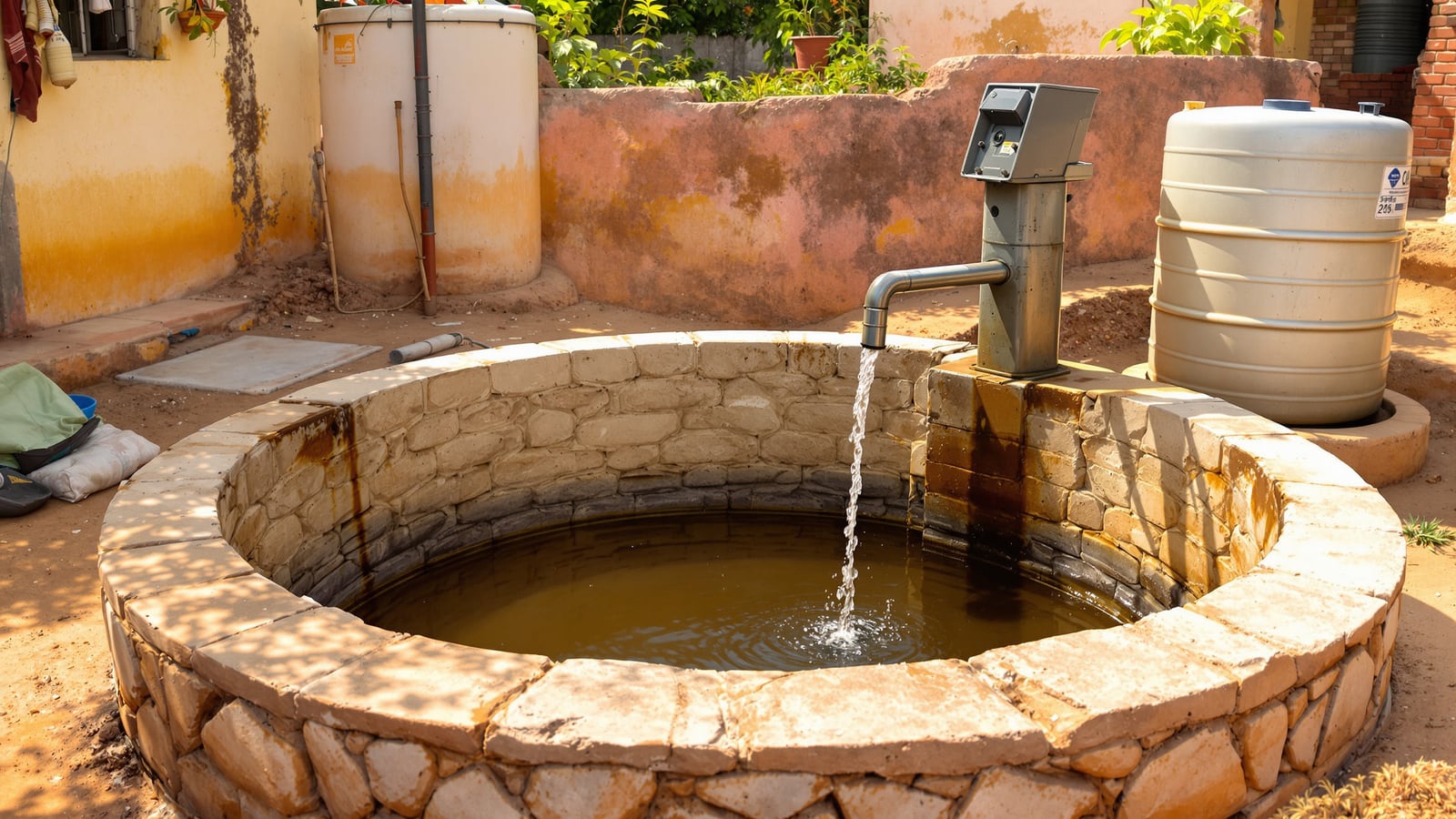
An open well is a wide, vertical shaft — typically 1 to 6 metres across and 6 to 15 metres deep — dug down until it meets the water table, the top of the shallow, unconfined aquifer that sits in the soil and weathered rock near the surface. Water seeps in through the sides and floor of the shaft and collects at the bottom, and you draw it from there.
Three features define the system:
- It taps a shallow, unconfined aquifer. Unlike a borewell that may punch 100 metres or more into deep confined rock, an open well feeds off water held in the top layers of soil, sand and weathered rock. That water is recharged directly by local rainfall, ponds and river seepage.
- The shaft is lined. In loose soil the walls are lined with stone masonry, brick, or precast concrete rings (a "ring well") to stop them caving in. In hard laterite — common in Kerala and the Konkan — a well often stands unlined because the rock holds itself.
- It recharges from the surface. Rain falling across the surrounding land percolates down and refills the well. This is its great strength and its great weakness at once: recharge is quick and cheap, but whatever is on the surface can travel down with it.
Because the aquifer is shallow, the well level tracks the rains closely. It fills within weeks of a good monsoon and can run low by the peak of a dry summer — behaviour every well owner learns to read.
Where an open well still makes sense
The open well has been widely displaced by the borewell, but it is far from obsolete. It remains the smart choice in specific conditions:
- High water table. Where groundwater sits close to the surface — coastal Kerala, coastal Karnataka, Goa, the Konkan, parts of the Ganga plain and river valleys — a shallow dug well reaches water without deep drilling.
- Laterite and soft-rock country. Kerala's laterite holds a stable, self-supporting shaft and yields steady seepage, which is exactly why the open well is the traditional Kerala house well.
- Rural and semi-urban plots with space. A dug well needs a wide footprint and a safe margin from septic tanks and drains, which large plots can provide.
- Where you value visible, rechargeable, low-tech water. No drilling rig, no deep submersible, parts anyone can maintain, and a source you can literally look into and inspect.
An open well also doubles neatly as a recharge structure: directing clean rooftop rainwater into or beside it lifts the level and improves quality. That overlap is covered in the forthcoming rainwater harvesting guide — see rainwater harvesting guide.
Where the water table is deep, or the ground is hard granite, or the plot is a tight urban site with contamination all around, a borewell is usually the better answer — compared head-to-head at the end of this guide and in the borewell water system guide.
Drawing water: rope-and-bucket to monoblock and jet pump
Traditionally water came up by rope and bucket, or a pulley, or a hand-operated lift pump. Today almost every home well runs an electric pump. The choice depends on how far the water sits below the pump.
- Monoblock (centrifugal) surface pump. The workhorse of the Indian open well. A motor-and-pump unit sits on the well edge or a nearby platform, with a foot-valve-fitted suction pipe dropped into the water. Cheap, simple and easy to service — but a surface pump can only suck water up about 7 to 8 metres at most (true suction lift is limited by atmospheric pressure). If the summer water level falls below that, it loses prime and runs dry.
- Jet (self-priming) pump. For deeper wells, a jet pump sends some water back down to a jet assembly near the water surface, which helps push water up to the pump. This extends effective lift to roughly 10 to 25 metres depending on the unit, keeping a deeper or seasonally low well working.
- Submersible / openwell-submersible pump. For deep wells or badly fluctuating levels, a submersible pump sits down in the water itself and pushes rather than sucks, so suction-lift limits no longer apply. It is the most expensive option and needs the water level to reliably cover it.
Most wells lift once into an overhead tank and then let gravity feed the house — the standard indirect arrangement. Sizing that pump to the well's depth and the tank height is its own subject, covered in the forthcoming water pumps guide.
| Lifting method | Practical lift | Best for | Rough cost (pump only) |
|---|---|---|---|
| Rope & bucket / hand pump | Any depth, low volume | Backup, tiny demand | ₹500 – ₹5,000 |
| Monoblock surface pump | Up to ~7–8 m suction | Shallow, high-water-table wells | ₹4,000 – ₹12,000 |
| Self-priming jet pump | ~10–25 m | Deeper wells, summer drop | ₹8,000 – ₹20,000 |
| Openwell submersible pump | Level dependent, pushes up | Deep or fluctuating wells | ₹12,000 – ₹40,000 |
Costs are indicative for domestic single-phase pumps; confirm current pricing and the right rating locally.
Yield and seasonal variation
An open well's yield — how much water it can give per day — is set by how fast the surrounding aquifer feeds water back into the shaft, not by how big the shaft is. A wide well simply stores more; it does not conjure more recharge. In good ground a domestic open well comfortably supplies a household, but the number swings hard with the season.
Planning demand is the easy half: Indian domestic design uses about 135 litres per person per day (lpcd) for a fully plumbed home (per CPHEEO guidance), so a family of four needs roughly 540 litres a day. The hard half is knowing the well can supply that in May, not just August.
| Season | Typical well level | Yield behaviour | What to do |
|---|---|---|---|
| Post-monsoon (Sep–Dec) | High, near full | Strong, recharges fast | Full supply; ideal time to test water |
| Winter (Jan–Feb) | Steady, gently falling | Reliable | Normal use |
| Pre-monsoon summer (Mar–May) | Low, may near bottom | Weak; can drop below suction | Ration; watch for the pump losing prime |
| Monsoon (Jun–Aug) | Rising | Recovers, may turn turbid | Let silt settle; recharge from rooftop |
The practical rule: judge a well by its summer low, never its monsoon high. A well that overflows in July but drops below the pump's suction in May is only a partial supply, and you will need a backup — a borewell, a municipal connection, or generous storage filled during the good months.
Water quality and contamination risks
This is where an open well demands respect. Because it draws from the shallow aquifer and recharges directly from the surface, it is far more exposed to contamination than a deep, sealed borewell. The very openness that makes it easy to inspect also lets trouble in.
The main risks:
- Surface runoff and drainage. Dirty rainwater, sullage and animal waste washing across the ground can carry straight into an uncovered or low-parapet well.
- Septic tanks and soak pits nearby. The classic hazard — bacterial contamination from a septic system too close by. Keep a well a safe separation from any septic tank, soak pit or drain (commonly advised at least 15 metres, more on sloping ground where the well is downhill); verify the required distance with your local authority.
- Falling debris, leaves and animals. An open mouth lets in leaves, dust, insects, frogs and rodents, all of which foul the water.
- Coastal salinity. Near the coast, over-pumping can pull saline water in from the sea (salt-water intrusion), turning a good well brackish.
Guarding water quality comes down to a few non-negotiables:
- Cover it. Fit a well cover / lid and a raised parapet (kerb) so surface water, debris and animals cannot enter. This single step prevents most contamination.
- Raise and slope the surround. A raised platform with the ground sloping away keeps dirty runoff out.
- Separate it from waste. Maintain the safe distance from every septic tank, drain and soak pit.
- Test the water — at least once a year, ideally post-monsoon. Get a lab test for bacteriological safety (coliform / E. coli) and key chemistry (nitrate, hardness, iron, chloride, TDS). Well water is often not safe to drink raw.
- Treat for drinking. For potable use, at minimum boil, or run drinking water through appropriate purification. Product-level treatment — RO, UV, softeners — sits in the treatment section; see smart water purifier. Keep the well side focused on keeping the source clean and stored safely.
An open well is only ever as safe as its cover, its surroundings and its last water test. Treat all three as routine, not optional.
Maintenance and desilting
A dug well is low-tech but not no-maintenance. Silt, leaves and organic matter settle at the bottom over the years, reducing depth, capacity and seepage. Left alone, a well slowly chokes.
- Desilting. Every few years — or after a heavy silt-laden monsoon — the well should be desilted: pumped down and the accumulated mud, sand and debris cleared from the bottom to restore depth and let the aquifer feed freely again. This is a specialist job with real confined-space danger from foul air; never send someone down without proper safety precautions and, ideally, professionals.
- Inspect and repair the lining. Check the stone or ring lining for cracks, loose stones or root intrusion, which can both weaken the shaft and let surface water shortcut in.
- Maintain cover and parapet. Keep the lid intact and the parapet high; repair any gap that lets debris fall in.
- Chlorinate after cleaning or floods. After desilting, or after floodwater has entered, disinfect the well (shock chlorination) and retest before drinking the water.
- Service the pump. Foot valves clog, and suction pipes develop air leaks that break the prime — a common reason a working well "suddenly goes dry." Check these before assuming the aquifer has failed.
Open well vs borewell at a glance
Neither is universally better; they suit different ground and different needs. Many Indian homes keep both — the open well for daily washing, gardening and recharge, the borewell as summer backup.
| Factor | Open (dug) well | Borewell |
|---|---|---|
| Depth | ~6–15 m (shallow aquifer) | Often 60–300 m (deep aquifer) |
| Diameter | Wide, 1–6 m | Narrow bore, ~100–200 mm |
| Recharge | Fast, local rainfall | Slow, deep, regional |
| Seasonal swing | High — visible summer drop | Lower, but can fall over years |
| Water quality risk | Higher (surface contamination) | Lower (sealed, deep) — but can carry fluoride/salinity |
| Pump | Monoblock / jet / openwell submersible | Deep submersible only |
| Inspection | Easy — you can see the water | None — sealed bore |
| Best suited to | High water table, laterite, Kerala/coastal | Deep water table, hard rock, tight sites |
| Storage / recharge use | Excellent — doubles as recharge pit | None |
Whatever the source, the water still has to reach your taps at a usable pressure. How that distribution is arranged — overhead tank and gravity, or a pressurised system — is set out in the water supply systems guide. And before you deepen, reline or re-plumb a well, get the work and the safe separations checked against your local groundwater and municipal rules by a licensed plumber and your local water authority.
References
- National Building Code of India (NBC) 2016, Part 9 — Plumbing Services — water supply and storage requirements.
- CPHEEO Manual on Water Supply and Treatment, Ministry of Housing and Urban Affairs — per-capita demand (lpcd), source protection and well design.
- IS 10500 — Drinking Water Specification — permissible limits for bacteriological and chemical water quality.
- Central Ground Water Board (CGWB) guidance on dug wells, shallow aquifers and artificial recharge.
Figures here are indicative for planning. Verify well depth, yield, pump sizing, safe separation from septic systems and water quality locally with a licensed plumber and your local water authority before you rely on the source.
Export this guide
Related Guides — Deep-dive reading
Plumbing Systems: The Ultimate Guide for Indian Homes & Buildings
The wide-angle pillar for the Studio Matrx Plumbing Knowledge Hub — what plumbing is, the two halves of every system (water supply and drainage/DWV), the whole-house water journey from source to fixture to drain, the main system types, and where conservation, building services and maintenance fit — with links down to every deeper guide.
PlumbingWater Supply Systems in India: How Water Reaches Every Tap in Your Home
The complete map of how water gets into an Indian home and out to every fixture — the sources it comes from, the sump-pump-overhead-tank storage model that buffers intermittent supply, how gravity and pressurised distribution differ, and the demand figures that size the whole thing.
PlumbingWater Pumps Guide for India: Types, How to Choose & Size (Head, Flow, Phase)
The master overview of domestic and building water pumps — what a pump actually does (lift plus pressure), the two numbers that decide everything (HEAD in metres and FLOW in LPM), a pump-type-to-use table, single vs three phase, priming, foot valve and NRV needs, dry-run protection, and BEE star rating with running cost at a glance for an Indian home.
PlumbingRelated Tools — Try Free
Rainwater Tank Sizer
How big should your rainwater tank be? Computes annual harvest, recommended tank capacity in litres, water-bill savings, and payback — for 10 Indian cities.
RWH CalculatorMonsoon-Readiness Checklist
Pre-rain home audit across 9 categories — terrace, drains, waterproofing, electrical, HVAC, pest, vehicles, documents.
Seasonal AuditCross-Ventilation Analyzer
Estimate airflow and air changes per hour (ACH) from room size, window areas, layout, and local wind — with NBC 2016 Part 8 compliance check.
Ventilation Calculator