
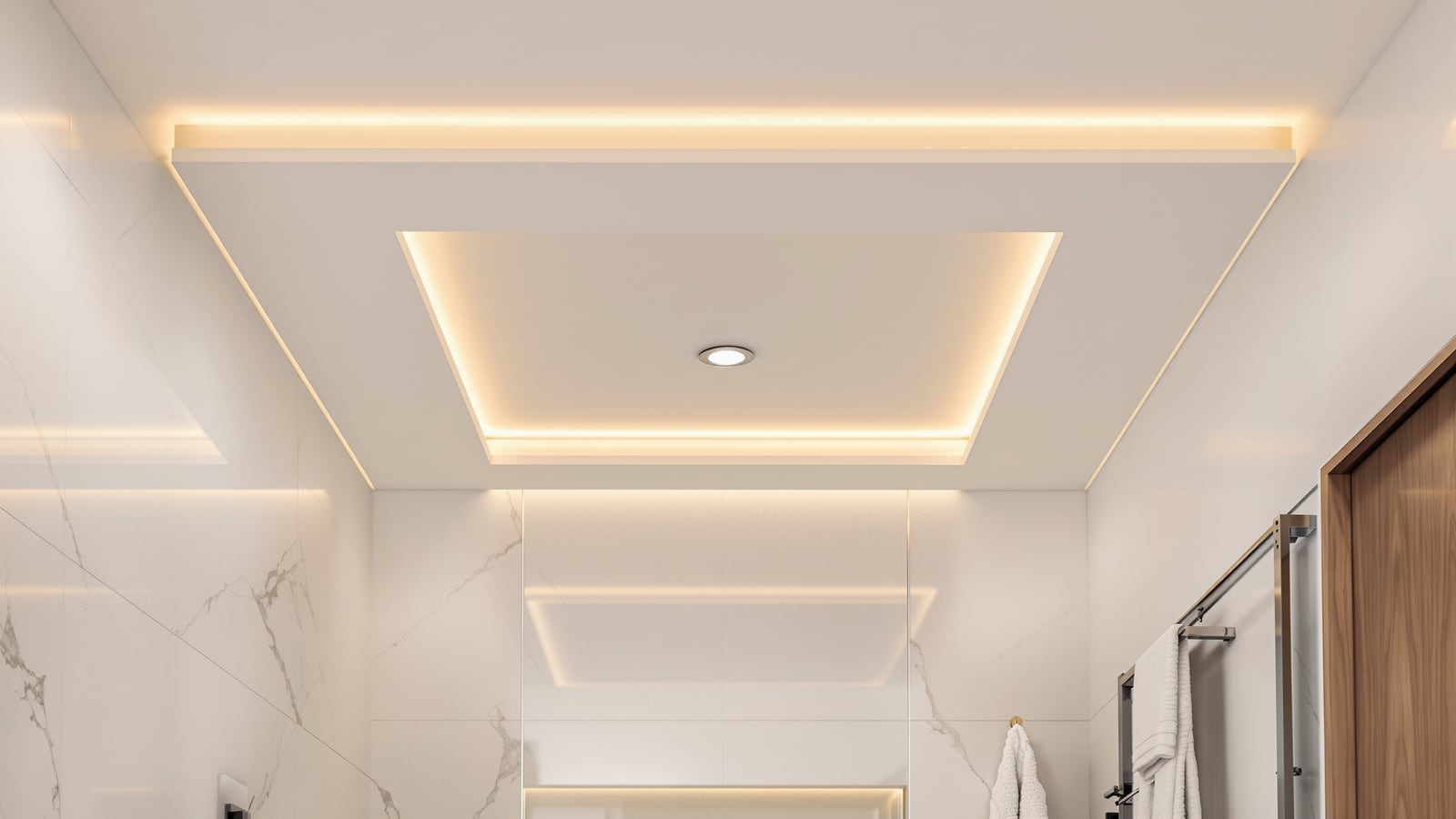
Gypsum False Ceiling Bathroom India: Moisture-Resistant Board, GI Framing & Cove Lighting
How to build a gypsum board false ceiling in an Indian bathroom the right way — only moisture-resistant (green) board, only in the dry zone, on a GI framework, with a seamless painted finish for cove lighting. Board specs, rupee costs vs PVC, and why ordinary gypsum fails in wet areas.
Gypsum board gives you the one thing a bathroom ceiling really wants: a dead-flat, seamless, paintable plane you can carve coves into and hide wiring, exhaust ducting and downlight housings above. It is why designers reach for it over grid ceilings when a bathroom needs to look built-in rather than bolted-on. But gypsum is calcium sulphate paper-faced board, and left to its own devices it drinks water, sags, delaminates and grows mould. In a room defined by hot showers, health-faucet spray and monsoon humidity, that is a real risk — and the reason so many gypsum bathroom ceilings in India stain and bow within a couple of years.
The good news: gypsum works well in a bathroom if you obey two non-negotiable rules. Use only moisture-resistant (green) board, and keep gypsum out of the direct wet zone — never build it as the ceiling immediately over an open shower. Get those right, frame it properly on GI, and paint it with the correct system, and you get a premium, cove-lit ceiling that lasts.
This is the gypsum-ceiling guide in the Studio Matrx bathroom hub. Read it alongside the bathroom false ceiling guide for India for the full comparison of ceiling systems, and the companion guides on moisture-resistant ceiling materials and waterproof bathroom paint. For where the ceiling sits in the wider plan, see the complete bathroom design guide and the wet-and-dry zone layout guide.
Gypsum belongs to the dry zone. The moment a ceiling is directly over the shower rose, switch to PVC, aluminium or a fully tanked soffit — no grade of gypsum board is meant to take standing shower steam and splash day after day.
Why ordinary gypsum fails in a wet room
Standard white gypsum board — the kind used for living-room and bedroom ceilings — has a plain paper facing and a core with no water-repellent additive. Three things then go wrong in a bathroom:
- The paper wicks moisture. Condensation and steam settle on the board face; the paper absorbs it, softens, and the paint film blisters and peels.
- The core loses strength. Wet gypsum crystals lose cohesion, so the board sags between screws and the joints crack.
- Mould feeds on the paper. Paper facing plus warmth plus humidity is a textbook mould substrate — the grey-black blooming you see spreading from ceiling corners.
Moisture-resistant board fixes the first two by using a water-repellent silicone-treated core and a green water-resistant facing, and the good ones add a fungicide to resist mould. It is not waterproof — it will still fail under direct water — but it comfortably handles the ambient humidity and occasional splash of a properly ventilated dry zone.
The distinction matters because the failure is slow and hidden. A standard board ceiling looks perfect on handover day; the sag, the brown tide-marks and the corner mould appear one or two monsoons later, by which point repainting no longer helps and the board has to come down. Paying the 25–40% premium for MR board up front is far cheaper than re-doing the ceiling — and it is the single detail most Indian bathroom ceilings get wrong. If your contractor quotes a suspiciously cheap gypsum ceiling, assume standard board and ask to see the packaging before work starts.
Regular vs moisture-resistant (green) gypsum board
| Property | Standard gypsum board | Moisture-resistant (MR / green) board |
|---|---|---|
| Facing colour | Ivory / grey | Green (industry convention) |
| Core | Plain gypsum | Silicone / water-repellent additive |
| Water absorption | High (no limit) | Typically ≤ 5% by weight (2-hour immersion) |
| Mould resistance | Poor | Good (many carry a fungicidal core) |
| Where it belongs | Bedrooms, living, dry lobbies | Bathroom dry zone, kitchens, utility |
| Typical thickness | 12.5 mm | 12.5 mm (use 15 mm for wider spans) |
| Cost premium | — | ~25–40% dearer than standard board |
Buy board that states compliance with the moisture-resistant classification of the relevant gypsum board standard, and ask specifically for MR/green board with a fungicidal core. The green colour is only a convention — confirm the specification on the box, not the tint.
The GI framework: what holds it up
A gypsum bathroom ceiling is only as durable as its framing, and the framing must resist corrosion in humid air. That means a galvanised iron (GI) framework throughout — never mild-steel angles or timber battens, which rust or swell.
The standard suspended system has three layers:
- Soffit cleats / anchor fasteners into the RCC slab, taking GI ceiling-angle or a threaded suspender.
- GI intermediate (main) channels hung at roughly 1,000–1,200 mm centres, levelled with a laser or water level.
- GI ceiling sections (furring channels) clipped across the mains at 450 mm centres using connecting clips and soffit cleats — this is the grid the board screws to.
Fix the MR board to the sections with corrosion-resistant drywall screws at ~200 mm centres, stagger the board joints, and leave a small expansion gap at the walls. Then tape and joint with fibre/paper tape and jointing compound over every seam and screw head, sand flat, and you have the seamless plane gypsum is famous for. Keep at least 200–250 mm of plenum above the board so exhaust ducting, the fan housing and downlight cans fit without crowding.
Finish: seamless paint and cove lighting
The reason to choose gypsum over a panel ceiling is the monolithic painted finish and the ability to form coves for indirect lighting. After jointing and sanding:
- Prime the board and joints, then apply a moisture-tolerant, washable, anti-fungal paint — the same family you would use on bathroom walls. See the waterproof bathroom paint guide for products and sheen. Avoid cheap distemper; it chalks in humidity.
- For cove lighting, drop a peripheral pelmet 100–150 mm below the main ceiling and conceal a warm-white LED strip that washes the ceiling plane. It reads as premium and hides the vanity task lights.
- Place recessed downlights over the dry vanity and WC, not over the shower. Any luminaire near the wet zone must be an appropriately IP-rated wet-area fitting.
- Ventilation is the whole game: an exhaust fan sized to the room (aim for 6–8 air changes per hour) sitting in or above the gypsum ceiling pulls steam out before it can condense on the board. A gypsum ceiling in an unventilated bathroom will fail regardless of board grade.
Gypsum vs PVC: cost and where each wins
PVC and gypsum are the two default false-ceiling choices in Indian bathrooms, and they solve different problems. PVC is fully water-safe and cheap but looks like panels; gypsum looks seamless and premium but must be kept dry.
| Factor | Gypsum (MR board) | PVC panel ceiling |
|---|---|---|
| Installed cost | ~₹90–160 / sq ft | ~₹60–120 / sq ft |
| Water tolerance | Humidity + light splash only | Fully water-safe, wipeable |
| Look | Seamless, paintable, cove-friendly | Visible panel joints |
| Cove / recessed lighting | Excellent | Limited |
| Direct shower zone | Not suitable | Suitable |
| Repair | Patch, joint, repaint | Swap a panel |
| Lifespan (dry zone, ventilated) | 10–15+ years | 10–15 years |
The practical answer in many Indian bathrooms is both: gypsum across the dry vanity and WC zone for the seamless cove-lit look, stepping to PVC or aluminium over the shower. That is exactly the material boundary the shower glass already draws.
Best-practice checklist
- Only MR (green) board with a fungicidal core — never standard gypsum in a bathroom.
- Never run gypsum as the ceiling directly over an open shower; use PVC/aluminium there.
- GI framing only — mains at ~1,000–1,200 mm, sections at 450 mm, screws at ~200 mm.
- Tape, joint and sand every seam; prime and paint with a washable anti-fungal system.
- Ventilate — a correctly sized exhaust fan is not optional for any gypsum bathroom ceiling.
- Keep 200–250 mm plenum for ducting, the fan and downlight housings.
- Confirm board specs on the packaging against the gypsum board standard — not by colour alone.
Done properly, a moisture-resistant gypsum ceiling gives an Indian bathroom the flat, seamless, cove-lit finish no panel system can match — as long as you respect the one rule that governs the whole detail: gypsum lives in the dry zone.
References
- NBC 2016 (National Building Code of India), Part 8 — building services, false ceilings and ventilation provisions.
- IS 2095 — Gypsum plaster boards, including the moisture-resistant classification.
- IS 2547 — Gypsum building plasters (relevant to board core and jointing).
- IS 3813 / GI framing practice — galvanised steel sections for suspended ceilings.
- CPWD Specifications — false ceiling and drywall workmanship norms used across Indian public works.
- IGBC / GRIHA — indoor material and ventilation guidance for healthy wet-area finishes.
Export this guide
Related Guides — Deep-dive reading
Bathroom False Ceiling India: PVC, Gypsum, Aluminium Panels, Cost & the #1 Moisture Rule
A complete guide to bathroom false ceilings for Indian homes — why you fit one, the material choices (PVC, moisture-resistant gypsum, aluminium and metal panels, ACP), access panels, integrating the exhaust fan and lights, and a rupee cost comparison — with the one rule that keeps a wet-zone ceiling from sagging.
BathroomsMoisture-Resistant Bathroom Ceiling India: PVC, Metal & Gypsum by Zone, Anti-Fungal Paint & Ventilation
How to design a bathroom ceiling that survives steam and condensation in an Indian home — matching waterproof PVC or metal over the wet zone, moisture-resistant gypsum in the dry zone, sizing the exhaust fan that actually protects it, and the anti-fungal paint, slope and drip detail that stops mould.
BathroomsBathroom Condensation and Mould India: Stop Damp, Black Mould & Musty Smell for Good
Why warm, wet shower air keeps fogging your tiles, ceiling and walls with black mould — and the full Indian playbook to stop it: exhaust run-on, anti-fungal paint, wet-dry separation, wiping down, a dehumidifier, and safely cleaning the mould you already have.
BathroomsRelated Tools — Try Free
False Ceiling Cost Estimator
Live ₹/sqft across 8 ceiling types — POP, gypsum, designer, metal, PVC, wooden — with cove and spot lighting for 20 Indian cities.
Cost CalculatorFull-Room BOQ — Living, Bedroom, Kitchen, Bath
Room-wise BOQ across living, bedrooms, kitchen, utility, and bathrooms with line-item pricing.
Full-Room BOQBathroom Exhaust Fan Calculator
Size a bathroom exhaust fan from room volume and air changes per hour — output in CFM and CMH with a recommended fan rating and diameter.
Bathroom Calculator