
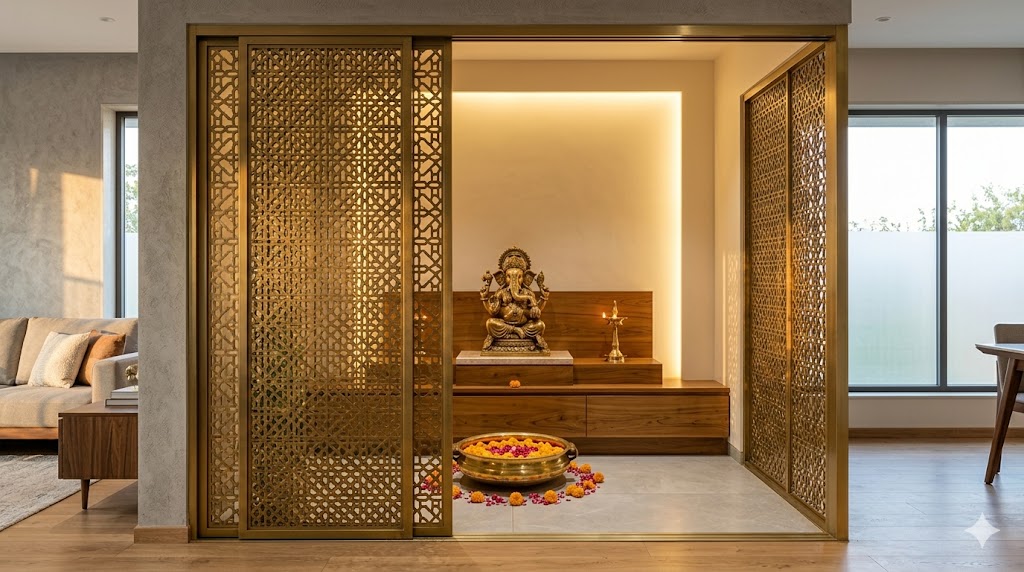
Modern Pooja Room Designs for Indian Homes
Five typologies, five style directions, door / shutter choices, modern materials and 25 numbered ideas — with Vastu intact
The pooja room is one of the most loved and least-modernised rooms in the Indian home. While the kitchen has moved through five generations of modular reform and bathrooms have absorbed two decades of luxury-imported fixtures, the pooja zone often still looks like an off-the-shelf timber cabinet bought in 1995 — even in apartments that otherwise read as crisply contemporary.
That gap is no longer necessary. Modern pooja-room design has matured into a distinct language — brass laser-cut jali screens, slim-frame glass shutters, book-matched marble alcoves, charcoal microcement walls with off-white plaster niches, and floor-to-ceiling teak feature walls — all of which respect the same Vastu fundamentals while reading as 2026 design.
This guide is a working reference for modern pooja-room designs in Indian apartments. It covers the five typologies, the five style directions, door and shutter options, Vastu direction rules, lighting, and twenty-five numbered ideas. For the deeper functional reference — ventilation sizing, dedicated 6A circuit isolation, samagri storage logic, fire safety — see the linked fundamentals guide.
Five Typologies
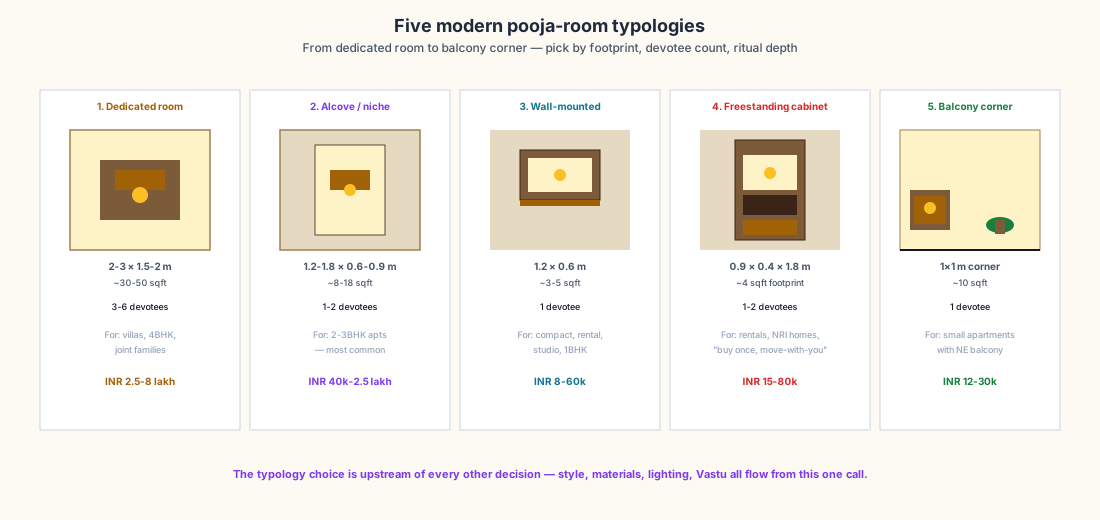
The typology decision precedes everything else. Style, materials, and lighting all flow from this one call.
| Typology | Footprint | Devotees | Cost band | Best for |
|---|---|---|---|---|
| Dedicated room | 30-50 sqft | 3-6 | INR 2.5-8L | Villas, 4BHK, joint families |
| Alcove / niche | 8-18 sqft | 1-2 | INR 40k-2.5L | 2-3 BHK apartments (most common) |
| Wall-mounted | 3-5 sqft | 1 | INR 8-60k | 1-2 BHK, compact, rentals |
| Freestanding cabinet | 4 sqft + tall | 1-2 | INR 15-80k | Rentals, NRI homes, move-with-you |
| Balcony corner | 10 sqft | 1 | INR 12-30k | Small apartments with NE balcony |
The biggest typology mistake is picking dedicated room in a 2 BHK — the room invariably becomes a junk room within 18 months and the rituals move to a cabinet. Better to pick the right-size typology and execute it well.
Five Style Directions
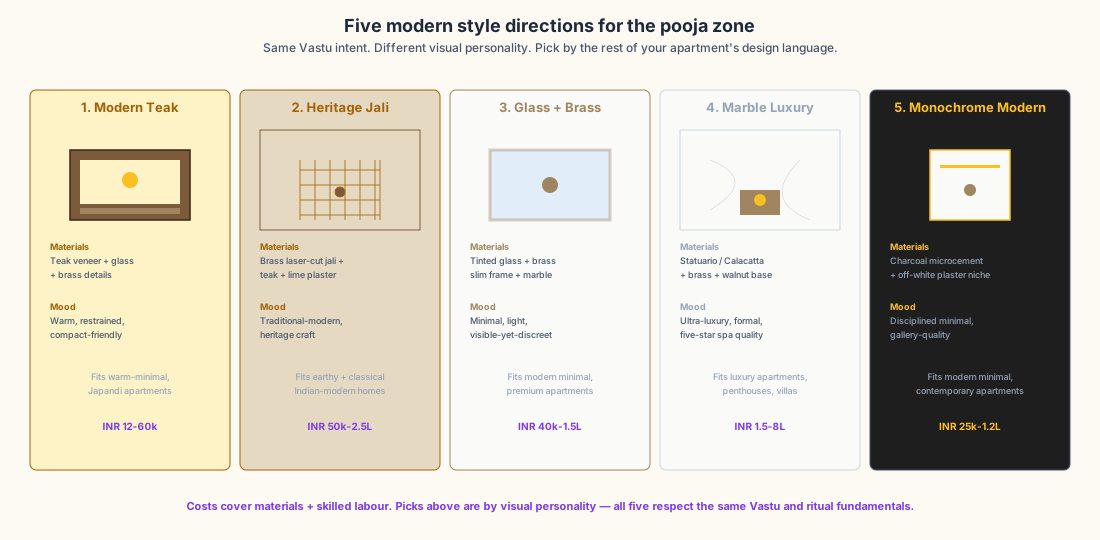
Five distinct visual languages, each respecting the same Vastu intent. Pick by the rest of your apartment's design vocabulary — the pooja zone should feel like part of the home, not a separate religious world.
1. Modern Teak
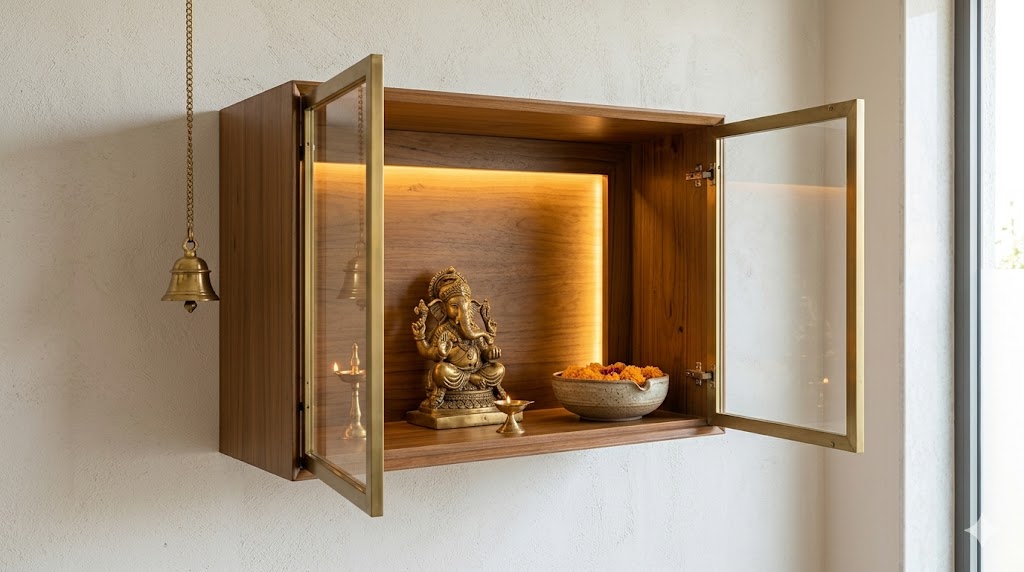
Teak veneer cabinet, tempered grey-tinted glass shutter, slim brass handle pulls, small marble base for idol. Warm, restrained, compact-friendly. Fits warm-minimal and Japandi apartments. Cost INR 12,000-60,000.
2. Heritage Jali
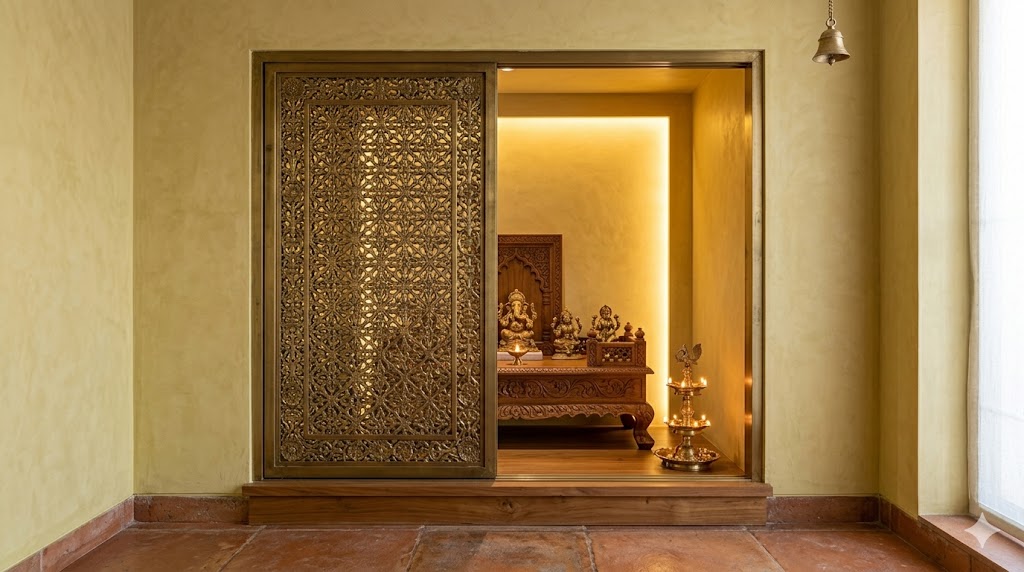
Brass laser-cut jali (latticework) screen, teak mandap-style platform, lime plaster background, brass diya stand and bell. Traditional craft in modern apartment. Fits earthy and classical Indian-modern homes. Cost INR 50,000-2,50,000.
3. Glass + Brass
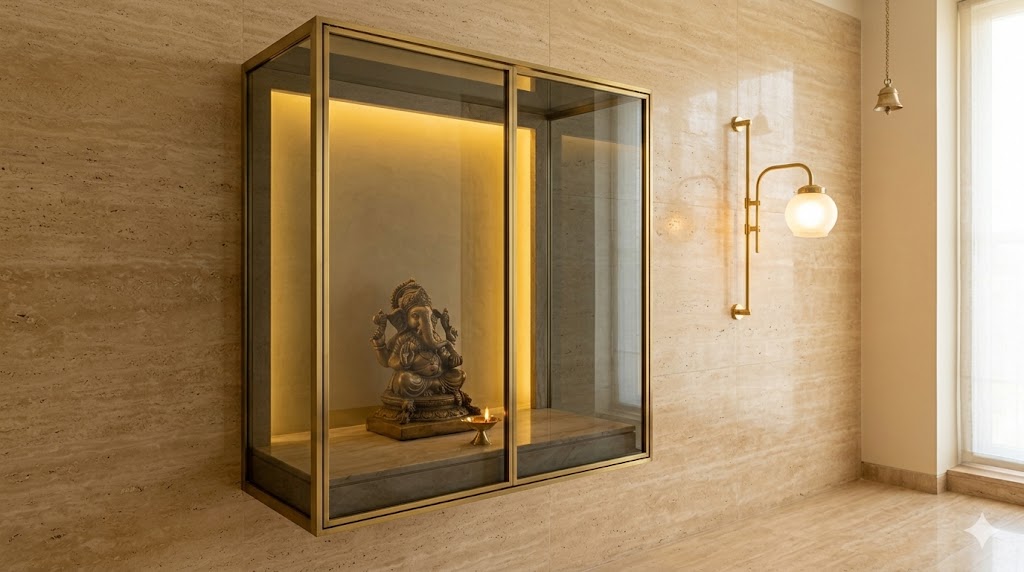
Tempered grey-tinted glass shutter framed in slim brass, polished marble base, brass swing-arm wall lamp. Minimal, visible-yet-discreet. Fits modern minimal premium apartments. Cost INR 40,000-1,50,000.
4. Marble Luxury
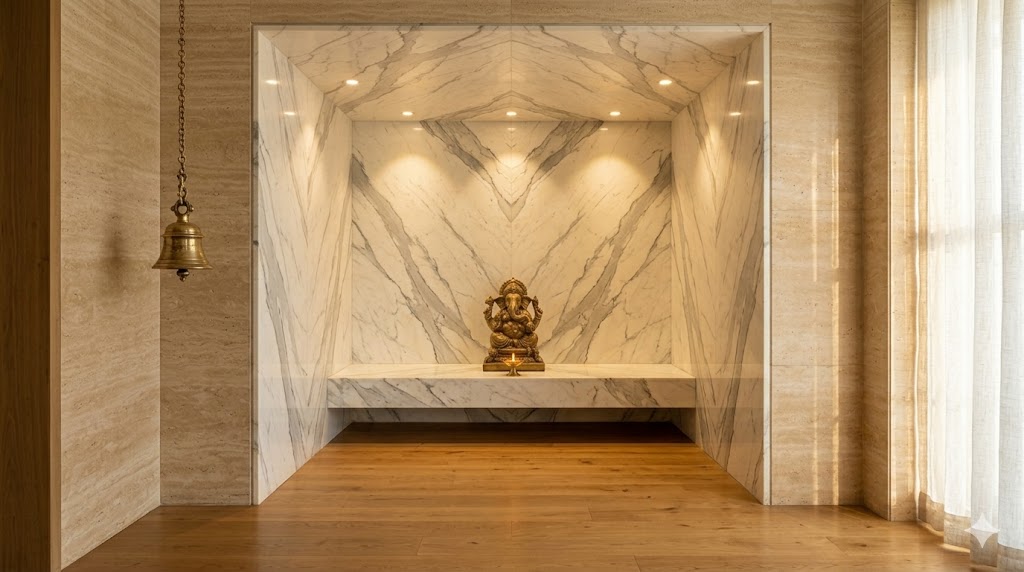
Full-height book-matched Statuario or Calacatta marble alcove, single floating step as platform with brass idol, recessed warm spotlights. Ultra-luxury, formal, five-star spa quality. Fits luxury apartments, penthouses, villas. Cost INR 1,50,000-8,00,000.
5. Monochrome Modern
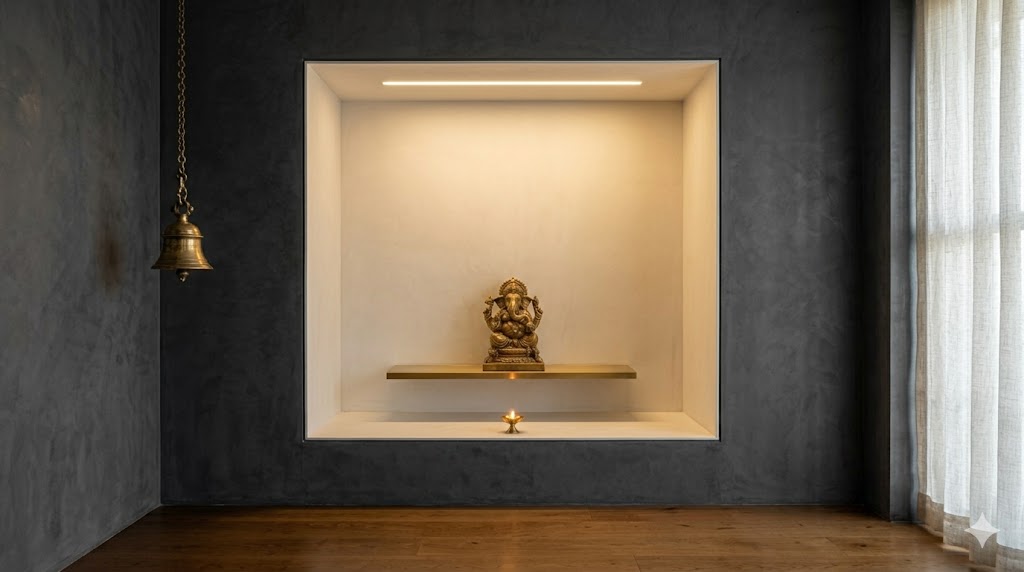
Rectangular niche cut into a charcoal microcement wall, niche interior in matte off-white plaster, single brass shelf for idol, single linear LED at top. Disciplined minimal, gallery-quality. Fits modern minimal contemporary apartments. Cost INR 25,000-1,20,000.
Door + Shutter Choices
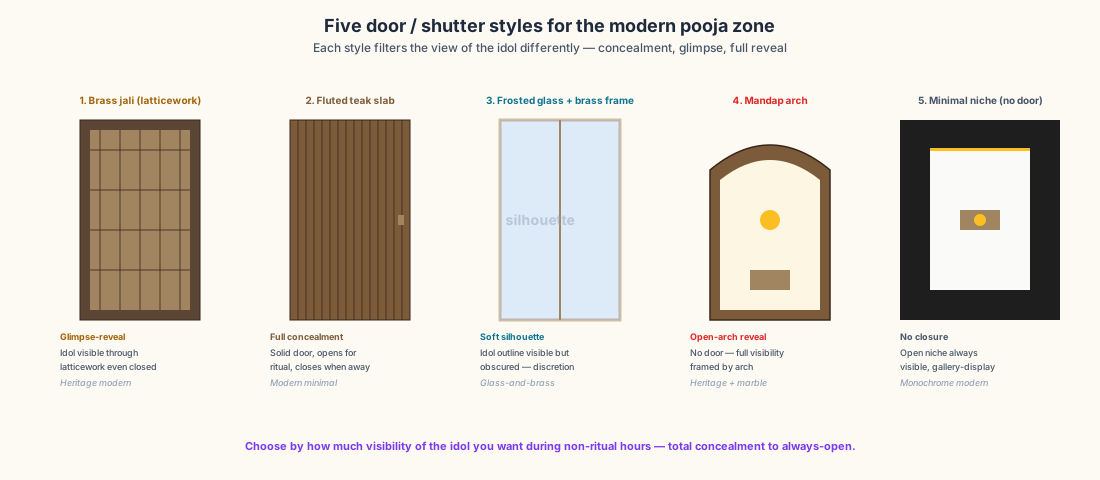
The shutter decides how visible the idol is during non-ritual hours — total concealment to always-open. The five options:
1. Brass jali (latticework) — glimpse-reveal even when closed; idol visible through the lattice. Heritage-modern.
2. Fluted teak slab — full concealment; solid door opens for ritual, closes when away. Modern minimal.
3. Frosted glass + brass frame — soft silhouette; idol outline visible but obscured. Glass-and-brass aesthetic.
4. Mandap arch (open) — no door; full visibility framed by arch. Heritage + marble luxury.
5. Minimal niche (no closure) — open niche always visible; gallery-display approach. Monochrome modern.
Choose by what you want the room to look like when no one is praying — concealed-and-quiet, glimpsed-and-suggested, or always-visible-and-celebrated.
Vastu Fundamentals
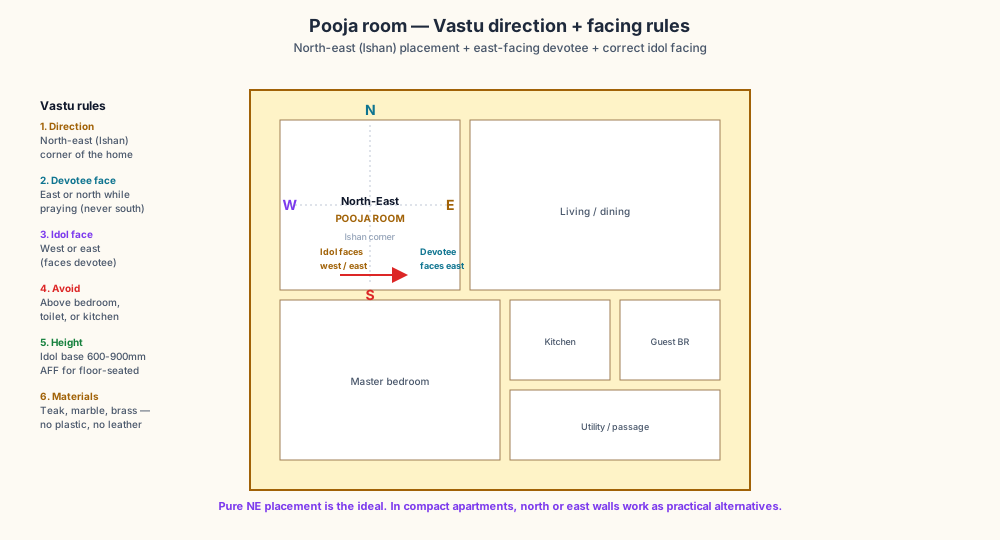
The six Vastu rules every modern pooja-room design must respect:
1. Direction — north-east (Ishan) corner of the home is ideal. North or east walls are acceptable alternatives in compact apartments.
2. Devotee facing — east or north while praying (never south).
3. Idol facing — west or east (faces the devotee).
4. Avoid — placing the pooja above a bedroom, toilet, or directly facing the kitchen.
5. Height — idol base at 600-900 mm AFF for floor-seated worship; 900-1200 mm for standing worship.
6. Materials — teak, marble, brass, lime plaster, stoneware. No plastic, no leather, no synthetic finishes.
Modern designs do not relax these rules — they reinterpret the materials and visual language while keeping the orientation and proportion fundamentals intact.
Lighting
A modern pooja zone uses three layers of warm light, all 2700-3000 K, all dimmable:
1. Ambient — soft general wash of the alcove or cabinet interior (LED strip inside the niche).
2. Accent — focused light on the idol (recessed warm spotlight or LED step-light at the platform).
3. Ritual — the diya, the brass lamp, the festival candle. Living flame is not optional for a pooja zone — it is the symbol of the ritual itself.
Bias the colour temperature warm. A pooja room lit with cool 4000K LEDs reads clinical, not sacred.
25 Modern Pooja Room Ideas
The twenty-five ideas below are organised by typology — five per typology.
Dedicated Room (Ideas 1-5)
1. Statuario marble dedicated room — Full-height book-matched Statuario walls, floating marble platform, brass idol pedestal, recessed warm spotlights, brass swing-arm wall lamp. The ultra-luxury master pooja.
2. Teak + jali dedicated room — Teak veneer walls, brass jali sliding entry door, teak mandap platform, hidden warm cove. Heritage-modern reading.
3. Microcement dedicated room — Warm-white microcement walls and floor, single charcoal feature wall behind idol, brass shelf and accents. Modern minimal sacred.
4. Open-arch dedicated room — Lime plaster walls with a single mandap arch entry (no door), teak platform inside, brass idols, warm cove light. Visible-and-celebrated.
5. Skylight dedicated room — Dedicated room with a single warm skylight directly above the idol platform — daylight as the primary illumination during day, warm LED at night.
Alcove / Niche (Ideas 6-12)
6. Brass-jali alcove with teak inside — Recessed alcove with brass laser-cut jali sliding screen, teak mandap inside, hidden warm light. Premium 3BHK.
7. Marble alcove sliding shutter — Statuario marble alcove with a sliding tempered glass + brass-frame shutter, marble idol base. Glass-and-brass aesthetic.
8. Plaster alcove minimal — Off-white plaster recessed alcove (no shutter), single brass shelf with idol, single linear LED at top of alcove. Monochrome modern.
9. Teak alcove with glass — Teak-veneer-lined alcove with frameless glass sliding shutter, teak floor, brass diya stand on step. Warm-minimal apartment.
10. Charcoal alcove with brass idol — Charcoal microcement walls, off-white plaster alcove interior, single brass idol on slim brass shelf. Disciplined minimal.
11. Two-tier alcove — Recessed alcove with two stepped platforms — main idol on upper, smaller idols and brass diya on lower. Mandap-inspired.
12. Corner alcove with two-side viewing — L-shaped corner alcove with glass shutter on both sides, idol visible from two rooms simultaneously. Open-plan apartment friendly.
Wall-Mounted (Ideas 13-17)
13. Modern teak cabinet — 1.2m × 0.6m wall-mounted teak veneer cabinet with frameless glass shutter, slim brass pull, marble base inside.
14. Brass-jali wall unit — Wall-mounted unit with brass jali shutter, teak interior, warm LED strip. Compact heritage-modern.
15. Glass-display pooja shelf — Slim wall-mounted brass-frame glass display box (visible always), idol inside lit by warm LED. Gallery-display style.
16. Hidden pooja behind mirror — Wall-mounted unit with a mirror-shutter facing outward — when closed, reads as a wall mirror; when open, reveals the pooja inside.
17. Two-cabinet stack — Two stacked wall-mounted cabinets — upper for idols and worship items, lower closed cabinet for samagri storage. Functional + modern.
Freestanding Cabinet (Ideas 18-21)
18. Tall teak mandir — 1.8m tall freestanding teak cabinet with glass shutters and brass step-base, internal LED. Heritage proportions, modular spec.
19. Modern brass-and-walnut mandir — Walnut cabinet with hand-engraved brass front panel, glass top, internal warm LED. Move-with-you premium.
20. Minimal slab mandir — Flat-slab walnut cabinet with single matte glass front, hidden warm LED, brass legs. Modern minimal.
21. Two-tone freestanding — Cream-laminate upper section (idol display) + walnut lower section (samagri storage) — functional pooja station.
Balcony Corner (Ideas 22-25)
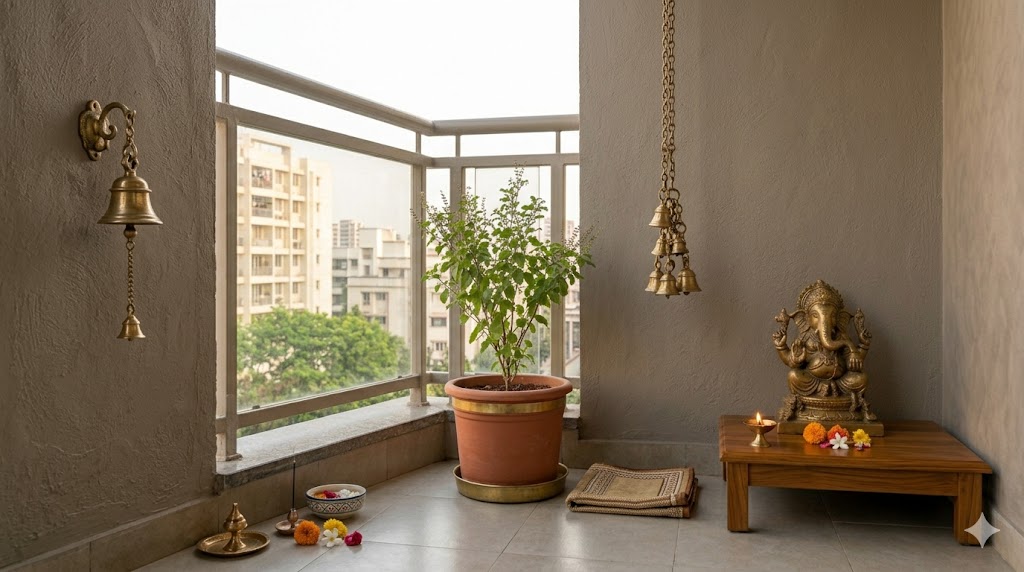
22. Teak chowki + tulsi balcony — Small teak chowki in the NE balcony corner with brass Ganesha + clay diya + a single tulsi planter beside in a brass-trim terracotta pot.
23. Wall-niche balcony pooja — Wall-mounted recessed niche on a balcony wall housing a small brass idol, with a tulsi planter at the centre of the balcony floor.
24. Festival-ready balcony pooja — Brass diya stand + small floor pooja chowki + foldable wooden pooja screen + brass urli for festival flowers. Sets up for Diwali and Tulsi Vivaha.
25. Vertical tulsi-and-pooja column — Wall column on a balcony with a small wall-mounted pooja unit at the top and a tall tulsi planter at the bottom — a vertical sacred composition in a 600 mm wide footprint.
Common Mistakes
1. Pooja above a bedroom or toilet — most common Vastu violation in apartments. Avoid at all costs.
2. South-facing idol — devotee faces south; never the recommended direction. Always east or north.
3. Plastic or synthetic idol bases — undermines the material discipline. Stick to teak, marble, brass, stoneware.
4. Cool 4000K lighting — reads clinical, not sacred. Always 2700-3000K warm.
5. No ventilation for incense — incense + agarbatti smoke accumulates; small extractor or NE window required.
6. Idol height wrong — too high (above chest level for standing worship) or too low (below 600 mm for floor seating) makes daily worship physically awkward.
7. Mixed religious symbolism without thought — in multi-faith homes, separate the spaces or unify the language with intent, not casually.
Compact Apartment Adaptations
For 1-2 BHK apartments where a dedicated room is not practical:
- Wall-mounted teak cabinet — the default compact answer. 1.2 × 0.6 m, brass-trim glass shutter, fits any wall.
- Niche cut into existing wall — if the apartment is yours, cut a 0.6 × 0.9 m niche into a non-load-bearing wall (typically in the entry or living-dining transition).
- Freestanding cabinet — buy once, move with you. Tall teak or walnut mandir-style cabinet.
- Balcony corner — if you have a NE balcony, this is often the most Vastu-compliant option in apartments.
References:
1. Vastu Vidya Pratisthan. Pooja Room and Mandir Vastu — Modern Indian Apartments, 2024.
2. Bureau of Indian Standards. National Building Code of India 2016, Part 4 — Fire and Life Safety (incense + diya safety).
3. Bureau of Indian Standards. National Building Code of India 2016, Part 8 — Building Services; Electrical Installations (dedicated circuit isolation).
4. Council of Architecture (India). Conditions of Engagement — Religious / Ceremonial Space Design.
5. International Council of Indian Crafts. Brass + Jali Latticework Tradition — Modern Application, 2024.
6. Bureau of Indian Standards. IS 1328 — Decorative Veneers (teak specification).
7. CIBSE LG07. Lighting Guide — Specialty Residential Spaces.
8. Indian Institute of Architects (IIA). Religious Space Integration in Modern Indian Apartments, 2024.
9. Royal Institute of British Architects (RIBA). Plan of Work — Stage 4 Technical Design (interior specification format).
10. Interior Designers' Association of India. Material + Finish Cost Schedule — 2025 update.
Related Guides
- Pooja room design — the comprehensive functional reference covering ventilation, electrical isolation, fire safety, samagri storage, multi-faith considerations
- /guides/vastu-house-plan-india — the broader Vastu reference for whole-house orientation including pooja-room placement
- /guides/wardrobe-finish-ideas — material reference for veneer, laminate, glass finishes applicable to pooja-cabinet specification
- /guides/architectural-lighting-design-india — deeper lighting reference covering the three-layer warm-light scheme used in pooja zones
- /guides/warm-minimal-bedroom-ideas-india — palette and material logic adjacent to modern teak + monochrome modern pooja styles
Interactive · Modern pooja style selector
Heritage Jali · INR 50,000-2,50,000
Brass laser-cut jali screen + teak platform + lime plaster — heritage craft in modern apartment.
Materials
- ▸Brass laser-cut jali screen
- ▸Teak mandap-style platform
- ▸Lime plaster background
- ▸Brass diya stand + bell
Door / shutter
Sliding brass jali (latticework) — glimpse-reveal even when closed
Lighting
Warm 3000K hidden cove inside alcove + soft accent on idol
Best for
Premium 3-4 BHK apartments, traditional-modern Indian homes, villas
All five styles respect the same Vastu fundamentals — north-east placement, east-facing devotee, correct idol facing, height above 600-900mm AFF. The difference is visual personality only.
Export this guide
Related Guides — Deep-dive reading
Pooja Room Design for Indian Homes
Vastu, Layouts, Materials, Lighting & Safety — A Complete Architect's Guide for Apartments, Villas & Compact Homes
Room PlanningMinimalist Door Designs in India (2026): Flush, Frameless & Concealed-Frame Doors
The clean-line, no-architrave, hidden-hardware door language behind modern Indian apartments and designer interiors — flush-to-wall doors, concealed hinges, recessed pulls, tall leaves and what the look really costs.
Home Doors & EntrancesWooden Door Designs for Indian Homes (2026): Styles, Patterns, Finishes & Costs
A design gallery of wooden door styles for Indian homes — traditional carved and panelled, classic 4/6-panel, modern flush wood, vertical-plank and slat, fluted, framed-glass, grooved CNC and minimalist — with grain-showing finishes, proportion tips and rough cost bands.
Home Doors & EntrancesRelated Tools — Try Free
Cross-Ventilation Analyzer
Estimate airflow and air changes per hour (ACH) from room size, window areas, layout, and local wind — with NBC 2016 Part 8 compliance check.
Ventilation CalculatorVastu Window Planner
Vastu guidance for window placement and size by wall direction and room — rating and remedies.
VastuWindow Orientation Planner
Pick the best window type, glass and shading by wall direction — north, east, south and west.
Window Tool