
The Tomb of the First Emperor: An Empire Buried to Rule Forever
How Qin Shi Huang, the first emperor of a united China, buried a whole functioning empire beneath Mount Li — an army of eight thousand life-size clay soldiers guarding a sealed palace where, an ancient historian says, the rivers of China flow in mercury under a ceiling of stars — a chamber so complete, and so dangerous, that we have never dared open it.
Every tomb in this series has been built for a person. Our next was built for an empire. When Qin Shi Huang — the man who conquered the warring states, unified China, and declared himself its First Emperor in 221 BCE — set out to prepare for death, he was not content to take his body, or his treasure, or even his court. He set out to take the whole of China with him: its army, its officials, its stables and menageries and entertainers, its very rivers and seas and stars, all reproduced underground so that he could go on ruling, exactly as before, forever.
The result, at the foot of Mount Li near Xi'an, is the largest and strangest tomb complex ever built — most of it still buried, and its heart still sealed. Above ground stands a great earthen mound whose central chamber no one has ever opened. Beneath and around it lies a buried empire, guarded by the most astonishing army in the history of the world: eight thousand life-size soldiers of clay, each with a different face, who lay hidden and forgotten for over two thousand years until a farmer's spade struck one in 1974.
This is the forty-second article in our Architectural Wonders series.
1. An empire taken into death
To understand this tomb you must first grasp its ambition, which is unlike anything else humans have built.
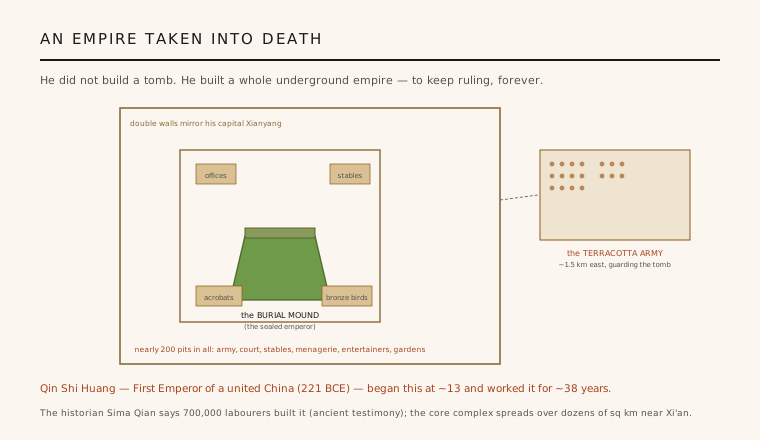
Qin Shi Huang began his tomb around 246 BCE, when he was a boy of thirteen newly on the throne of Qin, and worked on it for some thirty-eight years; the historian Sima Qian says seven hundred thousand labourers toiled on it (an ancient figure, treated by scholars with some caution). And what they built was not a tomb but a buried empire. The great mound sits within double walls laid out to mirror his capital city; scattered around it are nearly two hundred pits holding everything a ruler needs — the vast army about a kilometre and a half to the east, but also civil offices, stables and real horses, a bronze menagerie of cranes and swans, acrobats and musicians, gardens and treasuries. He was reproducing his entire realm, so that death would change nothing. It is the same instinct we met at Cerveteri — furnishing the tomb as a world to live in — taken to a scale of imperial megalomania: not a house for the dead, but a country for one.
2. The unopened mountain
At the centre of it all stands the tomb itself — a great flat-topped mound of earth — and here is the fact that sets this wonder apart from every other: its chamber has never been opened.
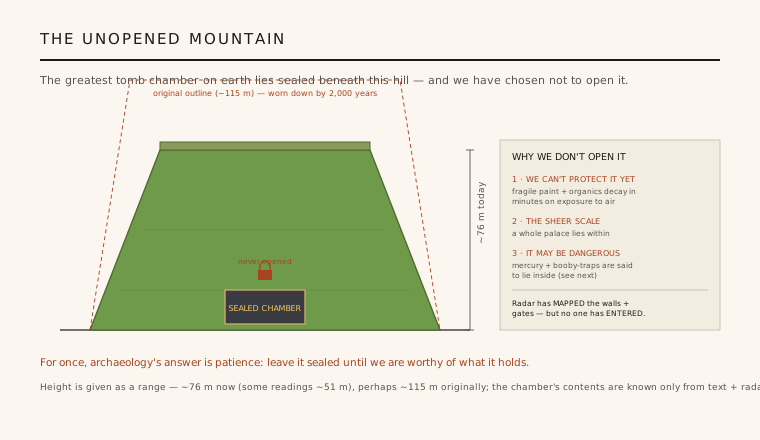
The mound is a stepped earthen pyramid, about seventy-six metres high today and perhaps a hundred and fifteen when it was new, worn down by two thousand years of wind and farming. And somewhere deep within it lies the sealed burial chamber of the First Emperor — mapped by ground-penetrating radar, its walls and gates traced from the surface, but never entered in modern times. This is not for lack of interest; it is a deliberate choice. The technology to protect what lies inside does not yet exist — as the painted warriors have taught us, ancient colour and organic material can perish within minutes of meeting the air. The scale is overwhelming. And it may be genuinely dangerous, for reasons we are about to see. So the greatest unopened tomb chamber on earth waits, sealed, while archaeology does the hardest thing of all: it leaves it alone, until we are ready. There is a deep humility in that — the discipline, so rare, of not digging, of admitting that some things are better guarded than grasped.
3. Rivers of mercury, a sky of stars
We know what may lie inside from a single, astonishing source — and modern science has given that ancient text an eerie new credibility.
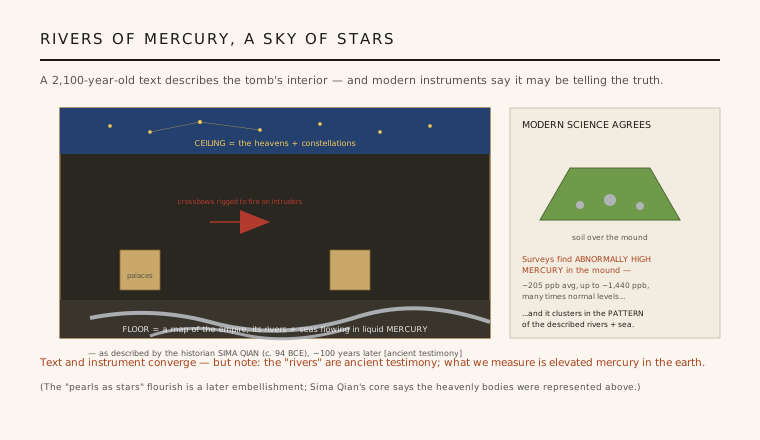
Around 94 BCE, roughly a century after the emperor's death, the great historian Sima Qian described the tomb's interior — and it reads like a fever-dream of power. Its ceiling, he wrote, was made to depict the heavens and their constellations. Its floor was a relief map of the whole empire, across which the rivers and seas of China — the Yangtze, the Yellow River, the ocean — were made to flow in liquid mercury, moved mechanically, an entire country rendered in running quicksilver. Crossbows were rigged to fire automatically on any intruder. For centuries this was taken as legend. Then came the twist: modern soil surveys of the mound have found abnormally high concentrations of mercury — many times the natural level — and, most tellingly, the mercury clusters in a pattern that matches where Sima Qian said the rivers and sea should be. The ancient text and the modern instrument converge. (Be precise about what this proves: the rivers of mercury remain ancient testimony; what science confirms is elevated mercury in the earth, patterned as described.) It is one of the most spine-tingling correlations in all of archaeology — a 2,100-year-old book, apparently telling the truth.
4. The eight thousand
And then there is the guardian — the wonder that made this tomb famous across the world, discovered entirely by accident.
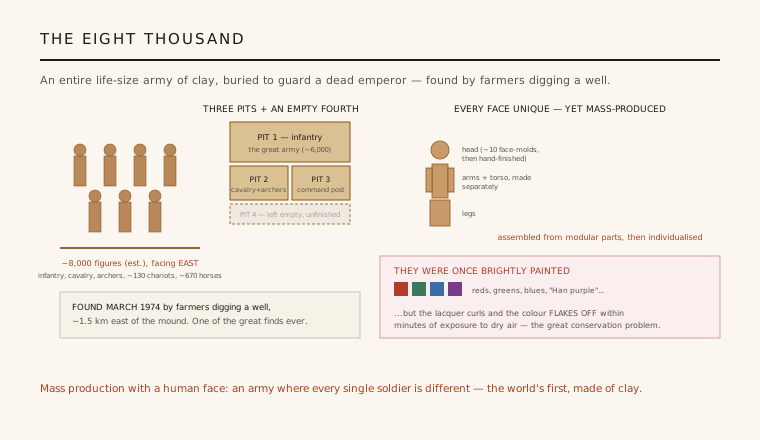
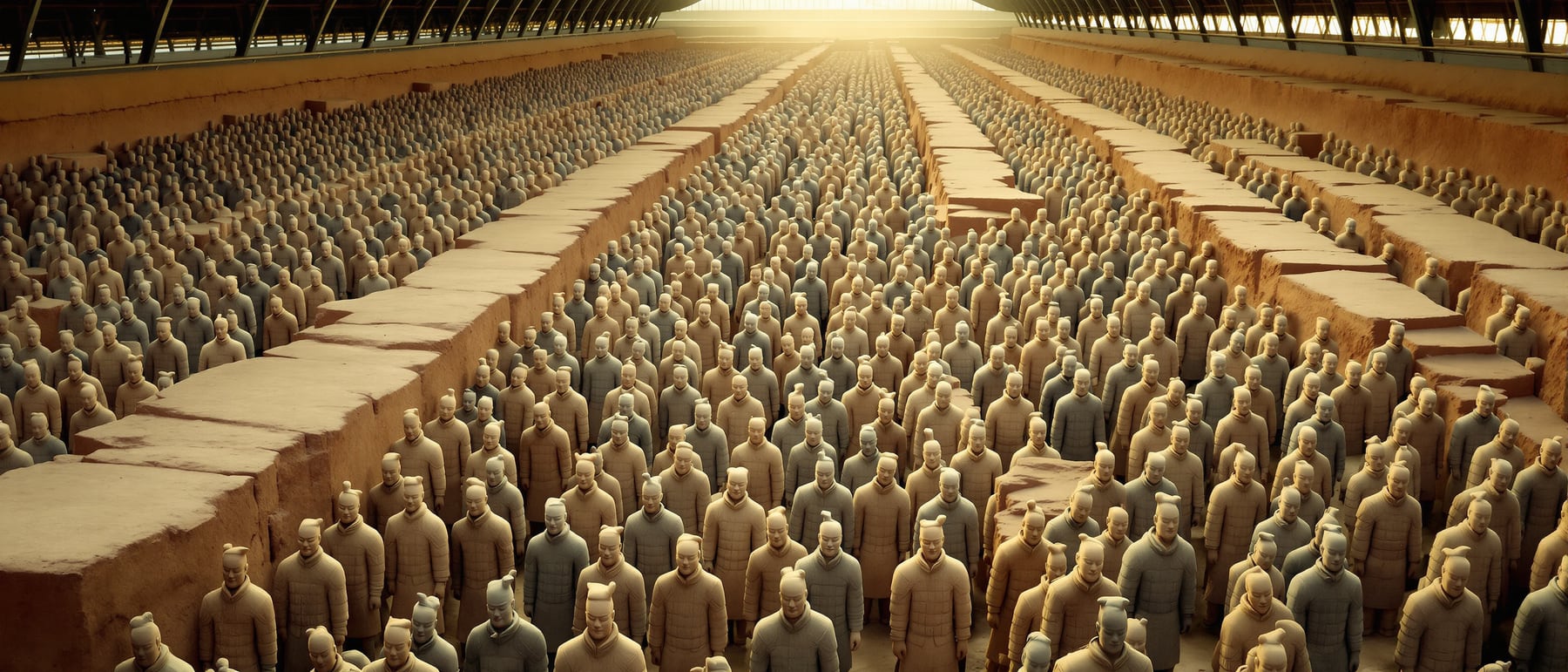
In March 1974, farmers digging a well about a kilometre and a half east of the mound struck something hard: a head of clay. They had found the Terracotta Army — an estimated eight thousand life-size soldiers, drawn up in full battle formation, facing east toward the lands the emperor had conquered, ready to defend him for eternity. They stand in three great pits — Pit 1, the huge infantry army; Pit 2, the cavalry and archers; Pit 3, the command post — with a fourth pit left empty and unfinished, the work interrupted. And here is the marvel within the marvel: every face is different — different features, hair, expression — and yet they were mass-produced. Torsos, legs, arms and heads were made separately in workshops (from perhaps ten basic face-moulds), assembled, and then each one hand-finished into an individual. It is the world's first true assembly line, over two thousand years old, producing not identical parts but eight thousand individuals — an astonishing marriage of industrial efficiency and human singularity. They were once brightly painted in reds, greens, blues and a rare synthetic purple; tragically, the lacquer beneath the paint curls and the colour flakes away within minutes of exposure to Xi'an's dry air, which is one more reason the deeper tomb stays sealed.
5. The man who tried not to die
There is a final, human irony to this vast machine for eternity — and it is the thing that makes the whole wonder unforgettable.
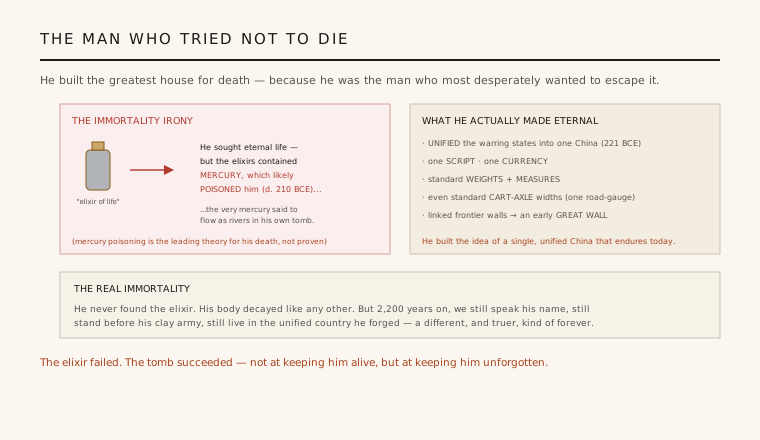
Qin Shi Huang did not merely prepare for death — he was desperate to escape it. He sent expeditions to find the islands of the immortals and dosed himself with alchemists' elixirs of eternal life. And those elixirs very likely contained mercury — so the pursuit of immortality is widely thought to have poisoned him, killing him in 210 BCE. The same silver poison he swallowed to live forever is the poison said to flow as rivers in his tomb. He never found his elixir; his body decayed like any other. And yet — this is the point — he did become immortal, only not in the way he sought. He forged a single, unified China and standardised its script, its money, its weights and measures, even the width of its cart axles; he linked the frontier walls into an early Great Wall. Twenty-two centuries later we still speak his name, still stand awestruck before his clay army, still live in the shape of the country he made. The elixir failed. The tomb succeeded — not at keeping him alive, but at keeping him unforgotten. It is the deepest lesson of every tomb in this series, written here in mercury and clay: we cannot cheat death, but we can, sometimes, outlast it — through what we build, and what we leave behind.
6. What a modern architect can learn from the First Emperor's tomb
- Scale is a statement of worldview. This tomb reproduces an entire empire because its builder believed he should rule one forever. The size and completeness of what we build declares what we think we deserve — a power worth using with more humility than the First Emperor showed.
- Sometimes the wisest act is not to build — or not to dig. The sealed chamber is left unopened because we cannot yet protect it. Restraint, patience, and knowing the limits of your own technology are as much a part of great practice as ambition.
- Standardisation and individuality can coexist. Eight thousand warriors from modular parts, each one unique. Mass-produced components need not mean soulless results; a system can be designed to deliver both efficiency and human particularity.
- Design for what the air will do. The warriors' paint vanishes on contact with the atmosphere. Materials live in an environment; anticipating how light, air and time will act on what you make is the difference between a thing that lasts and a thing that fades.
- The record can outlive the ruin. We know the sealed palace only through Sima Qian's words — and science is proving him right. Documentation is not secondary to building; sometimes the written account is what carries a work across the centuries.
- You cannot cheat death — so build meaning. The man who most wanted to live forever could not. What endures of him is not his body but his works: a country, an army of clay, a name. Build things whose meaning outlasts you; it is the only immortality architecture can honestly offer.
References & further reading
1. UNESCO World Heritage Centre — Mausoleum of the First Qin Emperor (inscribed 1987). https://whc.unesco.org/en/list/441/
2. Encyclopaedia Britannica — Qin tomb and Terra-cotta army. https://www.britannica.com/place/Qin-tomb
3. World History Encyclopedia — Terracotta Army. https://www.worldhistory.org/Terracotta_Army/
4. Smithsonian Magazine — What You Need to Know About China's Terra-Cotta Warriors and the First Qin Emperor. https://www.smithsonianmag.com/history/what-you-need-know-about-chinas-terra-cotta-warriors-first-qin-emperor-30942673/
5. National Museums Liverpool — China's First Emperor and the Terracotta Warriors: in numbers. https://www.liverpoolmuseums.org.uk/stories/chinas-first-emperor-and-terracotta-warriors-numbers
6. Sima Qian — Records of the Grand Historian (Shiji), Chapter 6 (the primary ancient description of the tomb; Burton Watson translation, Columbia University Press).
Last verified 2026-07-04. Figures follow UNESCO and standard archaeological/historical sources and are given as widely cited approximations. Qin Shi Huang unified China and became First Emperor in 221 BCE and died in 210 BCE; tomb construction ran c. 246–208 BCE. The "700,000 labourers" is Sima Qian's ancient testimony (Shiji, c. 94 BCE), treated cautiously by some scholars. The mound is ~76 m high today (some readings ~51 m) and perhaps ~115 m originally — give as a range; the central burial chamber remains sealed and unexcavated, its interior known only from Sima Qian and remote sensing. Sima Qian's description (heavens on the ceiling, rivers/seas of mercury on the floor, crossbow traps) is ancient testimony; modern soil surveys have independently found abnormally elevated mercury in the mound (reported ~205 ppb average, up to ~1,440 ppb), clustered in a pattern consistent with the described rivers — the two lines of evidence converge but are different in kind. The Terracotta Army (found 29 March 1974) is estimated at ~8,000 figures in three pits (plus an empty fourth); "8,000" and "~6,000 in Pit 1" are projections, not headcounts. Figures were assembled from modular parts and individually finished; original polychromy flakes rapidly on exposure. The once-cited chromium anti-corrosion coating on the bronze weapons is now disputed (2019 research attributes the chromium to lacquer contamination). Mercury poisoning is the leading hypothesis for the emperor's death, not proven. The "eighth wonder of the world" is a popular epithet. The Mausoleum of the First Qin Emperor is a UNESCO World Heritage Site (1987).
Export this guide
Related Guides — Deep-dive reading
Daisen Kofun: The Keyhole Tomb You Can Only See From the Sky
How ancient Japan raised a mound the size of a small city in the shape of a keyhole — a half-kilometre of earth ringed by three moats, guarded by thousands of clay haniwa, and sealed so completely as an imperial grave that no archaeologist has ever entered it, leaving one of the largest tombs on Earth, and the identity of the emperor within, a mystery kept by reverence.
Architectural WondersCahokia and Monks Mound: The Great City America Forgot
A thousand years ago, across the river from where St Louis now stands, Native Americans built a city of perhaps twenty thousand people — larger than London at the time — with a hundred and twenty earthen mounds, a plaza the size of dozens of football fields, and a solar calendar of cedar posts. At its heart rose Monks Mound, the largest earthwork in the Americas, with a footprint to rival the Great Pyramid. Then, before Europeans ever arrived, it vanished — and almost no one remembers it.
Architectural WondersPersepolis: The Palace Where Every Nation Came Bearing Gifts
On a vast stone terrace in southern Iran, the kings of Persia built the grandest ceremonial capital of the ancient world — a forest of impossibly tall columns whose walls, unlike those of any conqueror before them, carved not war and captives but a peaceful procession of twenty-three nations bringing gifts. It is the gentlest image of empire the ancient world produced — until Alexander burned it to the ground. The third article in our chapter on the palaces of worldly power.
Architectural WondersRelated Tools — Try Free
Material Schedule Generator
Generate a room-wise finish schedule — walls, floors, ceilings, trim, and joinery by location.
Material ScheduleBefore & After Studio
Generate AI before-and-after renders to preview how your redesign could look.
DesignAIFalse Ceiling Cost Estimator
Live ₹/sqft across 8 ceiling types — POP, gypsum, designer, metal, PVC, wooden — with cove and spot lighting for 20 Indian cities.
Cost Calculator