
The Templo Mayor: The Great Temple of the Aztecs, Buried Under a City
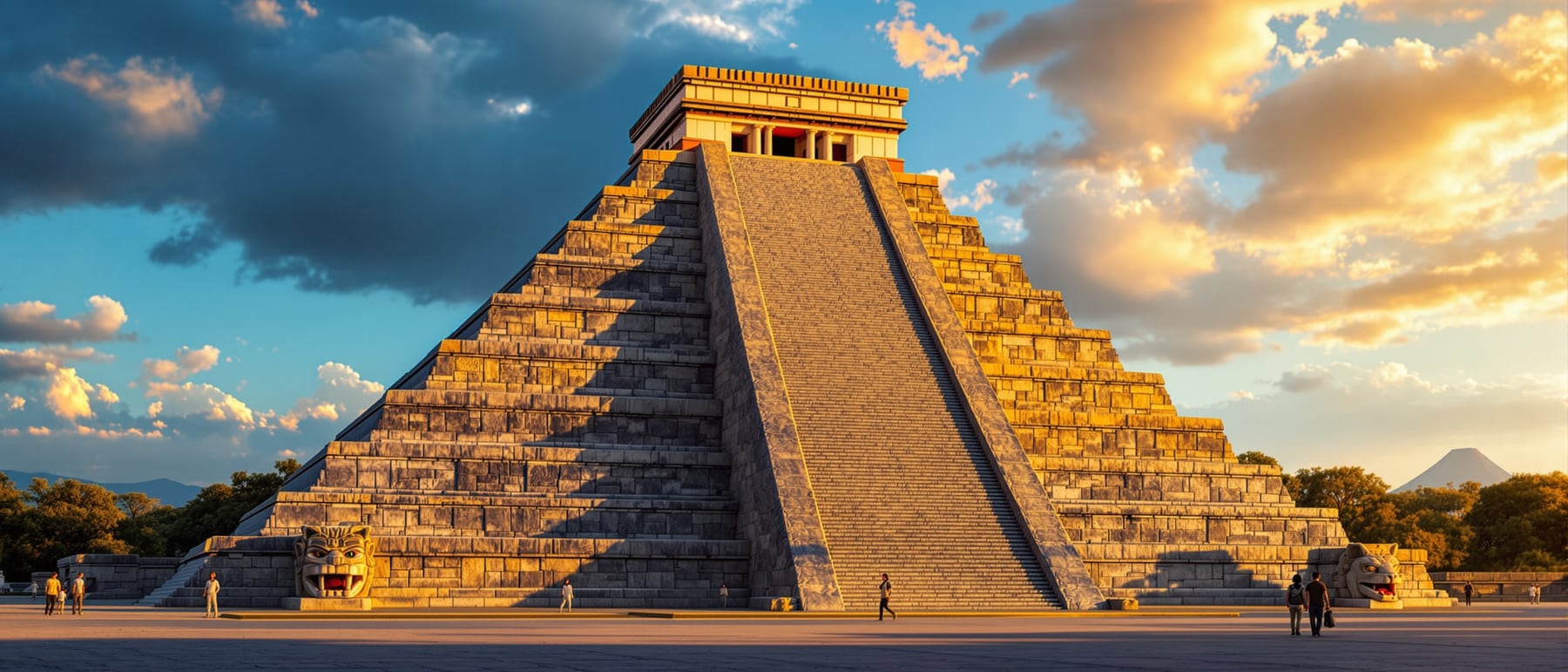
At the centre of Tenochtitlan — one of the largest cities on Earth, built on a lake where Mexico City now stands — rose a twin-peaked pyramid crowned by two temples, to the sun-god of war and the ancient god of rain. It was the beating heart of the Aztec universe, and the great theatre of their sacrifices. In 1521 the Spanish tore it down and built their cathedral on its ruins — until, in 1978, it rose again into the light. The finale of our chapter on the sacred places of the world.
We began this chapter with the oldest free-standing temples on Earth, and we end it with one of the last great sacred monuments raised before the modern world crashed in. From the mud mosques of Timbuktu, kept alive by a community that rebuilds them every year, we come to a temple destroyed in a single, deliberate act — and then, astonishingly, brought back into the light five centuries later. In the heart of what is now Mexico City, beneath the traffic and the colonial stone, lie the ruins of the Templo Mayor, the Great Temple of the Aztecs — the most sacred building of one of the most extraordinary, and most tragic, civilisations in history.
This is the sixty-third article in our Architectural Wonders series, and the sixteenth and final in our chapter on the great temples and sacred places of the world.
It is a fitting place to end, because the Templo Mayor holds, in one monument, almost every thread this chapter has followed: a sacred mountain and a model of the cosmos; a stage for a people's deepest beliefs; a marvel of engineering; and, in the end, a story of destruction, loss, and the long labour of bringing the past back to light.
1. The temple at the centre of the world
To stand before the Templo Mayor, you must first imagine the astonishing city that once surrounded it.
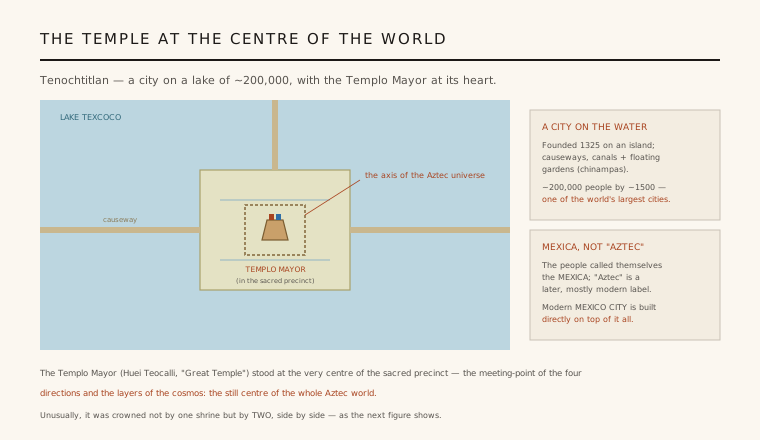
The Aztecs — who called themselves the Mexica ("Aztec" is a later label) — founded their capital, Tenochtitlan, in 1325 on an island in the middle of Lake Texcoco. Over two centuries it grew into one of the largest cities in the world: perhaps 200,000 people by 1500, laced with canals, ringed by floating gardens (chinampas), and joined to the mainland by great raised causeways — a shimmering city on the water that astonished the Spanish when they first saw it. At its very centre stood a walled sacred precinct, and at the heart of that precinct rose the Templo Mayor (Huēyi Teōcalli, the "Great Temple"), founded with the city itself in 1325. It was the axis of the Aztec universe — the meeting-point of the four directions and the layers of the cosmos, the still centre around which their whole world turned. And it took a form found almost nowhere else: it was crowned not by one temple, but by two.
2. Two gods, one mountain
That double summit is the key to the whole building — and to the two forces on which Aztec life depended.
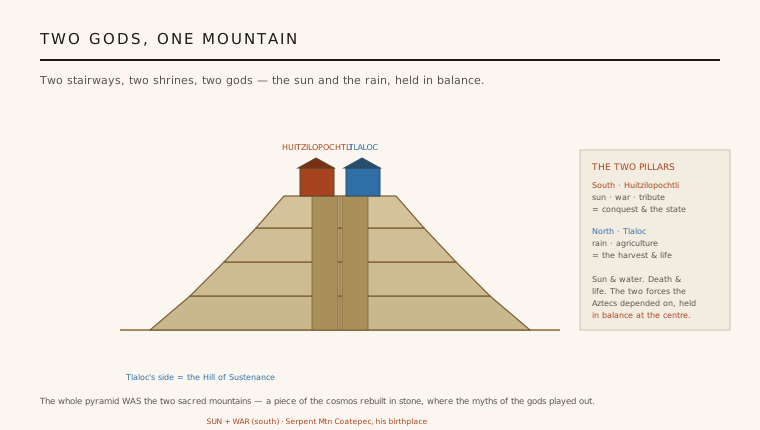
Two wide staircases climbed the western front, side by side, each leading to its own shrine on the summit. The southern (right-hand) shrine belonged to Huitzilopochtli, the god of the sun and of war — the special patron of the Mexica — and his side of the pyramid represented the Hill of Coatepec, the "Serpent Mountain," where in myth he was born. The northern (left-hand) shrine belonged to Tlaloc, the ancient, beloved god of rain and agriculture, and represented the Hill of Sustenance. Set them together and you have the whole logic of the Aztec world in a single silhouette: war and tribute on one side, rain and the harvest on the other; the sun and the water; death and life; the empire and the maize that fed it — the two pillars on which everything rested, held in balance at the exact centre of creation. Like Angkor Wat or Borobudur, the temple was not merely about the cosmos; it was the cosmos, rebuilt in stone so the myths of the gods could play out upon it.
3. The pyramid inside the pyramid
The Templo Mayor we can reconstruct is really the last of many — because the Aztecs built it the way you grow a pearl.
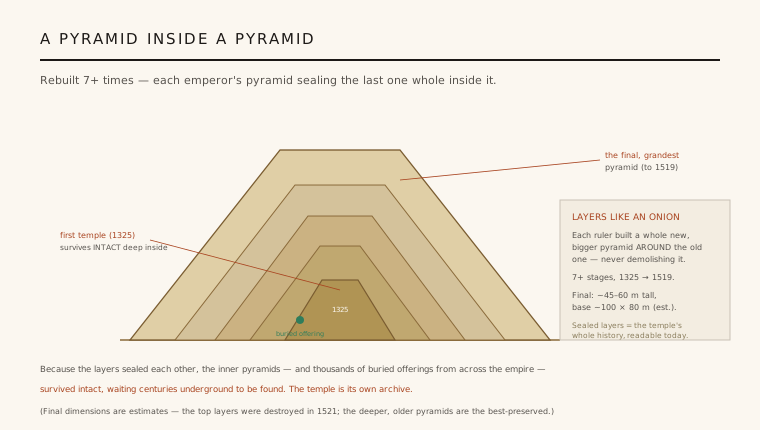
Rather than repair or replace the old temple, each Aztec ruler built an entirely new, larger pyramid right over the previous one — sealing the earlier temple whole inside it, like the layers of an onion or a nesting doll. Between the founding in 1325 and the Spanish arrival in 1519 it was rebuilt and enlarged at least seven times, swelling to a final height of perhaps 45 to 60 metres on a base of about 100 by 80 metres. This habit had a wonderful consequence. Because each layer sealed the one before, the older pyramids survive, intact, deep inside — so archaeologists can read the temple's entire history in cross-section, phase by phase, and the thousands of buried offerings placed within each rebuild (jade, coral, jaguar and eagle bones, sacrificial knives, treasures sent as tribute from every corner of the empire) waited underground for centuries to be found. The building is its own archive. (The final dimensions are estimates: the top layers were destroyed in 1521, and it is the deeper, older pyramids that survive best.)
4. Blood for the sun, and the fallen moon
We cannot tell the Templo Mayor's story honestly without confronting what happened at its summit — and it must be told with care, and with truth.
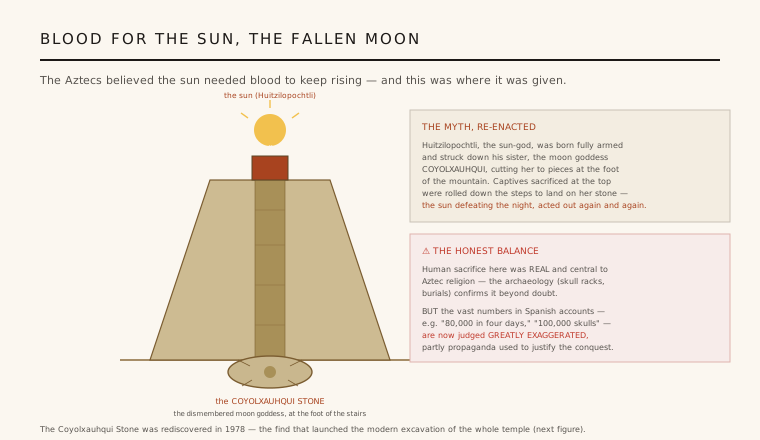
The Aztecs believed the universe was fragile — that the sun itself (in their belief the fifth sun, born in fire long ago at the ruined city of Teotihuacan) had to be fed with human blood to keep rising, and the world kept alive. The Templo Mayor was the principal stage of that belief: captives, most taken in war, were sacrificed at the top of Huitzilopochtli's stairs. And the architecture made the act a re-enactment of myth. At the foot of those same stairs lay the great round Coyolxauhqui Stone, carved with the dismembered body of the moon goddess Coyolxauhqui — Huitzilopochtli's sister, whom, in the myth of Coatepec, the newborn sun-god defeated and cut to pieces at the base of the mountain. Sacrificial victims, rolled down the steps to land on her image, made the sun's victory over the darkness happen again and again. Here, honesty requires holding two truths at once. Human sacrifice was real, and central to Aztec religion — the archaeology (skull racks, buried remains) confirms it beyond any doubt, and we should not soften it. But the staggering numbers in Spanish accounts — tens of thousands sacrificed in a few days, a skull rack of a hundred thousand — are now judged by scholars to be greatly exaggerated, inflated in part as propaganda to justify the conquest. The truth is grim enough without the myths layered on top of it; a serious account neither denies the sacrifice nor accepts the conquerors' numbers.
5. Razed, buried, and unearthed
The Templo Mayor's end came suddenly and deliberately — and its second life is one of the great archaeological stories of our age.
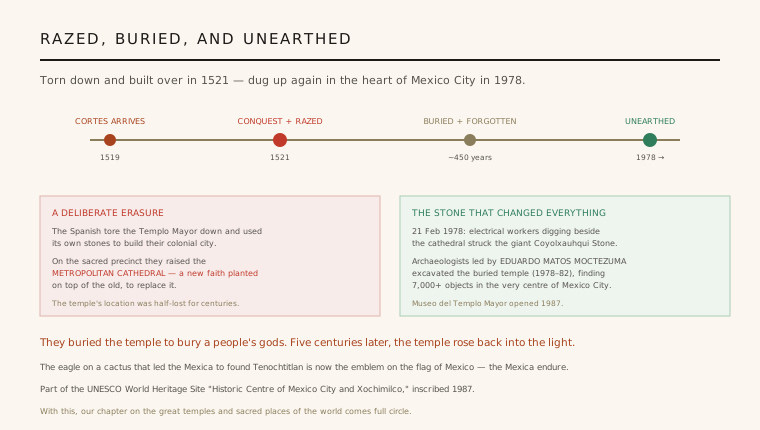
The Spanish under Cortés reached Tenochtitlan in 1519, and after a brutal siege, with tens of thousands of Indigenous allies who hated Aztec rule, they conquered the city in 1521. What followed was one of history's most deliberate erasures: the Spanish tore the Templo Mayor down to its foundations and used its own carved stones to build their new colonial capital — and, on the sacred precinct itself, they raised the Metropolitan Cathedral, planting their faith directly on top of the one they meant to destroy. The Great Temple was buried, its very location half-forgotten, for over four centuries. And then, on 21 February 1978, electrical workers digging beside the cathedral struck a huge carved stone — the Coyolxauhqui Stone. It triggered one of the great excavations of the twentieth century: archaeologists led by Eduardo Matos Moctezuma unearthed the buried temple in the very heart of a living metropolis, recovering more than 7,000 objects and, with them, the physical truth of the Aztec world. In 1987 the site and its museum opened, part of the UNESCO World Heritage listing for the historic centre of Mexico City. The Spanish had buried a temple to bury a people's gods — and five centuries later, the temple rose back into the light. The eagle on a cactus that once led the Mexica to found Tenochtitlan flies today on the flag of Mexico. The Mexica endure.
6. What a modern architect can learn from the Templo Mayor — and from this whole chapter
- A building can hold a civilisation's whole worldview. The twin temple is Aztec cosmology made concrete: two gods, two mountains, two forces in balance. The Templo Mayor is the ultimate proof that architecture can be a people's deepest ideas, built at full scale — a lesson written across this entire chapter.
- What is built to erase can itself be unearthed. A cathedral was raised to bury a temple; the temple came back anyway. You can destroy a building, but the knowledge, the meaning and the memory are far harder to kill — and later ages will often dig for exactly what was hidden.
- Tell hard truths whole. The Templo Mayor demands that we neither excuse its sacrifices nor accept a conqueror's exaggerations. Honest history — like honest design — refuses both denial and distortion.
- The centre matters. Every culture in this chapter built a centre — an axis where earth met sky and the community gathered: a stone circle, a ziggurat, an oculus, a mound, a mandala, a mosque, a twin pyramid. Humans everywhere need a place that means "here is the heart of things," and giving a community that place is one of architecture's oldest and highest tasks.
- We are one building species. From Ġgantija on its Maltese hill to this pyramid on its Mexican lake — across every faith, every continent, and more than five thousand years — human beings have raised temples to reach the sun, the moon, the gods, the dead and the cosmos. The forms differ wildly; the impulse is one. To build the sacred is among the most universal things our species does.
- And in the end, all of it is a way of not being forgotten. These sixteen monuments were built so that something — a god, a king, a people, a truth — would outlast the people who made it. That is the quiet thread that has run through every article: architecture as humanity's long argument against oblivion. It is the same reason Studio Matrx exists, and the same reason this series carries the name it does.
References & further reading
1. UNESCO World Heritage Centre — Historic Centre of Mexico City and Xochimilco (inscribed 1987; includes the Templo Mayor). https://whc.unesco.org/en/list/412/
2. World History Encyclopedia — Templo Mayor and Tenochtitlan. https://www.worldhistory.org/Templo_Mayor/
3. Smarthistory — The Templo Mayor and the Coyolxauhqui Stone. https://smarthistory.org/templo-mayor-at-tenochtitlan-the-coyolxauhqui-stone-and-an-olmec-mask/
4. Matos Moctezuma, Eduardo — Life and Death in the Templo Mayor (the excavator's own account). https://www.worldcat.org/title/life-and-death-in-the-templo-mayor/oclc/30036883
5. The Metropolitan Museum of Art — Tenochtitlan: Templo Mayor. https://www.metmuseum.org/essays/tenochtitlan-templo-mayor
6. Encyclopaedia Britannica — Templo Mayor and Tenochtitlan. https://www.britannica.com/topic/Templo-Mayor
Last verified 2026-07-04. Figures follow UNESCO, the World History Encyclopedia, Smarthistory, the Metropolitan Museum of Art and the work of Eduardo Matos Moctezuma, and are given as widely cited approximations that vary by source. The Templo Mayor (Nahuatl Huēyi Teōcalli, "Great Temple") was the main temple of the Mexica (Aztecs) at the centre of the sacred precinct of Tenochtitlan, founded 1325 CE on an island in Lake Texcoco — now the historic centre of Mexico City. Tenochtitlan reached perhaps ~200,000 people by ~1500 (estimates vary), among the largest cities in the world, with causeways, canals and chinampas. The temple was a twin pyramid: two western stairways to two summit shrines — Huitzilopochtli (sun/war; his side = the Hill of Coatepec, Serpent Mountain, his mythic birthplace) on the south, and Tlaloc (rain/agriculture; the Hill of Sustenance) on the north — embodying the dual foundations of Aztec life. It was rebuilt/enlarged at least seven times (each phase encasing the last), reaching an estimated ~45–60 m height on a ~100 × 80 m base by 1519; sealed inner phases and thousands of buried offerings survive. HUMAN SACRIFICE was real and central (victims sacrificed at Huitzilopochtli's summit; the Coyolxauhqui Stone at the stairs' foot depicts the dismembered moon goddess, and sacrifices re-enacted her mythic defeat), confirmed by archaeology (skull racks/tzompantli, burials) — but the huge tallies in Spanish sources (e.g. tens of thousands in days; ~100,000 skulls) are now judged greatly exaggerated, partly conquest propaganda. Cortés reached Tenochtitlan in 1519; the Spanish and their Indigenous allies conquered it in 1521 and razed the temple, reusing its stone and building the Metropolitan Cathedral over the sacred precinct. The Coyolxauhqui Stone was rediscovered on 21 February 1978, launching the Templo Mayor Project excavation (Eduardo Matos Moctezuma; 7,000+ objects); the site museum opened in 1987. Part of the UNESCO World Heritage Site "Historic Centre of Mexico City and Xochimilco," inscribed 1987. The eagle-on-a-cactus founding sign of Tenochtitlan appears on the flag of Mexico. This article is the sixteenth and final entry in the "great temples and sacred places of the world" chapter of the Architectural Wonders series.
Export this guide
Related Guides — Deep-dive reading
The Pyramid of the Sun: A Mountain Raised Over a Cave by a People With No Name
In the Valley of Mexico, a civilisation we cannot name built one of the largest pyramids on Earth — a man-made mountain of a million cubic metres — and set it precisely over a sacred cave they believed was the womb of the world. They left no writing we can read; even the words 'Pyramid of the Sun' were given, a thousand years later, by the Aztecs, who found the city in ruins and called it the birthplace of the gods.
Architectural WondersThe Mud Mosques of Timbuktu: The University Made of Earth
On the edge of the Sahara, a city that Europe turned into a byword for the middle of nowhere was in truth one of the great centres of learning in the medieval world — with a university of 25,000 students and libraries of hundreds of thousands of manuscripts. Its three great mosques are built entirely of mud, bristling with wooden beams, and must be re-plastered by the whole community every single year — which is exactly why, after seven centuries, they still stand.
Architectural WondersĠgantija: The Oldest Temple Standing, Built by 'Giants'
How a Neolithic island people on Malta — with no metal and no wheel — raised the oldest free-standing stone temples on Earth a thousand years before Stonehenge or the pyramids, moving fifty-tonne blocks on stone balls into clover-leaf sanctuaries for a faith we can trace but cannot read, then vanished, leaving stones so vast that later islanders swore only giants could have built them.
Architectural WondersRelated Tools — Try Free
Before & After Studio
Generate AI before-and-after renders to preview how your redesign could look.
DesignAIAI BOQ Generator
AI generates detailed Bill of Quantities with city-specific rates and labour breakdown.
ArchitectAIWindow Orientation Planner
Pick the best window type, glass and shading by wall direction — north, east, south and west.
Window Tool