
Mies van der Rohe's Façade Signature: The Glass Curtain Wall, the Bronze I-Beam and the Honest Paradox
How "less is more" and "skin and bones" gave the world the steel-and-glass curtain wall and the modern glass tower — the most copied façade on earth, and the one that bakes Indian cities unless you add the full solar kit.
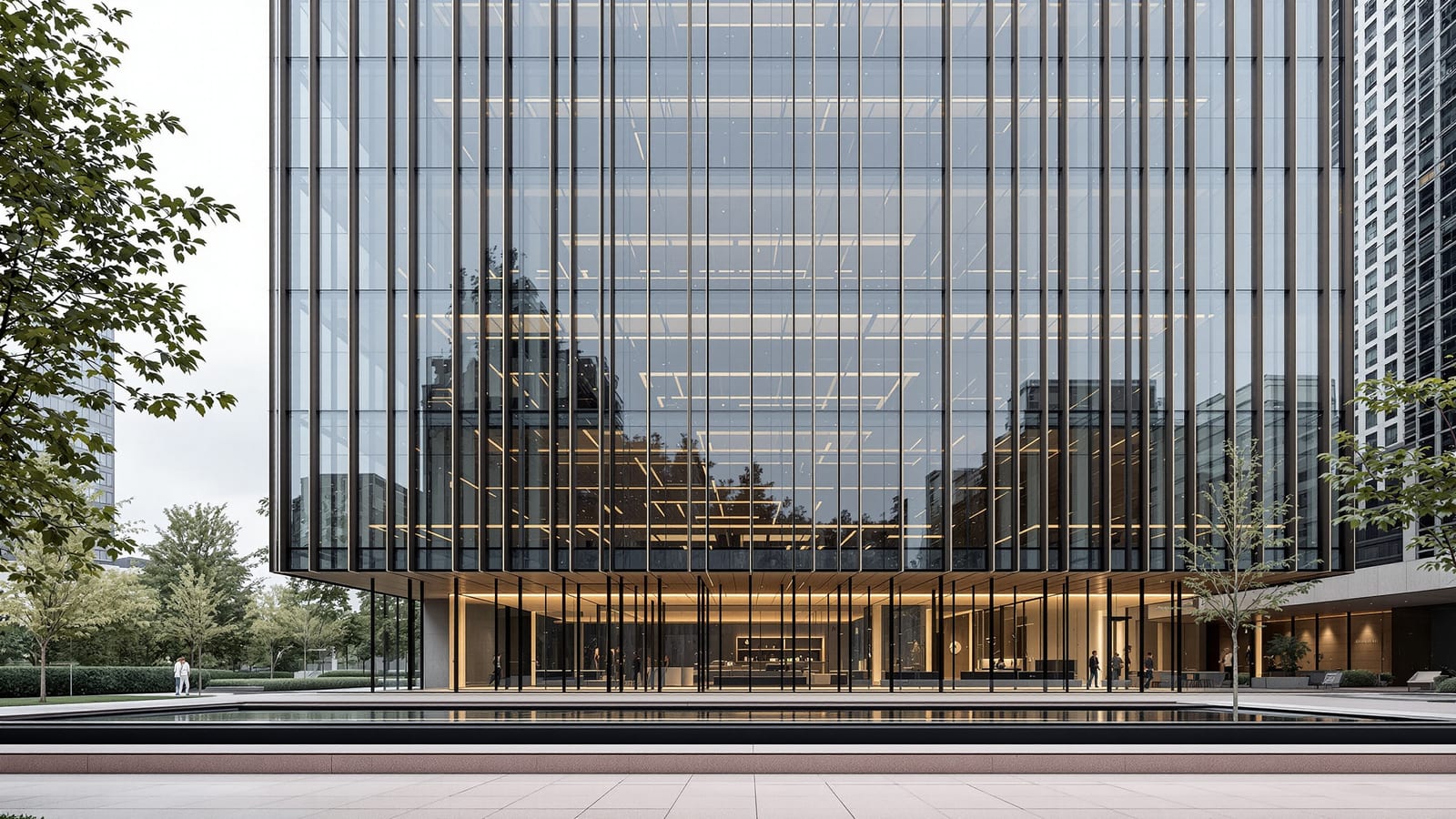
Stand on Park Avenue and look up at the Seagram Building, and you are looking at the single most influential façade decision of the twentieth century. A dark bronze tower, set back from the street behind a pink-granite plaza, its skin a calm, perfectly regular grid of grey-tinted glass laced with slender vertical bronze I-beams running unbroken from plaza to parapet. There is no cornice, no ornament, no rhetoric. There is only structure, skin and proportion — tuned to a degree of obsession that most architects never approach. And yet almost every glass office tower you have ever seen, from Manhattan to Gurugram, is a descendant of this one building.
Ludwig Mies van der Rohe (1886–1969) did not, strictly, invent the curtain wall. But he perfected it, canonised it, and turned it from an engineering convenience into a language — and through his Chicago and New York towers he gave the world the modernist glass skyscraper as a type. "Less is more," he said; "God is in the details." Those two phrases are the whole philosophy of a Miesian façade: strip the wall to its essentials, then perfect every joint until the result is luxurious in its restraint. This is also where the trouble begins for us, because that bare glass skin was designed for temperate Chicago, and in the Indian sun it becomes a greenhouse.
This is part of our Building Façades series — specifically our Masters of the Façade set, where we study how one great architect designed façades. We have a full life story at Mies van der Rohe, so this guide stays narrowly on his façade language. It is the essential companion to our glass curtain-wall façades guide (he invented the type), our energy-efficient façades guide, the Norman Foster façade signature (the environmental discipline that makes a glass tower survivable), and the Charles Correa façade signature — the climate-correct Indian answer to the very box Mies created.
1. "Less is more": the façade stripped to its essence
Less is more is the most quoted phrase in modern architecture, and it is fundamentally a statement about façades. Mies meant that you achieve beauty not by adding decoration but by removing everything inessential until only structure, skin and proportion remain — and then perfecting what is left. A Miesian façade has no cornices, no string courses, no applied ornament, no historicist references. It has a frame, a skin and a grid, and its entire expressive power comes from the quality of those three things and the proportion between them.
This is reductive minimalism, and it is harder than it looks. When you strip a façade of ornament, you have nowhere to hide. Every misaligned joint, every clumsy proportion, every cheap material reads instantly. A decorated façade can absorb mistakes; a bare one amplifies them. That is precisely why Mies paired "less is more" with "God is in the details" — once you have removed everything, the few things that remain must be flawless. The discipline of removal forces a discipline of execution.
2. "Skin and bones": frame and membrane
Mies described his architecture as skin and bones. The bones are the structural frame — a regular skeleton of steel or reinforced-concrete columns and beams that carries all the building's loads. The skin is a thin, taut outer membrane of glass and metal that carries nothing but its own weight and the wind, hung off the front of those bones like a curtain.
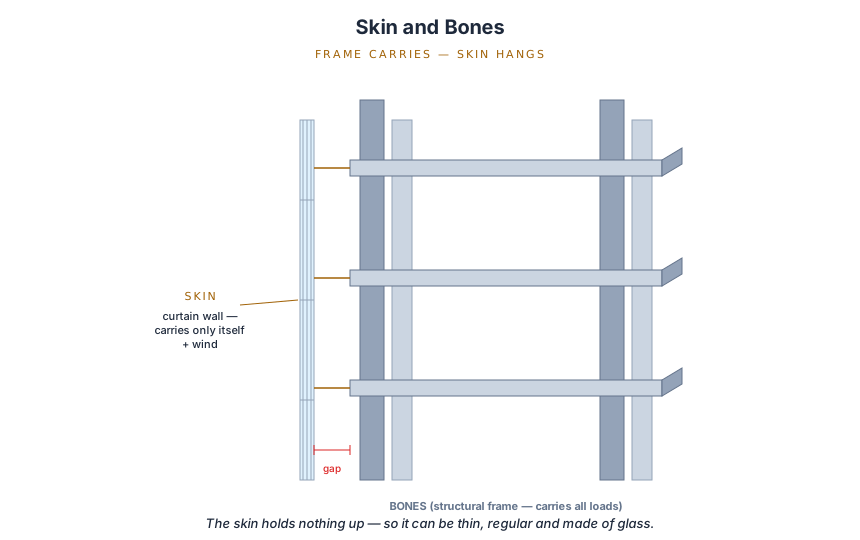
This separation is the conceptual engine of the modern glass building. Once the skin no longer holds the building up, it can be made of almost anything and as thin as you like — and Mies chose to make it of glass, so the building dissolves into a transparent or reflective membrane. The wall stops being a heavy mass and becomes a layer. Everything that follows — the curtain wall, the all-glass house, the glass tower — flows from this single move of separating the load-bearing bones from the weather-sealing skin.
3. The curtain wall: the skin hung off the frame
A curtain wall is a non-load-bearing outer skin. Because the structural frame carries the floors, the external wall is freed from any structural job and simply "hangs" off the edge of the floor slabs like a curtain across a window — sealing weather, admitting light, and nothing more. It can be a continuous, uninterrupted grid of glass and metal because there are no load-bearing walls interrupting it.
Mies did not literally first-invent the curtain wall — the principle existed in nineteenth-century iron-and-glass buildings. What he did was turn it into architecture: a disciplined, proportioned, detailed composition rather than a glazing system. At 860–880 Lake Shore Drive in Chicago (1951), he built two pioneering steel-and-glass apartment towers whose facades are a continuous curtain-wall grid — and from that prototype the entire post-war glass-tower industry grew. The terms you need: the vertical members of the grid are mullions, the horizontal members are transoms, and the rectangle of glass between them is a lite or panel. The proportions of that grid are the whole game. Our glass curtain-wall façades guide covers how this system is built and detailed in India today.
4. The structural module and the grid
Underneath every Miesian façade is a structural module — a single dimensional unit (the spacing of the columns, subdivided into bays of glass) that is repeated with absolute regularity across the whole elevation. The grid generated by this module governs everything: the width of each glass panel, the spacing of the mullions, the relationship between window and floor.
Mies tuned these grids obsessively. The question of how many mullions to put between structural columns, how wide each glass panel should be, where the spandrel (the opaque band hiding the floor slab) sits relative to the vision glass — these were decisions he agonised over for years. The regularity is not laziness; it is the source of the calm. A perfectly regular grid reads as ordered and serene. This is one of his most transferable lessons, and it costs nothing: proportion and disciplined repetition make even cheap materials look composed, while a badly proportioned grid makes expensive ones look chaotic.
The expressed I-beam mullion: Seagram and the honest paradox
Here is the technical heart of Mies's façade language, and its most famous controversy.
At the Seagram Building (1958, designed with Philip Johnson), Mies wanted the façade to express its structure — to show, on the skin, the vertical steel frame inside. But American fire codes made this impossible to do honestly. Structural steel must be wrapped in fireproofing (concrete or gypsum) so that it does not soften and collapse in a fire. That fireproofing makes the real columns fat, lumpy and buried inside the floor slabs — invisible from outside, and ugly if exposed.
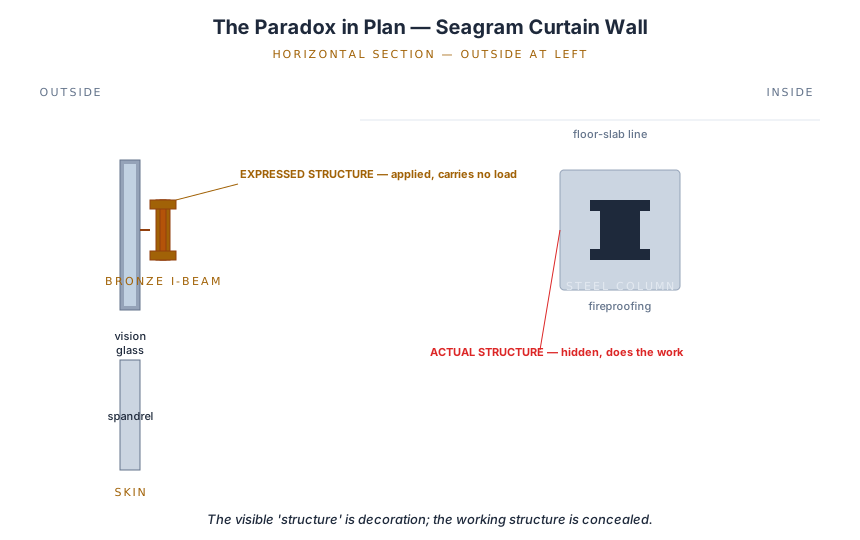
So Mies did something audacious. He took bronze I-beam extrusions — non-structural, decorative, roughly 4½ by 6 inches — and welded them vertically onto the outside of the curtain wall, running floor to floor as the mullions of the grid. These visible I-beams look exactly like exposed structural steel. They give the façade its rhythm, its shadow lines, its sense that you are seeing the bones through the skin.
But they carry no load. The expressed I-beam mullion is applied decoration. The real structure — the columns that actually hold up the tower — is fireproofed and hidden inside, set back from the glass. The visible "structure" on the skin is a representation of structure, not structure itself. Critics seized on this immediately, and the line that stuck was that Mies "lied in order to tell the truth": the supposedly honest, structure-revealing façade is one of the most celebrated paradoxes in architecture. The architecture that prized structural honesty above all else achieved its most famous expression of structure through applied ornament.
This matters enormously for India, where "expressed structure" is a fashionable façade idea. The lesson is sharp: façade expression is not the same as structural honesty. Putting structure-looking elements on a skin is a compositional and symbolic act, and it can be beautiful — Seagram is sublime — but be honest with yourself and your client about what is doing work and what is doing theatre. If you weld a fake beam onto a façade, call it what it is: a mullion shaped like a beam, chosen for rhythm and shadow, not a structural truth.
5. Rich materials within restraint
A common misreading is that "less is more" means cheap or cold. It does not. Mies achieved his restraint with some of the most luxurious materials available — the restraint is in the composition, not the palette. Seagram is clad in bronze with grey-pink tinted glass and a travertine and marble lobby; its plaza is pink granite. The Barcelona Pavilion is a composition of golden onyx, green marble, travertine, chrome-clad steel columns and glass.
The discipline is this: a few superb materials, each used as a clean plane, with the joints perfected and nothing fighting for attention. This is the most affordable lesson Mies offers India — not the materials themselves, but the strategy. Choose two or three good materials, use them as honest planes, get the joints right, and stop. A restrained façade in good local stone and well-detailed plaster will outclass a busy façade in expensive cladding every time.
6. The plaza, the podium and the setback
Mies treated the ground as part of the façade. At Seagram he set the tower back roughly 90 feet from Park Avenue, sacrificing rentable floor area to create a raised granite plaza with reflecting pools — a calm, generous public forecourt that lets you see the whole tower at once and approach it ceremonially. The setback and the plaza frame the façade the way a margin frames a page.
At the Neue Nationalgalerie and the Barcelona Pavilion, the building sits on a stone podium that lifts it slightly off the ground, giving it a base and a sense of platform. This is a quiet but powerful façade lesson for India, where towers are too often pushed hard against congested streets: the space in front of a façade is part of the design. A few metres of setback, a clean plinth, a considered approach — these transform how a façade is read, and they are within reach of any serious project.
7. Universal space and the glass box
Mies's other great obsession was universal space — a single, undivided, column-free interior volume that could be used for anything. When you remove the internal walls and columns, the façade is freed to become a continuous transparent membrane all the way around. This is the glass box or glass pavilion: the façade as a sheet of glass that dissolves the boundary between inside and landscape.
Three buildings show this purely. The Farnsworth House (1951, Plano, Illinois) is a single glass-walled room raised on slender white I-beam columns above a flood plain — floor-to-ceiling plate glass on all sides, the wall reduced to a transparent membrane, the house almost disappearing into the trees. Crown Hall at IIT (1956) is a clear-span glass hall, its roof hung from external steel girders so the interior is utterly column-free. The Neue Nationalgalerie in Berlin (1968) is a glass-and-steel "temple" — a vast coffered steel roof floating over an all-glass hall on a granite podium. In each, the façade has been reduced to its absolute limit: a frame and a membrane of glass. Beautiful, radical — and, in the Indian sun, a thermal problem we will come to.
Real buildings, not renders
These are verified projects. Look at how the façade works in each.
- Seagram Building, New York (1958, with Philip Johnson). A 38-storey bronze tower at 375 Park Avenue. The façade is a bronze-and-grey-glass curtain wall articulated by non-structural bronze I-beam mullions running its full height; the real columns are fireproofed and hidden inside. Set back roughly 27 m behind a pink-granite plaza with pools. The canonical glass tower and the source of the I-beam paradox.
- Farnsworth House, Plano, Illinois (1951). A weekend house reduced to a single glass-walled room. Eight white-painted steel I-beam columns carry precast roof and floor slabs; the façade is floor-to-ceiling plate glass fixed with steel mullions, raised above the Fox River flood plain, with travertine terraces. The purest glass pavilion — façade as transparent membrane dissolving into landscape.
- Barcelona Pavilion (1929, with Lilly Reich). The German pavilion for the 1929 Exposition (demolished 1930, reconstructed 1986). Eight chrome-clad cruciform steel columns carry the flat roof, freeing the walls to become free-standing planes — a famous golden-onyx wall, green and ancient-green marble, travertine, and glass partitions that slide past each other and never meet at corners. The façade as a composition of free-standing material planes rather than a sealed box.
- 860–880 Lake Shore Drive Apartments, Chicago (1951) / Crown Hall, IIT (1956). Lake Shore Drive is the pioneering steel-and-glass curtain-wall apartment pair — the prototype for every glass tower that followed. Crown Hall is a clear-span glass hall whose roof hangs from external steel plate girders, giving a column-free universal space behind an ultra-thin steel-and-glass skin.
- Neue Nationalgalerie, Berlin (1968). Mies's last masterpiece — a steel-and-glass temple on a granite podium, a huge coffered steel roof floating over an all-glass upper hall. The glass façade is the membrane of a single universal space; the architecture is roof, podium and glass.
Signature façade devices
| Device | What it is | Why Mies used it | Building | India lesson |
|---|---|---|---|---|
| The glass curtain wall | Non-load-bearing skin hung off the frame as a continuous grid | Frees the wall to be a thin, regular, transparent membrane | Lake Shore Drive; Seagram | The DNA of every Indian glass tower — but needs the full solar kit here |
| Expressed I-beam mullion | Non-structural bronze I-beams welded to the skin to look like exposed structure | To express structure on the façade (codes hid the real steel) | Seagram | Expression ≠ honesty; use rhythm devices, but be honest about what they are |
| Skin and bones | Structural frame (bones) wrapped in a thin glass-metal skin | Separates load-bearing from weather-sealing | All towers | The clean modern way to build — but the skin must suit the climate |
| The structural module / grid | A repeated dimensional unit governing the whole elevation | Regularity creates calm and order | Crown Hall; Seagram | Free, climate-neutral, transferable to any material — adopt this |
| Universal space / glass box | Column-free interior behind an all-glass membrane | Maximum flexibility and transparency | Farnsworth; Neue Nationalgalerie | Stunning, but a greenhouse in Indian sun without heavy shading |
| Rich materials within restraint | Few superb materials as clean planes, joints perfected | Luxury through composition, not ornament | Barcelona Pavilion | The cheapest lesson — a few good materials, done right |
| The plaza / setback / podium | Stone forecourt or plinth framing the tower | The ground is part of the façade | Seagram plaza; Neue Nationalgalerie podium | Give a façade margin and a base; it transforms how it reads |

What it teaches India
Be honest about this, because it is the whole point. Mies invented the glass tower that now bakes our cities. Walk through the glass office districts of Gurugram, Bandra-Kurla, Whitefield in Bengaluru or HITEC City in Hyderabad and you are walking through thousands of unacknowledged copies of Seagram and Lake Shore Drive. The single-skin glass curtain wall is the direct origin of the problem that Correa, Doshi, Laurie Baker and, later, Morphogenesis spent their careers correcting for India.
The mechanism is simple physics. A bare clear-or-tinted single-glass Miesian box was designed for temperate Chicago and New York — and even there it is a thermal compromise that the Seagram-era buildings ran enormous heating and cooling bills to maintain. Drop that same box into Indian sun and it becomes a greenhouse: solar radiation pours through the glass, is absorbed inside, and cannot escape, so the building overheats and the air-conditioning runs flat out all year. The façade that looks like cool restraint is, in our climate, an energy disaster. This is exactly the warning in our glass curtain-wall façades and energy-efficient façades guides.
So separate the man's two legacies cleanly. His bare glass skin is wrong for India unless you can afford — and actually build — the full environmental kit: solar-control or low-E glass, external shading (fins, brise-soleil, deep reveals), and ideally a ventilated double-skin façade. That kit is precisely the environmental discipline of Norman Foster (see the Norman Foster façade signature), which is what makes a glass tower survivable, and it is the climate-first thinking of Charles Correa, whose deep verandahs and shaded openings are the Indian answer to the Miesian box. Without that kit, do not build the bare glass box. Full stop.
But his deeper lessons are timeless, cheap and transferable to any material whatsoever. Proportion. Restraint — less is more. The disciplined, regular grid. The perfected detail — God is in the details. The honest intention to express structure (executed honestly, not as Seagram's celebrated fudge). These cost nothing extra and improve a façade in mud, brick, stone, plaster, concrete or aluminium just as much as in bronze and glass. The rule for India is therefore one sentence: keep Mies's discipline and proportion; drop his bare glass unless you can afford the full solar-control, shading and double-skin kit.
What this means for you
If you are designing or commissioning a façade in India, take the discipline and leave the glass. Start with the structural grid and tune it until it is calm and regular — that single decision will do more for your façade than any cladding budget. Choose two or three good materials, use them as clean planes, and obsess over the joints; restraint plus perfected detail is the cheapest luxury there is. If you want to "express structure" on the skin, do it — but be honest, with Seagram's paradox in mind, about what is structural and what is rhythm.
And if a developer or architect shows you a render of a gleaming all-glass tower for a site in Gurugram or Bengaluru, ask one question: where is the solar control and the shading? If the answer is "tinted glass," it is not enough — that building will bake and guzzle air-conditioning for its entire life. Mies gave the world a magnificent idea built for a cooler climate. Honour the discipline. Fix the skin for our sun.
Sources
- Seagram Building (1958, with Philip Johnson), New York — building documentation; SAH Archipedia; coverage of the bronze I-beam mullion and fireproofing-driven "expressed" structure.
- "Less is more" / "God is in the details" / skin and bones / International Style — Fundació Mies van der Rohe; Encyclopaedia Britannica.
- Farnsworth House (1951), Plano, Illinois — National Trust for Historic Preservation; ArchDaily; Britannica.
- Barcelona Pavilion (1929, with Lilly Reich; reconstructed 1986) — Fundació Mies van der Rohe (miesbcn.com); ArchDaily.
- 860–880 Lake Shore Drive Apartments (1951) and Crown Hall, IIT (1956) — Docomomo US; Illinois Institute of Technology; ArchEyes.
- Neue Nationalgalerie, Berlin (1968) — Staatliche Museen zu Berlin (smb.museum).
- Mies as last director of the Bauhaus — Bauhaus Kooperation; Britannica.
- Studio Matrx in-house: Mies van der Rohe biography, glass curtain-wall façades, energy-efficient façades, Norman Foster façade signature.
Export this guide
Related Guides — Deep-dive reading
Charles Correa's Façade Signature: How India's Master Made the Climate-Correct Wall
How Charles Correa eroded the flat sealed wall into deep, shaded, porous layers — verandahs, terraces, pergolas and open-to-sky courts — so the Indian façade filters sun and drives air instead of sealing it out.
Building FacadesNorman Foster's Façade Signature: The High-Tech Glass Diagrid and the Engineered Skin
How Norman Foster turned the building envelope into structure, climate machine and civic statement — the diagrid crystal, the breathing double-skin, the glazed gridshell — and what his glass towers really demand in Indian heat.
Building FacadesEnergy-Efficient Facades in India: How the Building Skin Cuts Your Cooling, Heating & Lighting Bills
How a building facade drives cooling, heating and lighting energy in India, the three levers of solar-heat-gain control, insulation and daylighting, U-value, SHGC, VLT and WWR in plain terms, ECBC and Eco-Niwas expectations, and real Indian green buildings.
Building FacadesRelated Tools — Try Free
Brise-Soleil Visualizer
Interactive horizontal-louvre cut-off angle calculator — sun altitude, louvre depth, and spacing inputs with a live shadow preview. Computes θ = arctan(spacing/depth) for façade shading, ECBC envelope compliance, hospital daylight design, and tropical sun-control detailing.
Sun Shading ToolConcept Generator
Get 3 AI-generated design concepts for any room with style, materials, and cost estimate.
DesignAICross-Ventilation Analyzer
Estimate airflow and air changes per hour (ACH) from room size, window areas, layout, and local wind — with NBC 2016 Part 8 compliance check.
Ventilation Calculator