
Ludwig Mies van der Rohe
Less is more — the master of steel, glass and the curtain-wall tower
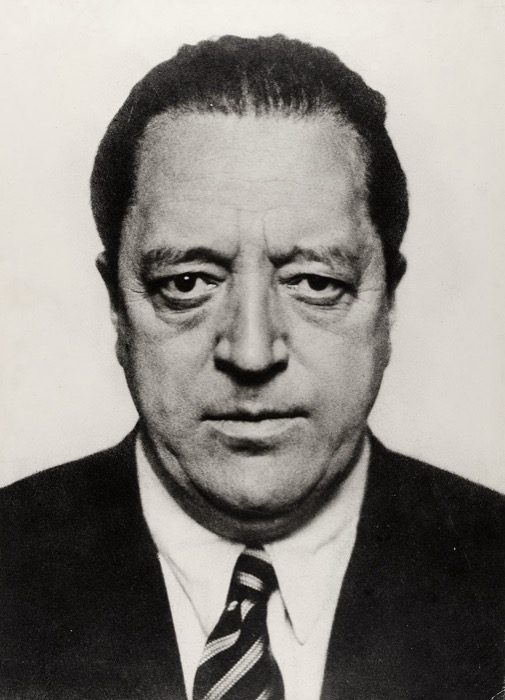
Portrait: public domain, via Wikimedia Commons
Movements
Signature works
- Barcelona Pavilion (1929)
- Villa Tugendhat, Brno (1930)
- Farnsworth House, Plano (1951)
- 860–880 Lake Shore Drive, Chicago (1951)
- S. R. Crown Hall & IIT campus, Chicago (1956)
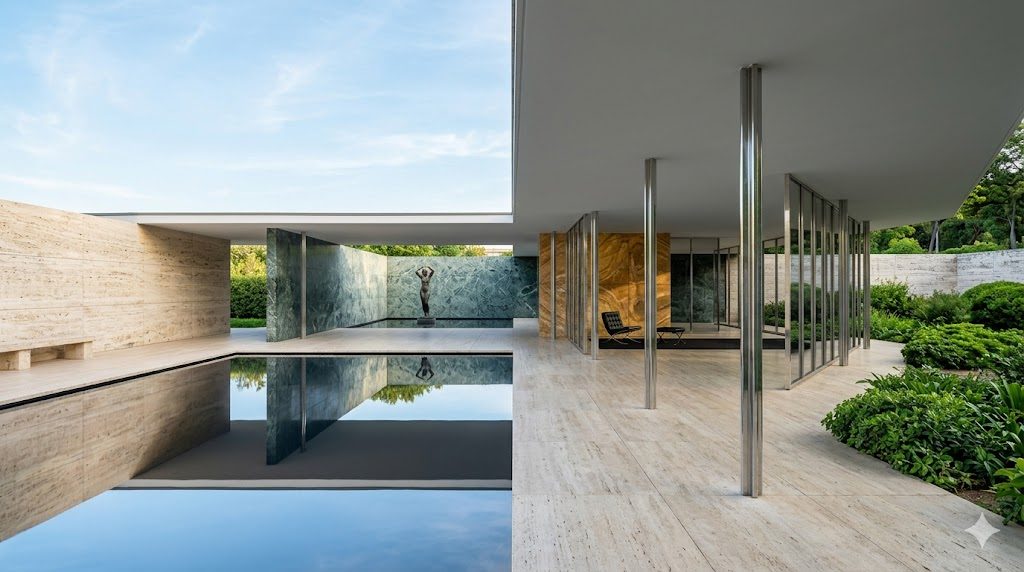
Stand in the Barcelona Pavilion on a still morning and you will struggle to say where the building begins or ends. A thin marble roof seems to hover, weightless, over a polished travertine platform. A single slab of golden onyx, sawn so its veins mirror each other, divides the space without ever closing it. Walls of green marble and grey glass slide past one another like cards laid loosely on a table, and a black reflecting pool throws the whole composition back at you, doubled and trembling. There are almost no rooms here, almost no objects — two leather chairs, a small dark pool with a bronze figure, the sky. And yet it is one of the most influential buildings ever made.
That pavilion was designed by Ludwig Mies van der Rohe — born in 1886, dead in 1969 — the German-American architect who, more than any other, taught the twentieth century how to build with steel and glass.
His central contribution can be stated almost as briefly as he would have wished. Mies reduced architecture to its barest essentials — a clear structural frame, a taut glass skin, a single flowing universal space — and then lavished obsessive care on those few elements until they achieved a serene, classical perfection. "Less is more," he said, and "God is in the details." From that doctrine came the glass curtain-wall tower, the template for the modern office building everywhere on earth, including the gleaming corporate campuses of Gurugram, Bengaluru and Hyderabad. (For a close reading of his building skins — the curtain wall, the expressed bronze I-beam mullion and the honest paradox at Seagram — see our Mies van der Rohe facade signature guide.)
The idea: almost nothing, made perfect
Most architects add. Mies subtracted. His lifelong project was to remove everything from a building that was not strictly necessary — ornament, applied decoration, even interior walls — until what remained was so reduced that it approached, in his own German phrase, "beinahe nichts," almost nothing.
But "almost nothing" was not emptiness. It was discipline. Once a building has been pared down to a frame of slender steel columns, a flat roof and a wall of glass, every single element that survives becomes visible and therefore important. The width of a window mullion, the way a steel beam meets a stone floor, the proportion of a bay, the precise grey-green of the glass — all of these now carry the entire expression of the building. There is nowhere to hide a clumsy joint. This is why he insisted that "God is in the details." When you have stripped a building to its bones, the bones must be flawless.
Two technical ideas made this possible. The first was skin-and-bone construction: a steel or reinforced-concrete frame (the bone) carries all the weight, so the external wall (the skin) no longer holds anything up and can dissolve into a continuous sheet of glass. The second was universal space — a single, uninterrupted, column-free volume, spanned by deep roof trusses, that could be used for almost anything: a chapel, a factory, a gallery, an office floor. Mies believed a building should not be tailored too tightly to one function, because functions change; better to make a beautiful, neutral, flexible space and let life flow through it.
Less is more.
The three words are the most compressed manifesto in modern architecture. He did not coin the underlying idea alone, but he made it his creed and proved it in steel — and the world has argued with it, and been shaped by it, ever since.

Life and path
He was born Maria Ludwig Michael Mies on 27 March 1886, in Aachen, the old cathedral city on Germany's western edge. His father was a stonemason, and the boy grew up among slabs of marble and limestone, learning the feel and grain of stone before he ever learned to draw a plan. That early, almost physical intimacy with material — its weight, its surface, its honesty — never left him; it is there in the onyx of Barcelona and the travertine of every podium he ever raised. Later, wanting a more distinguished name, he added his mother's maiden name "Rohe" with the Dutch-sounding "van der," and became Mies van der Rohe.
He had no formal training as an architect — no degree, no diploma. He learned, as Le Corbusier did, in the offices of others. He worked first for the furniture designer and architect Bruno Paul, then, decisively, in the Berlin studio of Peter Behrens, the pioneer of industrial design and the architect of the great AEG turbine factory. The Behrens office around 1910 was an extraordinary place: the young Mies worked there alongside two other future giants of modernism, Walter Gropius and Le Corbusier. From Behrens, Mies absorbed a love of clear structure and a disciplined, almost classical sense of proportion that he traced back to the German neoclassicist Karl Friedrich Schinkel.
Through the 1920s, in the ferment of Weimar Germany, Mies emerged as a leader of the avant-garde. He designed visionary, unbuilt glass skyscrapers, served as vice-president of the Deutscher Werkbund, and directed the influential 1927 Weissenhof housing exhibition in Stuttgart. In 1929 came the Barcelona Pavilion, and in 1930 the Villa Tugendhat — and in the same year he was appointed the last director of the Bauhaus, the famous school of art, craft and design. He led it through its final, embattled years until 1933, when the Nazis, who despised the Bauhaus as degenerate and "un-German," forced it to close.
Germany was no longer a place where Mies could work. In 1937 he emigrated to the United States, and in 1938 he was made head of the architecture school at the Armour Institute of Technology in Chicago, soon renamed the Illinois Institute of Technology (IIT). There he found his second life. He designed the IIT campus itself, taught a generation of American architects his rigorous method, and over the next three decades built the steel-and-glass masterpieces that would define a global style. He became an American citizen in 1944. He died in Chicago on 17 August 1969, having changed the skyline of nearly every major city in the world.
The signature works
A handful of buildings carry the whole evolution of his thought — from the flowing European pavilion to the crystalline American tower.
| Building | Place & date | Why it matters |
|---|---|---|
| Barcelona Pavilion | Barcelona, Spain, 1929 | The German national pavilion for the 1929 world's fair, designed with Lilly Reich. Free-standing planes of onyx, marble and glass under a floating roof, with reflecting pools and the famous Barcelona chair. The purest statement of the "free plan" and flowing space. Demolished in 1930, faithfully rebuilt in 1986. |
| Villa Tugendhat | Brno, Czech Republic, 1930 | A luxurious modern house on a sloping site, with a steel frame, a sweeping wall of glass that lowers into the floor, and an onyx partition. A UNESCO World Heritage Site and a domestic counterpart to Barcelona. |
| Farnsworth House | Plano, Illinois, 1951 | A single glass-walled room raised on slender white steel columns in a riverside meadow — a transparent pavilion in the landscape. The most radical, and most contested, house of the century. |
| 860–880 Lake Shore Drive | Chicago, 1951 | Twin steel-and-glass apartment towers on Lake Michigan. The first mature statement of the glass-skinned residential high-rise, with exposed black steel and an exacting curtain wall. |
| S. R. Crown Hall & IIT campus | Chicago, 1956 | The home of IIT's architecture school: a vast, clear-span hall with no internal columns, its roof hung from four great external steel girders. The definitive "universal space." |
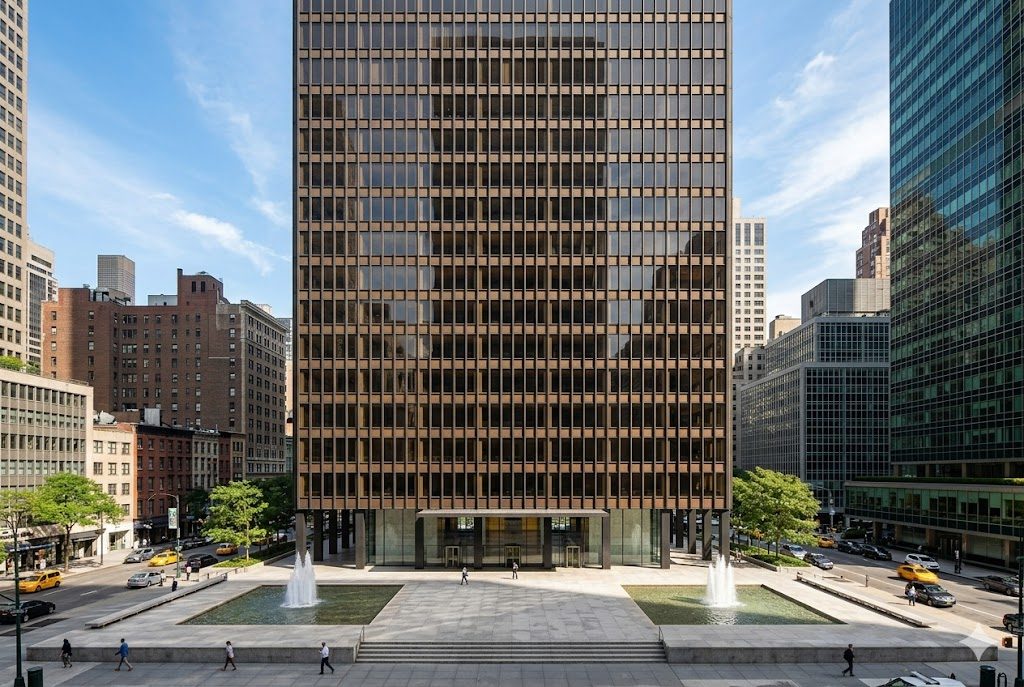
| Seagram Building | New York, 1958 | Designed with Philip Johnson, a 38-storey bronze-and-glass tower set back behind a granite plaza. The canonical curtain-wall skyscraper and the model for the corporate tower worldwide. |
| Neue Nationalgalerie | Berlin, 1968 | His late masterpiece and last completed work: a glass-walled temple of art under a vast black steel roof carried on just eight external columns — universal space as a serene classical pavilion. |
Look closely and you can see a single idea maturing across forty years. In Barcelona, the walls still wander freely beneath the roof. By Crown Hall and the Neue Nationalgalerie, the walls have vanished entirely into glass, the structure has migrated to the outside, and the inside has become one pure, column-free room — the universal space in its final, almost sacred form. And the Seagram Building is the work that changed cities: by setting his bronze tower back from the street behind an open plaza, Mies gave New York a new kind of civic generosity, and gave every developer after him a model to imitate (usually without his plaza, and always without his bronze).
It is worth dwelling on the materials, because for all his reputation as a minimalist, Mies was a sensualist about surfaces. He chose travertine, bronze, onyx, green Tinian marble and chromed steel with a connoisseur's eye. The "less" in "less is more" never meant cheap or plain; it meant few elements, each of the finest possible quality and craft. His friend and collaborator Lilly Reich was central to this material and furniture sensibility, and the Barcelona chair they produced remains one of the most recognisable objects of the modern movement.
The philosophy: minimalism as discipline
Mies is the patron saint of architectural minimalism, but it is worth being precise about what he meant by it, because the word is now so loose.
For Mies, reduction was never a style applied to a surface; it was a structural and ethical method. You begin with the rational frame that modern technology makes possible — steel, glass, the clear span. You let that structure be honestly visible. You remove everything that is not the structure or the space it shelters. And then you perfect what remains, down to the last millimetre of a mullion, because in a building this bare there is no other way to achieve beauty than through proportion, material and the exquisite resolution of every junction. This is why a Mies building can feel both severe and luxurious at once: severe in its geometry, luxurious in its execution.
He also believed, in a way that connects him to a long classical tradition, that architecture should express its own epoch rather than chase novelty. The age of steel and glass demanded a clear, ordered, technological architecture — calm, universal, almost anonymous — and his task was simply to bring it to its most refined form. He had little interest in the expressive individualism of an organic architect like Frank Lloyd Wright, or the sculptural drama of his old colleague Le Corbusier. He wanted order, repose and clarity.
That discipline of restraint — strip to essentials, then perfect the few elements that remain — is exactly the sensibility explored, in an Indian setting, in our guide to minimalist architecture in the Indian context. Mies is, in a real sense, the source of the river. To understand how a "less is more" ethic can be adapted to Indian light, dust, heat and the love of texture and pattern, that guide is the place to start.
India: the glass tower and the corporate campus
Mies van der Rohe never built in India, and it would be false to claim otherwise. His influence on the country runs along a different and, in its way, more pervasive channel: he gave India — and the whole world — the form of the modern office.
When you look at the IT parks of Bengaluru, the corporate towers of Gurugram's Cyber City, the financial high-rises of Mumbai's Bandra-Kurla Complex or the campuses of Hyderabad's HITEC City, you are looking at the distant descendants of the Seagram Building and 860–880 Lake Shore Drive. The vocabulary is Miesian to its core: a structural frame wrapped in a continuous glass curtain wall, deep open floor-plates of "universal space" that any company can fit out and refit at will, a set-back from the street, a clarity of repeated bays. The global corporation needed a building that was efficient, flexible, prestigious and identical from Frankfurt to Singapore — and Mies had already designed its template.
This is a double-edged legacy, and an honest account must say so. At its best, the Miesian tower brought daylight, openness and a calm rationality to the Indian workplace. At its worst — copied without his rigour, his proportion or his materials — the all-glass tower has become one of the most climatically inappropriate building types for a hot country. A sealed glass box in Gurugram or Chennai is a greenhouse, soaking up the sun and demanding enormous air-conditioning loads to stay habitable. Mies built mostly in temperate Chicago and New York; his skin was never designed for the Indian summer.
The intelligent Indian response has not been to reject his discipline but to climatise it. The best contemporary Indian offices keep the Miesian clarity — the clean frame, the flexible open floor, the honest structure — while replacing the naive glass wall with a shaded, layered facade: deep brise-soleil, perforated screens descended from the traditional jali, double skins and high-performance glass oriented to the sun. In other words, they marry Mies to the climate logic that Le Corbusier demonstrated at Chandigarh. To see how that synthesis plays out across India's varied climate, our guides on passive design for India's climate zones and what defines contemporary Indian architecture follow the thread directly.
There is a quieter Indian inheritance too, at the scale of the home. The reduced, calm, uncluttered interior — open-plan living, large clear glazing onto a garden or court, a few fine materials beautifully detailed — is a Miesian dream that an affluent, design-aware India has increasingly embraced. The challenge, again, is to make that minimalism breathe in the Indian climate, and that is precisely what our minimalist architecture in the Indian context guide sets out to do.
Legacy and what we can learn
Mies van der Rohe's influence is everywhere and almost invisible, because it became the ordinary language of building. Together with Gropius and Le Corbusier, he is one of the founders of the so-called International Style — the steel, glass and concrete modernism that conquered the world after the Second World War. For two generations, to design a serious office building anywhere was to design after Mies.
He also drew a backlash, and that backlash is part of his importance. By the 1960s and 70s, critics charged that the universal glass box was monotonous, placeless and inhuman — "less is a bore," quipped the architect Robert Venturi, deliberately mocking Mies's creed and launching the postmodern reaction. The Farnsworth House, for all its perfection, was famously hard to live in; its client sued him. These criticisms are fair, and a mature appreciation of Mies holds them alongside the genius. He showed both the sublime heights and the real limits of pure reduction.
What endures, and what is worth learning, is the deeper discipline beneath the style. Mies teaches that restraint is harder than abundance. Anyone can add; to remove until only the essential remains, and then to make that essential perfect, demands enormous control. He teaches that the detail is not a finishing touch but the whole game — that the way two materials meet can carry the entire dignity of a building. And he teaches respect for material: that even an austere architecture can be deeply sensuous if its few surfaces are chosen and crafted with love.
For anyone designing in India today, the lesson is to take Mies's discipline but not his climate-blindness. Keep the clarity, the flexible open space, the honest structure, the obsessive care for the detail. But let the glass be shaded, the plan be oriented to the sun, the skin be layered like a jali rather than sealed like an aquarium. The result is a minimalism that belongs to the Indian light — calm and clear, but cool, breathing and rooted.
His principles still shape how thoughtful, uncluttered spaces get planned today — try DesignAI to explore proportion, openness and restraint in your own rooms.
References
- Phyllis Lambert, Mies in America, Harry N. Abrams / Canadian Centre for Architecture.
- Franz Schulze and Edward Windhorst, Mies van der Rohe: A Critical Biography, University of Chicago Press.
- Detlef Mertins, Mies, Phaidon.
- Fritz Neumeyer, The Artless Word: Mies van der Rohe on the Building Art, MIT Press.
- William J. R. Curtis, Modern Architecture Since 1900, Phaidon.
- Kenneth Frampton, Modern Architecture: A Critical History, Thames & Hudson.
- The Museum of Modern Art (MoMA), Mies van der Rohe Archive, New York.
Trace the modern movement through Mies's contemporaries Le Corbusier, Louis Kahn and Frank Lloyd Wright, and read the discipline he founded in our guide to minimalist architecture in the Indian context.
Philosophies they championed