
IS Codes for Plumbing in India: BIS Standards, the ISI Mark and How to Buy Certified Pipes, Tanks, Valves and Fittings
A professional's plain-English guide to the Bureau of Indian Standards (BIS) system that governs plumbing materials — what the ISI mark actually certifies, how IS standards specify pipes, fittings, tanks and valves, why the marked product is the compliant one, and how to verify a standard on the BIS portal.
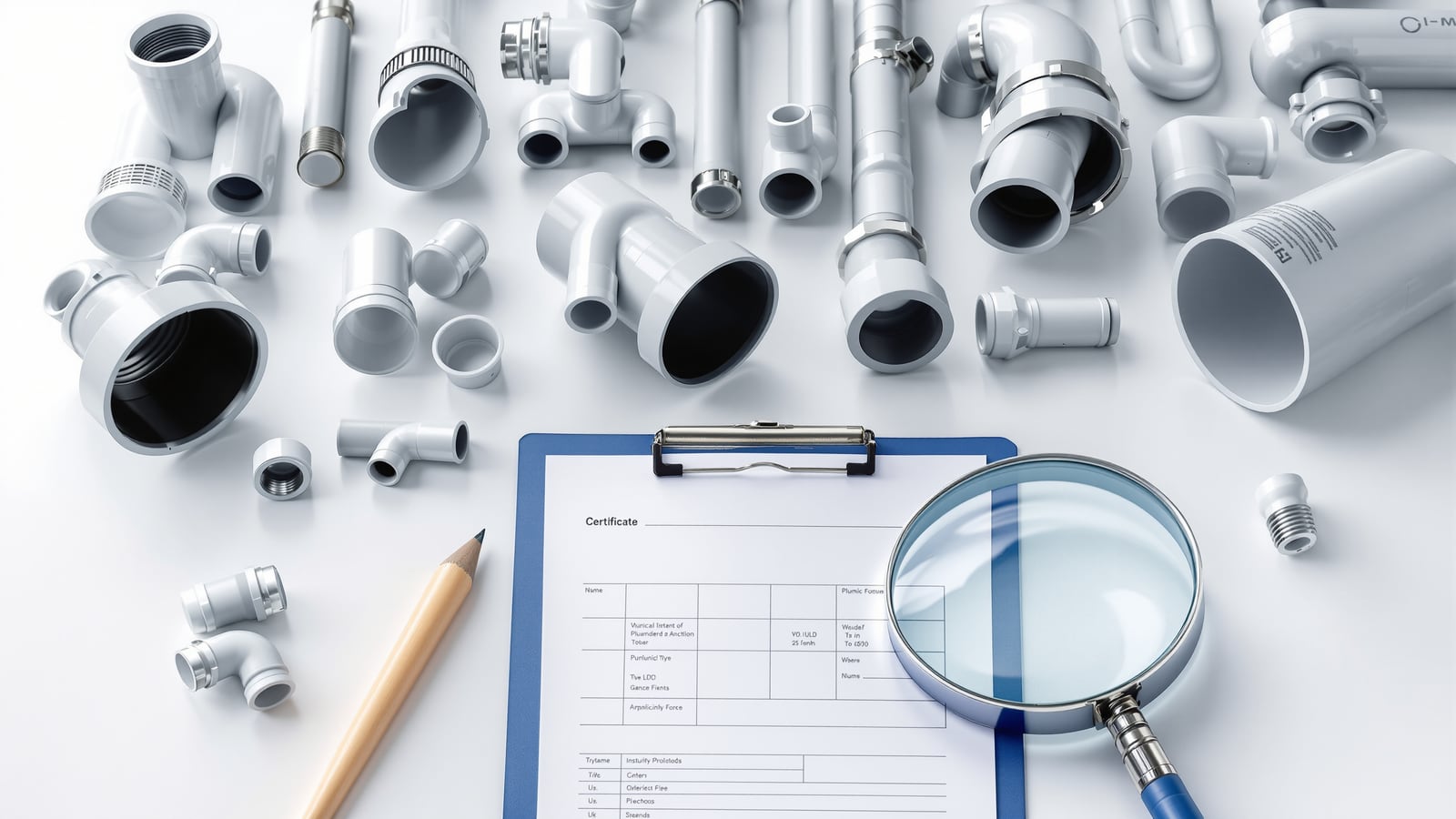
Every plastic pipe, water tank, tap and valve you specify on an Indian project is meant to be built to a written recipe — a national standard that fixes its dimensions, its material, its pressure rating and how it is tested. Those recipes are the IS standards, published by the Bureau of Indian Standards (BIS), and the badge that says a product was actually made to one is the ISI mark. This guide explains, for the specifier and site professional, what that system is, how it governs plumbing materials, and how to check any of it for yourself.
This guide sits in the Studio Matrx Plumbing Knowledge Hub. It is a regulations & standards guide — a companion to the plumbing regulations pillar, which maps the whole compliance landscape (codes, bye-laws and approvals). Here we zoom into one piece of it: the material standards. For the pipes those standards govern, see the plumbing pipes guide; for tanks, the water storage tanks guide.
The one-line version: BIS writes the standard (the "IS" number). The ISI mark on the product is the manufacturer's licensed claim that a specific batch was made to that standard. A standard with no mark on the goods is just paper; a mark you cannot trace back to a live licence is just ink. You want both, and they must match.
Who BIS is and what an IS standard is
The Bureau of Indian Standards is India's national standards body, established under the BIS Act. It does two jobs that matter to plumbing:
- It publishes standards. An "IS" document — for example the standard for uPVC water pipe — is a technical specification. It defines the material, the wall thicknesses, the pressure/working classes, the permitted tolerances, the marking requirements, and the laboratory tests a product must pass. When a fittings catalogue says a pipe is "conforming to IS 15778", it is claiming it meets that recipe.
- It runs a product certification scheme. Under this scheme BIS grants a manufacturer a licence to apply the ISI mark (the standard mark) to a named product made in a named factory to a named IS standard. The licence carries a CM/L licence number. The mark is not a decoration a factory awards itself — it is a licensed claim, backed by BIS surveillance and factory inspection.
For some product categories BIS operation is mandatory (the product is covered by a Quality Control Order and may not legally be sold without the mark); for others certification is voluntary but is still what every serious buyer, PHE consultant and municipal specification asks for. Which products are under mandatory control changes over time as new Quality Control Orders are notified — so treat the current scope as something to verify, not memorise.
What the ISI mark actually certifies — and what it does not
The ISI mark on a pipe or tank tells you three things at once:
- A standard exists for that product (the IS number printed alongside the mark).
- The maker holds a live BIS licence to apply the mark to that product (the CM/L number).
- BIS surveillance applies — routine factory and market checks are supposed to keep the marked product in conformity.
It does not tell you the product is the best on the market, or that it suits your specific service — a light-class GI tube carries the mark just as a heavy-class one does; both are "IS-marked", but only one may be right for your pressure. The mark certifies conformity to a class, not fitness for your purpose. Reading the printed marking — standard number and class/grade — is the specifier's job, not the mark's.
Every genuinely marked product carries a set of printed details. Each element answers a different question:
| Printed element | What it tells you | Why it matters |
|---|---|---|
| ISI standard mark | A BIS licence is claimed for this product | The claim you then verify |
| IS number | Which standard (recipe) it was made to | Ties the goods to a spec |
| CM/L licence number | Which licensed maker, traceable to BIS | Accountability after a failure |
| Class / grade / pressure rating | Which variant within the standard | Must match your design |
| Manufacturer name & size | Who made it and its dimension | Cross-checks the licence |
How IS standards govern plumbing materials
Almost every material a plumbing professional touches has a governing IS family. The pipe-material families below are the ones the Studio Matrx pipe guides already reference, and are safe, current specifications you can cite directly. For fittings, tanks, valves and fixtures, standards exist too — but the exact number can vary by material and type and can be revised, so verify the current one on the BIS portal rather than trusting an old spec sheet.
| Material / product | Governing IS standard | Where to verify |
|---|---|---|
| uPVC pressure pipe (potable cold water) | IS 4985 | BIS e-Sale portal |
| uPVC pipe for soil & waste discharge | IS 13592 | BIS e-Sale portal |
| CPVC pipe & fittings (hot & cold potable) | IS 15778 | BIS e-Sale portal |
| GI / steel tubes (water supply) | IS 1239 (Part 1 tubes, Part 2 fittings) | BIS e-Sale portal |
| Larger welded steel pipe (water & sewage) | IS 3589 | BIS e-Sale portal |
| HDPE pipe | IS 4984 | BIS e-Sale portal |
| Cast iron pipe (soil, waste, drainage) | IS 1536 / IS 1537 / IS 3006 | BIS e-Sale portal |
| Precast concrete (RCC) pipe | IS 458 | BIS e-Sale portal |
| Salt-glazed stoneware / vitrified clay pipe | IS 651 | BIS e-Sale portal |
| Water storage tanks, fittings, valves, taps & fixtures | The relevant IS standard for that specific product — verify on the BIS website | BIS e-Sale portal |
For the categories the table leaves open — overhead and underground water tanks, gate/globe/ball/check valves, taps and mixers, ceramic sanitaryware, cisterns and flush valves — the governing IS standard depends on the exact material and product type. Do not guess a number from memory or from a supplier's dated brochure. Look up the current standard on the BIS e-Sale portal (described below) and confirm the manufacturer holds a live licence for the exact product.
A recurring trap: standards get revised. An IS number stays the same but the edition changes (for example, "second revision, 2021"). A product marked to a superseded edition may no longer conform. Always check you are looking at the current edition, and that the licence is live — both are shown on the BIS system, not on the pipe.
Why buying ISI-marked products matters
For a professional, insisting on genuinely marked material is not box-ticking — it is risk control:
- Statutory compliance. Where a product is under a mandatory Quality Control Order, an unmarked product is not merely lower quality — it is not legal to sell. Specifying and accepting it exposes the project.
- Contract & tender conformity. Municipal, PWD, CPWD and PHE specifications routinely demand "ISI-marked, conforming to the relevant IS". Unmarked goods are a rejectable non-conformity at inspection.
- Traceable accountability. The CM/L licence number ties a defective batch back to a licensed maker under BIS surveillance. A no-name pipe with a copied mark leaves you holding the failure.
- Predictable performance. The whole point of the standard is that a Class-marked pipe has a known wall thickness and pressure rating. That is what lets you engineer the system — friction loss, working pressure, service life — instead of hoping.
- Insurance & liability. After a leak or a burst, the first question is whether specified materials met the standard. Marked, traceable, current-edition goods are your defence.
The counterfeit problem is real: fake or cloned ISI marks exist, and a printed "ISI" alone proves nothing. The mark is only worth what the licence behind it is — which is exactly why the verification step below is the one that matters.
How to verify a standard and a licence
Two different checks, both done on official BIS channels:
1. Verify the standard itself. Standards are published and sold through the BIS e-Sale portal (the official standards catalogue on the BIS website, bis.gov.in). Search by IS number or by product to confirm the standard exists, read its title and scope, and — critically — check the current edition / revision year. This tells you what the recipe actually requires today.
2. Verify the product's licence. BIS provides an online means to check whether a manufacturer holds a live certification licence for a given product and standard, via the BIS website and the official BIS Care app. Match three things: the CM/L number printed on the goods, the maker, and the IS standard — they must all correspond to a licence that is currently valid, not expired or cancelled.
How to verify / stay compliant
Compliance here is a habit, not a one-time act. On every project:
- Write the standard into the specification. State the IS number and the required class/grade for every pipe, fitting, tank and valve — never just "ISI-marked". Where you are unsure of the exact current number for a tank, valve or fixture, write "conforming to the relevant current IS standard" and pin it down before procurement on the BIS portal.
- Check the goods, not the invoice. Marking is on the product. Read it at delivery, against your spec.
- Verify the licence is live. Use the BIS website and the BIS Care app to confirm the CM/L licence is current for that maker, product and standard.
- Confirm the edition is current. On the BIS e-Sale portal, check you are specifying and receiving to the latest revision.
- Know that scope changes. Which products are under mandatory certification (Quality Control Orders) is periodically updated — check the current position for your product category rather than relying on an old list.
- Escalate genuine doubts to BIS. Suspected fake marks can be reported to BIS; do not let a questionable product onto the works.
Standards, editions and the list of products under mandatory certification all change over time. Treat every IS number and every "mandatory/voluntary" status in this guide as something to confirm on the official BIS website for your specific product on the day you procure — the authoritative source is BIS, not a brochure and not this page.
Compliance checklist
- Every plumbing material in the spec names an IS standard and a class/grade.
- Delivered goods carry a legible ISI mark, IS number and CM/L licence number.
- The class/grade on the goods matches the engineered requirement.
- The standard's current edition was confirmed on the BIS e-Sale portal.
- The CM/L licence was confirmed live for that maker + product + standard.
- Test certificates and invoices are filed for inspection and liability.
- Mandatory-certification scope was checked for the product category.
Related Studio Matrx guides
- Plumbing regulations guide — the full compliance landscape this standards guide sits inside.
- Plumbing pipes guide — the materials the IS pipe families govern.
- Water storage tanks guide — tanks and their standards.
- Choosing plumbing pipes — matching material and class to the job.
- Plumbing buying guide — buying marked, traceable material with confidence.
References
- Bureau of Indian Standards (BIS) — India's national standards body; publisher of all IS standards and operator of the ISI product certification scheme. Standards catalogue and licence verification: the official BIS website (bis.gov.in) and the BIS Care app.
- IS pipe-material standards referenced above (uPVC IS 4985; uPVC soil & waste IS 13592; CPVC IS 15778; GI/steel IS 1239; welded steel IS 3589; HDPE IS 4984; cast iron IS 1536 / IS 1537 / IS 3006; precast concrete IS 458; salt-glazed stoneware IS 651) — confirm the current edition of each on the BIS e-Sale portal before specifying.
- For tanks, valves, taps, cisterns and other fixtures, look up the current governing IS standard for the exact product on the BIS e-Sale portal — numbers vary by material and type and are periodically revised.
Export this guide
Related Guides — Deep-dive reading
BIS-Certified Plumbing Materials in India: ISI Marks, CPVC (IS 15778), UPVC & Soil-Pipe Standards (2026)
A professional reference to the BIS/ISI standards behind bathroom plumbing materials — CPVC (IS 15778), UPVC pressure pipe (IS 4985), PVC soil and waste (IS 13592), PEX, GI, solvent cements and pressure classes — plus how to read the marking printed on a pipe and why you must insist on the ISI mark.
BathroomsHow to Choose & Buy Plumbing Pipes in India: A Buyer's Guide
A shopping guide, not a materials lecture. Match the pipe to the job in one line each, then get the buying right — the ISI mark and correct IS number, the right class or pressure rating, branded vs local, spotting recycled or under-weight pipe, and matching fittings and solvent cement.
PlumbingBathroom Plumbing Code India: NBC 2016 Part 9, UPC-I & the IS Standards That Govern Pipework
A professional reference to the codes and standards that govern bathroom plumbing in India — the National Building Code (NBC 2016) Part 9 on Plumbing Services, the Uniform Plumbing Code India (UPC-I), the CPHEEO Manual, and the IS standards for water supply, drainage, trap seals, pipe sizing, slopes and venting — with a caveat to always verify the current code and your local authority.
BathroomsRelated Tools — Try Free
Plumbing Pressure-Test & Leak Checklist
Pre-closure pressure and leak test — 9 categories, 60+ checkpoints across water supply, drainage, fixtures, waterproofing, hot water, tanks.
Pre-Closure TestMaterial Quality Evaluation Checklist
20-point checklist to evaluate interior materials before signing off at delivery.
Quality ChecklistContract Studio
AI generates professional architecture service agreements with milestones and scope.
ArchitectAI