
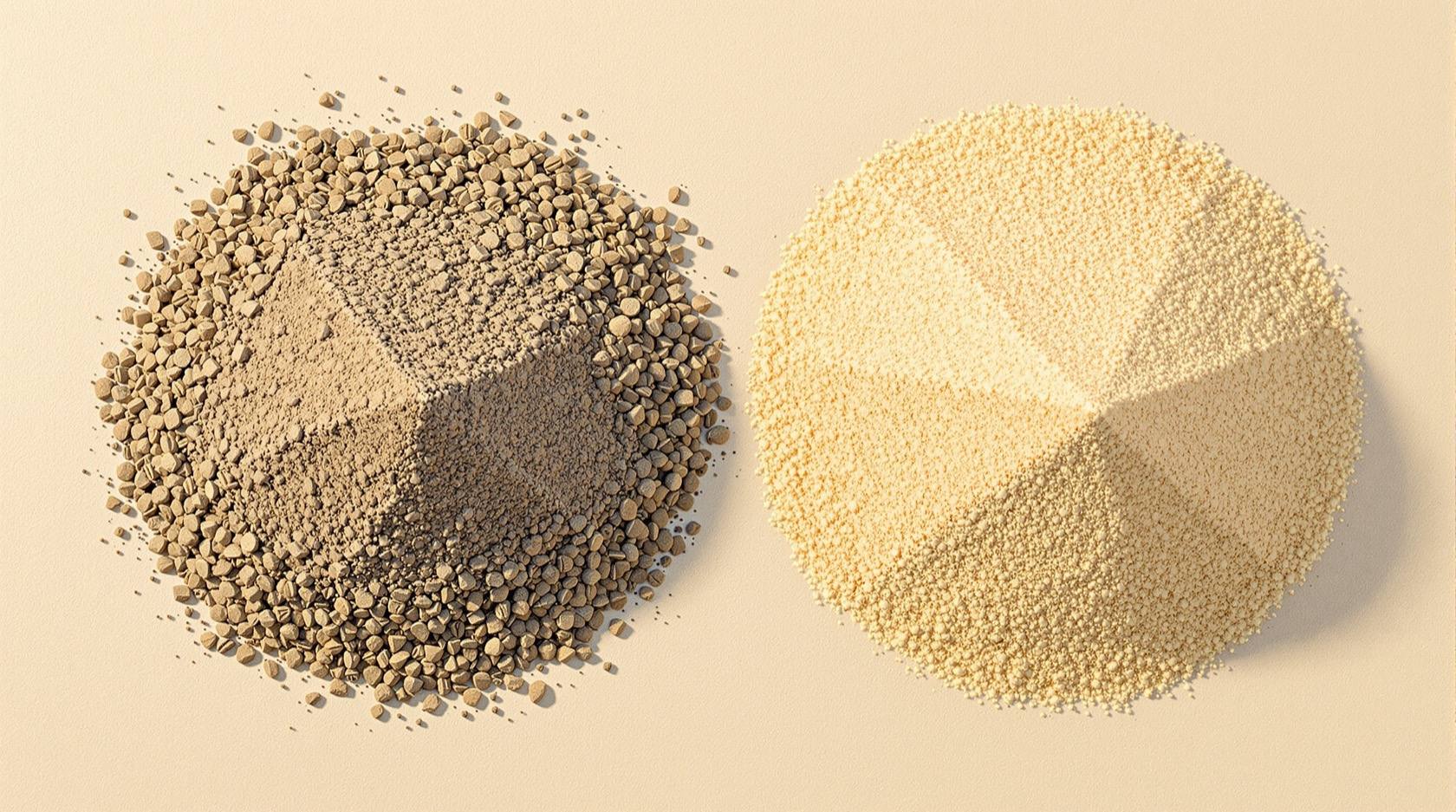
M-Sand vs River Sand in India: A Head-to-Head Comparison for Concrete and Plaster (2026)
Manufactured sand or natural river sand? This guide sets the two side by side across grain shape, grading, water demand, strength, cracking risk, legality, cost and sustainability, then tells you honestly where each one wins and how many sites use both.
For decades "sand" on an Indian site meant one thing - natural river sand, dredged from a riverbed and delivered by the tractor-load. That era is closing. Unregulated dredging has scarred rivers, collapsed banks and drained groundwater, so state after state has restricted, taxed or outright banned river-sand extraction. Into that gap has come manufactured sand, or M-sand: hard rock, usually granite, crushed and screened in a factory to sit in the same size band as river sand.
The result is a genuine choice on almost every project, and a lot of confused, often promotional advice about it. Suppliers of one will happily rubbish the other. This guide does neither. It puts M-sand and river sand next to each other, criterion by criterion, so you can specify the right fine aggregate for each job - and it is honest about the fact that a great many careful sites use both. If you have not yet read the broader picture, start with the sand for construction guide and the complete building materials guide.
Scope and how to read this. This guide helps you understand and specify. All prices, dosages and property ranges are indicative and swing with region, rock source, plant quality and season - get local quotes and a supplier test report. Sand is the fine aggregate in structural concrete: the actual mix design, water-cement ratio and any decision on load-bearing work belong to a qualified structural engineer, tested to IS 383 (aggregates) and IS 456 (concrete). Nothing here replaces that certification.
What each one actually is
River sand is natural sand. Water tumbling rock over thousands of years rounds each grain smooth and washes away most of the very fine dust, leaving well-rounded, well-sorted particles. That geological polishing is the whole reason it earned its reputation - and, increasingly, the reason it is scarce.
M-sand (manufactured sand) is made on purpose. Quarried hard rock - typically granite, sometimes basalt - is crushed through a series of machines and screened to fall within the fine-aggregate size band that IS 383 specifies. Because it is engineered rather than found, its grading can be controlled and repeated batch to batch. You may also hear "crushed sand," "robo sand" or "P-sand" (plastering sand, a finer M-sand grade); these are M-sand variants. A related but different product, crusher dust or quarry dust, is the raw unwashed by-product of stone crushing and is not the same as properly screened M-sand - do not let the two be substituted.
The single most important physical difference flows from how they are born: shape.
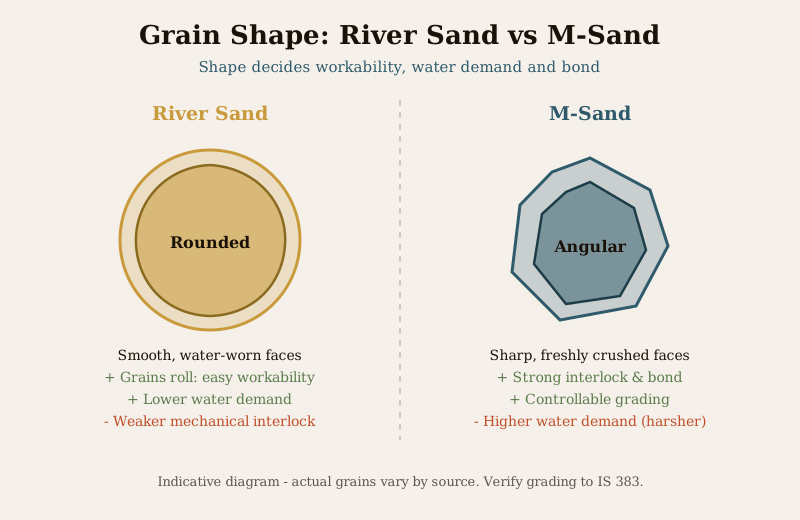
River-sand grains are rounded and smooth; they roll past one another, which is why fresh mortar made with river sand feels buttery and slides off the trowel easily. M-sand grains are angular with sharp, freshly fractured faces. Those faces interlock and grip cement paste harder - good for bond and strength - but they also resist flowing, which is why an unadjusted M-sand mix feels harsher and thirstier. Almost every practical difference below traces back to this one fact.
The head-to-head comparison
Here is the core comparison. Read the "why it matters" column, not just the winner - several of these trade-offs cut both ways.
| Criterion | River sand | M-sand | Why it matters |
|---|---|---|---|
| Grain shape and texture | Rounded, smooth | Angular, rough crushed faces | Round = workable; angular = stronger interlock and bond |
| Grading control | Whatever the river gave; varies by source and season | Screened and repeatable batch to batch | Consistent grading = consistent, predictable concrete |
| Silt and clay content | Often high unless washed; carries organic matter | Very low; contains fine rock dust (not clay) instead | Silt and clay weaken bond; must be within IS 383 limits |
| Water demand and workability | Lower water for the same flow; naturally workable | Higher water demand unless well-graded and plasticised | More water for flow can dilute strength if not managed |
| Compressive strength | Good, well proven | Equal or slightly higher at the same water-cement ratio | Angular grip and clean grading favour M-sand strength |
| Shrinkage and cracking risk | Low | Slightly higher if over-fines or over-watered | Excess rock fines and water raise plastic-shrinkage cracks |
| Availability and legality | Restricted, taxed or banned in many states; erratic | Manufactured to order; supply is steady | Legality and reliable supply increasingly favour M-sand |
| Cost | Volatile; cheap where legal, dear where scarce | More stable; often cheaper landed than legal river sand | Compare landed cost, not headline rate |
| Sustainability | Extraction damages rivers, banks and groundwater | Uses quarry rock and by-product; needs energy and water to wash | Neither is free of impact; M-sand is generally lower-harm |
A few of these deserve unpacking.
Silt versus rock fines are not the same thing. River sand's problem impurity is silt and clay - platy, weak particles that coat grains and wreck the cement bond. IS 383 caps how much a fine aggregate may carry, which is why river sand often needs washing. M-sand carries very fine crushed-rock dust instead. A small, controlled amount of that dust actually helps fill voids and can improve cohesion; too much makes the mix sticky and thirsty. A good plant washes and controls it - a bad one lets it run high. Always ask for the fines content and grading zone on the test report.
Water demand is the honest knock against M-sand. Because angular grains do not roll, an M-sand mix wants more water to reach the same flow. Add that water blindly and you raise the water-cement ratio, which lowers strength and raises cracking - the exact opposite of what people expect from a "stronger" sand. The fix is not more water; it is good grading plus a water-reducing admixture (plasticiser), so you keep the workability without the extra water. This is precisely the kind of thing your mix designer handles - see understanding concrete strength for why the water-cement ratio dominates the outcome.
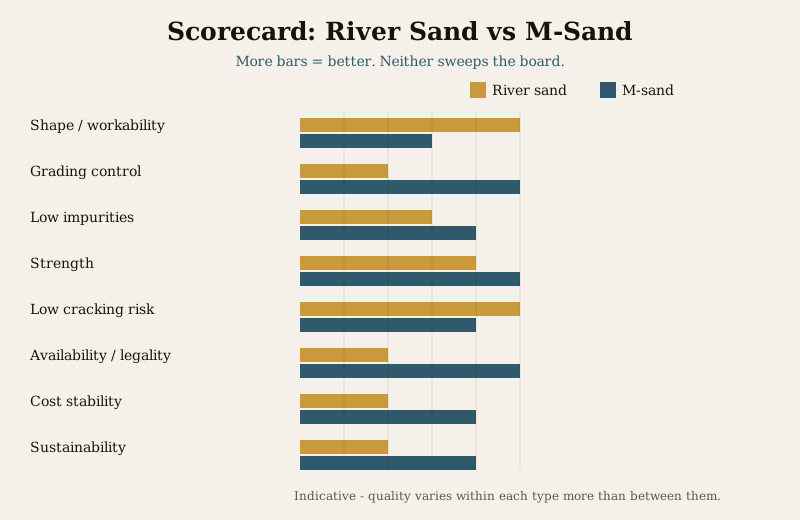
The scorecard makes the pattern clear. M-sand leads on the things an engineer can measure and control - grading, strength, supply, sustainability. River sand leads on native feel - the effortless workability of a finishing coat. Neither sweeps the board, which is the honest headline of this whole comparison.
Where each one wins
M-sand wins for structural concrete and RCC
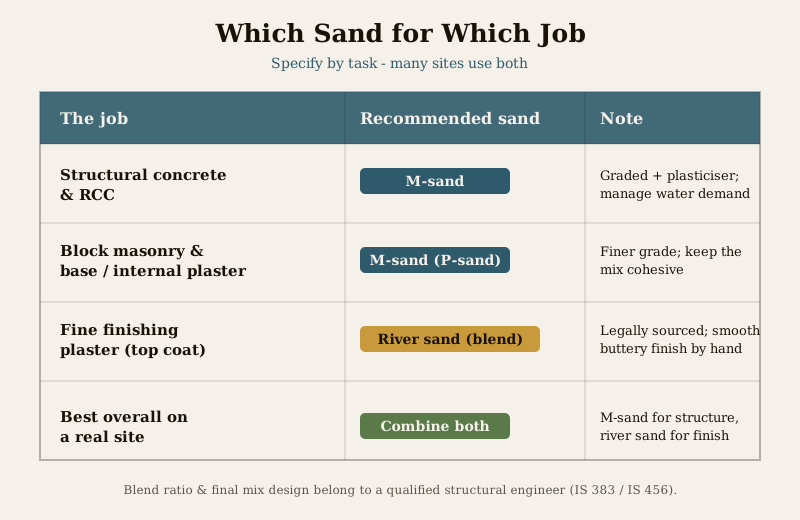
For load-bearing concrete - columns, beams, slabs, foundations - well-graded M-sand is the modern default and often the better choice. Its clean, repeatable grading and angular bond deliver strength as good as or better than river sand at the same water-cement ratio, and its steady supply lets a batching plant hold quality across a whole pour. This is why most ready-mix concrete plants have moved to M-sand: consistency is everything at scale. Pair it with the right cement (see types of cement in India) and the right coarse aggregate (see the construction aggregates guide).
M-sand also works well for masonry and internal plaster
For block work and for the base and internal coats of plaster, a finer M-sand grade (P-sand) performs well and bonds strongly. The one adjustment: because it is thirstier, keep the mix cohesive with good grading and, where needed, a plasticiser, so it stays workable without over-watering.
River sand still wins on the fine finishing feel
Where river sand keeps a real edge is the final finishing coat - the smooth skim where masons want a mix that spreads like butter and closes to a fine, crack-free surface. Its rounded grains and lower water demand make that surface easier to achieve by hand. Many experienced finishers still prefer washed river sand, or a very fine river-sand-heavy blend, for the top coat specifically. If your state allows legally-sourced river sand, reserving a small quantity for finishing is a defensible choice.
In practice, many sites combine the two
This is the part the marketing leaves out: it is common and sensible to use both. A typical pattern is M-sand for all structural concrete and the bulk of plaster, with a modest quantity of river sand (or a river-sand-rich blend) kept for finishing coats. Some sites even blend the two fine aggregates to hit a target grading curve - M-sand for strength and control, a fraction of rounded sand to ease workability. The blend ratio is a mix-design decision for your engineer, not a rule of thumb to copy off the internet.
Which to choose - the verdict
| If your priority is... | Choose | Note |
|---|---|---|
| Structural strength and RCC consistency | M-sand (well-graded) | Manage water demand with grading plus a plasticiser |
| Reliable, legal, steady supply | M-sand | Manufactured to order; not exposed to river-sand bans |
| Lowest environmental harm | M-sand (generally) | But it still needs energy and washing water |
| A silky, crack-free final plaster finish | River sand (legally sourced) | Native workability is genuinely easier by hand |
| Best of both | Combine | M-sand for structure and bulk, river sand for finishing |
| Lowest landed cost | Depends locally | Where river sand is banned, M-sand usually wins on price |
The single most important caveat: quality varies more within each type than between them. Badly graded, over-fines M-sand from a poor plant will underperform good washed river sand - and silt-laden, unwashed river sand will underperform good M-sand. Whatever you choose, insist on a supplier test report showing the IS 383 grading zone, fines content and, for river sand, silt content. Estimate how much you need with the sand quantity calculator, and let your engineer sign off the final mix.
Key takeaways
- M-sand is crushed hard rock screened to fine-aggregate size; river sand is naturally rounded and washed by water. The shape difference drives almost every other property.
- M-sand wins on grading control, strength, supply reliability and sustainability; river sand wins on native workability and finishing feel.
- M-sand's real weakness is higher water demand - never fix it with more water; fix it with good grading and a plasticiser, or the strength drops.
- River sand is restricted or banned in many Indian states, and unwashed river sand can be silt-heavy; legality and consistency increasingly favour M-sand.
- For structural concrete and RCC, well-graded M-sand is the modern default; for a fine finishing coat, legally-sourced river sand still has an edge; many sites use both.
- Compare landed cost and test reports, not headline rates or supplier claims. The final mix design and any structural decision belong to a qualified structural engineer.
References
- Bureau of Indian Standards - IS 383, Coarse and Fine Aggregate for Concrete (specification and grading zones for fine aggregate).
- Bureau of Indian Standards - IS 456, Plain and Reinforced Concrete, Code of Practice (mix design and water-cement ratio principles).
- National Building Code of India, NBC (SP 7:2026) - general provisions for materials and construction.
- State Sand Mining Policies and Ministry of Environment guidance on riverbed sand extraction and its restriction across Indian states.
- Studio Matrx guides: sand for construction, construction aggregates, types of cement, understanding concrete strength and ready-mix concrete.
Export this guide
Related Guides — Deep-dive reading
Construction Aggregates in India: Sizes, Quality & Selection (2026)
What coarse aggregate actually does in concrete, how to pick the right nominal size (10mm, 20mm, 40mm), and the field and lab checks that separate strong stone from a bad load - a specify-and-select guide for Indian homes.
Building MaterialsSand for Construction in India: Types, Quality and How to Choose (2026)
A homeowner-and-builder guide to the fine aggregate that fills every concrete, mortar and plaster mix - river sand, M-sand, pit and crushed stone sand, the grading zones and silt limits that decide quality, why river-sand mining is restricted, and which sand to specify for which job.
Building MaterialsThe Complete Building Materials Buying Guide (India) (2026)
The capstone of the Building Materials hub - a stage-by-stage buying process (estimate, specify, shortlist, compare, verify, store) plus how to buy well in every material category, the mistakes that cost the most, and a smart-buyer checklist that routes to every deep guide and calculator.
Building MaterialsRelated Tools — Try Free
Material Decision Framework (M-Score)
Score 30+ Indian construction materials across cost, durability, climate fit, maintenance, and sustainability.
MaterialsSand Quantity Calculator
The sand (fine aggregate) a concrete, mortar or plaster volume needs, in cubic metres, cubic feet and tonnes.
Material CalculatorStamp Duty Calculator — All Indian States
Stamp duty + registration charges for all 28 states and 8 UTs — gender concessions, urban/rural variants, metro cess built in.
Stamp Duty