
Lift Speed Selection Guide (India): How Fast Does a Home Lift Need to Be?
Why home lifts are slow by design, how to choose speed by travel height, and how higher speed adds cost and regulatory scrutiny
How fast should a home lift go? Less than you think. Walk into a tall office tower and the elevator may hit 2.5 metres per second or more — fast enough to make your ears pop. A home lift is a different animal entirely. It is deliberately slow, and for good reason. In a two- or three-storey house the lift is never carrying you far, so a calm, quiet, gentle ride matters far more than shaving a few seconds off the trip.
This guide demystifies lift speed for Indian homes: the typical range, why home lifts are slow by design, how to pick a speed by your travel height, how the drive type (pneumatic vacuum versus traction) caps what is possible, and how chasing higher speed quietly pushes up cost and — past certain thresholds — regulatory scrutiny.
A home lift is not a sports car. It is the lift equivalent of a comfortable lounge chair that happens to move. Slow is a feature, not a flaw.
The typical home-lift speed range
Home lifts in India run roughly 0.15 to 1.0 metre per second, but the great majority sit in the 0.15 to 0.5 m/s band. To put that in everyday terms, 0.3 m/s is about the pace of a slow, relaxed walk. You are not meant to feel acceleration; you are meant to barely notice you are moving at all.
| Speed band | Roughly equals | Where you see it |
|---|---|---|
| 0.15 m/s | Pneumatic vacuum lifts; slowest screw drives | Compact retrofit PVE cabins |
| 0.15 to 0.3 m/s | Most small home lifts | G+1 and G+2 villas, low-rise homes |
| 0.3 to 0.5 m/s | Mid-range home traction / gearless | G+2 to G+3 homes wanting a brisker ride |
| 0.5 to 1.0 m/s | Upper end of the home segment | Tall homes, higher floor counts, premium installs |
| 1.0 m/s and above | Commercial / apartment-block territory | Beyond a typical private home's needs |
Indicative ranges — confirm the exact rated speed with your vendor, because it depends on the specific model, drive and capacity you choose.
Why home lifts are slow by design
It is not that the industry cannot build a fast home lift. It is that a fast one would be worse for your home in almost every way that matters.
- You are not travelling far. Over one or two floors, the difference between 0.15 m/s and 0.5 m/s is a handful of seconds. The lift spends most of any trip simply accelerating and decelerating, so a higher top speed barely pays off on short travels.
- Comfort and gentleness win. Home lifts are often used by elderly parents, children and people with reduced mobility. A slow, smooth start and a soft, level stop are kinder than a quick lurch. This is the same reason accessible-lift standards favour gentle door timing and flush stops.
- Quieter and less vibration. Lower speed means less motor noise, less air rush and less structure-borne vibration through the shaft walls. In a home — especially with the shaft near living spaces — a calm lift is a quiet lift.
- Cheaper to buy, run and power. A slower lift uses a smaller motor, often a simpler drive, and frequently a single-phase electrical supply. Push the speed up and you start needing a bigger machine, three-phase power, and a heavier-duty controller.
- It stays under regulatory thresholds. Slower, lower-rise home lifts sit comfortably below the speed and height triggers that invite extra scrutiny.
Speed by drive type: PVE versus traction
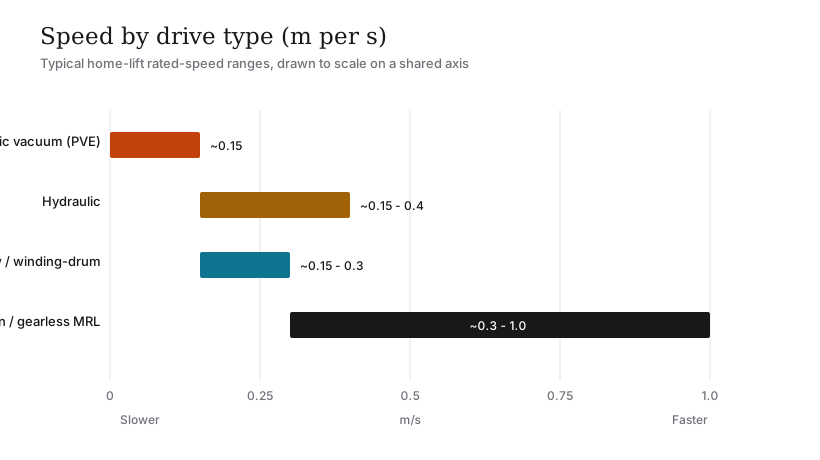
The drive mechanism you choose effectively sets your speed ceiling. You do not pick a speed in a vacuum — you pick a lift type, and that type comes with a speed band. (For how each drive actually works, see our guide on how home lifts work in India.)
- Pneumatic vacuum (PVE): A turbine lowers air pressure above a panoramic cabin and atmospheric pressure below pushes it up; it descends by a controlled release of that pressure. PVE is the gentlest and the slowest — typically around 0.15 m/s. That is fine, because PVE is chosen for easy retrofit (no pit, no shaft, no machine room), not for pace.
- Hydraulic: A pump pushes oil into a cylinder and the ram raises the car; it lowers by a controlled valve. Smooth and quiet, generally at the lower-to-mid end of the speed range, and well suited to two-to-four-floor homes.
- Screw / winding-drum: A platform climbs a rotating threaded column. Self-supporting and compact, with a modest, steady speed.
- Traction (geared / gearless): A motor turns a sheave; ropes carry the car against a counterweight. Gearless traction with a frequency-controlled (VVVF) drive is the smoothest and reaches the higher end of the home range. Machine-room-less (MRL) traction is the 2026 norm. If you want the brisker end of home speeds, this is the drive that gets you there.
| Drive type | Typical home speed | Character |
|---|---|---|
| Pneumatic vacuum (PVE) | about 0.15 m/s | Gentlest, slowest; retrofit-friendly |
| Hydraulic | about 0.15 to 0.4 m/s | Smooth, quiet, low-rise |
| Screw / winding-drum | about 0.15 to 0.3 m/s | Compact, steady, self-supporting |
| Traction / gearless (MRL) | about 0.3 to 1.0 m/s | Smoothest at speed; reaches the top of the home band |
Indicative — exact rated speeds vary by model and capacity. The drive you can fit also depends on your shaft, pit and power; coordinate all of it with your vendor.
Choosing speed by travel height: the ride-time test
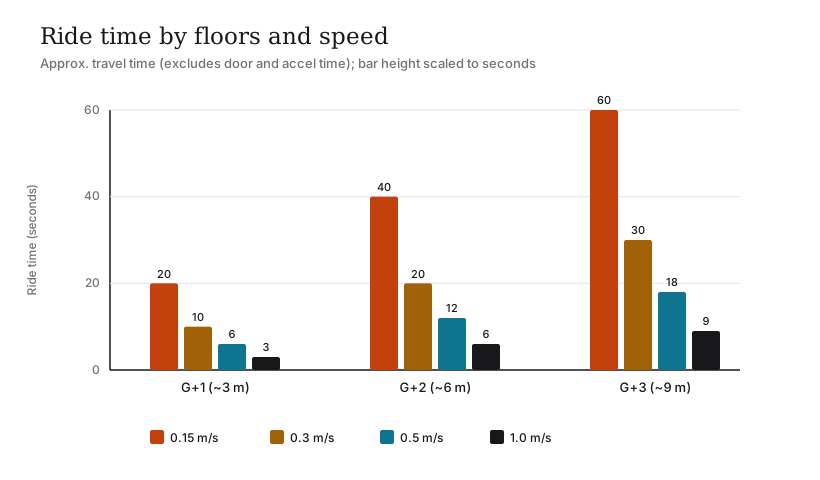
The honest way to pick a speed is to work out how long the ride will actually take and ask whether you would notice or mind. Travel height is roughly 3 metres per floor in a typical Indian home, so:
- G+1 (one floor up) is about 3 metres of travel.
- G+2 is about 6 metres.
- G+3 is about 9 metres.
The table below shows approximate ride times at common home speeds. These are simplified "distance ÷ speed" figures; real trips are a little longer because the lift accelerates and decelerates and the doors take time to open and close. But they are close enough to make the point.
| Travel (floors) | Distance | At 0.15 m/s | At 0.3 m/s | At 0.5 m/s | At 1.0 m/s |
|---|---|---|---|---|---|
| G+1 | about 3 m | about 20 s | about 10 s | about 6 s | about 3 s |
| G+2 | about 6 m | about 40 s | about 20 s | about 12 s | about 6 s |
| G+3 | about 9 m | about 60 s | about 30 s | about 18 s | about 9 s |
Indicative ride times — add a few seconds for acceleration, levelling and door operation. Confirm rated speed and door timing with your vendor.
What this tells you:
- For a G+1 or G+2 home, even the slowest lifts are fine. A 10-to-20-second ride is nothing, and you gain quiet, low cost and single-phase simplicity by staying slow.
- For G+3 and up, a slow lift starts to feel slow. A full minute to climb three floors on a 0.15 m/s lift can test your patience when you do it several times a day. Here, stepping up to 0.3 to 0.5 m/s (usually gearless traction) is a sensible comfort upgrade.
- Above the home band you are over-buying. 1.0 m/s and faster belongs in apartment blocks and offices, where many people share the lift and queues build. In a private home it adds cost and scrutiny for seconds you will rarely value.
How higher speed adds cost — and, past thresholds, scrutiny
Speed is not free. As you climb the speed ladder, three things rise with it.
1. Hardware cost. A faster lift needs a more powerful machine, a more sophisticated VVVF drive, and often a sturdier guide-rail and counterweight setup. That is more money up front. For where these numbers actually land in rupees, see our home lift cost guide for India 2026.
2. Electrical cost and complexity. Slower, smaller lifts often run happily on a single-phase 230 V home supply. Push to higher capacity and speed and you typically need three-phase 415 V — which means a sanctioned DISCOM connection, heavier cabling and a bigger connected load. Our lift power requirements guide and the single-phase versus three-phase guide cover this decision in full.
3. Regulatory scrutiny. Lifts in India are state-regulated, and roughly ten states require installation and operation licences plus periodic inspection by a government lift inspectorate. Standards such as IS 14665 and NBC 2016 Part 8 Section 5 set the safety frame for all lifts, but as speed, capacity and building height rise, you move into the territory where more is demanded — for example, taller buildings trigger requirements like a fireman's lift. Staying in the modest home band keeps your installation simple. These triggers vary by state, so confirm with your local municipal bye-laws and a licensed lift contractor.
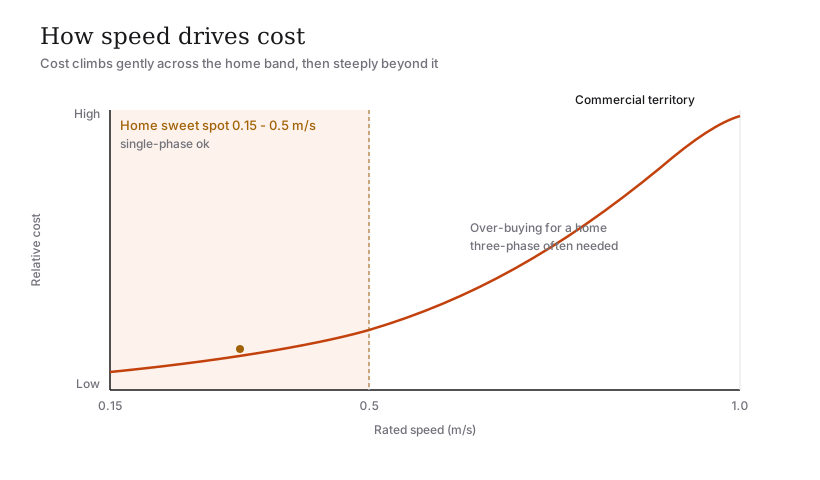
The sweet spot for almost every Indian home is 0.15 to 0.5 m/s. Below it you may feel impatient on a tall home; above it you are paying for speed you will not use and inviting complexity you do not need.
A simple way to decide
- Start from your travel height. G+1 or G+2: a slow lift (0.15 to 0.3 m/s) is genuinely fine. G+3 or more: consider 0.3 to 0.5 m/s.
- Let the drive follow. Want the gentlest retrofit with no shaft? PVE, accept about 0.15 m/s. Want the brisker, smoothest ride on a taller home? Gearless MRL traction.
- Check your power. If you only have single-phase and want to keep it that way, that nudges you toward the slower, smaller end. (See the power and phase guides.)
- Match speed to capacity. A bigger, heavier car and a higher speed both push you up the same cost-and-power curve — see the lift capacity guide so the two decisions are made together.
- Do not over-buy. Seconds saved on a short home trip rarely justify the extra cost, noise and scrutiny.
For the full picture across capacity, power, doors and safety, start with the residential elevator buyer's guide and the lift specification checklist.
References
- IS 14665 (Electric Traction Lifts), BIS — Part 1, Outline dimensions: https://law.resource.org/pub/in/bis/S05/is.14665.1.2000.pdf
- IS 14665, BIS — Part 2, Code of practice for installation, operation and maintenance: https://law.resource.org/pub/in/bis/S05/is.14665.2.1-2.2000.pdf
- National Building Code of India 2016, Part 8 (Building Services), Section 5 (Installation of Lifts, Escalators and Moving Walks), BIS: https://www.bis.gov.in/standards/technical-department/national-building-code/
- BIS Guide for Using NBC 2016: https://www.bis.gov.in/wp-content/uploads/2022/08/Booklet-Guide-for-Using-NBC-2016.pdf
- Lift regulations in India (overview): https://www.99acres.com/articles/know-all-about-the-lift-regulations-in-india.html
- National Government Services Portal — Maharashtra licence to operate a lift: https://services.india.gov.in/service/detail/maharashtra-license-to-operate-lift
- Nibav — machine-room-less (MRL) home elevator: https://www.nibavlifts.com/machine-room-less-mrl-home-elevator/
Export this guide
Related Guides — Deep-dive reading
Single Phase vs Three Phase Lift Systems (India): Which Supply Does Your Lift Need?
What 230 V single-phase can drive, what needs a sanctioned 415 V three-phase connection, and a clear method to decide for your Indian home.
Home Lifts & AccessibilityLift Specification Checklist (India): The Spec Sheet to Hand Every Home-Lift Vendor
One fillable spec sheet that forces every vendor to quote like-for-like on your shaft, your stops, your safety features.
Home Lifts & AccessibilityResidential Elevator Buyer's Guide (India 2026): Types, Cost, Sizing, Regulation & How to Choose
Everything an Indian homeowner needs to choose, size, budget, license and maintain a home lift the right way.
Home Lifts & AccessibilityRelated Tools — Try Free
Home Lift Comparison Tool
Compare hydraulic, traction, pneumatic vacuum and screw lifts side by side for your home.
Lift ComparisonHome Lift Cost Calculator
All-in home lift cost by floors, type, capacity and city — equipment, civil, GST and AMC, with a drive-type comparison.
Lift CalculatorLift Safety Audit Checklist
Interactive checklist that scores your home lift on safety devices, compliance and upkeep.
Checklist