
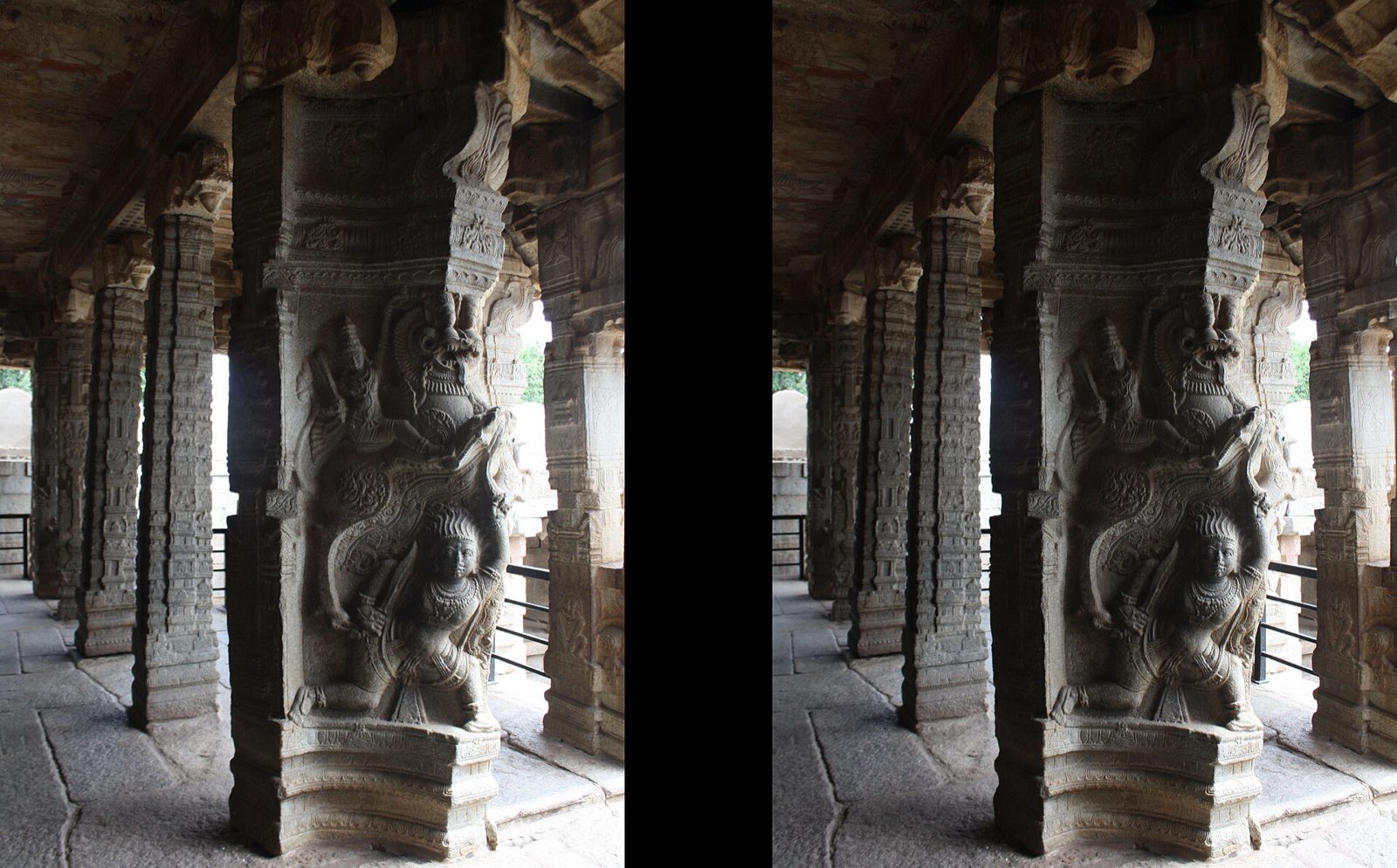
Lepakshi: The Temple of the Hanging Pillar and the Painted Sky
How the builders of a Vijayanagara temple set a stone pillar that does not touch the floor, painted their ceilings with the greatest murals of their age, and carved a giant bull from a single boulder — a temple of puzzles, colour and colossi
Most of the temples in this series impress in a single register — the soaring tower of Lingaraja, the carved mass of Khajuraho, the engineering of Ramappa. The Veerabhadra temple at Lepakshi, in the far south of the old Vijayanagara empire, impresses in three at once, and each is a genuine marvel: an engineering puzzle in the form of a pillar that does not touch the ground; a triumph of painting in the finest surviving murals of its age, spread across the ceilings; and a feat of monolithic sculpture in a colossal bull carved from a single boulder. Lepakshi is a temple of wonders stacked upon wonders, and it belongs near the end of this collection because it gathers, in one modest hill-temple, three of the great themes we have followed throughout — the structural, the painted and the carved.
Built around 1530–1540, in the last brilliant decades of the Vijayanagara empire whose capital we visited at Hampi, by two brothers, Virupanna and Viranna, who served the empire as treasurers, the temple is dedicated to Veerabhadra, a fierce form of Shiva. It sits on a low rocky hill, and it is unfinished — a fact that is itself part of its story.
The hanging pillar
The most famous thing at Lepakshi is a puzzle, and it is worth understanding as engineering rather than magic.
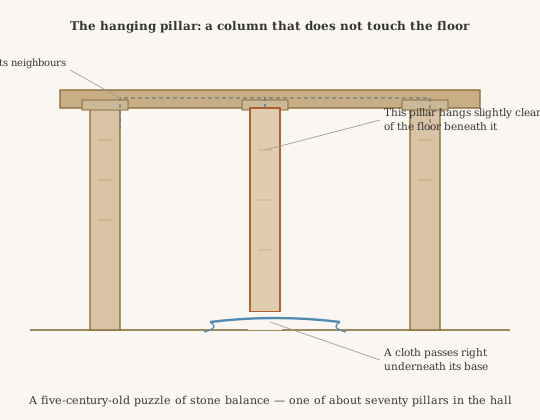
The great pillared hall of the temple contains around seventy carved stone columns, and one of them — the celebrated hanging pillar — does not quite rest on the floor. There is a gap beneath its base, and visitors have for centuries delighted in passing a thin cloth or a sheet of paper right underneath it, from one side to the other, proving that the pillar hangs clear of the ground. How can a stone pillar not touch the floor and yet stand? The answer lies in the post-and-beam structure of the South Indian temple: the pillar's load is carried not down into the floor but up into the massive stone beams of the ceiling, and out through them to the neighbouring columns, so that this one pillar effectively hangs from the roof-frame rather than standing on the ground. It is a demonstration — whether fully intended by the builders or the result of a slight settling — of a real structural truth, that in a rigid stone frame the load can travel sideways through the beams. Tradition holds that a British engineer in the colonial period tried to dislodge the pillar to discover its secret, and shifted it slightly, which is why it now sits a little askew. Set beside the floating bricks and sandbox foundation of Ramappa, the hanging pillar is another reminder that the temple-builders of the Deccan were sophisticated structural thinkers, playing knowingly with weight and balance in stone.
The painted sky
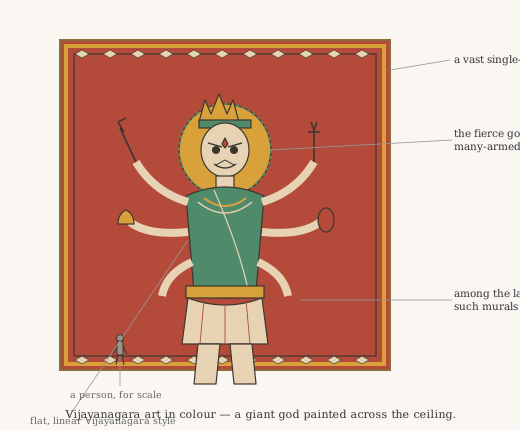
Lepakshi's second marvel is the one this whole series has hardly touched until now: painting. Almost every temple we have seen achieves its glory through carved stone, but Lepakshi's greatest treasure is on its ceilings, and it is painted.
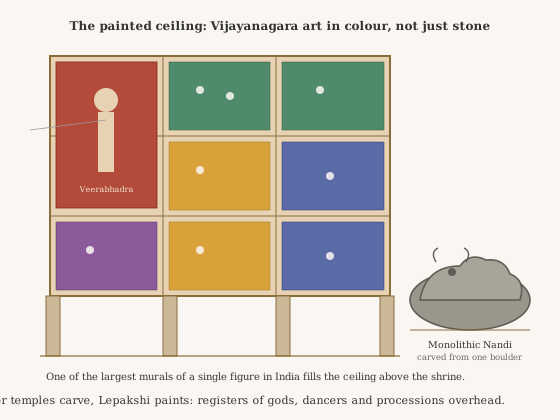
The flat stone ceilings of the temple's halls are covered with murals in earthy reds, greens, ochres and blacks — the largest and best-preserved body of Vijayanagara-era painting to survive anywhere. Divided into panels, they depict a teeming world: gods and goddesses, scenes from the epics, long processions of donors and courtiers, dancers and musicians, all in the flat, linear, richly patterned style of South Indian mural painting. Over the antechamber before the shrine sprawls a vast image of Veerabhadra himself, the fierce armed god — said to be among the largest murals of a single figure anywhere in India. To stand beneath these ceilings is to see Vijayanagara civilisation not as we usually meet it, in weathered grey stone, but in its original colour — the gods and dancers glowing overhead as they did five centuries ago. Lepakshi is the great reminder that Indian temples were not always the bare stone we see today; many were painted, inside and out, and here the paint survives to prove it.
The bull from a single stone
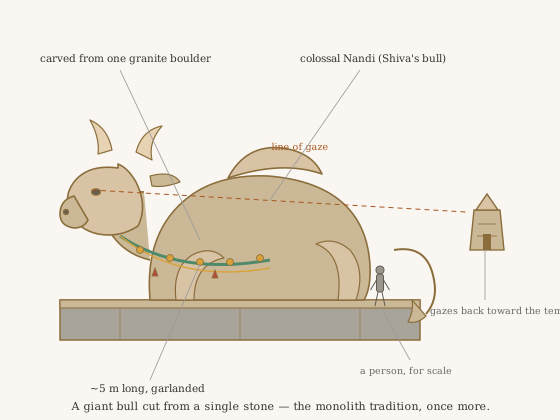
The third marvel stands in the open a short distance from the temple: a colossal Nandi, the bull that is Shiva's mount and guardian, carved from a single enormous granite boulder. Reclining, garlanded, some five metres long and nearly as tall, it is one of the largest monolithic Nandis in India, gazing back toward the temple and, by tradition, toward the great serpent-and-linga sculpture within the compound — itself carved, like the Gomateshwara colossus, from a single piece of living rock. So Lepakshi holds, alongside its hanging pillar and its painted ceilings, this third art we have followed across the series: the monolith, the giant figure cut from one stone.
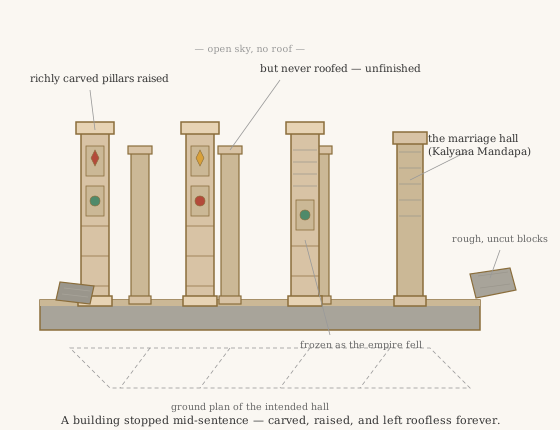
The temple's unfinished state — its great pillared marriage hall, the Kalyana Mandapa, stands with its richly carved columns raised but never roofed — adds a final poignancy. Legend says the builder Virupanna was accused of misusing the treasury and blinded as punishment, and that the name Lepakshi comes from le-pakshi, "rise, bird," words spoken over a fallen mythical creature nearby. Whatever the truth, the roofless hall leaves the temple caught forever mid-construction, its carvers' work suspended, a Vijayanagara building frozen at the moment the empire's golden age itself was about to end.
Why Lepakshi matters
Lepakshi earns its place in this series as the temple that shows Indian sacred art in all three of its great modes at once — structure, painting and monolithic sculpture — gathered in a single, human-scaled hill-temple. Its hanging pillar is a five-century-old engineering conversation piece; its ceilings preserve, almost uniquely, the lost colour of the Indian temple; its giant Nandi joins the long tradition of the colossus cut from living rock. And as one of the last great works of the Vijayanagara empire, unfinished when the age that made it fell, it carries the wistfulness of a golden moment interrupted.
Step into its painted halls, pass a cloth beneath the pillar that will not touch the floor, and walk out to the great stone bull gazing back at the shrine, and you hold, in one temple, the puzzle, the colour and the colossus of South Indian art — three wonders where most temples offer one.
Part of the Architectural Wonders series. For the empire that built it, read the ruined capital at Hampi; for the engineering of the Deccan temple, Ramappa; and for the monolithic colossus, the Gomateshwara at Shravanabelagola.
Hero photograph: “Veerabhadra Temple, Lepakshi” by VasuVR, via Wikimedia Commons, licensed under CC BY-SA 4.0.
Export this guide
Related Guides — Deep-dive reading
Great Zimbabwe: The Stone City Europe Refused to Believe Africans Built
In the hills of southern Africa stand the largest ancient stone ruins south of the Sahara — a whole city of massive granite walls built without a drop of mortar, the wealthy capital of a gold-trading kingdom. For a century, colonists refused to accept that Africans had raised it, and invented every other builder they could. This is the story of that architecture, and of the lie it outlived. The article that closes our chapter on the palaces and pleasures of worldly power.
Architectural WondersHampi: The Stone City of Vijayanagara
How a medieval South Indian empire built an entire capital out of the boulder field it stood on — granite that sings, a chariot carved in rock, two architectural worlds fused into one — and how the whole of it fell in a single year.
Architectural WondersPersepolis: The Palace Where Every Nation Came Bearing Gifts
On a vast stone terrace in southern Iran, the kings of Persia built the grandest ceremonial capital of the ancient world — a forest of impossibly tall columns whose walls, unlike those of any conqueror before them, carved not war and captives but a peaceful procession of twenty-three nations bringing gifts. It is the gentlest image of empire the ancient world produced — until Alexander burned it to the ground. The third article in our chapter on the palaces of worldly power.
Architectural WondersRelated Tools — Try Free
Circadian Light Meter
Patient-centric circadian lighting visualizer for Indian healthcare design — time-of-day × intensity → CCT, melanopic lux (EML / mEDI), melatonin suppression, and an alertness curve. Calibrated against WELL v2 L03 Circadian Lighting Design, CIE S 026:2018, Brainard 2001, and Lucas et al. 2014.
Circadian ToolMaterial Schedule Generator
Generate a room-wise finish schedule — walls, floors, ceilings, trim, and joinery by location.
Material ScheduleBefore & After Studio
Generate AI before-and-after renders to preview how your redesign could look.
DesignAI