

Landscaping vs Landscape Architecture — What's the Difference (and Which Do You Need)?
A practical guide to the spectrum of outdoor-space professionals in India, and how to match the right one to your project.
You have a half-acre plot in Pune, a budget that feels both generous and terrifying, and three people telling you three different things. The nursery owner says he can "do the whole garden" for a fraction of what the fancy firm quoted. A neighbour's mali offers to plant everything by Sunday. And a friend who built recently insists you should not touch a square foot of soil before a "landscape architect" stamps a drawing. Everyone is using the word "landscaping," and everyone means something different.
This confusion is not your fault. In India the words landscaping, landscape design, and landscape architecture get used interchangeably in brochures, on Justdial listings, and in WhatsApp forwards — even though they describe roles that are as different as a building contractor is from a structural engineer. Hiring the wrong one is rarely catastrophic, but it is quietly expensive: paving that ponds water against your plinth, a "lawn" that dies every April, drainage discovered only after the monsoon, or a beautiful planting plan that the contractor cannot read and so ignores.
The single most useful idea in this guide is this: landscaping is the verb and landscape architecture is the discipline. One describes the act of building and tending an outdoor space; the other is a licensed, design-led profession concerned with how land, water, climate, structure, and people fit together before anything is built. Most Indian homes need a blend of both — but you save the most money and heartache when you know which layer of the spectrum your particular project actually sits on, and engage the right person for that layer rather than over- or under-buying.
The spectrum: four roles, not two
It helps to stop thinking of "designer versus doer" as a binary and instead picture a spectrum. At one end sits pure design and judgement; at the other, pure execution and care. Four overlapping roles occupy that line in the Indian market.
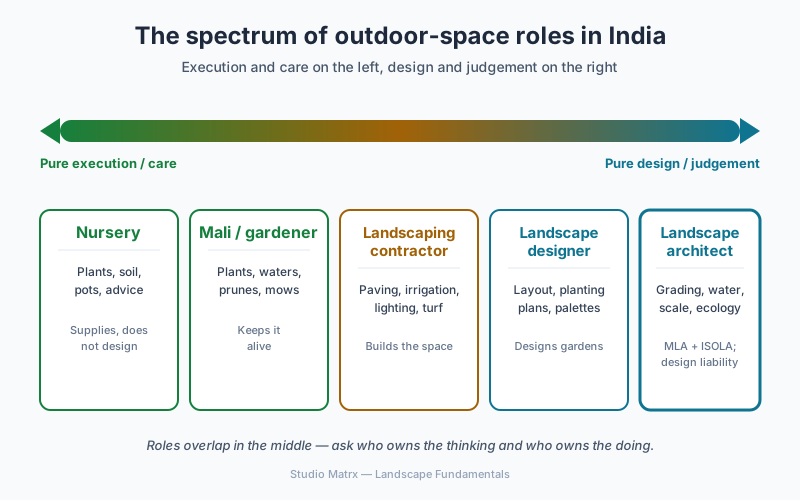
The nursery. Your starting point for plants, pots, soil mix, and informal advice. A good nursery owner — many in India carry decades of plant knowledge — will tell you what survives in your microclimate and sell it to you cheaply. They do not design, level, or guarantee a layout.
The mali / gardener. The person who plants, waters, mows, prunes, and keeps things alive. Skilled malis are the unsung backbone of Indian gardens; without one, every design eventually fails. But a mali executes a vision rather than authoring one, and rarely deals with hardscape, grading, or drainage.
The landscaping contractor. A build-and-maintain firm that lays paving, builds planters and water features, installs irrigation and lighting, lays turf, and supplies plants. The best run tidy sites and finish on time. They are organised around execution; design, when offered, is usually a free add-on to win the job and tends to be conservative and pattern-book.
The landscape designer. A trained designer — often with a diploma or degree, sometimes self-taught with a strong portfolio — who produces planting plans, layout drawings, mood boards, and material palettes for gardens and small sites. They bridge taste and buildability but typically do not stamp structural, drainage, or statutory documents.
The landscape architect. A university-qualified professional (a Master of Landscape Architecture, MLA, or the older B.Arch-plus-specialisation route) trained in site engineering, grading, stormwater, soils, ecology, and large-site planning as well as aesthetics. In India the profession is represented by ISOLA (the Indian Society of Landscape Architects), and landscape architects often coordinate with the project's architect and civil engineer. They are the people you want when land, water, or scale becomes genuinely complex.
The crucial point: these roles overlap heavily in the middle. A capable landscaping contractor may employ an in-house designer; a landscape architect may also run a build wing. The labels matter less than the question, "Who is taking responsibility for the thinking, and who for the doing?"
Design versus build versus maintain — what each actually delivers
Almost every dispute on a residential landscape job traces back to a fuzzy boundary between three activities: deciding what to make (design), making it (build), and keeping it alive (maintain). Different professionals cover different bands of that range, and the overlaps are where money leaks.
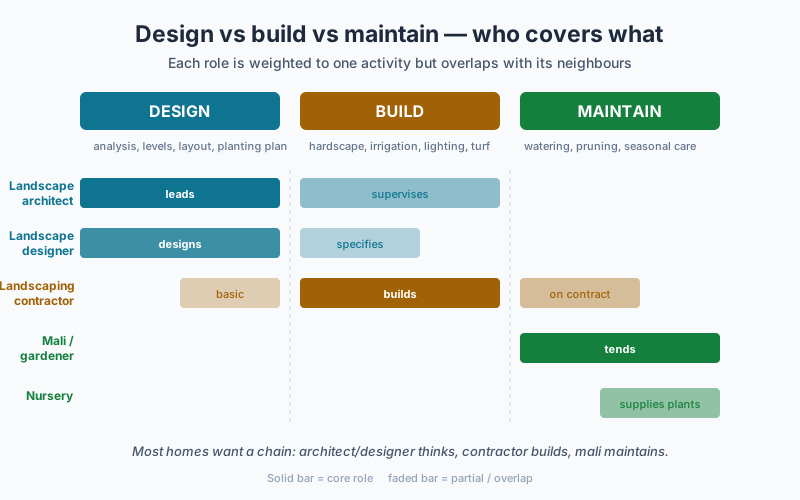
| Activity | Nursery | Mali | Landscaping contractor | Landscape designer | Landscape architect |
|---|---|---|---|---|---|
| Site analysis, levels, drainage strategy | No | No | Basic | Limited | Yes — core skill |
| Concept and layout design | No | No | Pattern-book | Yes | Yes |
| Planting plan / species selection | Informal | Informal | Standard list | Yes | Yes, climate-led |
| Hardscape, water, lighting construction | No | No | Yes — core skill | Specifies, rarely builds | Specifies and supervises |
| Statutory / large-site coordination | No | No | No | No | Yes |
| Ongoing maintenance | Supplies plants | Yes — core skill | Often, on contract | No | No |
| Takes design liability | No | No | Limited | Moderate | Yes (professional) |
Read that table as a map, not a verdict. A small balcony or a refresh of an existing garden may need only the right-hand maintenance bands and a nursery. A new villa garden on sloping ground with a pool, by contrast, touches every column — and getting the design column wrong is what later forces you to break and redo the build column.
Qualifications: what the titles actually mean in India
Titles in this field are unregulated for most rungs, which is precisely why "landscaper" can mean a teenager with a lawnmower or a firm with a structural team. Knowing what training sits behind each role lets you read past the brochure.
| Role | Typical training | Recognising body / signal | What to ask for |
|---|---|---|---|
| Nursery owner | Experience, family trade | None formal | Years in trade, local species track record |
| Mali / gardener | Apprenticeship, on-job | None formal | References from gardens they tend now |
| Landscaping contractor | Trade experience, sometimes diploma | GST registration, completed-site photos | Site visits, client references, warranty terms |
| Landscape designer | Diploma or degree in design / horticulture | Portfolio; sometimes ISOLA associate | Drawing set samples, planting plans |
| Landscape architect | MLA (2-yr postgraduate) or B.Arch + LA | ISOLA membership; allied with COA-registered architects | Degree, ISOLA status, stamped drawing examples |
A few India-specific notes. There is no statutory licence to call yourself a "landscape designer" or "landscaper," so the portfolio and references do the work a licence would. Landscape architecture as a formal degree is offered by a handful of institutions — among them CEPT University in Ahmedabad, the School of Planning and Architecture in Delhi, and a small number of others — and the postgraduate MLA is the gold-standard credential. ISOLA, founded in the 1970s, is the professional body that landscape architects affiliate with; membership is a useful signal but not a legal requirement. For anyone curious about the training pathway itself, our companion piece on studying and practising landscape architecture in India walks through the courses, fees, and career arc.
When do you actually need a landscape architect?
Here is the honest answer most firms will not give you: many beautiful Indian home gardens are created without a landscape architect ever being involved, and that is fine. The question is not prestige; it is risk and complexity. The more your project involves moving earth, managing water, working at scale, or carrying design liability, the more the landscape architect earns their fee.
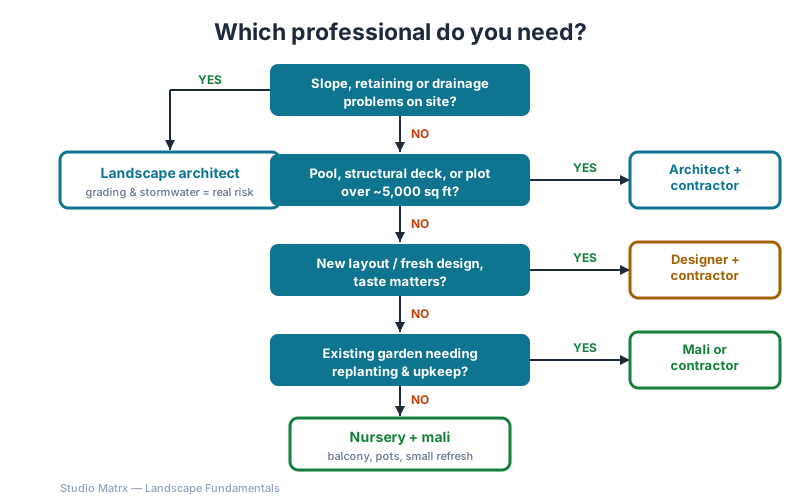
| Your situation | Right primary professional | Why |
|---|---|---|
| Balcony, terrace pots, small refresh | Nursery + mali | Low complexity, plant-led, reversible |
| Existing garden needing replanting / care | Mali or landscaping contractor | Execution and upkeep dominate |
| New garden, flat plot, modest hardscape | Landscape designer + contractor | Design taste matters; engineering is light |
| Sloping site, retaining walls, drainage issues | Landscape architect | Grading and stormwater carry real risk |
| Pool, large water feature, structural decks | Landscape architect + contractor | Liability, integration, waterproofing |
| Plot above ~5,000 sq ft or multiple zones | Landscape architect | Scale demands a coordinated master plan |
| Apartment complex, layout, or institutional grounds | Landscape architect | Statutory and multi-stakeholder coordination |
Three triggers reliably tip a project from "designer-and-contractor" into "landscape-architect" territory: significant change in levels (anything that needs cut-and-fill, retaining, or steps), water that must be moved or held (drainage, stormwater, large pools, water harvesting), and scale or shared use that introduces coordination and liability. If none of those apply, a strong landscape designer working with an honest contractor will usually serve you better and cheaper. If two or more apply, paying for the architect's judgement up front is the cheaper path, because their drawings prevent the expensive demolition that follows a contractor's guesswork. Our landscape cost guide for Indian homes breaks down where those rupees actually go once the build begins.
How they collaborate (the team most homes actually want)
In practice the best residential outcomes rarely come from one person doing everything. They come from a small chain of responsibility where each role does what it is trained for and hands off cleanly to the next.
A typical well-run villa-garden project looks like this. The landscape architect (or a senior landscape designer) sets the concept, levels, drainage logic, and planting strategy, and produces a drawing set. The landscaping contractor prices and builds the hardscape, irrigation, and lighting strictly to those drawings, with the designer reviewing key stages. The nursery supplies the specified plants — ideally the same species in the plan, not "equivalents" swapped in to cut cost. And the mali, engaged before handover so they learn the garden, takes over watering, pruning, and seasonal care for the years that follow.
The single most common failure is skipping the design hand-off — letting the contractor both design and build with no independent drawing to check against. It removes the very accountability that protects you. A close second is forgetting maintenance: a sophisticated planting scheme with no mali budgeted is a scheme that looks superb for one season and ragged thereafter. If you want to understand why some gardens age into something restful while others just decline, our reflection on why some Indian gardens feel peaceful is a good companion read.
Fees and engagement models in India
Money is where the spectrum becomes most visible. Each role prices differently, and mixing up the models is a frequent source of mismatched expectations. The figures below are indicative ranges for residential work in metro and tier-1 cities as of the mid-2020s; treat them as orientation, not quotation, and expect premium firms and complex sites to sit well above the top of each band.
| Role | Common engagement model | Indicative range (residential) | Notes |
|---|---|---|---|
| Nursery | Per plant / per pot | As priced; advice free | Bargain on bulk; verify species |
| Mali | Monthly retainer or per-visit | ₹3,000–₹12,000 / month part-time | Varies by city and garden size |
| Landscaping contractor | Lump-sum build or per sq ft | ₹150–₹600+ / sq ft of treated area | Wide range by hardscape intensity |
| Landscape designer | Design fee, lump sum or per sq ft | ₹20–₹80 / sq ft, or fixed package | Drawings only; build billed separately |
| Landscape architect | Percentage of works, or design fee | 8–15% of landscape works value, or staged fee | Includes coordination and supervision |
A few practical translations. A landscape architect quoting "10% of works" is using the percentage-fee model familiar from architecture; on a ₹15 lakh garden that is roughly ₹1.5 lakh for design and oversight — money that typically saves more than it costs by preventing rework. Designers more often quote a flat package or a per-square-foot rate for drawings only, with construction tendered separately. Contractors quote build, sometimes with a "free design" that, as noted, is rarely independent. And the mali is a recurring operating cost, not a one-time capital one — budget for it from day one rather than discovering it later. The largest single swing in any quote is hardscape intensity: paving, walls, decks, and water features dwarf planting costs, which is exactly why getting their layout right at the design stage matters so much.
Red flags on every rung of the ladder
Because the field is lightly regulated, your own vigilance is the main quality control. The warning signs differ by role, but a few cut across the whole spectrum.
| Red flag | What it suggests | Better practice |
|---|---|---|
| "Free design" bundled to win the build | No independent check on the build | Pay separately for design or for a review |
| No drawing set, only verbal plans | Nothing to hold the build accountable to | Insist on a layout and planting drawing |
| No talk of drainage or levels on a sloped site | Engineering being ignored | Raise grading and stormwater explicitly |
| Species swapped for "equivalents" silently | Cost-cutting that breaks the planting logic | Approve every substitution in writing |
| No maintenance plan or mali handover | Garden will decline after season one | Budget upkeep before signing |
| Per sq ft quote with no scope definition | Surprises and change-orders later | Define included items line by line |
| "We do everything" with no references | Generalist with no proven depth | Ask for completed-site visits |
The thread running through all of these is documentation and accountability. The professionals worth hiring — at any price point — are the ones happy to put scope, species, drainage, and warranty in writing, and unbothered when you ask to visit a garden they finished three years ago. The ones to avoid are those who treat your questions as distrust. In a field with no licensing safety net, the paper trail is your safety net.
A short worked example
Imagine two neighbours in Bengaluru, each with a new 3,000 sq ft garden. The first hires a landscaping contractor on a "free design" basis; the contractor lays generous paving, a small lawn, and a row of standard palms, and the garden looks crisp at handover. Within two monsoons the paving — sloped subtly toward the house — sends sheet water against the plinth, the lawn struggles in the shade the palms now cast, and a mali is hired reactively to nurse it.
The second neighbour pays a landscape designer roughly ₹50,000 for a drawing set, then tenders the build to the same kind of contractor. The drawings fall the paving away from the house, place a shade-tolerant ground cover where the trees will mature, and specify a simple rain-garden swale to soak monsoon runoff. The design fee was a fraction of the build, and it bought the one thing the first garden lacked: a tested idea on paper before anyone poured concrete. Neither neighbour needed a full landscape architect — but both needed the design layer, and only one bought it. That, in miniature, is the whole argument of this guide.
Where this leaves you
Start by placing your own project honestly on the spectrum. If it is plants, pots, and care, a good nursery and a reliable mali will serve you beautifully and cheaply. If taste and layout matter but the engineering is light, buy the design layer from a landscape designer and let an honest contractor build it. And the moment your site involves real slope, real water, real scale, or real structure, the landscape architect stops being a luxury and becomes the cheapest insurance you can buy. Match the professional to the layer, insist on drawings and a maintenance plan, and the rest tends to follow.
For the bigger picture of what the discipline can do, see our overview of what landscape architecture is and why it matters in India, browse the wider landscape design hub, or read about the masters who shaped Indian landscape architecture. The right outdoor space is rarely the most expensive one — it is the one where the right person was asked the right question at the right time.
References
- Indian Society of Landscape Architects (ISOLA) — professional body overview and membership categories.
- Council of Architecture (COA), India — register of architects, allied to landscape practice coordination.
- CEPT University, Ahmedabad and School of Planning and Architecture, New Delhi — Master of Landscape Architecture (MLA) programme descriptions.
- National Building Code of India (NBC 2016) — site planning, drainage, and external development provisions.
- Studio Matrx, Landscape Cost Guide for Indian Homes — indicative residential landscape cost ranges.
Export this guide
Related Guides — Deep-dive reading
Sloping Site Design: Building on a Gradient
How to read a slope, choose between terracing, cut-and-fill and stilts, and turn a hillside plot in Pune, Bengaluru's outskirts or the Ghats into an asset instead of a liability.
Site PlanningDesign/Build vs. Hiring Separately: What Indian Homeowners Should Know
The procurement-model decision behind every home project — one turnkey firm that designs and builds, or an independent designer and a separately appointed contractor — and how to choose the one that fits your time, budget, and appetite for control.
Planning Your ProjectLandscape Cost Guide India: What a Garden Really Costs
A transparent, table-rich 2026 costing guide for home landscaping in India — every component priced, with the maintenance cost everyone forgets
LandscapeRelated Tools — Try Free
Monsoon-Readiness Checklist
Pre-rain home audit across 9 categories — terrace, drains, waterproofing, electrical, HVAC, pest, vehicles, documents.
Seasonal AuditLandscape Cost Calculator
Estimate a garden's cost — hardscape, softscape, lawn, irrigation, lighting and annual upkeep — by area, tier and city.
Budget CalculatorGarden Planning Toolkit
Get a tailored garden plan — planting layers, Indian species, features and a checklist — from your climate, space, sun and goals.
Planner