
kVA vs kW Explained: Sizing Inverters, Generators & Your Connection
Why your inverter is rated in VA but your appliances in watts — the difference between kVA and kW, what power factor has to do with it, and how to use both correctly when sizing an inverter, a generator, or a sanctioned load.
Shop for an inverter or generator and you'll notice they're rated in VA or kVA, while your appliances are rated in watts (W) or kW — and your electricity connection's "sanctioned load" is often quoted in kVA too. These aren't the same unit, and confusing them leads to under-sizing. The difference comes down to power factor. This short guide explains kVA vs kW in plain language, and how to use both correctly when sizing backup power and your connection.
It is a sizing deep-dive in the Electrical Knowledge Hub, supporting the inverter, generator and load guides.
The safety line. This is sizing knowledge to help you specify and question. The actual sizing, wiring and connection are a licensed electrician's / installer's job.
Real power (kW) vs apparent power (kVA)
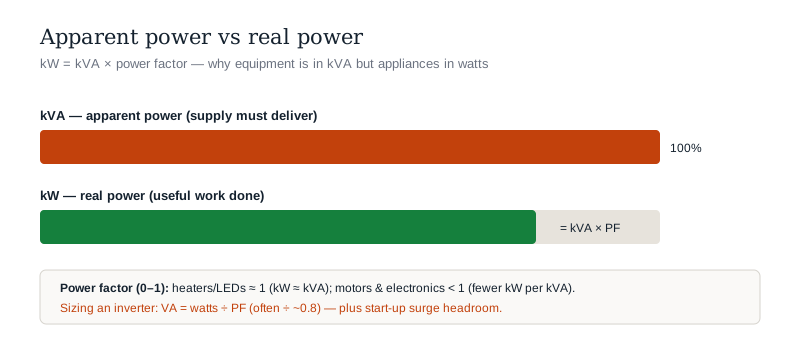
The two are related but distinct:
- kW (kilowatts) — real power. The actual useful work done — heat, light, motion. Your appliances' wattage is real power.
- kVA (kilovolt-amperes) — apparent power. The total power the supply must deliver — voltage × current, before accounting for how efficiently it's used.
- Power factor (PF) — the ratio: kW = kVA × power factor. It's a number between 0 and 1 describing how much of the supplied (apparent) power becomes useful (real) power.
For purely resistive loads (heaters, incandescent bulbs), PF ≈ 1, so kW ≈ kVA. For motor and electronic loads (ACs, fridges, pumps, some electronics), PF is less than 1, so a given kVA delivers fewer kW. That gap is why the units differ.
Why equipment is rated in kVA
- Inverters and generators are rated in VA/kVA because they must supply the apparent power (the actual current at the voltage), regardless of the load's power factor — the equipment "sees" kVA.
- Appliances are rated in watts (kW) because that's the useful power they consume.
- Your connection's sanctioned load is often in kVA because the utility sizes the supply to the apparent power it must deliver.
So you're constantly translating between the watts your appliances need and the VA your inverter/generator/connection must provide.
Using both to size correctly
The practical upshot when sizing backup:
- Add up your appliances' watts (real power) to know the useful load — use the load calculator.
- Convert to VA for the equipment: VA = watts ÷ power factor. Since home loads often have PF around 0.7–0.8, the VA rating you need is higher than the watts — e.g. 800 W of load at PF 0.8 needs about 1000 VA (1 kVA).
- Don't just match watts to VA — that under-sizes the equipment. Allow for the power factor and for motor start-up surge (ACs, fridges, pumps draw several times their running current briefly).
- A common mistake: buying a "1 kVA" inverter for "1 kW" of appliances — after power factor and surge, it may not cope. Size with headroom.
Power factor and your bill
- For domestic flat-rate billing, you're generally charged on kWh (real energy), so power factor isn't directly penalised at home.
- For commercial/industrial tariffs, a poor power factor is penalised, which is why businesses correct it — a point noted in the energy management guide but rarely a home concern.
- For a home, the practical relevance of power factor is sizing (inverter/generator/connection), not the bill.
The one-line answer
kW (real power) is the useful work your appliances actually do; kVA (apparent power) is the total the supply must deliver (voltage × current); and power factor is the ratio linking them (kW = kVA × PF). For resistive loads PF ≈ 1 so they're nearly equal, but for motor and electronic loads PF is below 1, so a given kVA delivers fewer kW — which is why inverters, generators and your sanctioned load are rated in kVA (they must supply the apparent power) while appliances are rated in watts. To size backup correctly, add your appliances' watts, then convert to VA (VA = watts ÷ power factor, often ÷ ~0.7–0.8) and add headroom for motor start-up surge — never just match watts to VA, or you'll under-size. At home, power factor matters for sizing, not the bill.
Where to go next
- Size an inverter: Inverter & Battery Guide · Inverter & Battery Calculator.
- Size a generator: Generator Guide.
- Add up your load: Electrical Load Calculator.
- The units behind it: Watts, Volts, Amps & Units Explained.
References
- National Electrical Code of India, SP 30 : 2023, Bureau of Indian Standards.
- IS 732 : 2019, Code of Practice for Electrical Wiring Installations, BIS.
- Central Electricity Authority (Measures relating to Safety and Electric Supply) Regulations, 2010 (as amended) — supply and load: https://cea.nic.in/
Sizing depends on your actual loads, power factor and surge; figures are indicative. All sizing and installation must be done by a licensed professional. Verify any standard's status via the BIS catalogue before relying on it.
Export this guide
Related Guides — Deep-dive reading
Residential Electrical Systems: The Complete Guide for Indian Homes
How the electricity in an Indian home actually works — from the utility supply and meter through the distribution board, circuits, wiring, earthing and protection, to lighting, safety, energy efficiency, smart controls, solar and backup — written so a homeowner can understand, plan and judge it, and know exactly where a licensed electrician must take over.
Electrical & WiringHome Generators: Portable, Standby, Sizing & When You Need One
When a battery isn't enough — how a generator produces power for heavy loads and long outages, the difference between a portable set and a fixed standby DG, how they are sized, the fuel, noise and emission realities, and whether a home actually needs one.
Electrical & WiringWatts, Volts, Amps & Units Explained: Electrical Basics for Homeowners
The four words behind every electrical decision — volts, amps, watts and units (kWh) — explained with a simple water analogy, so you can read an appliance rating, understand your bill, and follow every other guide with confidence.
Electrical & WiringRelated Tools — Try Free
Electrical Safety & Load Audit
Home electrical audit — 10 categories, 65+ checkpoints across earthing, RCCB, MCB, wiring, switchboards, appliance circuits, DG/inverter backup.
Safety AuditInverter & Battery Calculator
Size a home inverter (VA) and battery (Ah) for the load you want to back up and the hours of backup you need.
Backup PowerElectrical Load Calculator
Estimate a home's connected load and realistic maximum demand from its appliances, whether it needs single or three-phase supply, and a suggested main switch rating.
Electrical