
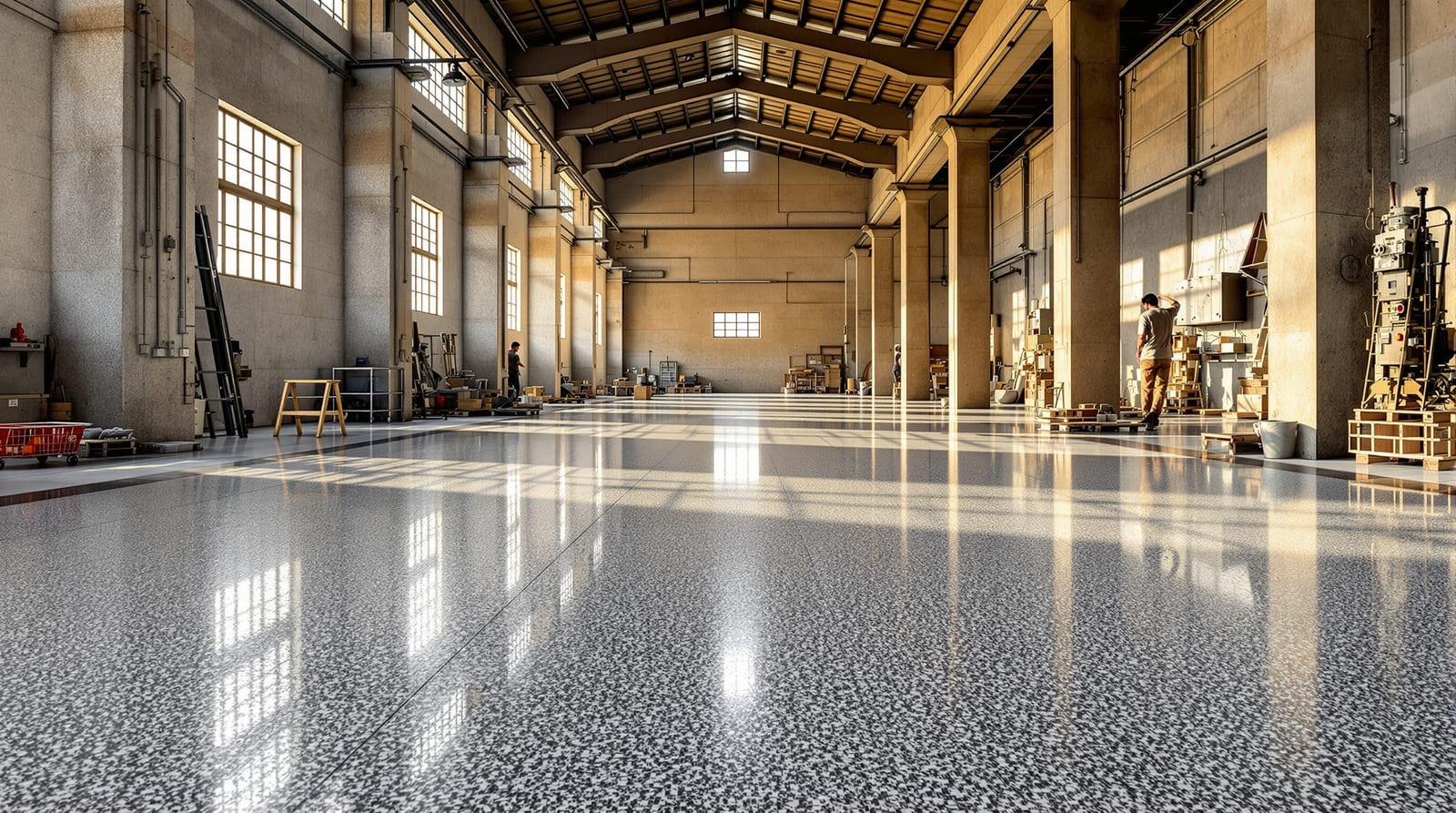
Granolithic Flooring in India: Cement-and-Granite Wearing Topping for Industrial Floors, Method, Cost & IS 5491
Granolithic is the heavy-duty cement-and-crushed-granite wearing topping trowelled over a concrete base for factories, warehouses, garages, godowns, staircases and high-traffic floors — abrasion-resistant, dust-free and cheap at ₹50–150 per sq ft. Here is what it is, how it is laid to IS 5491, its finishes, where it suits and its trade-offs.
Granolithic flooring is the unglamorous workhorse beneath much of industrial India. It is a rich cement mortar made with crushed hard granite or basalt chips, trowelled as a thin wearing topping over a concrete base — engineered to take forklifts, steel-wheeled trolleys, dragged crates and decades of abrasion without dusting or wearing through. At ₹50–150 per sq ft it is one of the cheapest ways to give a factory, warehouse, godown, garage or workshop a tough, monolithic, jointless floor.
This guide explains what granolithic actually is, why it is so abrasion-resistant, how it is laid on Indian sites to IS 5491, the bonded versus monolithic options, hardener add-ons and finishes, where it suits, and how it stacks up against VDF and other industrial floors.
What granolithic flooring is
Granolithic — from "granite" and the Greek "lithos" (stone) — is not a separate floor you lay down, but a wearing topping that becomes part of a concrete floor. The base is a normal structural concrete slab. Over it goes a high-strength mortar of cement and specially selected hard, angular crushed stone (granite, basalt or other tough trap rock), screeded and trowelled to a dense, smooth, durable surface. That topping, typically 20–40 mm thick, is the layer that actually takes the wear, so the relatively expensive cement and hard aggregate is concentrated only where it is needed — at the surface.
The defining idea is abrasion resistance. Ordinary concrete floors dust and wear because the soft cement-sand skin at the top is weak. Granolithic deliberately replaces that skin with a rich (cement-heavy) mortar packed with the hardest crushed rock available, so the wearing surface is essentially a thin layer of artificial stone. Indian practice and IS 5491 (the code of practice for laying in-situ granolithic concrete, cement concrete and terrazzo floors) govern the mix and method.
It is a close relative of the IPS (Indian Patent Stone) floor and the in-situ terrazzo floor — all are trowelled cementitious toppings. The differences are in purpose: IPS is a plain cement floor for general and decorative use, terrazzo uses marble chips ground and polished for looks, while granolithic uses hard granite chips left as a robust matte surface for sheer toughness. Studio Matrx groups it with the seamless, in-situ industrial floors.
Why granolithic is tough, dust-free and cheap
Three properties make granolithic the default heavy-duty floor:
- Abrasion resistance. The combination of a rich cement matrix and very hard angular granite or basalt chips resists the grinding action of steel wheels, dragged loads and grit far better than plain concrete. Done well, the wearing depth over decades is small.
- No dusting. A properly proportioned, well-trowelled and well-cured granolithic surface does not generate the fine cement dust that plagues bare concrete floors — important in workshops, food units and stores where dust contaminates product and machinery.
- Monolithic and jointless. When laid bonded to a green base, the topping and slab act as one. There are no tile joints or grout lines to chip, lift or harbour dirt — a big advantage under wheeled traffic and washdown.
On top of that it is genuinely cheap. The materials are commodity OPC cement (UltraTech, ACC, Ambuja and similar), local crushed granite or trap aggregate, and ordinary mason labour — no proprietary product, no imported resin. That keeps it at ₹50–150 per sq ft applied, against several times that for epoxy or PU systems.
How granolithic flooring is laid
Granolithic is laid by skilled flooring masons, not specialist contractors, but the timing, mix and curing discipline matter enormously. The two ways to bond the topping to the base define the whole job.
Bonded (monolithic) granolithic
In the monolithic method, the topping is laid on the base concrete while the base is still green — within a few hours of casting, before it has set hard. The fresh topping fuses chemically and mechanically with the base, so the two become a single mass with no weak interface. This is the strongest, most durable option and the one IS 5491 favours where it can be programmed, because it almost eliminates the risk of the topping debonding and curling later. It demands tight coordination so the topping crew follows the slab crew on the same day.
Bonded to hardened base
Where the topping must go onto an already-hardened or existing slab, the base is mechanically roughened (hacked, scabbled or shot-blasted), thoroughly cleaned, soaked, and a cement slurry or bonding agent (SBR or acrylic) is scrubbed in immediately before the topping is laid wet-on-wet. Done carefully this bonds well; done carelessly it is the commonest cause of failure — the topping lifts and hollow-sounds underfoot. For thin toppings on old floors many engineers now prefer a self-bonding screed or a min 40 mm unbonded topping with mesh.
The mix, laying and finishing sequence
A typical sequence on an Indian site:
1. Base preparation. Compact and cast the structural base to falls; for hardened bases, hack and clean to expose aggregate, then soak.
2. Topping mix. A rich mortar, commonly around 1 part cement to 1–2 parts crushed granite/trap chips of 3–6 mm and graded fines, at low water-cement ratio for strength. A slightly drier, workable "semi-dry" mix gives the densest wearing surface.
3. Lay to panels. The topping is spread to thickness (commonly 20–40 mm; thicker for heavy traffic) between screed rails or in alternate bays/panels to control shrinkage cracking. Panel sizes are kept modest, often around 1 to 2 m, with joints at columns and over base-slab joints.
4. Compact and float. The mortar is well tamped and floated to drive out voids and bring up the matrix.
5. Trowel. As it stiffens it is steel-trowelled — repeatedly for a hard, dense, closed surface. Power-trowelling (helicopter) is used on large industrial bays.
6. Cure. Continuous moist curing for at least 7 days (ponding, wet hessian or curing compound) is non-negotiable — granolithic that is allowed to dry early dusts, crazes and weakens. India's heat and dry winds make early curing failures common, so this step is where quality is won or lost.
The diagram below shows the layer build-up: structural base, bonding interface, and the granolithic wearing topping with its hard granite chips.
Finishes, hardeners and colour
Out of the trowel, granolithic is a dense matte grey — utilitarian and that is usually the point. But several treatments add performance or appearance:
- Surface hardeners (dry-shake). For the most punishing floors, a non-metallic (quartz/silica or natural-mineral aggregate) or metallic (iron-aggregate) dry-shake hardener is broadcast onto the fresh topping and trowelled in. This builds an even harder, more abrasion-proof skin. Metallic hardeners suit floors under steel-wheeled or impact loads; non-metallic suit general industrial use and are non-rusting.
- Pigment / colour. Mineral oxides can be mixed in or surface-applied to give red, green, grey or buff floors — common in workshops for zoning and in showrooms.
- Anti-skid texture. Where wet or oily, the surface can be left lightly textured, wood-floated rather than fully steel-trowelled, or carborundum grit added for grip. This matters at ramps, washdown areas and external aprons.
- Polish or seal. Granolithic can be ground and polished like polished concrete for an industrial-chic look, or sealed/densified with a silicate hardener to further cut dusting and ease cleaning.
Where granolithic flooring suits
Granolithic is built for traffic and abrasion rather than looks, so it belongs in working spaces:
| Use case | Why granolithic suits it |
|---|---|
| Factories & workshops | Abrasion-resistant, dust-free, takes machinery loads and dragged stock |
| Warehouses & godowns | Cheap over large areas, monolithic, survives forklift and pallet-truck wheels |
| Garages & service bays | Oil-resistant when sealed, hard, easy to hose down |
| Parking floors & ramps | Durable under tyres; textured for anti-skid on ramps |
| Staircases (industrial/institutional) | Cast in-situ with hard-wearing nosings; a classic granolithic stair use |
| Utility, plant & service rooms | Tough, low-cost, no-frills floor for back-of-house |
| Loading docks & aprons | Withstands impact and weather when properly mixed and cured |
It is generally not chosen for living rooms, bedrooms or premium retail, where IPS, terrazzo, microcement or stone give a warmer or more refined finish.
Cost of granolithic flooring in India
Granolithic is priced by the applied square foot, and the figures below are indicative for 2026 and vary by city, vendor, topping thickness, hardener and labour rates.
| Specification | Indicative cost (₹/sq ft, applied) | Notes |
|---|---|---|
| Plain granolithic topping, 20–25 mm | ₹50–90 | Standard industrial floor on a fresh base |
| Heavier topping 30–40 mm | ₹80–130 | Thicker wearing layer for heavy traffic |
| With non-metallic dry-shake hardener | ₹90–150 | Added abrasion resistance, dust-proofing |
| With metallic hardener | ₹120–150+ | Steel-wheeled / impact-loaded floors |
| Pigmented / coloured | +₹15–40 | Oxide colour added |
| Ground & polished granolithic | ₹130–200+ | Industrial-chic finish, extra grinding |
These are topping costs over an existing or freshly cast base; the structural slab is separate. Compared with epoxy (₹100–400+), PU (₹150–500) or VDF with hardener, granolithic is usually the lowest-cost durable option, which is why it endures on budget industrial projects. For a project-wide picture use the Studio Matrx flooring cost calculator and the IPS flooring cost calculator, and see the broader flooring cost per square foot in India guide.
Granolithic vs VDF and other industrial floors
Granolithic is one of several routes to a hard industrial floor, and the right choice depends on flatness, area and budget.
| Floor system | Typical ₹/sq ft | Strengths | Where it wins over granolithic |
|---|---|---|---|
| Granolithic topping | ₹50–150 | Cheap, abrasion-resistant, monolithic, simple materials | Small-to-medium areas, budget jobs, stairs |
| Vacuum dewatered (VDF / "Tremix") | ₹60–200 | Very dense, flat, dust-free over large bays, fast | Large warehouse/parking slabs needing flatness |
| Floor hardener on VDF/concrete | ₹80–250 | Hard wearing skin integral to slab | One-pass slab + wearing surface together |
| Epoxy coating/screed | ₹100–400+ | Seamless, chemical/stain resistant, hygienic, glossy | Food, pharma, clean areas, chemical exposure |
| PU / PU-cement | ₹150–500 | Thermal-shock + chemical resistant, flexible | Wet-process, cold storage, thermal cycling |
The honest summary: granolithic is the value choice for general abrasion resistance and dust control where you do not need chemical resistance, mirror flatness over huge bays, or a coloured seamless coating. For large flat warehouse and parking slabs, vacuum dewatered concrete flooring is often laid instead or as the base. For chemical and hygiene-critical floors, epoxy flooring takes over. Many real industrial floors combine them — a VDF or granolithic base with an epoxy or PU topping. See the industrial flooring guide for the full decision map and the specialty flooring guide for where granolithic fits among all alternative floors. Where the goal is an exposed industrial-chic interior rather than a working floor, compare polished concrete flooring.
Pros and cons of granolithic flooring
| Pros | Cons |
|---|---|
| Very abrasion-resistant and hard-wearing | Utilitarian grey look; not for premium interiors |
| Dust-free when well trowelled and cured | Dusts, crazes and fails if curing is skipped |
| Cheap — commodity materials and ordinary labour | Bonding to hardened bases can fail (debonding, hollows) |
| Monolithic, jointless wearing surface | Needs skilled trowelling and tight site timing for monolithic laying |
| In-situ — suits stairs, ramps, irregular layouts | Cracks if panel jointing and shrinkage control are poor |
| Cool underfoot; hose-washable | Can be slippery when wet+polished unless textured |
| Hardeners and pigments extend performance | Repairs to a worn topping are patchy and visible |
Frequently asked questions
What thickness should a granolithic topping be?
Commonly 20–25 mm for normal floors and 30–40 mm or more for heavy industrial traffic. Bonded monolithic toppings can be thinner because they fuse with the base; unbonded toppings on hardened slabs need to be thicker (often 40 mm minimum) with mesh to avoid curling and debonding. Your structural engineer fixes the thickness against the expected loads.
What is the difference between granolithic and IPS flooring?
Both are in-situ trowelled cement toppings. IPS (Indian Patent Stone) is a plain or pigmented cement floor for general and decorative use, often quite thin. Granolithic is specifically engineered for abrasion resistance using a rich cement mix and hard crushed granite or basalt chips, laid thicker for industrial and heavy-traffic floors. Granolithic is, in effect, a heavy-duty industrial cousin of IPS.
Why does granolithic flooring dust or crack, and how do I prevent it?
The usual causes are too much water in the mix, poor trowelling, and above all inadequate curing — common in India's heat and dry winds. Prevent it by using a low water-cement ratio, compacting and steel-trowelling well, jointing into modest panels to control shrinkage, and curing continuously moist for at least 7 days. A surface densifier or hardener further reduces dusting.
Is granolithic flooring suitable for homes?
It can be, for utility areas, garages, parking, staircases, service yards and back-of-house, where its toughness and low cost shine. For living spaces most homeowners prefer the warmer, more refined finishes of IPS, red oxide, terrazzo, microcement or stone. A ground-and-polished granolithic floor can, however, give an industrial-chic look indoors.
Can granolithic be laid over an existing concrete floor?
Yes, but bonding is the risk. The old slab must be mechanically roughened, thoroughly cleaned and soaked, and a fresh cement slurry or bonding agent applied immediately before the topping is laid wet-on-wet. Even so, thin bonded toppings on old floors are prone to debonding. For reliability over a hardened base, use a thicker reinforced topping or have the work done by a contractor experienced in granolithic to IS 5491.
Export this guide
Related Guides — Deep-dive reading
Industrial Flooring in India: Floor Hardeners, VDF, Epoxy & PU Systems for Factories, Warehouses & Parking — Method, Flatness & Cost
Industrial flooring is the family of heavy-duty floor systems built for factories, warehouses, godowns, workshops, parking and logistics — dry-shake floor hardeners, vacuum-dewatered concrete, granolithic, epoxy and PU toppings, and polished concrete, all rated for forklift traffic, point loads, abrasion, chemicals and dust control at roughly ₹80–400 per sq ft. Here is how to choose the right system by use, with the joints, curing, flatness and cost detail.
Flooring & SurfacesVacuum Dewatered Concrete (VDF / Tremix) Flooring in India: Process, Strength, Cost & Where It Suits
Vacuum dewatered concrete — the VDF or "Tremix" floor — sucks the excess mixing water out of a freshly laid slab through vacuum mats to leave a denser, stronger, flatter, dust-free surface. It is the workhorse floor for warehouses, factories, parking, godowns, footpaths and industrial yards at ₹60–200 per sq ft. Here is how it is laid, why it is tougher than ordinary concrete, its joints, curing, hardener options, costs and trade-offs.
Flooring & SurfacesEpoxy Flooring in India: Seamless Resin Floors for Homes & Spaces
A seamless, jointless poured resin coating over concrete — types, costs, where it suits, and the realities of metallic and decorative epoxy in Indian homes.
Flooring & SurfacesRelated Tools — Try Free
Flooring Cost Calculator
Estimate the all-in cost of a floor — material, laying, wastage, skirting and GST — by area and material.
Flooring CalculatorIPS Flooring Cost Calculator
Estimate the cost of an in-situ cement floor — plain or pigmented IPS, red oxide, lime or granolithic.
Flooring CalculatorCross-Ventilation Analyzer
Estimate airflow and air changes per hour (ACH) from room size, window areas, layout, and local wind — with NBC 2016 Part 8 compliance check.
Ventilation Calculator