
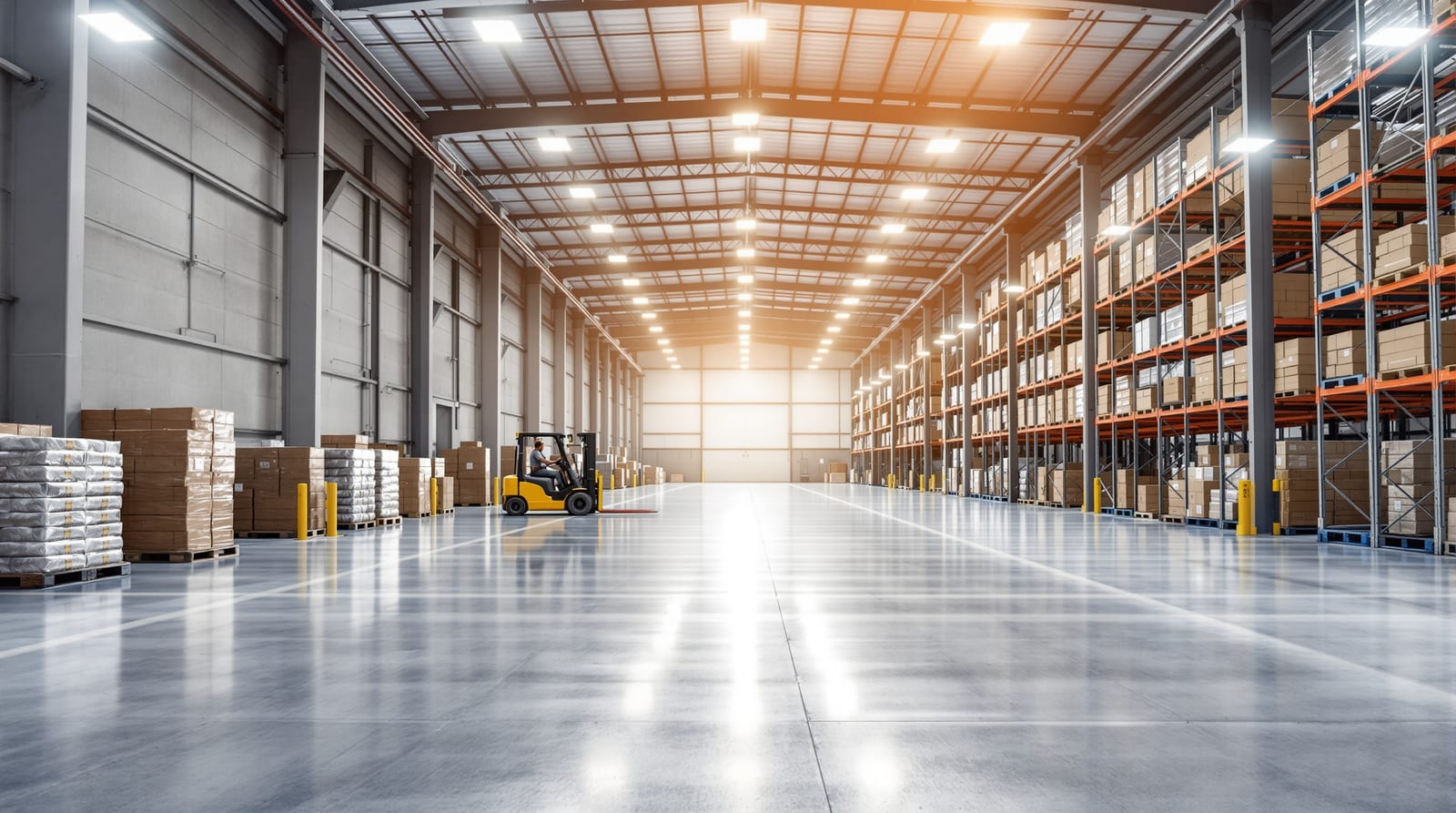
Warehouse Flooring in India: VDF Concrete, Hardeners & FM2 Flatness
How vacuum-dewatered concrete with a dry-shake hardener became the workhorse warehouse floor — and how load, flatness and joint design decide whether it survives forklifts and high-bay racking.
A warehouse floor is the most heavily worked floor most engineers will ever specify, and the only one whose failure can stop an entire business overnight. It carries point loads from racking legs that concentrate tonnes onto a few square centimetres, takes the pounding of forklift and reach-truck wheels all day, abrades under pallet trucks dragging steel across it, and must stay flat enough — to a fraction of a millimetre over a wheelbase — that a 12-metre-high-bay turret truck can lift a pallet without the mast swaying. It also has to be dust-free over an area the size of several football fields, built fast, and cost a number per square foot that survives a logistics business case. In India the floor that meets nearly all of this is not a tile or a coating but a slab: vacuum-dewatered concrete with a dry-shake hardener. This guide explains why, how load, flatness and joints actually decide the spec, and what each option costs in 2026.
What makes a warehouse floor different
A modern distribution centre, cold store or fulfilment shed asks four things of its floor that ordinary commercial floors never face together, and getting any one wrong is expensive to fix once the racking is loaded.
Load — and it is point load, not area load. The headline number a warehouse floor must survive is rarely the uniformly distributed load of stacked goods; it is the concentrated point load under a racking leg base plate, which can put several tonnes through an area smaller than a postcard. Forklift wheel loads and the dynamic punch of a fully laden reach truck add to it. The slab thickness, the sub-base, the concrete grade and the reinforcement are all sized around these point loads and the racking layout, which is why warehouse floors are a structural design exercise, not a finish choice. See industrial flooring for the broader load-class picture.
Flatness — the quiet make-or-break. As racking gets taller and mechanical handling equipment (MHE) gets faster, surface regularity stops being cosmetic and becomes operational. In a wide-aisle warehouse a "free-movement" floor to FM2 flatness is usually enough. But in a high-bay, very-narrow-aisle (VNA) operation, where a turret truck is guided down a defined aisle and lifts to 12 metres or more, the floor must be "defined-movement" superflat — controlled to tight FF/FL (or DM) tolerances along the wheel tracks — or the mast sways, the truck slows, and at worst it cannot safely place a pallet at height. Flatness is the single most under-appreciated line in a warehouse floor spec.
Abrasion and dust. Steel wheels, dragged pallets and grit turn a soft concrete surface to powder, and that dust contaminates goods, clogs MHE and never stops being generated. The cure is a hard, dense, sealed wearing surface — most often a dry-shake hardener vacuum-pressed into the slab — that resists abrasion and stops the floor dusting. A bare power-floated slab will dust; a hardened one will not.
Speed over huge areas, and the joints. Warehouse slabs are poured in very large pours against tight programmes, and the joints between pours — and the saw-cut contraction joints within them — are where forklift wheels hammer hardest. Unprotected joint arcises spall under repeated impact, so the joints, not the field of the slab, are usually where a warehouse floor first fails. Armoured (steel-edged) joints are the defence.
VDF concrete with a dry-shake hardener: the workhorse
For the vast majority of Indian warehouses the answer is vacuum-dewatered concrete, almost always finished with a dry-shake metallic or non-metallic floor hardener. It is the workhorse because it solves load, abrasion and dust together, at the lowest cost per square foot of any serious industrial floor, over very large areas, fast.
The process matters, so it is worth understanding. Concrete is placed, levelled and then vacuum-dewatered: a suction mat draws a controlled volume of excess mixing water out of the fresh slab before it sets. Removing that water lowers the effective water-cement ratio at the surface, which raises compressive and abrasion strength sharply and reduces shrinkage and curling. Before or during finishing, a dry-shake hardener — a blend of graded hard aggregate (metallic, like iron filings, for the most punishing forklift floors, or quartz/non-metallic for general duty) and cement — is broadcast onto the surface and power-trowelled in. The result is a monolithic floor with a dense, hard, dust-free wearing surface integral to the slab, no separate coating to debond, and a friendly rate. For the detail of how the vacuum process works and where it suits, see vacuum-dewatered concrete flooring; for the hardener-and-aggregate science in depth, see the industrial flooring guide.
Where the duty is even heavier, or a richer, harder topping is wanted, a granolithic topping — a high-strength cement-and-hard-aggregate screed laid monolithically or bonded onto the base slab — gives an exceptionally tough wearing course for the most abrasive material-handling environments. It costs more and is slower than a dry-shake hardener, so it is reserved for the hardest-worked aisles and docks.
When to coat: epoxy, PU and clean zones
A hardened VDF slab is the field floor; resin coatings come in where the brief adds chemistry, hygiene or appearance to the load-and-abrasion baseline.
A heavy-duty epoxy floor coating — typically a self-levelling or screed-grade build — is specified where the warehouse stores or handles chemicals, needs a sealed easy-clean surface, demands a particular colour for aisle marking and zoning, or wants a brighter, more reflective floor that lifts lux levels and lowers lighting cost. Epoxy is hard and chemical-resistant but can be brittle under heavy impact and point load, so it is laid over a sound, flat concrete base and chosen by film build to suit the traffic.
Where the floor faces thermal shock, steam, food-grade washdown or aggressive chemicals — cold-store ante-rooms, food and pharma warehousing, battery or chemical stores — a PU resin floor (polyurethane screed) outperforms epoxy: it tolerates temperature swings and hot washing without cracking and resists a wider range of chemicals. It costs more, and like epoxy it relies on a properly prepared concrete substrate underneath. The decision tree is simple: bare load and abrasion duty go to a hardened slab; add chemistry, hygiene or colour and you add a resin coat over it.
Load, flatness and joints — the floor in section
The drawing below shows what is actually happening under a loaded warehouse floor: a racking leg base plate punching a concentrated point load through the hardened wearing surface into the slab and sub-base, and an armoured saw-cut joint where forklift wheels cross. These two details — the point-load path and the joint — decide whether the floor survives.
Three principles fall out of that section. First, the slab and sub-base are sized for the worst point load, not the average — get the racking layout from the operator before designing the floor. Second, the wearing surface must be hard enough to take wheel abrasion without dusting, which is the hardener's job. Third, every joint a wheel crosses must be protected, because joint arrises spall under repeated forklift impact long before the field of the slab wears out. Armoured (steel-angle) joints, correctly load-transferred with dowels, are standard on serious warehouse floors and are the cheapest insurance you will buy.
Recommendation and cost table
The table pairs the common warehouse floor systems with the duty they suit, indicative 2026 installed cost over large areas, and the dominant driver that should decide the choice. Rates are broad and area-, thickness- and location-sensitive; confirm against current quotes and the flooring cost per square foot guide.
| Floor system | Best for | ₹/sq ft (installed) | Key driver |
|---|---|---|---|
| VDF concrete + dry-shake hardener | General DC, fulfilment, storage — the workhorse | 130-420 | Load + abrasion + dust + lowest cost over large area |
| Granolithic topping | Heaviest MHE traffic, dock aprons, intense abrasion | 130-420 | Maximum abrasion resistance |
| Heavy-duty epoxy coating | Chemical storage, easy-clean, aisle colour/zoning, brighter floor | 120-350 | Chemical resistance + hygiene + appearance |
| PU resin (polyurethane screed) | Cold store, food/pharma, washdown, thermal shock | 180-500 | Thermal + chemical resistance + hygiene |
| Superflat (FM2 / defined-movement) VDF floor | High-bay VNA, turret-truck aisles | premium over VDF | Flatness for high-level MHE |
For a quick comparison of these systems against each other and against tiled alternatives, the specialty flooring selector is a useful shortlist tool, and the commercial flooring cost calculator will model a whole-floor budget across mixed zones.
Flatness classes: FM2, superflat and why they matter
Flatness deserves its own note because it is where warehouse-floor projects most often go wrong, and where retrofitting is most painful. Two regimes apply.
Free-movement floors (wide-aisle, random traffic). Where forklifts move freely in any direction, the floor is specified to an overall flatness class — commonly FM2 in Indian and UK practice — measured by property over the whole area. FM2 is appropriate for most general distribution and storage warehouses with racking up to moderate heights.
Defined-movement floors (VNA, superflat). Where a turret truck runs a fixed path down a very narrow aisle and lifts high, the critical control is the flatness and levelness along the precise wheel tracks and the difference between the two tracks. These are specified to tight FF/FL (flatness/levelness) numbers or a defined-movement superflat class, and they demand specialist laying — laser screeds, defined-traffic finishing and survey verification — at a premium over a standard VDF floor. If the operation is high-bay VNA, the flatness spec must be settled before the floor is poured, in coordination with the racking and MHE suppliers, because you cannot reliably grind a placed slab up to superflat after the fact.
The practical rule: tell the floor contractor the rack height, the MHE type and the aisle plan first, and let the flatness class follow from the operation — never the other way round.
Design and specification tips
A handful of decisions separate a warehouse floor that lasts twenty years from one that spalls and dusts within two.
Design the slab to the racking, not a rule of thumb. Get the racking leg loads, base-plate sizes and layout from the operator and size the slab, sub-base and reinforcement to the real point loads. A floor designed for "general warehouse" and then loaded with high-bay racking will crack under the legs.
Settle the flatness class before the pour. FM2 for wide-aisle free movement; defined-movement superflat for high-bay VNA. This is the line most often missed, and the most expensive to fix afterwards.
Armour every joint a wheel crosses. Steel-edged, dowelled armoured joints at construction joints and across trafficked saw-cuts are standard; they are where the floor would otherwise fail first.
Cure and saw-cut on time. Vacuum-dewatered slabs still need proper curing, and contraction joints must be saw-cut early enough to control random cracking. Late cutting is a classic cause of mid-panel cracks.
Coat only for a reason. A hardened VDF slab is enough for bare load and abrasion. Add epoxy for chemicals, colour or hygiene, or PU resin for washdown and thermal shock — but do not pay for a coating the duty does not need.
For where warehouse floors sit within the wider commercial picture, see the commercial flooring guide.
Do and don't for warehouse flooring
Do design the slab to the actual racking point loads and MHE wheel loads, with the operator's layout in hand. Do finish with a dry-shake hardener to get a hard, dust-free wearing surface integral to the slab. Do fix the flatness class — FM2 or defined-movement superflat — before pouring, matched to the rack height and aisle type. Do armour the joints that forklift wheels cross.
Don't leave a power-floated slab bare and unhardened — it will dust and abrade. Don't specify a high-bay VNA operation on a plain free-movement floor; the truck mast will sway. Don't rely on an epoxy coating to carry point loads it was never meant to take. Don't treat joints as an afterthought; unprotected arrises spall under wheel impact and are the usual first failure.
To shortlist the right system for your duty, run the specialty flooring selector; to budget a whole floor, use the commercial flooring cost calculator.
Frequently asked questions
What is the best flooring for a warehouse in India?
For most warehouses, vacuum-dewatered (VDF) concrete finished with a dry-shake floor hardener. It carries heavy racking point loads and forklift traffic, resists abrasion, stays dust-free, is laid fast over very large areas, and is the cheapest serious industrial floor per square foot. Add an epoxy or PU resin coat only where chemicals, hygiene or washdown demand it. See vacuum-dewatered concrete flooring for the detail.
What floor flatness does a high-bay warehouse need?
A wide-aisle, free-movement warehouse is usually specified to FM2 flatness. A high-bay, very-narrow-aisle (VNA) operation with turret trucks lifting to 12 metres or more needs a defined-movement superflat floor, controlled to tight FF/FL tolerances along the wheel tracks — otherwise the mast sways and the truck cannot safely place pallets at height. Settle the flatness class with the racking and MHE suppliers before the floor is poured.
Why do warehouse floors need a dry-shake hardener?
A bare power-floated concrete slab dusts and abrades under steel forklift wheels and dragged pallets, contaminating goods and equipment. A dry-shake hardener — graded hard aggregate broadcast and trowelled into the fresh, vacuum-dewatered surface — creates a dense, hard wearing layer integral to the slab that resists abrasion and stops dusting, with no separate coating that can debond.
How much does warehouse flooring cost per square foot in India in 2026?
Indicatively, ₹130-420/sq ft for VDF concrete with a dry-shake hardener (the workhorse) or a granolithic topping, ₹120-350/sq ft for a heavy-duty epoxy coating, and ₹180-500/sq ft for a PU resin screed in cold-store or washdown areas. Superflat (defined-movement) VNA floors carry a premium over standard VDF. Model a whole-floor budget in the commercial flooring cost calculator.
Are armoured joints really necessary in a warehouse floor?
Yes, wherever forklift wheels cross a joint. Unprotected joint arrises spall under repeated wheel impact long before the field of the slab wears out, so the joints — not the slab surface — are usually where a warehouse floor first fails. Steel-edged, dowelled armoured joints transfer load across the joint and protect the edges, and they are among the cheapest insurance in the whole floor.
Export this guide
Related Guides — Deep-dive reading
Industrial Flooring in India: Floor Hardeners, VDF, Epoxy & PU Systems for Factories, Warehouses & Parking — Method, Flatness & Cost
Industrial flooring is the family of heavy-duty floor systems built for factories, warehouses, godowns, workshops, parking and logistics — dry-shake floor hardeners, vacuum-dewatered concrete, granolithic, epoxy and PU toppings, and polished concrete, all rated for forklift traffic, point loads, abrasion, chemicals and dust control at roughly ₹80–400 per sq ft. Here is how to choose the right system by use, with the joints, curing, flatness and cost detail.
Flooring & SurfacesVacuum Dewatered Concrete (VDF / Tremix) Flooring in India: Process, Strength, Cost & Where It Suits
Vacuum dewatered concrete — the VDF or "Tremix" floor — sucks the excess mixing water out of a freshly laid slab through vacuum mats to leave a denser, stronger, flatter, dust-free surface. It is the workhorse floor for warehouses, factories, parking, godowns, footpaths and industrial yards at ₹60–200 per sq ft. Here is how it is laid, why it is tougher than ordinary concrete, its joints, curing, hardener options, costs and trade-offs.
Flooring & SurfacesGranolithic Flooring in India: Cement-and-Granite Wearing Topping for Industrial Floors, Method, Cost & IS 5491
Granolithic is the heavy-duty cement-and-crushed-granite wearing topping trowelled over a concrete base for factories, warehouses, garages, godowns, staircases and high-traffic floors — abrasion-resistant, dust-free and cheap at ₹50–150 per sq ft. Here is what it is, how it is laid to IS 5491, its finishes, where it suits and its trade-offs.
Flooring & SurfacesRelated Tools — Try Free
Flooring Cost Calculator
Estimate the all-in cost of a floor — material, laying, wastage, skirting and GST — by area and material.
Flooring CalculatorSpecialty Flooring Selector
Find the right specialty floor for your use — gym, data centre, factory, hospital, heritage home, driveway and more.
Flooring ToolCommercial Flooring Cost Calculator
Estimate a commercial fit-out flooring cost by space type — office, retail, restaurant, hospital, warehouse and more.
Flooring Calculator