
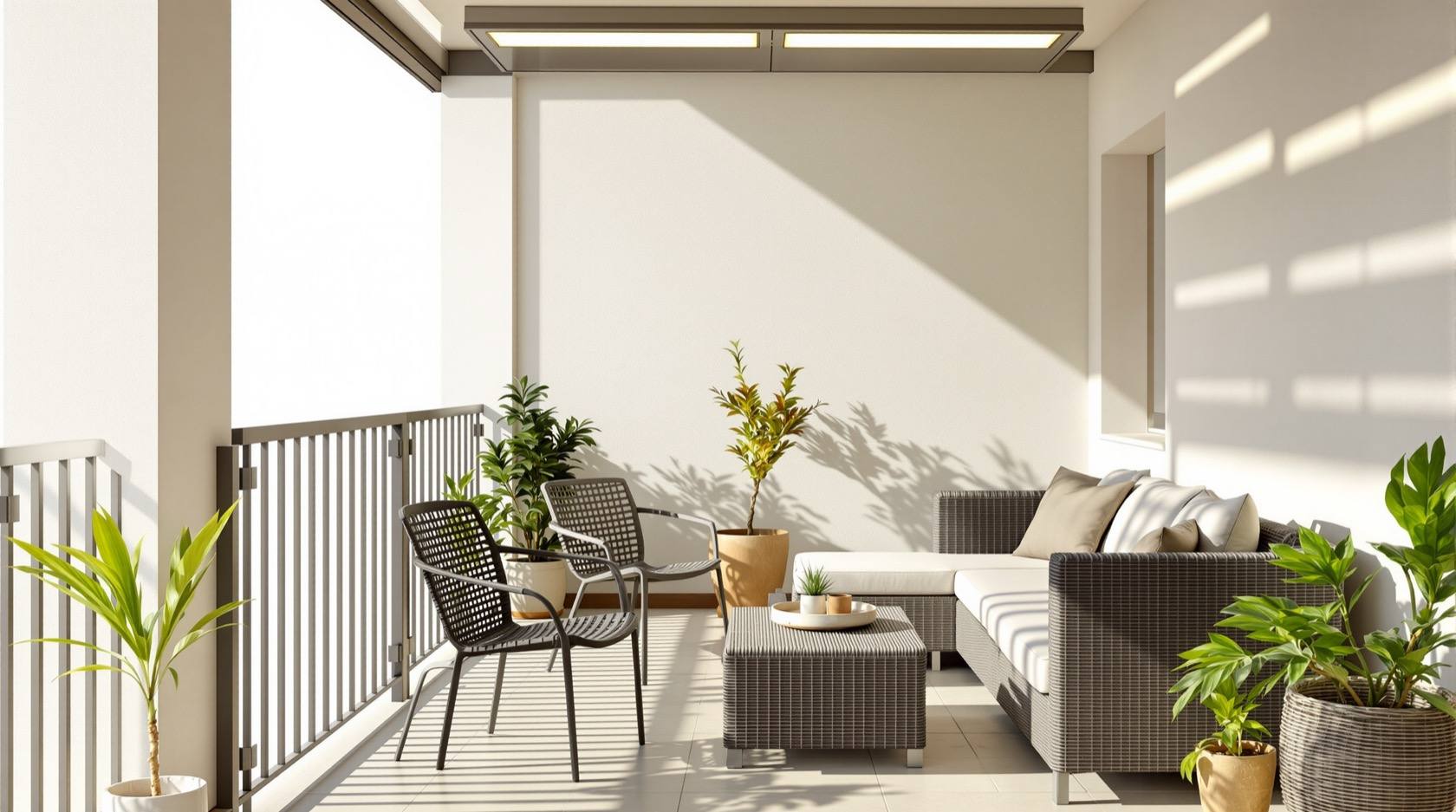
Indoor vs Outdoor Furniture in India: Materials, Durability & Cost (2026)
Why outdoor furniture is a genuinely different product — engineered for India's hard sun, monsoon and humidity — how to read a material for the balcony, terrace, garden or poolside, what it should cost, and why putting an indoor sofa outside is false economy.
The most expensive mistake on an Indian balcony is a beautiful indoor sofa dragged outside "just for now." Six weeks of April sun bleaches the fabric, the first monsoon swells the engineered-wood frame, and by the second season the legs are rusting and the foam smells of mildew. It looked like a saving. It was a write-off.
Outdoor furniture is not indoor furniture that happens to be outside. It is a different product, designed from the fastener up to survive ultraviolet light, driving rain, roof-slab heat, coastal salt, standing humidity and termites — the exact conditions that quietly destroy the materials our indoor furniture is made from. This guide explains why the two are different, how to read a material for the space you actually have, what outdoor-rated pieces cost, and how to make them last. For laying out and buying a full outdoor scheme, this pairs with the dedicated outdoor furniture planning guide; for the indoor side of the house, see the residential furniture guide and the complete guide to furniture in India.
Scope & how to read this. Every material note, durability range and cost band here is indicative — a planning and buying aid, not a specification. Actual life depends on your microclimate (a Chennai seafront terrace is brutal; a covered Bengaluru balcony is gentle), the grade you buy and how you maintain it. Confirm frame strength and stability against the general IS furniture standards and ask sellers for BIS / BIFMA-type test backing and IGBC / GreenPro eco-certification where it matters. Costs are relative bands — always get local quotes.
Why outdoor is a different product
Move a piece of furniture from a living room to a terrace and you change almost every load it has to survive. Indoors, the enemies are gentle: some spills, some wear, the odd knock. Outdoors, the environment attacks the material itself, continuously, for years.
- Ultraviolet light. India's sun is intense for most of the year. UV breaks down polymers, fades dyes and makes untreated plastics and ordinary fabrics brittle and chalky. Outdoor materials are UV-stabilised; indoor ones are not.
- Water — rain and humidity. The monsoon does not just wet furniture, it drives water into every joint and pore. Engineered woods swell and delaminate; untreated steel rusts; foam holds water and grows mould. Coastal and lakeside humidity keeps everything damp for months.
- Heat. A terrace slab or an uncovered balcony floor can get genuinely hot. Heat softens cheap plastics, cracks finishes and cooks upholstery.
- Salt and pollution. Near the sea, salt-laden air accelerates corrosion dramatically. In cities, grime and acidic pollution etch finishes.
- Termites and pests. Anything cellulose-based sitting near soil or damp masonry is a termite target; birds and insects foul soft furnishings.
Indoor furniture is optimised for a different problem — looking good and feeling comfortable in a protected room — using materials chosen for finish and cost, not weather. That is exactly why it fails outside.
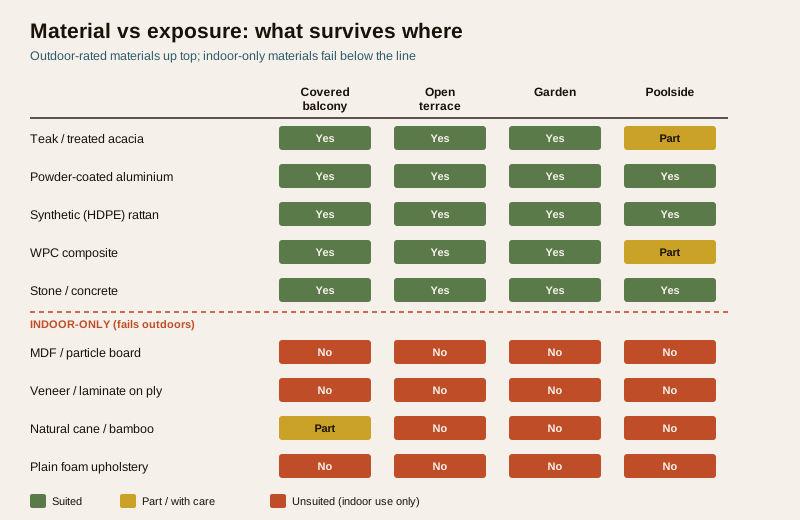
The four enemies — and the materials built to beat them
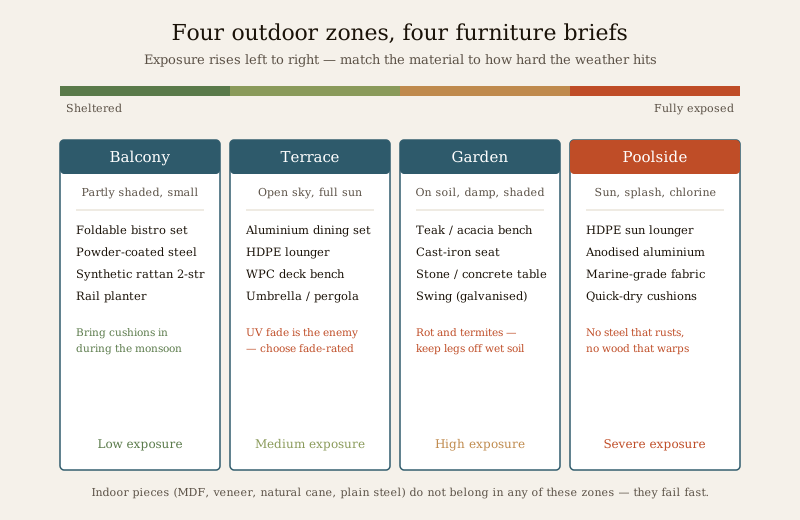
Almost every outdoor-furniture failure traces to one of four enemies: sun, water, rust and termites (mildew rides in on water). A material earns the "outdoor" label by defending against all four at once. Here is how the real outdoor materials stack up.
| Material | Beats sun | Beats water | Beats rust | Beats termites | Best for |
|---|---|---|---|---|---|
| Teak (and treated acacia) | Yes, silvers gracefully | Yes, natural oils | N/A (wood) | Yes, naturally resistant | Premium garden and terrace, timeless look |
| Powder-coated aluminium | Yes | Yes, will not rust | Yes, does not rust | N/A (metal) | The all-round outdoor workhorse; light, movable |
| Powder-coated / galvanised steel | Yes | Yes if coating intact | Only while coating intact | N/A (metal) | Heavier, stable pieces; watch chips near coast |
| Synthetic (HDPE / PE) rattan & wicker | Yes, UV-stabilised | Yes | On its metal frame | Yes (plastic) | The cane look without cane's fragility |
| WPC (wood-plastic composite) | Yes | Yes | N/A | Yes | Decking-style benches, planters, low tables |
| Stone / concrete / cast terrazzo | Yes | Yes | N/A | Yes | Permanent tables, seats, heavy anchor pieces |
| Marine-grade / solution-dyed acrylic fabric | Yes, fade-resistant | Sheds water, quick-dry foam | N/A | N/A | Cushions and slings that stay out (Sunbrella-type) |
Contrast that with the materials our indoor furniture is built from — every one of which fails outdoors:
| Indoor-only material | Fails because | Where it belongs |
|---|---|---|
| MDF / HDF | Swells and crumbles the moment water reaches it | Dry indoor cabinetry only |
| Particle board | Delaminates and sags with any damp | Budget indoor units |
| Veneer / laminate on ply | Edges lift, surface bubbles in sun and rain | Indoor tops and shutters |
| Natural cane / bamboo (untreated) | Rots, splits and is a termite magnet | Covered indoor accents |
| Ordinary foam + cotton/poly upholstery | Soaks water, grows mildew, fades fast | Indoor sofas and beds |
| Mild steel (painted, not galvanised) | Rusts within a season once paint chips | Indoor frames away from damp |
If a "garden set" is quietly built from ply, MDF or plain foam, it is indoor furniture wearing an outdoor price tag. The material honesty here matters more than the styling — for the wood-panel side of that question, the plywood grades guide and marine ply vs HDHMR vs MDF explain which boards even pretend to handle moisture (and why none of them truly belong on an open terrace). The broader material behaviour lives in the materials hub.
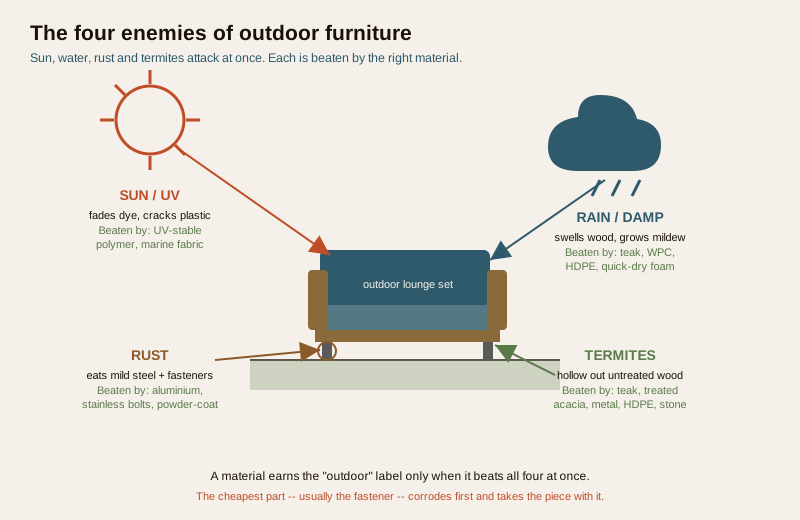
Match the piece to the exposure — balcony to poolside
"Outdoor" is not one condition. A covered balcony and an open poolside are as different from each other as either is from a living room. Read your space by how much sun and rain actually reach it, then buy to match.
| Zone | Real exposure | What works | What to avoid |
|---|---|---|---|
| Covered balcony | Shade, some blown rain, city grime | Aluminium, synthetic rattan, quick-dry cushions; light and movable | Heavy fixed pieces; anything you cannot wipe down |
| Open terrace | Full sun and full monsoon, roof-slab heat | Powder-coated aluminium, teak, WPC, marine fabric; foldable or storable | Untreated wood, plain foam, mild steel |
| Garden / lawn | Sun, rain, soil contact, termites, damp underfoot | Teak, stone/concrete, synthetic rattan on treated frames | Anything cellulose touching soil; ply, MDF, cane |
| Poolside | Constant splash, chlorine, UV glare, wet feet | Non-corroding aluminium, HDPE, all-weather slings; fast-draining | Steel that can rust-stain the deck; water-holding foam |
| Coastal (any of the above) | Salt air multiplies corrosion | Teak, marine-grade aluminium, HDPE, stainless fasteners | Ordinary powder-coat over steel; standard hardware |
Two rules cut across every zone. First, fasteners and hardware decide the real lifespan — a teak bench with mild-steel bolts still fails at the bolts; insist on stainless or properly coated hardware, because the cheapest part corrodes first and takes the piece with it. Second, movable beats fixed on balconies and terraces, because the single most effective life-extender is simply bringing cushions in — or the whole light piece — when the monsoon breaks. For laying these zones out as usable rooms, the outdoor furniture planning guide does the space-planning; the furniture size chart helps you check a lounger or dining set actually fits the balcony before you buy.
Durability, maintenance and monsoon care
Outdoor-rated does not mean maintenance-free — it means maintenance rewards you instead of merely delaying a write-off. Set expectations by material, and build a simple monsoon routine.
| Material | Realistic life outdoors | Routine care | Monsoon action |
|---|---|---|---|
| Teak / treated acacia | Very long; decades if cared for | Wipe down; oil yearly to hold colour, or let it silver | Fine in rain; keep off standing water, let it dry |
| Powder-coated aluminium | Long | Wash with mild soap; touch up any coating chips | Leave out; dry cushions indoors |
| Powder-coated / galvanised steel | Long if coating stays intact | Inspect for chips, touch up fast, especially near coast | Cover or store to protect coating; watch rust spots |
| Synthetic (HDPE) rattan / wicker | Long | Rinse dust from the weave; check the metal frame | Rain-tolerant; store frames in heavy salt air |
| WPC / composite | Long | Occasional wash; it will not need sealing | Fully rain-tolerant |
| Stone / concrete | Effectively permanent | Rinse; reseal porous stone occasionally | Ignores rain |
| Marine-grade cushions & slings | Several seasons | Brush off, spot-clean, dry fully before storing | Bring in or use a vented storage box; never leave damp foam sealed |
A few habits do most of the work. Covers and a dry store — a ventilated deck box, a dry corner of the utility balcony, or breathable covers (never airtight plastic, which traps condensation and grows mould) — are the single best investment after the furniture itself. Elevate pieces off wet floors on glides or feet so water drains and legs are not sitting in a puddle. Dry cushions fully before storing, because sealing damp foam is how mildew starts. And rinse coastal pieces of salt periodically. Done consistently, this is the difference between furniture that reads tired in two years and furniture that looks intentional in ten.
Cost — why outdoor-rated is cheaper in the end
Outdoor furniture costs more up front, and the reason is entirely in the materials and hardware: UV-stabilised polymers, marine fabrics, non-corroding metals and stainless fasteners simply cost more than ply, foam and mild steel. That premium is real — but it buys years, and the alternative is not cheaper, it is a recurring bill.
| Buying approach | Up-front cost | What actually happens | True cost over ~5 years |
|---|---|---|---|
| Indoor furniture placed outdoors | Lowest | Fades, swells, rusts, moulds; replaced within 1-2 seasons | Highest — you buy it two or three times |
| Budget "outdoor-look" (ply/cane/plastic) | Low | Better than indoor, but weak hardware and boards fail early | High — frequent repair and early replacement |
| Genuine outdoor-rated (aluminium/HDPE/teak) | Higher | Survives with light care; occasional cushion refresh | Lowest — bought once, maintained |
Think in cost per usable year, not sticker price. A powder-coated aluminium set that costs more than a plywood-framed "garden" sofa but lasts a decade is dramatically cheaper per year — and it never gives you the mid-monsoon moment of dragging a ruined sofa to the scrap dealer. Put a number on the trade-off with the furniture cost calculator, and read the up-front premium the way you would read built-in vs modular vs loose furniture: the cheapest option at purchase is rarely the cheapest to own.
Where to spend and where to save: put your money into frames, metals and fasteners (the parts you cannot replace), and treat cushions and fabric as consumables you will refresh once or twice over the furniture's life. A strong non-corroding frame with a replaceable marine-grade cushion is the sweet spot for almost every Indian home.
How it connects
- Plan and lay out the actual space with the outdoor furniture planning guide — this guide chooses materials, that one arranges the room.
- Anchor both sides of the house in the complete guide to furniture in India and, for the indoor rooms, the residential furniture guide.
- Get the board-and-moisture facts straight in plywood grades and marine ply vs HDHMR vs MDF, with the deeper science in the materials hub.
- Weatherproof the backdrop too — exterior-grade paints and cladding for the wall behind the set live in the wall finishes hub.
- Weigh the up-front premium honestly with the furniture cost calculator and the built-in vs modular vs loose furniture guide; check fit with the furniture size chart.
- Style the transition from inside out with living room design ideas.
Key takeaways
- Outdoor furniture is a different product, engineered from the fastener up for UV, rain, heat, salt and termites — indoor furniture put outside is a write-off, not a saving.
- The four enemies are sun, water, rust and termites (mildew rides on water); a real outdoor material beats all four — teak, powder-coated aluminium, synthetic HDPE rattan, WPC, stone and marine-grade fabric do; MDF, particle board, veneer, natural cane and plain foam do not.
- Match the piece to the exposure — a covered balcony, open terrace, garden and poolside are genuinely different conditions; buy movable and storable for balconies and terraces.
- Fasteners decide lifespan — insist on stainless or coated hardware; the cheapest part corrodes first.
- Maintenance rewards you — covers, a dry ventilated store, elevated feet and fully dried cushions turn a two-year look into a ten-year one.
- Outdoor-rated is cheaper per usable year — spend on frames and metals, treat cushions as consumables, and compare true cost over five years, not sticker price.
References
- The IS furniture standards — general provisions for furniture strength, stability and durability (named generally; confirm the current parts with your seller).
- IS 303 / IS 710 — plywood grades (MR / BWR / BWP) and IS 1734 test methods; IS 3087 / IS 3097 particle board; IS 12406 MDF; IS 1659 blockboard — for judging any board-based "outdoor" claim (named generally).
- Formaldehyde emission classes E0 / E1 / E2 (CARB / EN 13986 context) — relevant where composite boards are used near living spaces.
- IGBC / GreenPro (Indian Green Building Council) eco-certification and BIFMA-type furniture testing — evidence of durability and responsible sourcing to ask sellers for.
- Manufacturer material and warranty documentation — UV-stabilisation, marine-grade fabric ratings, powder-coat and corrosion specifications for the specific product.
All material notes, durability ranges and cost bands here are indicative planning aids only; real-world life depends on your microclimate, the grade you buy and how you maintain it. Confirm strength and stability against the current IS furniture standards, ask sellers for BIS / BIFMA and IGBC / GreenPro backing, and get local quotes for cost.
Export this guide
Related Guides — Deep-dive reading
The Complete Guide to Furniture for Indian Homes (2026)
The start-here master guide for furnishing an Indian home — what furniture actually does, the five families of pieces, the decisions in the order you face them (space and needs, loose vs modular vs built-in, materials, size and layout, budget, buy, maintain), an honest read on plywood, humidity and termites, and where every choice hands off to the carpenter, the brand or the fixer.
FurnitureOutdoor Furniture Planning
Planning the outdoor room — sizing and clearances, materials for the Indian climate, cushions and fabrics, shade, maintenance and monsoon storage
LandscapeMDF vs Particle Board Furniture in India: Which Is Better? (2026)
A plain-spoken head-to-head between the two cheapest engineered boards — MDF and particle board — plus their denser cousins HDF and HDHMR: how each is made, how they hold a screw, take an edge and survive Indian humidity, what they cost, where each belongs, and the line at which you should stop saving and buy plywood instead.
FurnitureRelated Tools — Try Free
Door Material Comparison Tool
Compare 2–4 door materials on cost, durability, maintenance, security and moisture resistance.
Comparison ToolApartment Furniture Size Chart
Standard furniture dimensions for Indian apartments — sofas, beds, tables, dining, storage.
Reference ChartWindow Maintenance Cost Calculator
Estimate annual window upkeep by frame material — yearly, per-window and 5-year cost.
Window Calculator