
Housing Society CCTV Policy in India (2026): Writing the Rules Everyone Signs Up To
Cameras in a housing society are only as fair and lawful as the written policy behind them. Here is how a committee or RWA drafts, approves and publishes a CCTV policy that satisfies the DPDP Act, settles disputes, and earns resident trust.
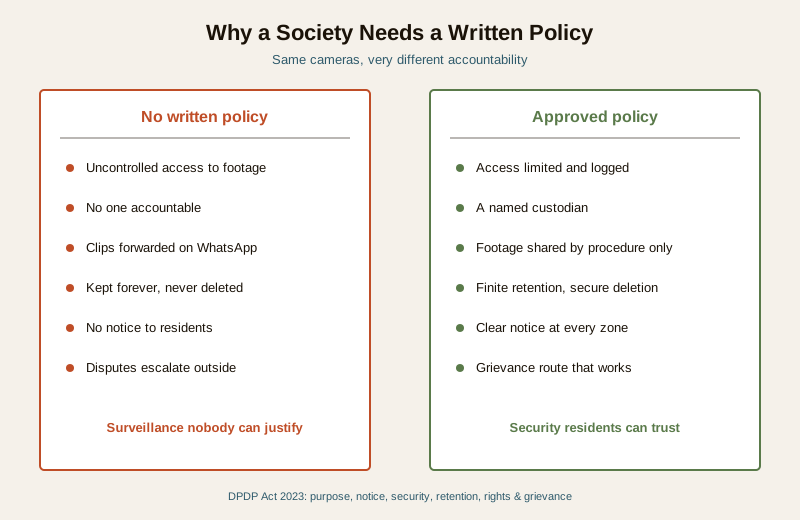
Most housing societies buy cameras first and think about rules later, if at all. A committee approves a quotation, an installer mounts thirty domes around the compound, and the footage sits on a recorder in the security cabin — watched by whoever is on duty, kept for as long as the hard drive allows, and shared on WhatsApp whenever a dispute flares up. That is not a security system. It is a liability waiting to become a grievance.
A housing society cctv policy is the written document that fixes this. It is the governing text — approved by the managing committee and ideally ratified by the general body — that says why the cameras exist, where they point, who may look at the footage, how long it is kept, and what a resident can do if they feel the system is being misused. It is the difference between surveillance that residents trust and surveillance that quietly turns neighbours against one another. This guide is the practical companion to CCTV in common areas: that guide explains what a society may lawfully record; this one explains how to write it all down.
Scope & how to read this. This is practical compliance literacy, not legal advice or authoritative code. Requirements vary by state and city and change over time — always confirm the current position with the Authority Having Jurisdiction (your registrar of cooperative societies, a qualified lawyer, or a Data Protection Officer) before you adopt or rely on any policy. Have a professional review your draft before the general body signs off.
Why a society needs a written policy at all
A camera collects personal data — the faces, movements, vehicles and routines of every resident, worker and visitor. Under the Digital Personal Data Protection Act, 2023 (DPDP Act), an organisation that decides why and how personal data is collected carries duties: a clear purpose, a lawful basis, notice to the people affected, security of what is held, and a route for individuals to exercise their rights. A housing society running cameras is exactly such an organisation. A written policy is how the committee demonstrates it has actually thought about those duties rather than stumbled into them.
Beyond the law, a policy does three practical things:
- It resolves disputes before they start. When a resident demands footage of the parking lot at 2 a.m., the policy already says who they ask, what they get, and what they cannot get. No argument, no favouritism.
- It protects the committee. Volunteers who run societies are personally exposed when footage is mishandled. A policy that names a custodian and limits access moves the society from "whoever felt like watching" to a defensible, accountable arrangement.
- It earns resident trust. People accept cameras they understand. A published policy signals that the committee is watching the compound for everyone's safety, not watching individual residents.
What the policy should contain, section by section
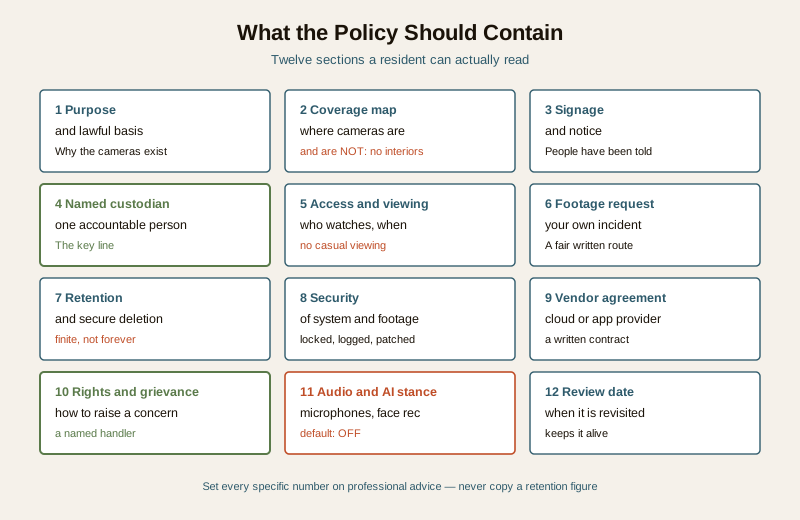
A good policy is plain, short and specific. It should read like something a resident can actually understand, not a legal document nobody opens. Below is what each section covers — in words, without inventing a single number, because the specifics (how many days footage is kept, which clauses apply) are decisions your committee makes with professional input, not figures anyone should copy blindly.
Purpose and lawful basis. In one or two sentences, why the society operates cameras — typically the safety and security of residents and property in common areas. Tie it to a lawful basis under the DPDP Act and keep it honest: security, not monitoring who visits whom.
A coverage map. List where cameras are and, just as importantly, where they are deliberately NOT. Common areas — gates, lobbies, parking, staircases, the perimeter — are the legitimate zone. The policy must state plainly that cameras never cover private interiors, toilets, bathrooms, changing rooms or any spot where a person reasonably expects privacy. A camera that peers into a flat's window or balcony is a defect to be fixed. The common-areas guide works through where the line falls.
Signage and notice. Require visible notices at every entrance and monitored zone, telling people the area is under CCTV surveillance and who to contact. Notice is a core DPDP expectation, and it is what turns lawful monitoring into something people have been told about rather than caught by. See the wider CCTV privacy guide for how notice fits the whole picture.
The named custodian. This is the single most important line in the document. One accountable person — a designated committee member or the manager — is the custodian of the system and its footage, and everything about access flows through the role. Without a custodian, "who may watch" has no answer, and that is where societies get into trouble.
Who may view, and when. Spell out who can see live monitoring (usually the security desk, for real-time safety) and who can access recorded footage (a much smaller, named set, under the custodian). Casual viewing — bored guards scrolling through last night, a committee member checking on a neighbour — must be ruled out explicitly.
The footage-request procedure. Residents will ask for footage, most often of an incident that involves them: a scraped car, a theft, a confrontation. Set out a fair, written route — how to request, who decides, what they receive, and the limits (a resident may see footage of an incident involving them, but not roam the archive or obtain footage of unrelated third parties). Police requests follow their own lawful process. Ground this in the footage retention guide.
Retention and secure deletion. State that footage is kept only for a defined period tied to its security purpose, then automatically and securely deleted. Do NOT invent a number here — the committee sets the period on advice, weighing security needs against the DPDP principle of not keeping data longer than necessary. The policy must promise that the period is finite and enforced, not "kept forever until the disk fills."
Security of the system and footage. Recorders in a locked room, changed default passwords, restricted network access, and logs of who accessed what. If the footage is not secured, none of the other promises hold.
The vendor and cloud agreement. Many societies now use app-based or cloud-recorded systems run by a vendor who processes residents' personal data on the society's behalf — which means a written data-processing agreement defining what the vendor may do, the security they must maintain, and that they act only on the society's instructions. The data-processing agreements guide explains what that contract must cover.
Resident rights and a grievance route. Under the DPDP Act, individuals have rights over their personal data. Tell residents how to raise a concern, request information or complain about misuse — and name the person or committee that handles it. A grievance route that actually works keeps a dispute inside the society instead of escalating outside it.
Audio and AI stance. State the default clearly: audio recording off, and any facial-recognition or AI analytics off unless the general body has separately, knowingly approved it with its own safeguards. These are high-intrusion features that should never arrive quietly bundled with a camera upgrade.
A review and renewal date. Name when the policy will be reviewed — because cameras get added, the law evolves, and a document nobody revisits drifts out of date. A stated review date keeps it alive.
| Policy section | The question it answers |
|---|---|
| Purpose and lawful basis | Why do the cameras exist? |
| Coverage map | Where are cameras — and where are they deliberately not? |
| Signage and notice | Have people been told? |
| Named custodian | Who is accountable for the system? |
| Access and viewing | Who may watch live and recorded footage, and when? |
| Footage-request procedure | How does a resident get footage of their own incident? |
| Retention and deletion | How long is footage kept, and how is it destroyed? |
| Security | How is the system and footage protected? |
| Vendor agreement | Is the cloud or app provider bound by a written contract? |
| Resident rights and grievance | How does a resident raise a concern? |
| Audio and AI stance | Are microphones and face recognition off by default? |
| Review date | When is the policy revisited? |
How to adopt the policy
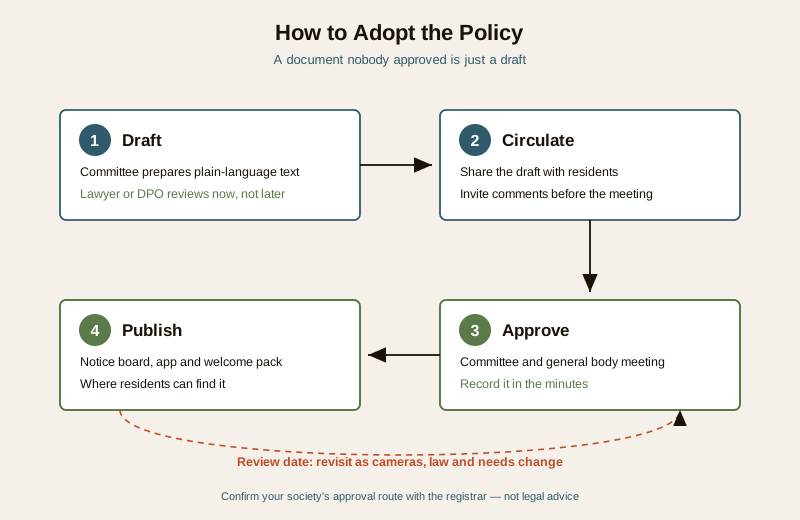
A policy nobody approved is just a document. Adoption is what gives it authority, and it follows a general path that most societies will recognise from their normal governance.
1. Draft. The committee, or a small sub-committee, prepares a plain-language draft using the sections above. Getting a lawyer or Data Protection Officer to review the draft at this stage is far cheaper than fixing a dispute later.
2. Circulate. Share the draft with residents before the meeting, so people can read and comment. A policy about watching residents should not be sprung on them.
3. Approve. Table it in the managing committee and, for a document this consequential, place it before the general body meeting (GBM) for ratification. Record the approval in the minutes — that record is what makes the policy the society's official position.
4. Publish. Put the approved policy where residents can find it: the notice board, the society app or portal, and the welcome pack for new residents. A policy that lives in a committee member's inbox protects no one.
The fairness angle: security demand versus privacy
The hardest conversations in a society are not technical. One resident, shaken by a break-in, wants a camera on every corner and the footage available on demand. Another, equally reasonable, does not want a lens tracking who visits their flat or a neighbour pulling up clips of their comings and goings. A good policy is where these two are balanced — not by siding with the loudest voice, but by fixed rules that apply to everyone.
That balance shows up in concrete restrictions the policy should carry:
- No WhatsApp-forwarding. Footage is not to be copied to personal phones, posted in resident groups, or shared outside the request procedure. A single forwarded clip can turn a security system into a tool for public shaming.
- No targeting individuals. The cameras watch common areas for everyone's safety. They are not to be used to build a picture of one resident's movements, monitor domestic workers beyond legitimate security, or settle personal scores.
- Proportion over appetite. More cameras and longer retention are not automatically better. The DPDP principle of collecting no more than needed is also the fairness principle. When in doubt, the policy should favour the least intrusive option that still meets the genuine security purpose. A structured privacy assessment helps a committee weigh this honestly, and the visitor data protection guide covers the gate register and visitor footage that sit alongside the cameras.
Fairness is the policy's real job. Any society can point cameras at its compound. The policy exists so that one resident's security does not quietly become another resident's surveillance. If a rule in your draft would let footage be used to watch a person rather than protect the community, that rule is the problem.
A ready policy-contents checklist
Print this and tick it against your draft. If a line is missing, the policy is not finished.
- Purpose stated, tied to a lawful basis under the DPDP Act.
- Coverage map: where cameras are, and an explicit list of where they are not (never private interiors, toilets, changing rooms).
- Signage and notice required at monitored zones.
- A single named custodian accountable for the system.
- Who may view live and recorded footage, and the rule against casual viewing.
- A written footage-request procedure, including a resident asking for footage of their own incident.
- A finite retention period with secure automatic deletion (number set on advice, not copied).
- System and footage security measures, including access logs.
- A data-processing agreement with any cloud or app vendor.
- Resident rights and a working grievance route with a named handler.
- Audio and AI or face-recognition stance, defaulting to off.
- A stated review and renewal date.
- A record of committee and general-body approval in the minutes.
Policy red flags
If any of these describe your society, treat it as urgent — each is a common way that camera systems drift into misuse.
- No written policy at all — cameras running on habit and goodwill, with nothing to point to when a dispute arrives.
- No named custodian — everyone and no one is responsible, so footage is effectively open access.
- Keep-forever retention — recordings overwritten only when the disk is full, with no defined period or deletion.
- Uncontrolled access — guards, committee members or a vendor able to watch and export footage with no log and no limits.
- Footage on WhatsApp — clips shared in resident groups or forwarded to phones outside any procedure.
- A cloud vendor with no contract — a company holding residents' footage with nothing in writing about what it may do with it.
- No notice — cameras with no signage, so residents and visitors were never told.
- A policy nobody approved or can find — a draft that never went to the general body, or an approved one that lives nowhere residents can read it.
Who to ask, and getting it reviewed
Writing the policy is committee work, but the review should not be. Before the general body signs off:
- A qualified lawyer or Data Protection Officer should check that the purpose, lawful basis, notice, retention approach and grievance route line up with the current DPDP Act and its rules — which are still settling and change over time.
- Your registrar of cooperative societies or the applicable state framework governs how societies adopt binding rules; confirm the correct approval route for your state and society type.
- A licensed security installer confirms what the hardware actually supports — whether audio can be disabled, access logged, and retention set and enforced — so the policy's promises match the equipment.
Do not treat a template found online, including this checklist, as a finished policy. It is a starting point for the conversation with a professional, not a substitute for one.
Key takeaways
- A housing society CCTV policy is the document that makes the cameras lawful, fair and accountable under the DPDP Act — without it, a society is running surveillance it cannot justify.
- Name a custodian and control access. The single most important lines in the policy are who is accountable and who may watch; uncontrolled access is where societies go wrong.
- Write down the coverage map, the footage-request route, a finite retention period and secure deletion — and never fabricate the retention number; set it on advice.
- Adopt it properly: draft, circulate, approve in the committee and general body, and publish it where residents can read it.
- Fairness is the point. No WhatsApp-forwarding, no targeting individuals, and the least intrusive option that meets a genuine security need.
- This is not legal advice. Have a lawyer or Data Protection Officer review your draft, and confirm your society's approval route with the registrar before you rely on the policy.
References
- Digital Personal Data Protection Act, 2023 — collect personal data (including CCTV footage) for a clear, lawful purpose, with notice, security, defined retention and a route for individuals to exercise their rights; verify the current text and rules before relying on it.
- CCTV in common areas — the companion guide on what a housing society may lawfully record and where the privacy line falls.
- Your state cooperative societies framework and registrar — governs how a society adopts binding rules; confirm the correct approval route locally.
- A qualified lawyer or Data Protection Officer — for review of your specific draft, lawful basis and retention approach before adoption.
This is an educational overview, not legal advice. A society's CCTV obligations depend on its exact facts and its state framework — have a qualified lawyer or Data Protection Officer review your policy, and confirm your approval route with the registrar of cooperative societies before you adopt or rely on it.
Export this guide
Related Guides — Deep-dive reading
CCTV Recording Failure in India (2026): Live View Works but Nothing Was Saved
You open the recorder to pull footage of an incident and there is nothing there, even though every camera shows a crisp live picture. A calm, ordered guide to why an Indian CCTV system records live but saves nothing, and how to fix it before the next incident.
SecurityCCTV Footage Retention in India (2026): How Long to Keep It, and When to Delete
Footage of identifiable people is personal data, and the honest answer to how long to keep it is almost never forever. Here is how to set a sensible retention window for a home, an RWA or a small office, delete on schedule, and preserve only what a real incident needs.
SecuritySecurity Data-Processing Agreements in India (2026): The Contract Behind Your Vendor
When you hand CCTV footage, faces, access logs or visitor data to a security vendor, they process it for you — and you stay accountable. A plain-English look at the data-processing agreement that should govern that relationship under the DPDP Act.
SecurityRelated Tools — Try Free
CCTV Placement Compliance Checker
A quick DPDP-grounded privacy and safety self-check for where a camera is pointed — flags the items to fix.
ComplianceInterior Contract Clause Checklist
16 sections and 98 checkboxes covering scope, BOQ, milestones, penalties, warranty, and disputes.
Contract ChecklistCCTV Camera Coverage & Count Calculator
Estimate how many CCTV cameras you need, the NVR channels, storage in TB for your retention period, and an indicative all-in cost with GST.
CCTV Calculator