
Centralized Plumbing System in India: Central Plant Design Guide
How a centralized plumbing system works — one central plant (hot-water calorifier, softening, boosted supply) serving a whole hotel, hospital or large home through circulation loops and return lines — with its efficiency case, its heat, pressure and Legionella risks, and when it beats going decentralized.
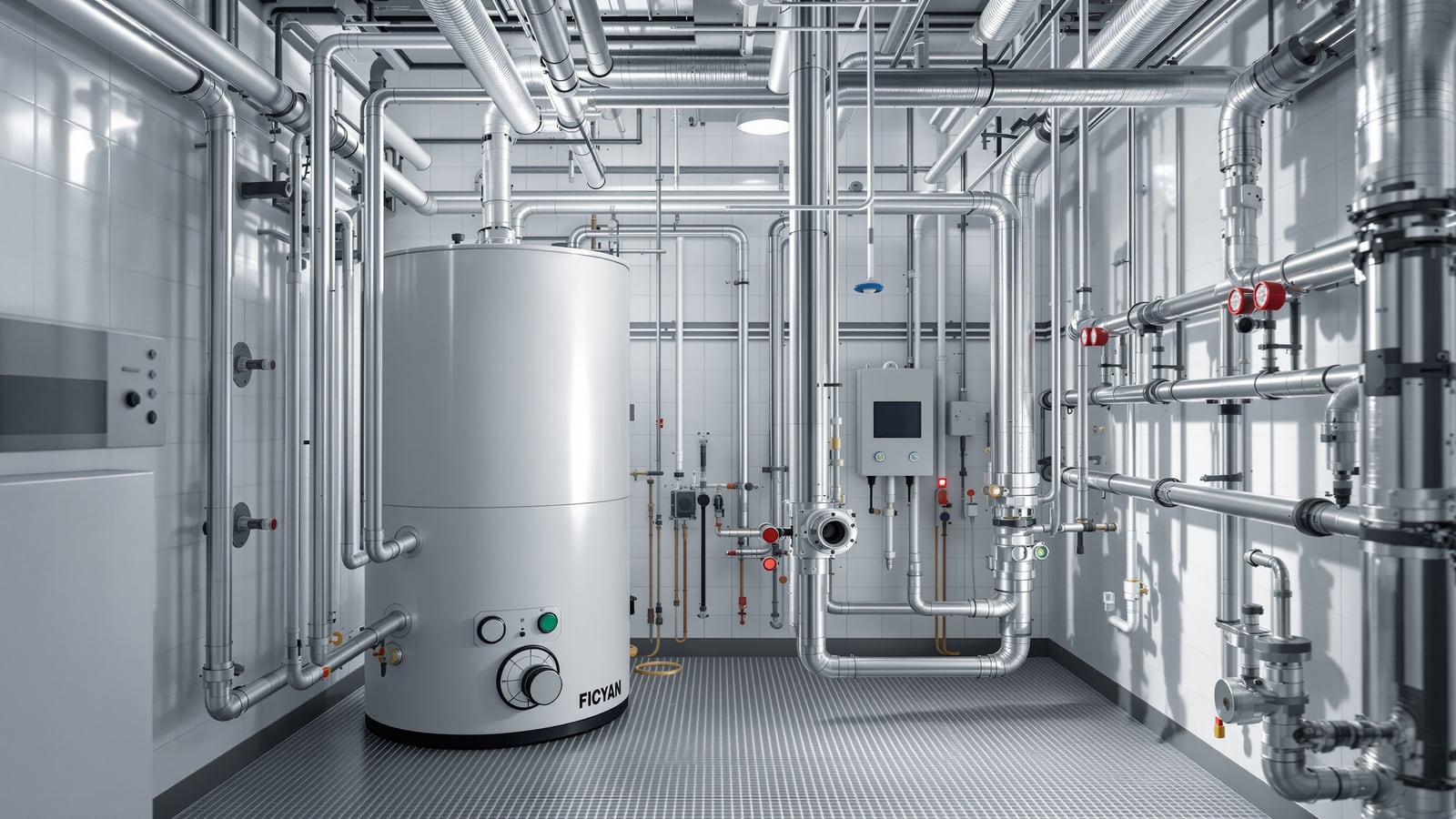
A centralized plumbing system puts the water-making machinery in one place — a plant room — and pipes its output to the whole building. Instead of a geyser in every bathroom and a softener under every sink, one central calorifier heats all the hot water, one softening plant treats all the supply, and one boosted supply set pushes it out. This is the default architecture for hotels, hospitals, hostels and large homes, and it is the sibling design to the decentralized plumbing system.
This guide sits inside the Studio Matrx Plumbing Knowledge Hub and covers the system architecture: the central plant, the circulation loops that make it usable, the trade-offs, and where it earns its keep. For fixture selection and geyser product detail we link out; this hub owns the pipe, pump, tank and loop side.
The defining move of a centralized system is the circulation loop. Central hot water is useless if a guest on the eighth floor has to run the tap for ninety seconds before it turns warm. A pumped return line keeps hot water perpetually circulating past every riser, so it arrives within seconds — and that single design decision is the source of both the system's greatest strength and its most dangerous failure mode.
What "centralized" actually means
Centralization can apply to any of the water-conditioning functions independently. A building may centralize one, two or all three:
- Central hot water. One or more large calorifiers (indirect storage cylinders) or a bank of heaters in the plant room, sized for the whole building's simultaneous demand, distributed through a flow-and-return ring main.
- Central water treatment. A single softening, filtration or RO plant conditions all incoming water before it enters the building risers — protecting every fixture and the calorifier itself from scale.
- Central boosted supply. One hydro-pneumatic pump set or a set of zone pumps pressurizes the whole building from the underground tank, rather than relying purely on overhead-tank gravity.
The alternative — a local geyser, a point-of-use softener, a booster per flat — is decentralization. Most real Indian buildings are hybrids: central softening and boosted supply, but decentralized hot water; or central everything in the guest wing and local geysers in staff quarters. The design question is never "central or not" in the abstract, but which function, at what scale, for whom.
The central hot-water plant and its loop
Hot water is where centralization is most visible and most demanding. A large calorifier — a storage cylinder heated indirectly by a boiler coil, heat-pump, solar bank or electric elements — holds a reservoir of hot water at a stored temperature. From it, a flow pipe carries hot water up and out to every bathroom group, and a return pipe brings the un-drawn water back to the calorifier, driven by a small recirculation pump.
That flow-and-return ring is what makes central hot water tolerable. Without it, the long pipe run from a basement plant to a top-floor room would sit full of cooling water between draws; the loop keeps the whole ring hot and primed.
Sizing the plant is a diversity calculation, not a sum. A 120-room hotel does not need 120 geysers' worth of stored hot water; it needs enough for the realistic simultaneous morning peak. Typical planning figures used for indicative sizing in India are below — always confirm against the actual fixture schedule and a licensed plumber's demand model.
| Building type | Hot water @ ~60 C (indicative) | Storage basis | Recirc temp target |
|---|---|---|---|
| Hotel (per room) | 90–110 lpd | Peak-hour + reheat | Return ≥ 55 C |
| Hospital (per bed) | 100–130 lpd | Round-the-clock demand | Return ≥ 55 C |
| Hostel (per resident) | 40–60 lpd | Sharp morning peak | Return ≥ 55 C |
| Large home | 40–50 lpd/person | Family peak | Return ≥ 50 C |
Cold-water demand is planned separately against the standard supply figure of about 135 lpcd for domestic occupancy, adjusted upward for hotels and hospitals. For fixture-level hot-water sizing and geyser product detail, use the bathroom-side geyser size calculator.
Central water treatment
Where the incoming supply is hard — most of peninsular and northern India — a central softening plant upstream of the risers protects the entire building at once. One base-exchange or ion-exchange softener, sized to the peak flow, means no scaled shower rose, no choked aerator and, critically, no scale building up inside the expensive central calorifier. Filtration and, where potable polishing is required, central RO can sit in the same treatment train.
Centralizing treatment is almost always the right call even when hot water is decentralized: it is cheaper to soften once at the inlet than to fit and maintain a softener at every point of use. The saved plumbing headache is real — a single regeneration schedule, one salt store and one service contract replaces dozens of neglected under-sink cartridges.
Materials, insulation and the balanced return
A centralized system lives or dies by its insulation and balancing, not its heat source. Every hot pipe in the ring — flow and return — should be lagged continuously; bare pipe in a shaft is money and hygiene leaking away hour after hour. India commonly runs central hot lines in CPVC or, for higher-temperature or code-mandated runs, in insulated copper or stainless steel, with the whole ring insulated to a specified thickness and vapour-sealed.
The balanced return is the quiet discipline that keeps the whole thing honest. Fit thermostatic balancing valves on each return branch so that every riser gives up the right share of flow and no branch is left cool. An unbalanced loop will over-circulate the nearest riser and starve the furthest — reintroducing exactly the cold-arrival and Legionella problems the loop was built to solve. Balancing is commissioning work: it must be measured and set, not assumed.
The trade-offs: why central is not automatically better
Centralization concentrates efficiency and concentrates risk in the same place. The honest engineering picture:
| Advantage | Cost / risk | |
|---|---|---|
| Plant efficiency | One large heat source runs at high efficiency; heat-pump/solar/boiler economies of scale | Single point of failure — plant down means the whole building loses hot water |
| Space & maintenance | One plant room to service, not hundreds of fixtures | Long distribution runs; more pipe, insulation and pump energy |
| Standing loss | — | Heat lost continuously from the whole hot ring, 24×7 |
| Pressure | Central boosting gives even pressure across zones | Pressure and heat both drop over long runs; needs zoning |
| Water quality | Treated once, consistently, for all fixtures | Legionella risk in warm, stagnant loop water and dead legs |
Three failure modes deserve their own attention.
- Heat and pressure loss over distance. Every metre of hot pipe bleeds heat and every metre of run drops pressure. Long runs demand thick insulation, a properly balanced return, and often pressure zoning — breaking a tall building into vertical pressure zones with break tanks or pressure-reducing valves so the lowest floor is not battered while the top floor starves.
- Dead legs. A dead leg is a branch of pipe with no circulation — a spur to a rarely used fixture, or a capped stub left after a renovation. Water sits there, cools into the danger zone, and never flushes. Dead legs are the enemy of both efficiency and hygiene; good design keeps every branch short and the circulated ring as close to each outlet as practical.
- Legionella. Legionella bacteria thrive in warm, stagnant water — roughly 20–45 C — exactly the temperature a poorly balanced loop or a dead leg can sit at. The mitigations are temperature-based: store hot water at ≥ 60 C, keep the return above ~55 C everywhere so no part of the ring cools into the growth band, eliminate dead legs, and design so the coldest returning branch still clears the threshold. This is precisely why a centralized system carries a hygiene duty a bank of local geysers does not.
The comparison below sets the centralized architecture against its decentralized sibling so the trade is visible at a glance.
When a centralized system suits
Centralization pays off when three things line up: high, overlapping simultaneous demand; a long building life that rewards durable plant; and an operator who will maintain it. That describes hotels, hospitals, hostels, clubhouses, spas and large multi-bathroom homes. It works poorly where demand is sparse and intermittent — a small apartment block where a central loop would spend most of the day circulating hot water past empty bathrooms, burning standing losses for nobody. There, decentralized point-of-use heating usually wins.
For the pumps, tanks, risers and boosting that any large building needs regardless of this choice, see building plumbing services. Sewage and effluent treatment sit outside plumbing distribution entirely — those belong to the STP hub.
Rule of thumb: centralize the function whose demand overlaps and whose plant is expensive to duplicate. Softening and boosting almost always centralize well. Hot water centralizes well only when the building is large, busy and professionally run — otherwise the loop losses and Legionella duty outweigh the plant efficiency.
References
- National Building Code of India (NBC) 2016, Part 9 — Plumbing Services — water supply, hot-water distribution and building drainage.
- CPHEEO Manual on Water Supply and Treatment, Ministry of Housing and Urban Affairs — demand figures and treatment guidance.
- IS 1172 — Code of Basic Requirements for Water Supply, Drainage and Sanitation.
- Manufacturer data and a licensed plumbing engineer for calorifier sizing, loop balancing and Legionella control; verify all indicative figures against local bye-laws and the actual fixture schedule.
Export this guide
Related Guides — Deep-dive reading
Bathroom Water Supply India: Cold & Hot Feed, Pipe Sizing, Pressure & Booster Pumps (2026)
How water actually reaches your fixtures in an Indian home — gravity-fed cold from the overhead tank, hot from the geyser, the pipe sizes that decide whether your shower gushes or dribbles, isolation valves at every fixture, booster pumps and hard-water protection, all mapped to IS 1172.
BathroomsBuilding Plumbing Services Guide (India): MEP-Grade Water, Drainage & Riser Design
A professional, India-first reference to plumbing engineering for larger and commercial buildings — integrated design with MEP, multi-storey water distribution, and drainage and venting stacks.
PlumbingWater Supply Systems in India: How Water Reaches Every Tap in Your Home
The complete map of how water gets into an Indian home and out to every fixture — the sources it comes from, the sump-pump-overhead-tank storage model that buffers intermittent supply, how gravity and pressurised distribution differ, and the demand figures that size the whole thing.
PlumbingRelated Tools — Try Free
Plumbing Pressure-Test & Leak Checklist
Pre-closure pressure and leak test — 9 categories, 60+ checkpoints across water supply, drainage, fixtures, waterproofing, hot water, tanks.
Pre-Closure TestRainwater Tank Sizer
How big should your rainwater tank be? Computes annual harvest, recommended tank capacity in litres, water-bill savings, and payback — for 10 Indian cities.
RWH CalculatorSolar Water Heater Size Calculator
Size a solar water heater — storage LPD and collector area — from occupants, per-person hot water and system yield.
Plumbing Calculator