
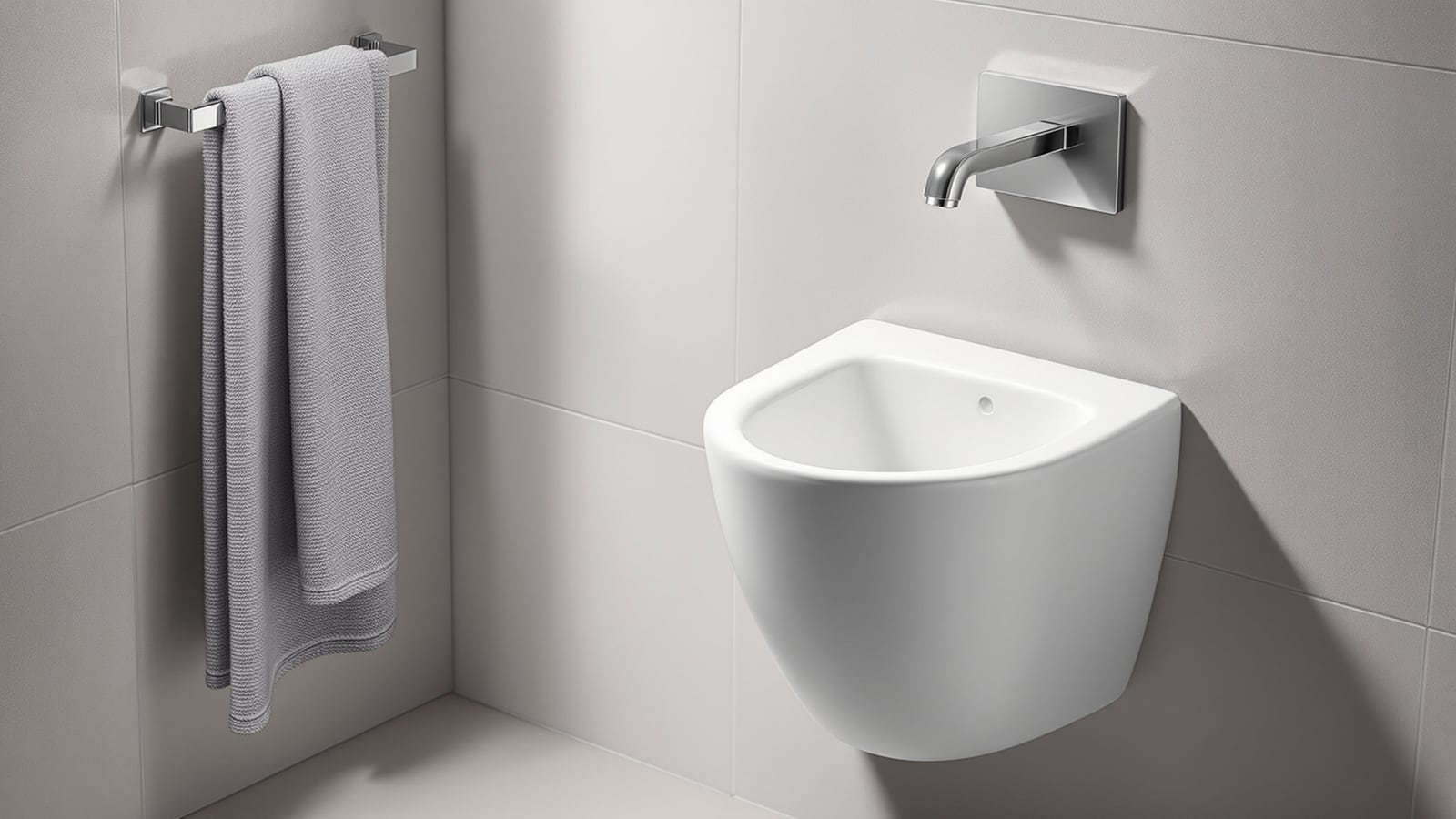
Urinal for Home India: Wall-Hung, Waterless & Sensor-Flush Guide
A practical, India-first guide to adding a urinal in the home bathroom — wall-hung types, waterless vs flush, sensor flush, mounting height and spacing in mm, water saving, hygiene, splash and odour control, and what it costs to install.
For decades the urinal in India lived only in offices, malls and railway stations — never at home. That is changing. As master bathrooms get larger and homeowners rethink hygiene and water use, a wall-hung urinal is increasingly appearing beside the WC in the main or male bathroom. It is quick, it splashes less on the seat and floor, and a waterless or sensor model can save thousands of litres a year. Done thoughtfully it is a genuinely useful fixture; done as an afterthought it becomes a smelly corner nobody wants to clean.
This is a component guide in the Studio Matrx bathroom hub. Read it alongside the complete toilet and WC guide for India for the fixture it sits next to, and the master bathroom design guide for the room it usually belongs in. For the tap and flush technology it shares, see the sensor faucets guide and the water-saving faucet guide.
A home urinal earns its place on three counts: it saves water, it keeps the WC and floor cleaner, and it speeds up a shared morning bathroom. If your space can only justify one of those, you probably do not need it — spend the money on the WC and vanity instead.
Does a urinal make sense in an Indian home?
A urinal is not for every bathroom. It needs about 350–450 mm of clear wall width, its own drain point, and a water or vent connection. In a compact common bathroom that space is better spent elsewhere. But there are homes where it clearly pays off:
- Large or master bathrooms with a separate WC compartment — room to give the urinal its own zone.
- Homes with elderly men, where a urinal at the right height is easier and safer to use than lowering onto a WC.
- Families training young boys, where a low urinal builds independence and cuts the mess around the WC.
- Households where the main bathroom is heavily male-used in the mornings and the WC becomes a bottleneck.
If none of those apply, a good WC with a health faucet does the whole job. Be honest about which camp you are in before you cut a new drain.
Types of home urinal
Urinals for the home are almost always wall-hung ceramic (vitreous china to IS 2556). The variations are in how they flush and how they drain.
| Type | How it works | Water use per flush | Best for |
|---|---|---|---|
| Manual flush (push/lever) | You press a valve or lever | 1.5–3 litres | Budget installs, reliable, no power |
| Sensor flush (infrared) | Auto-flushes after use | 1–2 litres, dosed | Hygiene-first homes, shared bathrooms |
| Dual/timed flush | Small pre and post rinse | 0.8–1.5 litres | Water-conscious homes |
| Waterless (trap cartridge) | Sealant liquid + drain, no flush | 0 litres | Max water saving, low-odour if maintained |
Within these, you will also choose a rim style — a full-shroud or "concealed trap" bowl hides the pipework and is far easier to keep clean than an open-back model. For a home, always pick the shrouded, wall-hung version: no floor pedestal to trap grime, easy to mop under.
Waterless vs flush: which to choose
The waterless urinal is seductive — zero water, no valve to fail — but it is not free. It relies on a cartridge holding a lighter-than-urine sealant liquid that lets urine pass while blocking sewer gas. That cartridge and sealant need topping up, and the trap needs periodic replacement. In India's hard water and warm climate, neglect shows up fast as odour. It is a maintenance-for-water trade, not a fit-and-forget one.
- Choose waterless if you are genuinely committed to the upkeep, want the maximum water saving, or have no easy flush-water connection. Budget for sealant refills every 1–3 months and a cartridge every few thousand uses.
- Choose sensor flush if hygiene and hands-free use matter more than the last litre. It flushes automatically after each use, keeping the bowl fresh, and dosing controls keep water low. It needs power or a long-life battery — plan for load-shedding with a battery-backed sensor.
- Choose manual flush if you want the simplest, cheapest, most robust option and do not mind pressing a button. In a family home this is often the sane default.
For most Indian homes a dual-dose sensor flush hits the sweet spot: low water, high hygiene, no odour drama.
Mounting height and spacing
Height is where home urinals most often go wrong, because the fixture has to suit the actual users — not a generic office spec. Measure from finished floor level (FFL) to the front rim of the bowl.
| User | Rim height from FFL | Notes |
|---|---|---|
| Adult men (standard) | 600–650 mm | The default for a shared/male bathroom |
| Elderly / seated-height need | 550–600 mm | Lower rim, add a nearby grab bar |
| Young boys (training) | 400–500 mm | Or fit a step; move up as they grow |
| Mixed household | ~610 mm | Compromise height most adults find comfortable |
Give the urinal breathing room: at least 350–400 mm of clear width to the fixture centre, and 700 mm of clear standing space in front. If you install two side by side (rare at home), centre them 750 mm apart. Keep it out of the direct splash path of the vanity and, ideally, in its own alcove or behind a half-height privacy screen.
Water and hygiene: the real payoff
The case for a home urinal is mostly water and cleanliness. A man visiting a WC forces a full 4–6 litre cistern flush each time; a urinal does the same job on 0–2 litres. Over a family's daily use that is a meaningful cut to the water bill — the same logic behind a water-saving faucet and a dual-flush WC.
Hygiene is the quieter win. Because men use the urinal instead of the WC, the seat and the floor around the WC stay far cleaner and drier — less mopping, less smell, a WC that stays fresh for everyone. A sensor flush adds hands-free operation, so nobody touches a valve, which matters most in a shared or common bathroom.
Splash, odour and drainage — getting it right
These three are what separate a good home urinal from a regretted one:
- Splash control. Choose a deep-bowl bowl with an integral target and, ideally, a splash-guard rim. Keep the wall behind and floor below in easy-clean tile — see the anti-skid bathroom tiles guide — and extend tiling at least 300 mm each side.
- Odour control. Odour comes from a dry or fouled trap. A flush model needs a working water seal; a waterless model needs its sealant topped up. Either way, fit a proper trap and vent the drain so the seal is not siphoned dry. A small extract fan in the alcove helps in monsoon humidity.
- Drainage. The urinal needs a dedicated 32–40 mm waste connecting to a trapped, vented soil/waste line — you cannot simply tee it into a floor drain. Run the waste at a steady fall (about 1:40 to 1:50) so nothing pools. In hard-water areas, an anti-scale trap or periodic descaling keeps flow clear.
Do not connect a waterless urinal's outlet to a copper or brass fitting — undiluted urine corrodes it. Use uPVC or PP waste, which most Indian installs already use.
What it costs to install
| Item | Typical range (₹) | Notes |
|---|---|---|
| Ceramic wall-hung urinal (manual) | 3,000–8,000 | Vitreous china, shrouded bowl |
| Sensor flush urinal (unit + sensor) | 9,000–25,000 | Battery or mains sensor |
| Waterless urinal + first cartridge | 8,000–20,000 | Plus sealant refills |
| Plumbing: new waste + water/vent | 4,000–12,000 | Higher if chasing finished walls |
| Tiling + labour | 3,000–8,000 | Splash zone, mounting |
| Typical fitted total | 12,000–45,000 | Sensor/waterless at the top end |
Retrofitting into a finished bathroom costs more because walls and floors must be opened for the new waste — the reason a urinal is far cheaper to add during a new-home bathroom fit-out or a full renovation than as a standalone job later.
The bottom line
A home urinal is a niche fixture that shines in the right bathroom: a large or master bath, a home with elderly men or young boys, or a busy shared morning bathroom. Get the height right for your actual users, give it a proper trap and vent, pick sensor flush for easy hygiene or waterless only if you will maintain it, and it will quietly save water and keep the whole bathroom cleaner. In a small common bathroom, skip it — a good WC and health faucet already do the work.
References
- National Building Code of India (NBC 2016) — Part 9 Plumbing Services: sanitary appliance provision, drainage and venting.
- IS 2556 (Series) — Vitreous china sanitary appliances, including urinals: quality and dimensional requirements.
- IS 1172 — Basic requirements for water supply, drainage and sanitation.
- IS 2065 — Code of practice for water supply in buildings.
- CPHEEO Manual on Water Supply and Sanitation, Ministry of Housing and Urban Affairs — drainage, traps and venting practice.
- IGBC Green Homes / GRIHA — water-efficiency credits for low-flush and waterless fixtures.
Export this guide
Related Guides — Deep-dive reading
Bathroom Plumbing Code India: NBC 2016 Part 9, UPC-I & the IS Standards That Govern Pipework
A professional reference to the codes and standards that govern bathroom plumbing in India — the National Building Code (NBC 2016) Part 9 on Plumbing Services, the Uniform Plumbing Code India (UPC-I), the CPHEEO Manual, and the IS standards for water supply, drainage, trap seals, pipe sizing, slopes and venting — with a caveat to always verify the current code and your local authority.
BathroomsBathroom Plumbing India: The Complete Guide to Water Supply, Drainage, Traps & Pipes
The whole plumbing picture for an Indian bathroom in one place — the two systems (cold and hot water supply, and waste/soil drainage with its vented SWV stack), traps and the floor trap, slopes and gradients, concealed vs exposed pipework, pipe materials (CPVC/UPVC/PEX/GI) and the overhead-tank pressure reality — with the coordination that must happen before any civil work starts.
BathroomsDual Flush Toilet India: 3/6 Litre Two-Button WCs & Water Saving
How a dual-flush toilet with a 3/6 (or 4/6) litre two-button cistern cuts water against an old 10-12 litre single flush — litres and rupees saved a year, retrofitting a dual-flush valve to an existing WC, why trap design decides whether less water still clears the pan, and IGBC/GRIHA credit.
BathroomsRelated Tools — Try Free
Monsoon-Readiness Checklist
Pre-rain home audit across 9 categories — terrace, drains, waterproofing, electrical, HVAC, pest, vehicles, documents.
Seasonal AuditBathroom Renovation Cost Calculator
Cost to renovate an existing bathroom with a replace-vs-keep model — demolition, re-waterproofing, tiles, fittings and the money saved by keeping items.
Bathroom CalculatorBathroom Water Savings Calculator
See the water and money saved by switching to efficient bathroom fittings — dual-flush, low-flow shower and tap aerators — per year.
Bathroom Calculator