
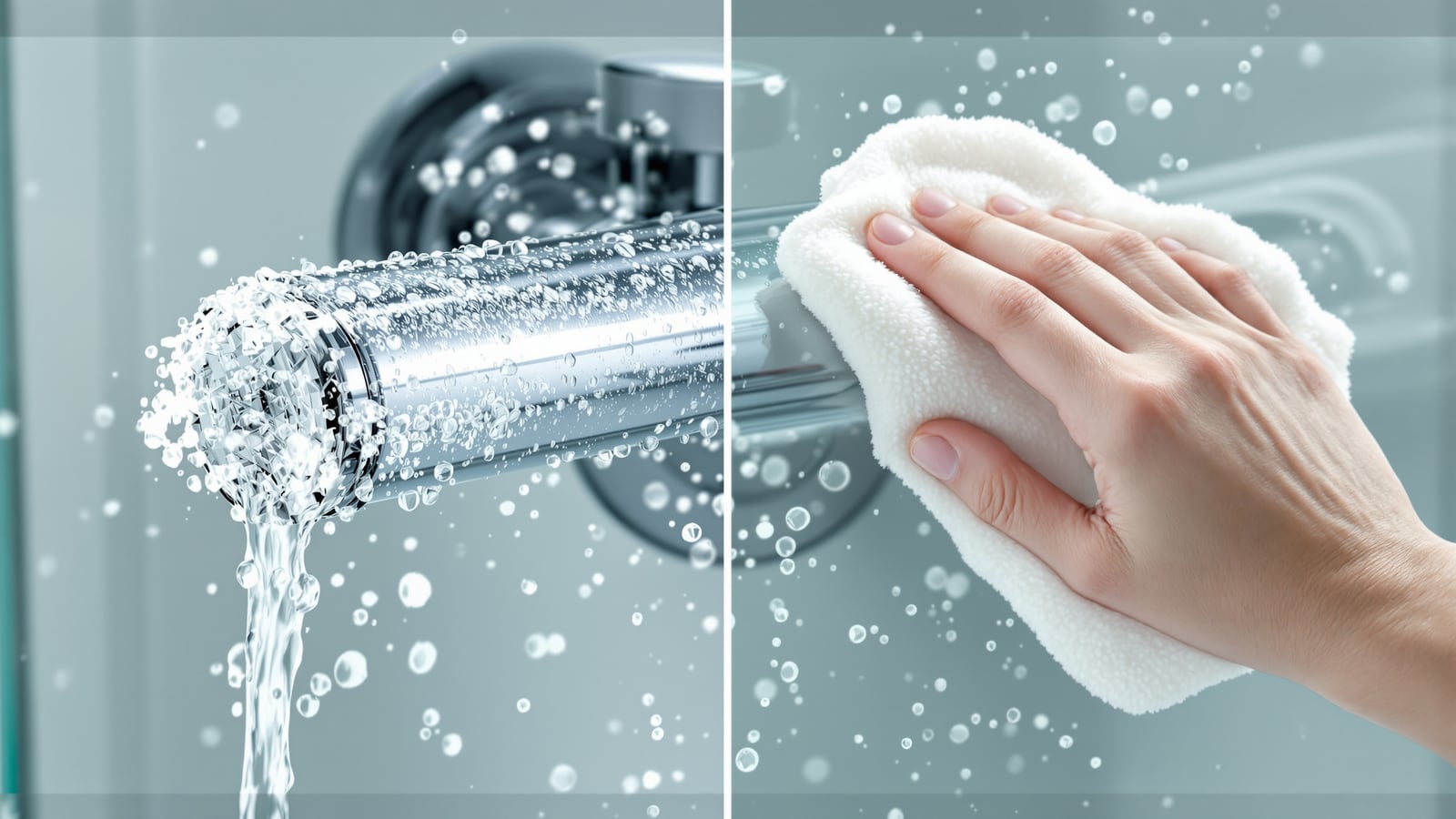
Hard Water Stain Removal in the Bathroom (India): Beat Limescale on Taps, Glass & Tiles
India's number-one bathroom nuisance is hard water — the chalky white deposits and cloudy spots that dull chrome taps, fog shower glass, crust up tiles and stain sanitaryware. This guide shows you how to remove limescale surface by surface (and where acid is dangerous), and how to stop it coming back.
If you live almost anywhere in India, you already know the enemy: the chalky white crust that builds on your tap spouts, the cloudy film that fogs your shower glass no matter how new it is, the dull grey haze creeping across your tiles, and the ring that will not scrub off inside the WC. That is hard water — groundwater and municipal supply loaded with dissolved calcium and magnesium. When a droplet dries, the water evaporates and leaves the minerals behind as limescale. Do that a few thousand times a day across a bathroom and you get the single most common upkeep headache in Indian homes.
The good news: limescale is beatable, cheaply, with things already in your kitchen. The catch: the exact method depends on the surface, and using the wrong one — acid on marble, an abrasive scourer on chrome — causes permanent damage that is worse than the stain. This guide is part of the Studio Matrx bathroom hub. Read it alongside the bathroom cleaning guide for your overall routine, the tile cleaning guide for grout and floors, the faucet maintenance guide for taps and aerators, and the mirror and glass care guide for spotless glass.
The golden rule of hard water: acid dissolves limescale, but acid also dissolves marble, natural stone and terrazzo. White vinegar and citric acid are your friends on chrome, glass, ceramic and porcelain — and your enemy on anything made of calcium carbonate. When in doubt, do not use acid.
Why hard water stains — the one thing to understand
Limescale is mostly calcium carbonate. It is alkaline (basic), which is why a mild acid dissolves it: the acid reacts with the carbonate and washes it away. That single fact explains almost every method below — vinegar (acetic acid) and citric acid (from lemon or a packet of nimbu-ke-phool / food-grade citric) are the cheap heroes.
But the same chemistry is a trap. Marble, Makrana, Botticino, travertine and terrazzo are also calcium carbonate. Pour vinegar on them and the acid does not politely stop at the scale — it eats the stone itself, leaving a dull, rough etch mark that no polishing at home will fix. So the first question is never "how do I remove it?" It is "what surface is under the scale?"
Removal, surface by surface
Here is the practical playbook. In every case, work on the scale, give the acid time to react (patience beats scrubbing), rinse well, and — this is the part everyone skips — dry the surface afterwards.
| Surface | What works | What to AVOID | Method in short |
|---|---|---|---|
| Chrome taps & fittings | White vinegar (1:1 with water) or citric acid solution | Steel wool, gritty scourers, strong descaler left on for hours | Wrap a vinegar-soaked cloth around the spout, leave 15–20 min, wipe, rinse, buff dry |
| Shower / partition glass | Vinegar spray or citric acid; a rubber squeegee daily | Abrasive pads, razor scraping on coated glass | Spray, dwell 10–15 min, agitate with a soft pad, rinse, squeegee dry |
| Ceramic / porcelain tiles | Diluted vinegar or a mild acidic tile cleaner (CIF, Colin for light film) | Acid on the grout repeatedly (erodes it); wire brushes | Apply, wait 10 min, scrub with a nylon brush, rinse, mop dry |
| WC pan & cistern rim | Toilet acid cleaner (Harpic) or citric acid soak overnight | Mixing acid cleaner with bleach; metal scrapers | Pour, leave overnight, brush the water-line ring, flush |
| Wash basin (ceramic) | Vinegar paste with a little baking soda for the ring | Scouring powder on the glaze over time | Paste on, 10 min, sponge, rinse, dry |
| Marble / natural stone / terrazzo | pH-neutral stone cleaner ONLY; poultice for set stains | ANY acid — vinegar, lemon, citric, Harpic; it etches | Damp-wipe with stone soap, buff dry; call a stone polisher for etch marks |
| Shower head / aerator | Unscrew, soak in warm vinegar or citric solution | Poking jets with a pin (deforms them) — soak instead | Detach, soak 30–60 min, brush nozzles, refit |
| Acrylic / solid-surface | Mild vinegar dilution, soft cloth | Abrasive scourers (they scratch and dull) | Wipe with diluted vinegar, rinse, dry |
A few notes that save regret:
- Citric acid vs vinegar. Both work. Citric acid (a spoon of food-grade powder in a cup of warm water) is odourless and slightly stronger on stubborn scale; vinegar is cheaper and always in the house. Use either — never both mixed with anything else.
- Give it time, not muscle. Limescale needs contact time to dissolve. A 15-minute soak does more than five minutes of hard scrubbing, and it protects the finish.
- The wrapped-cloth trick. For tap spouts and shower arms, soak a cloth (or kitchen tissue) in vinegar, wrap it around the fitting, and secure with a rubber band or a plastic bag. This keeps the acid in contact with a curved surface.
- Never mix chemicals. Acid (vinegar, citric, toilet cleaner) plus bleach or certain disinfectants releases toxic chlorine gas. One product at a time, with ventilation. This is the one non-negotiable safety rule.
Stopping it coming back — the real win
Removing scale is a chore; preventing it is a habit. Once you have a clean surface, keeping it clean is far easier than starting over. The single most effective thing you can do costs nothing: get the water off the surface before it dries. No standing droplet, no deposit.
- Squeegee the glass after every shower. Ten seconds. This one habit does more for shower glass than any product.
- Wipe taps and the basin dry with the towel you are already holding. A daily quick wipe means scale never gets a foothold.
- Keep the bathroom ventilated so surfaces dry faster — pair this with your exhaust fan or window.
- Apply a rain-repellent / glass sealant on shower glass every few months so water beads and runs off instead of clinging.
- Descale monthly as maintenance, before deposits harden — a quick vinegar wipe on taps and a shower-head soak keeps things easy.
Treat the water, not just the symptom
If you are constantly fighting scale, the durable fix is to soften the water itself. There are two routes:
- Whole-house / overhead-tank water softener — a resin-based ion-exchange softener plumbed into your supply (often at the tank inlet) treats every tap in the home. Best if hardness is high and you also see scale in the geyser and washing machine. Indicative ₹15,000–45,000+ installed, plus periodic salt. It is the real cure, not a patch.
- Point-of-use options — an inline shower filter or a small softener for one bathroom (roughly ₹1,500–8,000) tackles just the shower glass and skin/hair complaints. Cheaper, quicker, but partial; other taps keep scaling.
A softener does not "clean" existing scale — it stops new scale forming. Remove what is there first, then let the softener keep it away. For most Indian homes with visibly hard water, a whole-house softener pays for itself in saved cleaning time and longer-lasting fittings and geysers.
Troubleshooting the stubborn cases
| Problem | Likely cause | Fix |
|---|---|---|
| Glass stays cloudy after cleaning | Etching — scale sat so long it pitted the glass | Try a polishing compound; badly etched glass may need replacing. Prevent with daily squeegee |
| Vinegar isn't touching the scale | Deposit is old and thick, or it is soap scum not scale | Longer dwell (30+ min), reapply; for soap scum add a little dish soap to cut grease |
| Dull patch on marble after cleaning | Acid etch, not scale — the stone is damaged | Stop using acid; use a marble polishing powder or call a stone polisher |
| Scale returns within days | Water is very hard and surfaces air-dry | Adopt the wipe-dry habit; consider a softener — treat the water |
| Orange-brown stain, not white | Iron in the water, not calcium | Use a rust/iron stain remover; a whole-house filter addresses the source |
When to DIY and when to call someone
Nearly all hard-water stain removal is a confident DIY job — vinegar, citric acid, a squeegee and patience handle 95% of cases. Call a professional when: shower glass is permanently etched and needs replacing; marble or terrazzo has etch marks that need machine re-polishing; you want a whole-house water softener sized and plumbed correctly; or the WC scale hides a slow, chronic leak that keeps the pan wet. Softener installation in particular is worth doing right — get a plumber who will test your water hardness first and size the unit to it.
Beat hard water and everything else in the bathroom gets easier — taps shine, glass stays clear, tiles keep their colour, and sanitaryware looks new for years. Remove what's there, then never let a droplet dry on its own again.
References
- Studio Matrx bathroom hub — bathroom cleaning guide, tile cleaning, faucet maintenance, and mirror and glass care.
- Faucet and sanitaryware care guidance from manufacturers such as Jaquar, Hindware, Cera and Kohler — follow the fitting-specific cleaning instructions supplied with your product (avoid acids and abrasives on plated finishes).
- Natural-stone care guidance from marble and stone suppliers and the Marble Institute conventions — use only pH-neutral cleaners on calcareous stone; never acids.
- Water-softener and water-quality guidance per BIS drinking-water standard IS 10500 for total hardness limits, and softener manufacturer sizing instructions.
Export this guide
Related Guides — Deep-dive reading
How to Clean Bathroom Tiles (India): Shine, Hard-Water Film & Soap Scum
A practical, India-first routine for cleaning bathroom tiles and keeping them glossy — the daily squeegee habit, weekly wash, monthly deep clean, and the safe cleaner for each tile type, including the golden rule that natural stone must never meet acid.
BathroomsBathroom Cleaning India: The Complete Cleaning & Upkeep Guide (Daily, Weekly, Monthly)
The pillar guide to keeping an Indian bathroom clean — a daily/weekly/monthly/annual schedule, the right cleaner for every surface (tiles, grout, glass, chrome, sanitaryware, acrylic), safe DIY mixes, what you must never mix, the hard-water routine, and the 5-minute daily wipe that prevents most problems.
BathroomsToilet Maintenance India: Clean the Bowl, Fix a Running or Weak-Flush WC (2026)
The WC is the hardest-working fitting in an Indian bathroom and the quietest money-waster when it fails. This is the practical, do-it-yourself guide to keeping a toilet clean and working: scrubbing the bowl and under the rim, killing the hard-water limescale ring, and fixing the four things that actually go wrong — a running cistern, a weak flush, a leak, and a blockage.
BathroomsRelated Tools — Try Free
Cross-Ventilation Analyzer
Estimate airflow and air changes per hour (ACH) from room size, window areas, layout, and local wind — with NBC 2016 Part 8 compliance check.
Ventilation CalculatorWindow Cleaning Cost Calculator
Estimate professional window cleaning cost per visit and per year by access and frequency.
Window CalculatorRainwater Tank Sizer
How big should your rainwater tank be? Computes annual harvest, recommended tank capacity in litres, water-bill savings, and payback — for 10 Indian cities.
RWH Calculator