
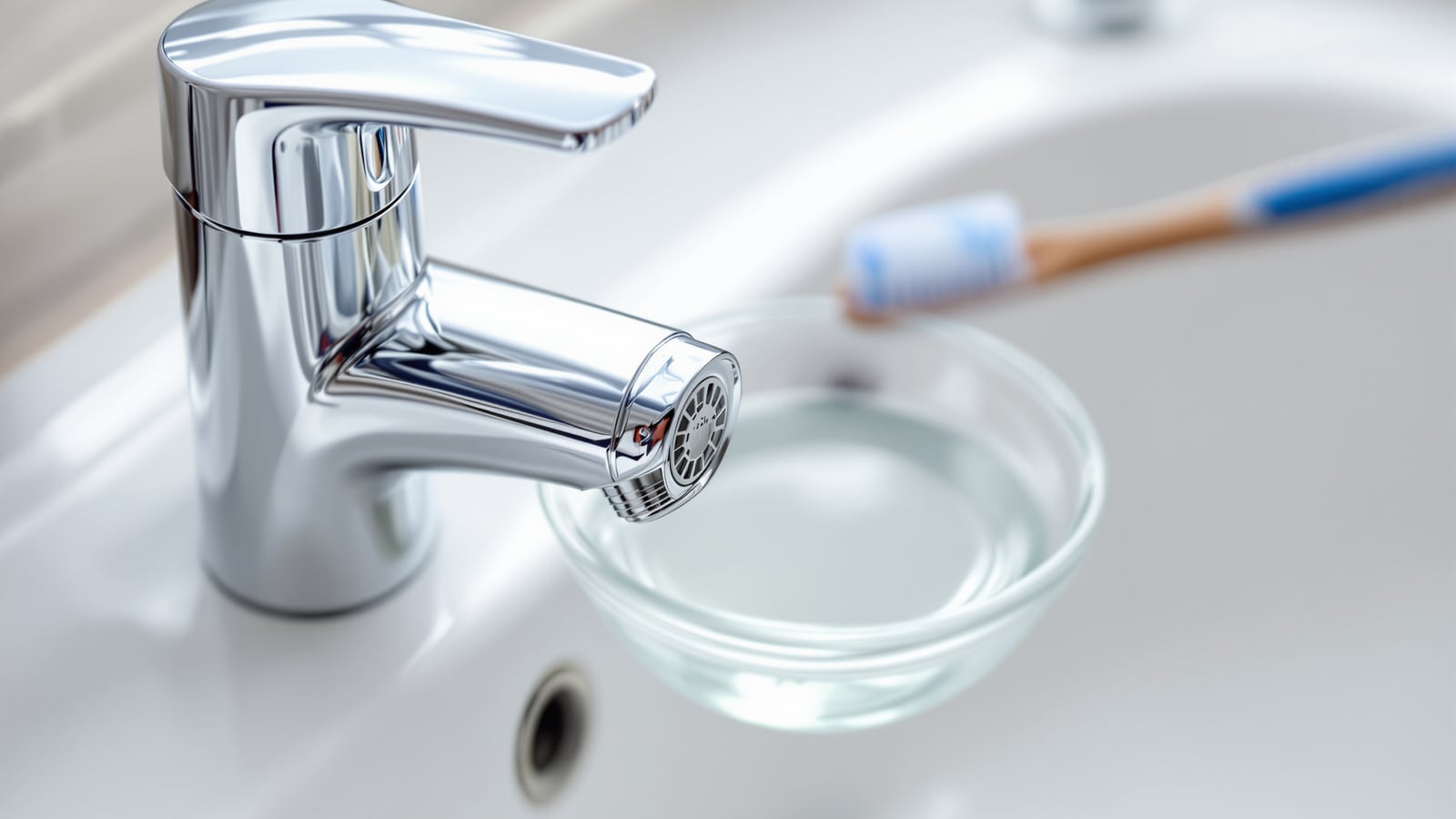
Tap Maintenance India: How to Descale, Clean & Fix Bathroom Faucets (2026)
A practical upkeep guide for CP fittings and faucets in Indian bathrooms — descaling the aerator and spout when hard water weakens the flow, cleaning chrome, PVD and matte-black finishes safely, fixing a dripping tap, sealing a leaky base, freeing a stiff lever, and knowing when to swap the cartridge.
A good faucet is built to last a decade, but in most Indian homes it starts misbehaving within a year — the flow weakens, the chrome dulls to a chalky white, the lever stiffens, and eventually a slow drip taps out through the night. None of that is the tap failing. It is hard water and neglect, and almost all of it is a ten-minute fix you can do yourself with things already in the kitchen. This guide covers the everyday upkeep of CP (chrome-plated) fittings and faucets: descaling, safe cleaning by finish, and the small repairs — washer, cartridge, base seal, lever — that keep a tap working for years.
If you are still choosing tapware, read the bathroom faucets guide for India first; it explains the ceramic-disc cartridge and CP quality that decide how easy a faucet is to maintain. For whole-bathroom upkeep, this sits under the bathroom cleaning and maintenance guide.
The enemy of every Indian faucet is limescale. Wipe the tap dry after use and descale the aerator every couple of months, and you have prevented ninety percent of the problems below.
Why hard water is the whole story
Most Indian municipal and borewell supply is hard — rich in dissolved calcium and magnesium. Every time water dries on a tap it leaves those minerals behind as a white, crusty limescale. It builds up fastest exactly where water sits: inside the aerator mesh, around the spout tip, and on the base where droplets pool. Left alone it chokes the flow, roughens the finish, and works into the cartridge. The fix is a mild household acid — white vinegar — which dissolves scale without harming genuine CP brass. The wrong fix is a strong acid (like Harpic or any toilet-bowl cleaner) or an abrasive scourer, both of which strip plating and PVD coatings permanently.
Descaling a clogged aerator — the weak-flow fix
Weak, spitting or lopsided flow is almost never a supply problem. It is the aerator — the small mesh screen threaded into the spout tip — clogged with scale and grit.
1. Unscrew the aerator. Turn it anticlockwise by hand. If it is stuck, wrap the jaws of a plier or spanner in a cloth or masking tape to protect the finish, and gently loosen it.
2. Separate the parts. Note the order of the mesh screen, plastic insert and gasket so you can reassemble them the same way.
3. Soak in white vinegar. Drop the parts into a cup of undiluted white vinegar for 30–60 minutes. Scale will fizz and soften.
4. Brush and rinse. Scrub the mesh with an old toothbrush, poke out debris, and rinse under running water. A stubborn screen can be replaced for ₹30–₹80.
5. Reassemble and test. Screw back hand-tight only. The flow should be full and soft again.
Do the whole spout the same way if the tip is crusted: tie a small vinegar-soaked cloth or a plastic bag half-filled with vinegar around it with a rubber band, leave 30–60 minutes, then wipe. Descale the aerator every 2–3 months in hard-water areas — see the hard-water stain removal guide for the same trick across the rest of the bathroom.
Cleaning by finish — what is safe, what ruins it
The golden rule for every faucet finish is the same: mild soap or a little white vinegar, a soft cloth, then wipe dry. What kills finishes is acid strength and abrasion. Never use a scouring pad, steel wool, scouring powder (Vim/CIF cream on a scrub pad), or a strong acidic cleaner on any tap.
| Finish | Safe to use | Never use | Notes |
|---|---|---|---|
| Chrome (CP) | Mild soap, diluted white vinegar, soft/microfibre cloth | Abrasive scourers, toilet-bowl acid | Buff dry to stop water spots |
| PVD-coated (gold, rose, black) | Warm soapy water, soft cloth only | Vinegar/acids, any abrasive, alcohol | Coating is hard but chemicals dull it |
| Matte black | Mild soap, soft damp cloth | Vinegar, cream cleaners, abrasive pads | Acids leave shiny etch marks |
| Brushed / satin nickel | Mild soap, wipe along the grain | Abrasives across the grain | Hides spots; keep the brushed direction |
| Antique / brushed brass | Mild soap, dry well | Metal polish if lacquered | Lacquer wears; then it patinas |
Two India-specific cautions. First, matte black and PVD finishes must not see vinegar or any acid — the very trick that cleans chrome will etch or dull them; use only mild soapy water. Second, never mix cleaning chemicals — bleach (Harpic/Domex) plus any acid (vinegar or toilet cleaner) releases toxic chlorine gas. Pick one, rinse well, and move on.
Fixing a dripping tap — washer vs cartridge
A tap that drips when fully closed is wasting litres a day and is the most satisfying DIY repair in the bathroom. First, close the angle valve (the small stop-cock under the basin) or the main supply, and plug the drain so nothing small falls in.
- Two-handle / pillar tap that drips — the culprit is a worn rubber washer (or the ceramic seat/spindle). Unscrew the handle, lift out the headwork/spindle, and replace the washer — a ₹5–₹20 part sold at any hardware shop. Refit and test. This is genuinely a five-minute, no-skill job.
- Single-lever mixer that drips or won't fully shut off — the ceramic-disc cartridge is scaled or worn. Prise off the lever cap, undo the grub screw and retaining nut, lift out the old cartridge, take it to the shop to match it exactly (₹150–₹800 for a genuine part), and drop in the replacement. Turn the supply back on and test.
Replace the cartridge — rather than nurse a drip — when the lever feels gritty, won't stop the flow, or leaks from around its base. In genuinely hard water a cartridge lasts several years; buy the matching brand part, as generic cartridges rarely seal well.
Leaky base and a stiff lever
- Water pooling around the base of a deck tap usually means a perished O-ring or base gasket, or a spout swivel seal. Shut the supply, lift the spout or tap body, and replace the rubber O-rings (a cheap assorted kit covers most). A leak from the inlet connection below the basin is often just a loose union nut or a hardened washer — hand-tighten, or renew the connector hose.
- A stiff or grinding lever is scale and dried grease in the cartridge. Often, descaling the aerator plus a gentle exercise of the lever helps; if it stays gritty, the cartridge needs cleaning in vinegar or replacing. A little silicone (plumber's) grease on the cartridge O-rings restores smooth movement — never use oil or petroleum jelly, which swells the rubber.
A simple upkeep schedule
| Frequency | Task |
|---|---|
| Daily | Wipe the tap dry with a used towel after the last use — the single biggest scale-preventer |
| Weekly | Clean with mild soap and a soft cloth; buff chrome dry to kill water spots |
| Monthly | Check for drips and base seepage; wipe the aerator tip |
| Every 2–3 months | Unscrew and vinegar-descale the aerator (hard-water areas) |
| Yearly | Inspect washers/cartridge feel; regrease a swivel spout; check angle-valve operation |
| As needed | Replace washer at first persistent drip; replace cartridge when the lever won't shut off |
When to DIY and when to call a plumber
Descaling, aerator cleaning, washer swaps, O-ring and cartridge replacement, and tightening a connector are all safe DIY jobs with basic tools. Call a plumber when a concealed (in-wall) mixer leaks — reaching the cartridge means opening tile; when the leak is inside the wall or from the supply pipe rather than the fitting; when the angle valve itself is seized or weeping; or when a tap keeps dripping after a fresh cartridge, which points to a damaged seat or body. A basic plumber visit runs about ₹300–₹700 in most Indian cities. Persistent leaks that soak the vanity or wall are covered in the bathroom leak repair guide.
Keeping the shine
Shine is mostly about water not being allowed to dry on the metal. A ten-second wipe with a dry cloth after use does more than any polish. For a deeper renewal, a light rub with a chrome-safe wax or even a smear of car wax on chrome only (never on matte black or PVD) beads off water for weeks. In very hard water, a point-of-use or whole-house water softener protects every faucet, geyser and showerhead at once — the most effective long-term maintenance investment of all.
References
- Bureau of Indian Standards — IS 8931: Copper alloy single-control (single-lever) sanitary fittings.
- Bureau of Indian Standards — IS 1701: Copper alloy pillar taps, bib taps and stop valves.
- Manufacturer care guidance from Jaquar, Kohler, Grohe and Hindware on cleaning CP, PVD and matte finishes (mild soap only; no acids or abrasives on coated finishes).
- Bureau of Indian Standards — IS 10500: Drinking-water specification, including hardness limits relevant to scaling.
- CPHEEO Manual on Water Supply and Treatment, Ministry of Housing and Urban Affairs — water hardness and softening guidance.
Export this guide
Related Guides — Deep-dive reading
Toilet Maintenance India: Clean the Bowl, Fix a Running or Weak-Flush WC (2026)
The WC is the hardest-working fitting in an Indian bathroom and the quietest money-waster when it fails. This is the practical, do-it-yourself guide to keeping a toilet clean and working: scrubbing the bowl and under the rim, killing the hard-water limescale ring, and fixing the four things that actually go wrong — a running cistern, a weak flush, a leak, and a blockage.
BathroomsBathroom Faucets India: The Complete Guide to Taps, Cartridges, Finishes & Flow (2026)
Every faucet type explained for Indian bathrooms — pillar taps, basin mixers, single-lever vs two-handle, wall vs deck vs concealed, sensor and thermostatic — plus the ceramic-disc cartridge that survives hard water, CP-fitting quality to IS standards, finishes, aerators and honest rupee ranges.
BathroomsBathroom Leak Repair in India: Find & Fix Common Leaks (2026)
A practical, India-first guide to finding and fixing the everyday bathroom leaks — dripping taps, weeping traps and angle valves, a running cistern, failed silicone seals — plus how to tell a simple fixture leak from a waterproofing failure that needs a professional.
BathroomsRelated Tools — Try Free
Shower Water Flow Calculator
Shower water use per shower, day and month by head type, plus a pressure-adequacy check for your tank height or pump and low-flow savings.
Bathroom CalculatorWater Softener Size Calculator
Size a water softener from your hardness, daily water use and days between regeneration, with the grain capacity needed.
Plumbing CalculatorPool Water Calculator
Chlorine, shock and salt doses plus top-up water for your pool — an indicative balancing guide.
Pool Calculator