
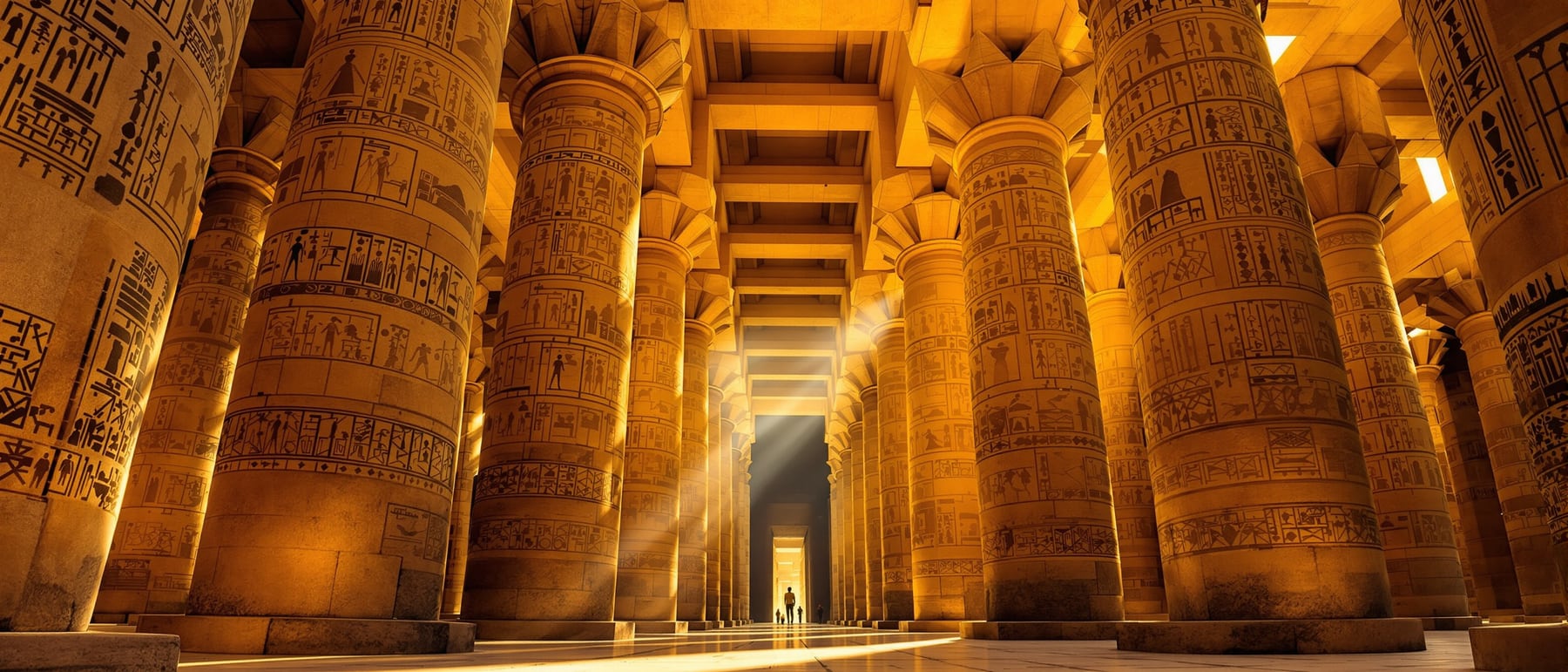
The Temples of Karnak: A Sacred City Built by Thirty Kings
How thirty pharaohs across two thousand years — from the Middle Kingdom to the age of Ramesses — kept adding to a single sacred precinct at Thebes until it became the largest religious complex of the ancient world, crowned by a hall of 134 colossal stone columns raised as a petrified papyrus marsh, a forest of stone built to be the very morning of creation for the King of the Gods, Amun-Ra.
From a mountain of brick raised for the moon god in Mesopotamia we come to the greatest temple-city of ancient Egypt — a place so vast, and built over so many centuries, that it is less a building than a continent of stone. On the east bank of the Nile at Luxor — ancient Thebes — stands the Temple Complex of Karnak, called by its own builders Ipet-isut, "the Most Select of Places." It is widely described as one of the largest religious complexes ever built, and it holds, at its heart, the single most overwhelming interior in the ancient world: the Great Hypostyle Hall, a roofed forest of 134 colossal columns.
This is the fifty-first article in our Architectural Wonders series, and the fourth in our chapter on the great temples and sacred places of the world.
What makes Karnak unlike almost any other monument is that no single person built it. It grew — added to, rebuilt, torn down and overwritten by roughly thirty pharaohs across some two thousand years, from the Middle Kingdom through the imperial New Kingdom of Hatshepsut, Thutmose III and Ramesses II, and on into the age of the Greek Ptolemies. It is a sacred city assembled by an entire civilisation, one reign at a time — and every stone of it was raised for one god above all: Amun-Ra, the King of the Gods.
1. Not one temple — a sacred city
The first thing to understand about Karnak is that "Karnak Temple" is a misnomer. It is not a temple; it is a walled district of temples.
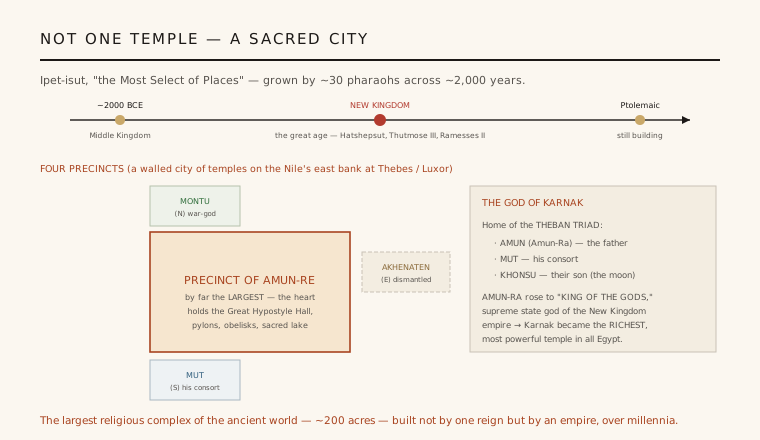
Karnak is divided into four main precincts, each ringed by its own great mud-brick wall. By far the largest is the Precinct of Amun-Re — so dominant that when people say "Karnak" they nearly always mean this one enclosure, and it is essentially all that visitors see. To the south lies the smaller Precinct of Mut, Amun's consort; to the north the Precinct of Montu, a Theban falcon war-god; and to the east once stood a temple of the heretic pharaoh Akhenaten, dismantled soon after his death (its blocks reused as rubble inside later gateways — the building recycling its own history). Karnak was the cult home of the Theban Triad — Amun, his consort Mut, and their son Khonsu, the moon — but it belonged above all to Amun-Ra. A once-local Theban god, Amun was fused with the sun-god Ra into "Amun-Ra, King of the Gods," and as Thebes became the capital of Egypt's New Kingdom empire, the tribute of conquered lands poured into his temple. Karnak grew into the richest and most powerful temple in Egypt — so rich that, in time, the priesthood of Amun came to rival the pharaoh himself. This was not just a house of god; it was a centre of national power.
2. The Great Hypostyle Hall
At the heart of the Amun precinct is the space that has stunned every visitor for three thousand years — and it is worth slowing down to measure it.
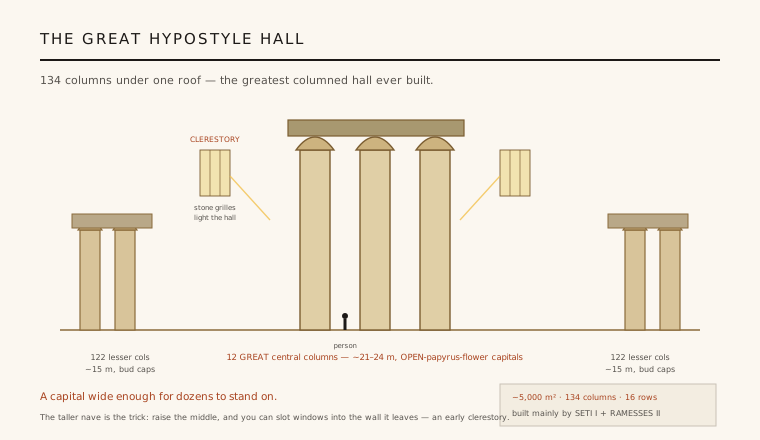
A hypostyle hall is simply one whose roof is held up by columns — but nothing prepares you for this one. It covers about 5,000 square metres (roughly 103 by 52 metres) and is packed with 134 columns in 16 rows. Down the central aisle march 12 giant columns, about 21 to 24 metres tall (sources vary, so a range is honest), crowned with spreading open-papyrus-flower capitals — each capital broad enough, it is often said, for dozens of people to stand on its top. Flanking them, 122 lesser columns rise about 15 metres, capped with closed papyrus buds. The genius is in that height difference: because the central nave stands taller than the side aisles, the builders could fill the gap between the two roof levels with stone-grille clerestory windows — so light falls from above, in dusty golden shafts, exactly as you see it in the great photographs. The hall was raised and carved chiefly by Seti I (who decorated the northern half) and his son Ramesses II (the southern half) — the same Ramesses who would go on to cut his colossal temple at Abu Simbel far to the south — around the thirteenth century BCE. (Older textbooks credited Amenhotep III or Horemheb with building it; scholars now downgrade that — a small example of how even Karnak's authorship gets corrected.) Every surface — walls, columns, architraves — is carved with reliefs and was once brilliantly painted; colour still clings to the sheltered upper stones.
3. A stone forest — the marsh of creation
Why a forest of papyrus columns? Because the hall was built to be a place, and a moment — the beginning of the world.
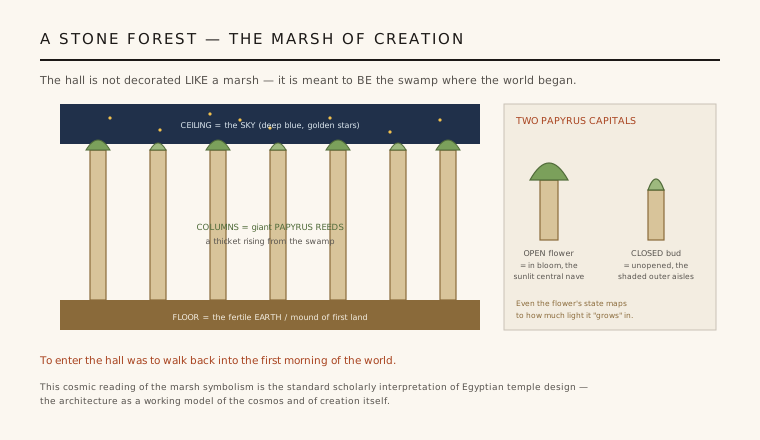
In Egyptian belief, the world first rose as a mound of earth emerging from the primeval waters of chaos, its edges a marsh of papyrus reeds. The Hypostyle Hall is, on the standard scholarly reading, a stone model of that first marsh. The columns are not merely decorated with papyrus — they are papyrus, giant reeds turned to stone, standing in a thicket. The floor is the fertile earth. The ceiling was painted deep blue and strewn with golden stars to be the sky. To walk into the hall was to walk into the First Time, the moment of creation itself — a piece of theology you could stand inside. Even the two kinds of capital carry the idea: the tall central columns, in the light, wear open papyrus flowers in bloom; the shaded outer columns wear closed buds, not yet opened. This cosmic interpretation is exactly that — an interpretation, drawn from Egyptian creation texts and the papyriform design rather than from a caption on the wall — but it rests on well-attested belief, and once you know it, the forest of stone stops being a warehouse of columns and becomes a working image of the universe. This is architecture asked to do the hardest thing of all: to be an idea.
4. The working temple: pylons, obelisks, and the journey of the god
A temple, to the Egyptians, was not a place you visited to sit quietly. It was a machine for procession — and Karnak's other great features only make sense as parts of that machine.
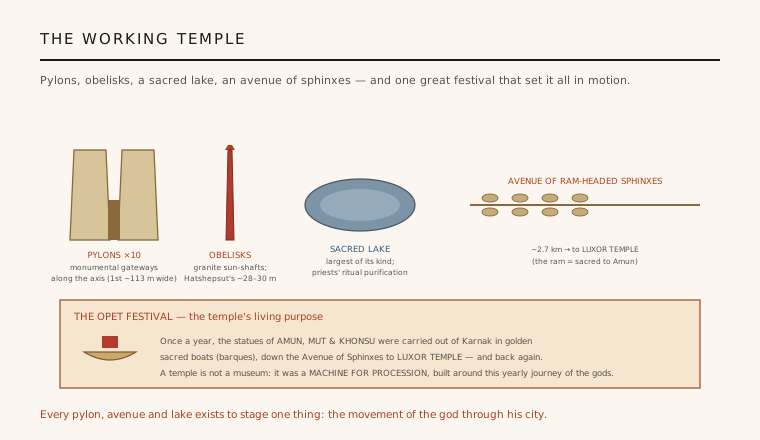
The approach to the sanctuary runs through a series of ten monumental gateways called pylons — great sloping twin towers, each built by a different reign, that punctuate the processional axis like chapters. The First Pylon, the present entrance, is the largest at about 113 metres wide — and was left unfinished, which is why it is barely decorated. Rising among the courts are obelisks: single tapering shafts of Aswan red granite, solar symbols once tipped with gleaming electrum, the tallest being Hatshepsut's, at nearly 30 metres one of the tallest ancient Egyptian obelisks still standing. Beside the temple lies the Sacred Lake, the largest of its kind, where the priests purified themselves. And out through the gates runs the Avenue of Sphinxes — a 2.7-kilometre processional way lined with ram-headed sphinxes (the ram being Amun's sacred animal), connecting Karnak to Luxor Temple (it was restored and gloriously reopened in 2021). All of this existed to serve one event: the Opet Festival. Once a year, the cult statues of Amun, Mut and Khonsu were lifted into golden sacred boats (barques) and carried in triumphant procession from Karnak to Luxor and back, renewing the fertility of the land and the divine kingship of the pharaoh. The pylons frame the route; the avenue is the road; the whole colossal complex is, in the end, a stage set for the journey of a god.
5. How it rose — and who erased whom
Two last things a modern eye should know: how the Egyptians actually built at this scale, and how Karnak records its own quarrels in stone.
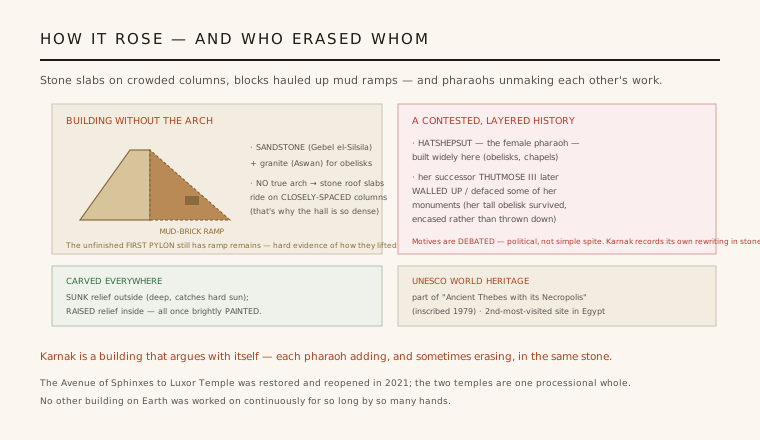
Most of Karnak is sandstone, floated down the Nile from the quarries of Gebel el-Silsila, with Aswan granite for the obelisks. And here is the key architectural fact behind the whole look of the place: the Egyptians did not use the true arch for their great roofs. A stone lintel can only span a short gap before it snaps under its own weight — so to roof a huge hall, they had to set the columns close together, one after another, each carrying flat stone slabs. That single limitation is why the Hypostyle Hall is a dense thicket rather than an open room: the forest of columns is a structural necessity turned into sublime effect. As for lifting seventy-tonne roof beams into place — we are not left to guess. The unfinished First Pylon still preserves the remains of a mud-brick construction ramp piled against its back, the clearest surviving evidence that the Egyptians raised their stone up long earthen ramps. Karnak's history is also visibly contested: the female pharaoh Hatshepsut built lavishly here, and her successor Thutmose III later walled up her obelisk and chiselled her name and image from the walls — an erasure that is documented fact, though its motive (personal spite, or cold dynastic politics?) is debated. Karnak, uniquely, is a building that argues with itself, each king adding to and sometimes unmaking the work of the last. It is part of the UNESCO World Heritage Site "Ancient Thebes with its Necropolis" (inscribed 1979) — and remains, after Giza, among the most visited places in all of Egypt.
6. What a modern architect can learn from Karnak
- A great place can be built by many hands over many lifetimes. No one architect designed Karnak; thirty kings and two thousand years did. The most powerful places are often not authored but accreted — which asks a designer to build something others can meaningfully add to, and to add humbly to what others began.
- Turn a structural limit into the defining experience. With no arch, the Egyptians had to crowd their columns — and made that necessity into the most sublime interior of the ancient world. Constraints, embraced rather than hidden, become a building's signature.
- Sculpt the light, not just the walls. The whole magic of the Hypostyle Hall is the clerestory — raise the centre, and light pours in from above. Where the light enters is a design decision as important as where the walls stand.
- Let the building carry meaning, not just function. Karnak's hall is a working model of creation; its plan is a route for a god. The Egyptians expected architecture to mean something — to be theology and cosmology you could walk through — not merely to shelter an activity.
- Design for the event. Every pylon, avenue, lake and gate exists to stage the Opet procession. When a building's true purpose is a ritual or an experience that moves through it, design the sequence — the approach, the thresholds, the reveal — as carefully as the rooms.
- Monuments are edited by those who follow. Hatshepsut's erasure is a warning and a truth: what you build will be altered, reinterpreted, even effaced by later hands with their own agendas. Build well enough, and even the attempt to erase you becomes part of the story the stones still tell.
References & further reading
1. UNESCO World Heritage Centre — Ancient Thebes with its Necropolis (inscribed 1979; includes Karnak). https://whc.unesco.org/en/list/87/
2. World History Encyclopedia — Karnak. https://www.worldhistory.org/Karnak/
3. University of Memphis — Karnak Great Hypostyle Hall Project (epigraphic survey; the great columns). https://www.memphis.edu/hypostyle/
4. Digital Karnak, UC Santa Cruz — Hypostyle Hall and First Pylon. https://digitalkarnak.ucsc.edu/
5. Smarthistory — Temple of Amun-Re and the Hypostyle Hall, Karnak. https://smarthistory.org/temple-of-amun-re-and-the-hypostyle-hall-karnak/
6. Encyclopaedia Britannica — Karnak. https://www.britannica.com/place/Karnak-Egypt
Last verified 2026-07-04. Figures follow UNESCO, World History Encyclopedia, the University of Memphis Great Hypostyle Hall Project, Digital Karnak and Smarthistory, and are given as widely cited approximations that vary by source. The Karnak Temple Complex (ancient Ipet-isut, "the Most Select of Places") stands at Luxor (ancient Thebes/Waset), east bank of the Nile, Upper Egypt. It was built and modified by roughly 30 pharaohs over about 2,000 years (earliest surviving core under Senusret I, Middle Kingdom, c. 1971–1926 BCE; imperial floruit in the New Kingdom, c. 1550–1070 BCE; additions to the Ptolemaic period) — the "~30 kings / 2,000 years" figure is a standard round approximation, and the "largest religious complex ever built" (~200 acres) is an oft-repeated superlative rather than an adjudicated measurement. Four precincts: Amun-Re (largest/central), Mut (south), Montu (north), and the dismantled Akhenaten temple (east); cult centre of the Theban Triad (Amun-Ra, Mut, Khonsu). The Great Hypostyle Hall (Precinct of Amun-Re) is ~5,000 m² with 134 columns in 16 rows: 12 central columns ~21–24 m (sources vary: ~20 m Memphis / ~22 m WHE / ~24 m Wikipedia) with open-papyrus capitals, and 122 outer columns ~14–15 m with closed-bud capitals; a clerestory lights the taller nave. It was built/decorated mainly by Seti I (north) and Ramesses II (south), 19th Dynasty, c. 13th century BCE (earlier Amenhotep III/Horemheb attributions now downgraded). The "marsh of creation" reading (columns as papyrus, floor as earth, starred ceiling as sky) is the standard scholarly interpretation, not an inscriptional statement. Karnak has ten pylons (First Pylon ~113 m wide, unfinished), standing obelisks (Hatshepsut's ~28.5–30 m, ~320–343 tonnes Aswan granite), the largest Sacred Lake in Egypt, and a ~2.7 km Avenue of ram-headed Sphinxes to Luxor Temple (restored/reopened 2021). The Opet Festival carried the Triad's barques from Karnak to Luxor and back. Construction: sandstone (Gebel el-Silsila) + Aswan granite; trabeated post-and-lintel (no true arch → closely spaced columns); mud-brick construction ramps (remains preserved at the unfinished First Pylon); sunk relief (exterior) vs raised relief (interior). Hatshepsut's monuments were later defaced/walled up by Thutmose III (fact documented; motive debated). Part of the UNESCO World Heritage Site "Ancient Thebes with its Necropolis" (inscribed 1979).
Export this guide
Related Guides — Deep-dive reading
Abu Simbel: The Temple a Pharaoh Cut Into a Mountain — and the World Moved to Save It
How Ramesses the Great hollowed two temples out of a Nubian cliff, guarded them with four twenty-metre giants of himself, and aimed the whole mountain so precisely that twice a year the rising sun still races sixty metres into the dark to touch the gods at the very back — and how, three thousand years later, more than fifty nations sawed the temples into a thousand pieces and lifted them bodily up the cliff to escape a rising lake.
Architectural WondersPersepolis: The Palace Where Every Nation Came Bearing Gifts
On a vast stone terrace in southern Iran, the kings of Persia built the grandest ceremonial capital of the ancient world — a forest of impossibly tall columns whose walls, unlike those of any conqueror before them, carved not war and captives but a peaceful procession of twenty-three nations bringing gifts. It is the gentlest image of empire the ancient world produced — until Alexander burned it to the ground. The third article in our chapter on the palaces of worldly power.
Architectural WondersThe Colosseum: The Machine That Fed a City Its Pleasures
Rome's greatest emperors built palaces for themselves; the Flavian emperors did something shrewder — they drained a fallen tyrant's private lake and raised, on the spot, a stupendous arena for fifty thousand ordinary citizens. The largest amphitheatre ever built is a masterpiece of crowd engineering, a hidden stage-machine of lifts and trapdoors, and a place of real, organised killing — all at once. The fourth article in our chapter on the palaces and pleasures of worldly power, and the first on pleasure.
Architectural WondersRelated Tools — Try Free
AI Measurement Tool
Measure your room using voice, photos, or video sweep — no tape measure needed.
DesignAICross-Ventilation Analyzer
Estimate airflow and air changes per hour (ACH) from room size, window areas, layout, and local wind — with NBC 2016 Part 8 compliance check.
Ventilation CalculatorFalse Ceiling Cost Estimator
Live ₹/sqft across 8 ceiling types — POP, gypsum, designer, metal, PVC, wooden — with cove and spot lighting for 20 Indian cities.
Cost Calculator