
Fluoride Removal from Water in India: Defluoridation Methods, IS 10500 Limits, Health Risks and Cost
High-fluoride groundwater causes dental and skeletal fluorosis across many Indian states. This guide explains how to test for fluoride, what the IS 10500 drinking-water limit is, and the real defluoridation options for a home — activated alumina, reverse osmosis, the Nalgonda technique, bone char and electrocoagulation — with pros, cons and indicative cost.
Fluoride is one of the few water contaminants that is genuinely dangerous at levels you cannot taste, see or smell — and it sits in the groundwater under large parts of India. A little fluoride protects teeth; too much, taken in every day for years, causes fluorosis: first mottled, stained teeth, later painful, stiff and deformed bones. This guide explains, in plain terms, how to know whether your water has a fluoride problem and how to actually remove it at home.
This is a domestic drinking-water guide inside the Studio Matrx Plumbing Knowledge Hub. It sits under the pillar water treatment guide for India. Because fluoride is invisible, the single most important step comes first: send a sample for a water quality test — this is not a problem you should guess at. If your supply comes from the ground, also read the borewell water system guide, as borewells are the usual source of high fluoride.
Do not treat what you have not measured. Fluoride cannot be judged by taste, colour or smell — the only honest starting point is a laboratory number in mg/L. Everything below assumes you have a test result in hand.
Why fluoride matters: fluorosis
Fluoride enters groundwater naturally, dissolved out of fluoride-bearing rocks and minerals as water moves slowly underground. The health effect is cumulative — it depends on the concentration multiplied by how many years you drink it, which is why children and long-term residents of an area are most at risk.
- Dental fluorosis — the early, visible sign. Teeth develop white flecks, then brown or yellow mottling and pitting of the enamel. It mainly affects children while their permanent teeth are forming, and it is permanent.
- Skeletal fluorosis — the serious form. Long-term intake of high-fluoride water hardens and thickens bone and calcifies ligaments, causing joint pain, stiffness, a stooped posture and, in severe endemic cases, crippling deformity. It builds up silently over years.
Because the damage accumulates and cannot be reversed, the goal of defluoridation is to bring your everyday drinking and cooking water below the safe limit — not to chase perfection.
What the IS 10500 limit is
The Indian drinking-water standard, IS 10500, sets two numbers for fluoride: an acceptable limit of 1.0 mg/L and a permissible limit of 1.5 mg/L where no better source is available. The World Health Organization guideline value is likewise 1.5 mg/L. Above that, and especially well above it, the fluorosis risk climbs.
| Fluoride in water (mg/L) | How it reads against IS 10500 | Typical long-term concern |
|---|---|---|
| Below 1.0 | Within the acceptable limit | Generally considered safe for drinking |
| 1.0 to 1.5 | Up to the permissible limit | Acceptable only if no better source; watch children |
| 1.5 to 3.0 | Above the permissible limit | Dental fluorosis risk rises; treatment advised |
| Above 3.0 | Well above the limit | Skeletal fluorosis risk with long-term intake; treat |
These bands are indicative for planning; the numbers that bind are on your own lab report. If your result is 1.5 mg/L or higher, defluoridation of drinking and cooking water is worth doing.
Where high-fluoride groundwater occurs in India
High-fluoride groundwater is not a rare, isolated problem — it has been reported across many districts in roughly twenty states, mostly where deep or hard-rock borewells tap fluoride-bearing geology. States commonly named in the fluorosis literature include:
- Rajasthan — among the most widely affected states.
- Andhra Pradesh and Telangana — the Nalgonda district here gave its name to a well-known treatment method.
- Gujarat, Madhya Pradesh, Karnataka, Tamil Nadu, Uttar Pradesh and others.
The lesson is not "my state is safe." Fluoride varies borewell to borewell within the same street, because it follows local geology and depth. Wherever you are, the deciding factor is your test result, not a state-level map.
The removal methods, honestly compared
There is no single "best" answer — the right method depends on your fluoride level, how much treated water you need, budget and whether you are treating one home or a whole community.
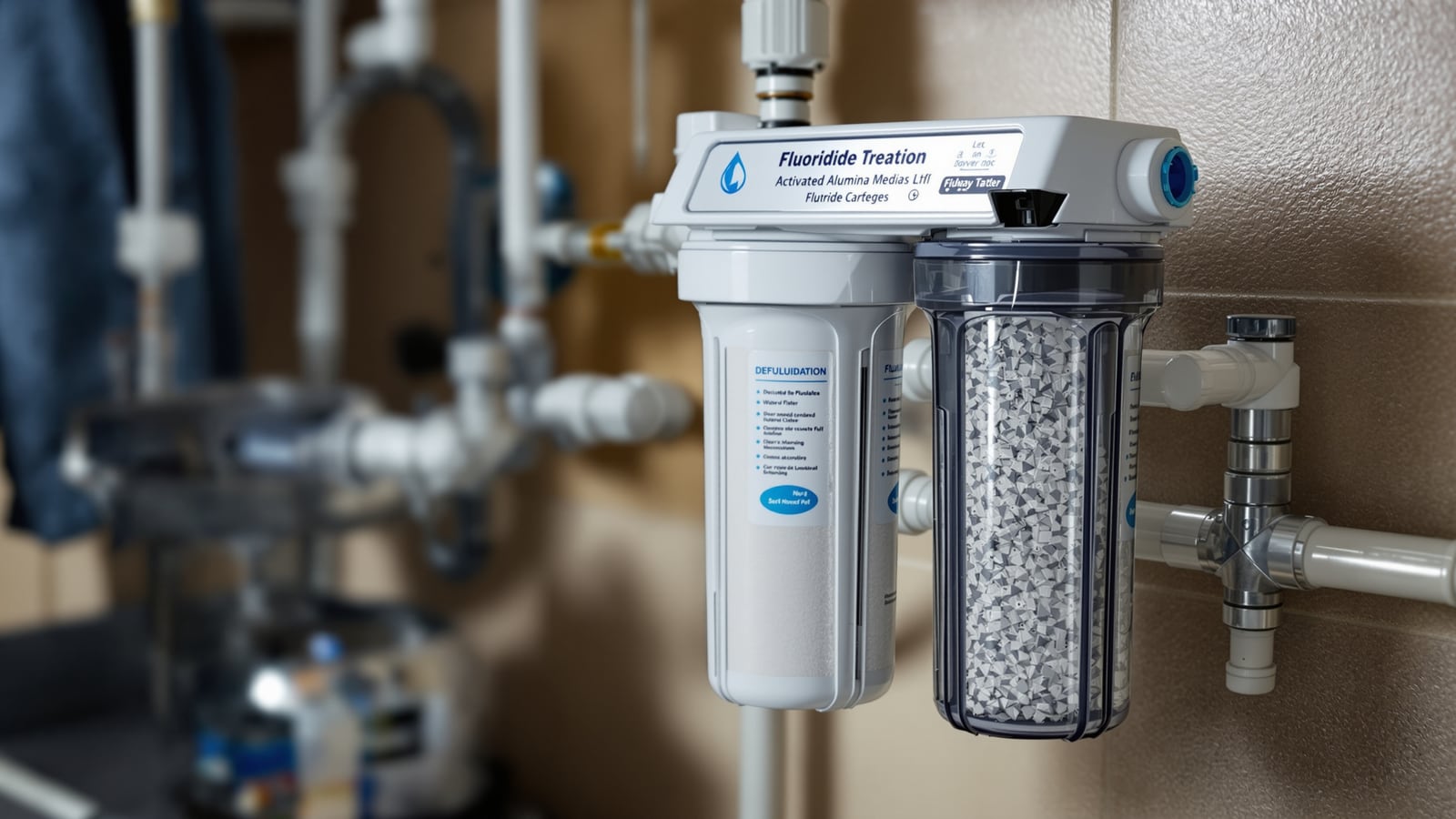
Activated alumina adsorption
The workhorse of defluoridation. Water passes through a bed of activated alumina (a porous aluminium-oxide media) and fluoride ions stick to the media surface. It works well and is affordable, but it is pH-sensitive — it performs best in mildly acidic water and loses capacity in alkaline water. The bed gradually saturates and must be regenerated (usually with alum and caustic) or replaced once fluoride starts breaking through.
Reverse osmosis (RO)
An RO membrane rejects the large majority of dissolved fluoride along with other salts, which is why domestic RO units — often with a dedicated alumina or activated-carbon stage — are the most common home fix. The trade-offs are that RO wastes reject water (several litres rejected per litre of clean water, depending on the unit) and strips beneficial minerals, so many units re-mineralise. See the dedicated RO water systems guide for sizing, wastage and maintenance.
Nalgonda technique
A well-known Indian batch method, named after the district in Telangana and developed at national research labs. Lime, alum (aluminium sulphate) and bleaching powder are dosed into a tank, stirred, and the fluoride co-precipitates and settles as sludge in a fill-and-draw cycle. It is low-cost and uses familiar chemicals, but it is labour-intensive, adds residual aluminium and sulphate, needs careful dosing, and produces sludge to dispose of. It suits community and rural settings more than a modern flat.
Bone char
Charred animal bone (a calcium-phosphate media) adsorbs fluoride effectively and has a long history. Its drawbacks are cultural acceptability (its animal origin) and the need for consistent quality and regular replacement, so it is uncommon in urban Indian homes.
Electrocoagulation
An emerging approach: an electric current through aluminium electrodes generates coagulant in the water itself, which binds fluoride into a removable floc. It avoids bulk chemical dosing but needs power, electrode replacement and competent operation — more common in packaged plants than in homes.
| Method | Typical removal | Pros | Cons | Indicative cost |
|---|---|---|---|---|
| Activated alumina | Good | Affordable, proven, compact | pH-sensitive; needs regeneration or media swap | Media and POU units from about ₹3,000 |
| Reverse osmosis | High | Effective, low effort, whole-package units | Rejects water; strips minerals | ₹12,000 to ₹25,000 for a home unit |
| Nalgonda technique | Good | Low cost; familiar chemicals | Labour-heavy; sludge; residual aluminium | Chemical and tank based |
| Bone char | Good | Effective, long history | Acceptability; frequent replacement | Media based |
| Electrocoagulation | Good | Low chemical use | Needs power and skilled operation | Plant-scale, higher |
All figures are indicative for planning and vary by brand, capacity and city — confirm current quotes locally.
Point-of-use vs community defluoridation
Fluoride only needs removing from water people drink and cook with — not the water that flushes toilets or waters the garden. That makes point-of-use (POU) the sensible household choice: a single treated tap or under-sink unit at the kitchen. Treating the whole house (point-of-entry) for fluoride is usually wasteful and expensive. At village scale, a shared community defluoridation plant treats one supply point that many households draw from.
The catch nobody mentions: spent media and sludge
Defluoridation does not destroy fluoride — it concentrates it. Exhausted activated alumina, regeneration wash-water, Nalgonda sludge and RO reject all carry the fluoride you removed. Tipping spent media or fluoride-rich sludge into a drain or open ground simply puts the fluoride back into the environment. Follow the maker's disposal guidance, and for community plants handle and dispose of sludge responsibly rather than dumping it near water sources.
Maintenance and running cost
Every defluoridation method degrades with use, and a unit past its capacity quietly lets fluoride through while looking fine. That is why the discipline is: treat, then verify by testing.
- Activated alumina — media exhausts and must be regenerated or replaced on a schedule that depends on your fluoride load and water volume. Retest output fluoride periodically to catch breakthrough.
- RO — replace pre-filters and the membrane per the maker's schedule; sanitise the storage tank. Budget for the reject water.
- Nalgonda / community plants — need trained operation, chemical stocks, sludge handling and routine output testing.
Because capacity falls as media saturates, put a periodic lab test of the treated water into your calendar. That single habit is what separates safe water from a false sense of safety.
The bottom line
If your lab result shows fluoride at or above the IS 10500 permissible limit of 1.5 mg/L, treat your drinking and cooking water — do not wait for visible fluorosis, because by then the exposure has already happened. For most Indian homes a point-of-use RO or activated-alumina unit at the kitchen is the practical answer; larger communities are better served by a shared plant. Whichever you choose, test first, treat only drinking water, dispose of spent media responsibly, and retest to confirm the fluoride is actually staying below the limit.
References
- IS 10500 — Bureau of Indian Standards, Drinking Water Specification (fluoride acceptable 1.0 mg/L, permissible 1.5 mg/L).
- World Health Organization, Guidelines for Drinking-water Quality (fluoride guideline value 1.5 mg/L).
- Studio Matrx Plumbing Knowledge Hub — water treatment guide for India, RO water systems, water quality testing, borewell water system.
Export this guide
Related Guides — Deep-dive reading
RO Water System for Indian Homes: How Reverse Osmosis Works, When You Need It, Reject Water and Cost
The point-of-use purifier that strips dissolved salts, TDS and heavy metals from high-TDS borewell and brackish water — how the membrane and cartridge train actually work, when RO is right (and when it just wastes water and strips minerals), how to reuse reject water, and what it costs to run in India.
PlumbingRO vs UV Water Purifier: Which One Does Your Home Need? (India)
A fair, India-first head-to-head decided by one number — your feed-water TDS. RO strips dissolved salts and heavy metals for hard borewell water; UV only kills microbes and suits already-clear, low-TDS municipal supply. What each removes, water wastage, running cost, and a verdict by measured TDS.
PlumbingElectrocoagulation for Wastewater Treatment: How It Works and Where It Fits
How electrocoagulation uses electrodes instead of dosing drums to destabilise pollutants, strip colour and heavy metals, and where it earns its place in Indian industrial and tertiary treatment — with an honest look at the cost, sludge and maintenance trade-offs against chemical coagulation.
Sewage Treatment PlantsRelated Tools — Try Free
Rainwater Tank Sizer
How big should your rainwater tank be? Computes annual harvest, recommended tank capacity in litres, water-bill savings, and payback — for 10 Indian cities.
RWH CalculatorRO Water Wastage Calculator
See how much water a domestic RO purifier rejects for the purified water you use, from your daily use and recovery ratio.
Plumbing CalculatorApartment vs Villa Interior Planning Guide
Compare ceiling height, structural flexibility, lighting, storage, and services between apartments and villas.
Planning Guide