
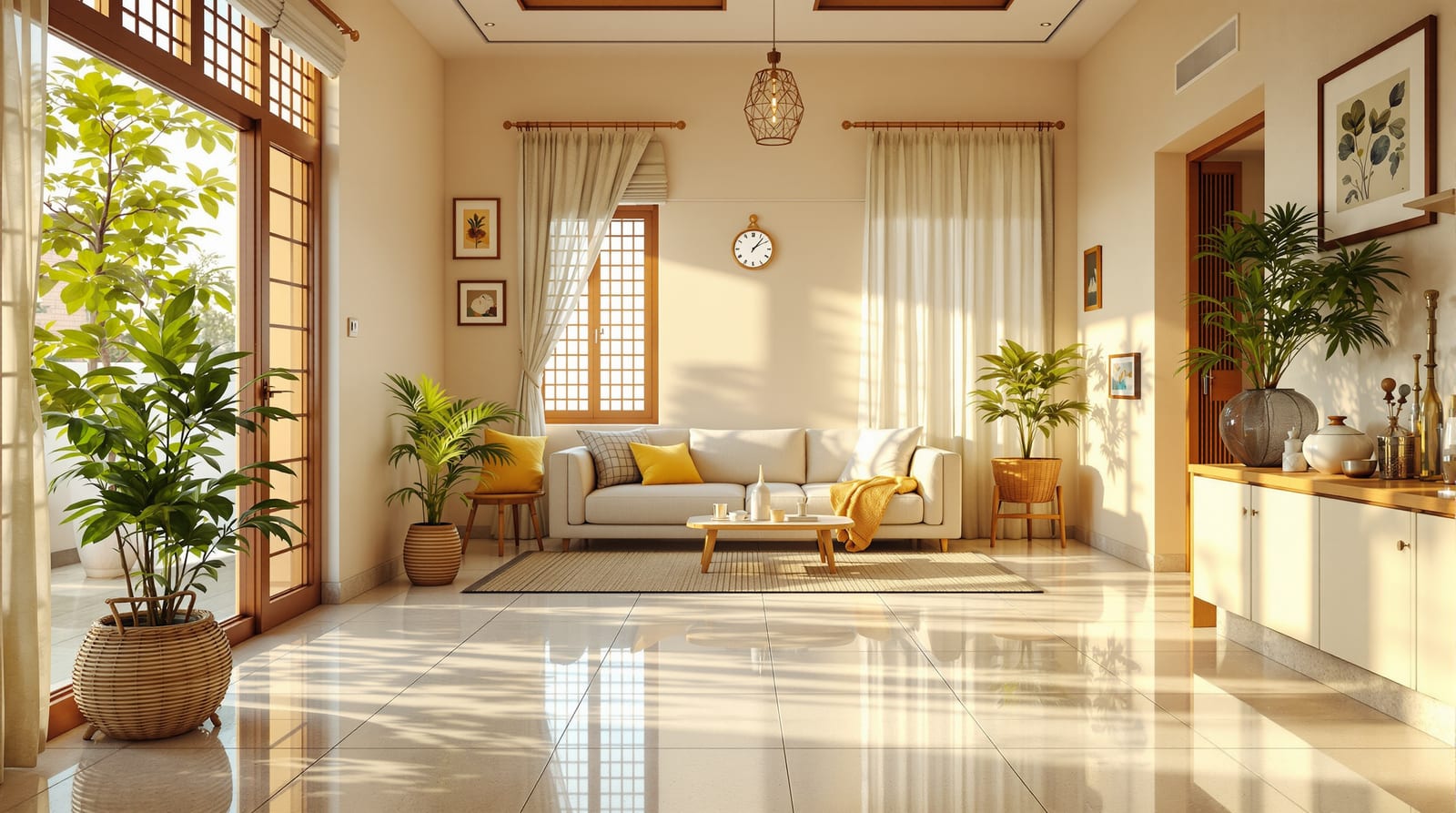
Flooring Cost in Chennai 2026: Installed Price per Sq Ft by Material
What flooring really costs in Chennai in 2026 — installed per-square-foot rates for vitrified, granite, marble, wood, laminate and vinyl, the local Salem-Madurai granite advantage, why the coastal heat and humidity should steer your choice, where to buy, and a worked 2BHK estimate.
Flooring a home in Chennai is a different sum from flooring one in Mumbai or Delhi, and not only because labour rates differ. Chennai sits on a hot, salty, humid coastal plain where the floor has to cope with a long sticky summer, a wet north-east monsoon and tracked-in dust — while at the same time the city sits an hour or two from the Salem and Madurai granite belts, which makes natural granite cheaper here than almost anywhere else in the country. This guide gives you the real installed cost of every common floor in Chennai for 2026, the local laying labour, where to buy, the climate caveats that should steer your choice, and a worked estimate for a typical 2BHK flat.
What drives flooring cost in Chennai
The price you finally pay per square foot is built from a few moving parts, and Chennai's profile sits a little below the dearest metros on labour but with its own quirks.
- Laying labour. Chennai is a tier-2 metro on tiling wages — typically around ₹20–40 per square foot for tile and stone laying in 2026, below Mumbai and Bangalore but above small towns. Intricate work (large-format slabs, patterns, herringbone wood) costs more.
- Material proximity. Granite is a genuine Chennai bargain because the quarries and cut-to-size factories of Salem, Madurai, Krishnagiri and Hosur are close — you skip the long-haul freight that loads the same stone in Delhi or Kolkata. Vitrified tiles, by contrast, mostly travel from Morbi in Gujarat, so they carry transport that an Ahmedabad buyer avoids. Marble travels even further, from Rajasthan.
- The coastal-humid climate. Chennai's heat, salt air and monsoon dampness make some floors a false economy. Solid wood is risky here; anti-skid and water-tolerant surfaces are worth paying for. More on this below.
- Adhesive, skirting, grouting and GST. A tile rate is never the whole story — tile adhesive adds roughly ₹12–30 per square foot, plus skirting, grout, transport, loading and 18 percent GST on tiles and on labour (works contract). Always compare all-in numbers.
For the national picture behind these city figures, see flooring cost per square foot in India and flooring cost in India 2026; for how laying wages vary across the country, flooring labour cost in India.
Installed cost per square foot in Chennai, 2026
The table below is the heart of this guide: indicative 2026 ₹ per square foot installed in Chennai — that is, material plus laying labour plus the usual adhesive or mortar, but before skirting, heavy transport and GST unless noted. Ranges are wide because grade, size, finish and area drive a lot of the number; treat them as a planning band, not a quote.
| Flooring type | Material ₹/sq ft | Laying labour ₹/sq ft | Installed ₹/sq ft (indicative) | Chennai note |
|---|---|---|---|---|
| Ceramic floor tile | 35–70 | 20–35 | 60–120 | Budget bedrooms, utility; pick anti-skid for wet areas |
| Vitrified tile (GVT/PGVT) | 50–130 | 25–40 | 90–200 | The Chennai default — travels from Morbi but copes best with heat and humidity |
| Double-charged vitrified | 70–140 | 25–40 | 110–220 | Heavy-traffic living areas, hard-wearing |
| Granite (local, e.g. Steel Grey, Tan Brown) | 55–140 | 25–45 | 90–210 | Local-source bargain; durable, cool underfoot |
| Granite (premium, Black Galaxy) | 120–250+ | 30–50 | 170–320+ | Platforms and feature floors; still cheaper here than up north |
| Indian marble | 90–250 | 35–55 | 150–340 | Travels from Rajasthan; needs care in humid coastal homes |
| Italian marble | 350–900+ | 45–70 | 450–1100+ | Luxury only; imported via the port, premium maintenance |
| Athangudi handmade tiles | 90–180 | 35–55 | 150–280 | Chettinad heritage cement tiles, locally available, characterful |
| Red-oxide / IPS floor | 60–130 | (cast in place) | 90–200 | Traditional, cool, beautiful — skilled artisans needed |
| Laminate flooring | 70–180 | 25–40 | 110–250 | Cheap warmth; vulnerable to Chennai humidity and any water |
| Engineered wood | 250–600 | 40–70 | 320–750 | Safer than solid wood here but still humidity-sensitive |
| Solid hardwood | 500–1200+ | 60–100 | 650–1500+ | Not recommended in Chennai's coastal-humid climate |
| Vinyl / LVT / SPC | 70–250 | 25–45 | 110–350 | SPC is dimensionally stable and water-tolerant — a smart humid-climate pick |
A few Chennai-specific reads of this table. Vitrified tile is the city's workhorse and rightly so — it shrugs off heat, humidity and mopping, and a wide PGVT range is stocked in every showroom. Granite is unusually good value here thanks to local sourcing, so a granite floor that would feel premium elsewhere is within reach for many Chennai homes. Wood is where the climate bites: laminate and especially solid wood are the floors most likely to disappoint in a salty, humid coastal flat.
Why the climate should steer your choice
Chennai's weather is the single biggest reason its flooring decisions differ from an inland city. The summer is long and brutally hot, the air is salty and humid for much of the year, and the north-east monsoon brings driving rain and standing water. Three rules follow.
First, favour vitrified and anti-skid surfaces. Fully vitrified porcelain tiles (water-absorption Group BIa, under 0.5 percent) barely take up moisture, resist staining and clean easily — ideal for a humid coastal home. For bathrooms, balconies, the kitchen and any area that gets wet, choose a matt or textured anti-skid finish (look for a DIN 51130 R10 or R11 rating) because wet polished floors are dangerously slippery in monsoon. The reasoning is laid out in flooring for coastal-humid homes in India and anti-slip flooring for wet areas in India.
Second, be wary of solid wood and laminate. Solid hardwood swells, cups and warps in sustained high humidity, and Chennai's air provides exactly that; it is the floor most likely to fail here. Laminate's fibreboard core also reacts badly to moisture and any flooding. If you want the wood look, engineered wood is more stable, but the genuinely humidity-proof warm option is SPC vinyl, whose stone-polymer core does not swell.
Third, lean into the local cooling traditions. Chennai and the wider Tamil region have long used floors that stay cool underfoot in heat — granite, the handmade Athangudi cement tiles of Chettinad, and red-oxide (Indian Patent Stone) floors. Red oxide and Athangudi are not merely nostalgic; they are genuinely comfortable in this climate and increasingly fashionable in contemporary Chennai homes. They need skilled artisans and good sealing, but they reward it. For the wider regional context see regional flooring traditions in India.
The cost stack — where your rupees go
It helps to see that the tile or stone price is only part of the installed cost. The bar below breaks down a typical mid-range vitrified floor in Chennai at roughly ₹150 per square foot installed, all-in.
The lesson is to compare an all-in ₹ per square foot — material plus adhesive plus laying plus skirting plus grouting plus GST plus transport and loading — rather than being seduced by a low tile sticker price. Two quotes with the same tile rate can differ by 30 percent once adhesive, labour and GST are in. The flooring cost calculator and the city flooring cost calculator let you build this number for your own area and material.
Where to buy in Chennai
Chennai has a deep flooring trade, and buying from the right channel saves real money over builder-supplied rates.
- Granite yards in the Salem-Madurai orbit and around Chennai. For granite, this is the city's superpower. Yards and cut-to-size factories in the Salem, Madurai, Krishnagiri and Hosur belts — and trading yards on Chennai's outskirts — let you pick the actual slab in daylight, get edges polished and pieces cut to size, and pay close to source. Builder rates usually carry a margin over yard rates.
- Tile showrooms across the city. Branded showrooms for Kajaria, Somany, Nitco, Johnson, Orient Bell, Simpolo and Varmora stock the full vitrified and ceramic range; tiles themselves are largely Morbi-made, so the transport from Gujarat is baked into the price.
- Marble dealers. Indian and Italian marble is sold by specialist dealers; remember the stone travels from Rajasthan (Indian) or arrives imported through the port (Italian), so transport and care costs are higher here than in Jaipur or Udaipur.
- Athangudi and red-oxide artisans. Heritage Athangudi tiles and cast-in-place red-oxide floors are available through Chettinad-linked suppliers and specialist artisans; these are craft products, so vet samples and references.
Wherever you buy, insist on the ISI (BIS) mark on ceramic and vitrified tiles — they fall under a mandatory Quality Control Order — and ask the spec: water-absorption group, PEI rating for glazed tiles, and slip rating for wet areas. For the buying discipline in detail, see how to buy floor tiles in India and how to buy granite in India, and to compare quotes fairly, the city flooring cost calculator.
A worked estimate — flooring a 2BHK Chennai flat
Consider a typical 900 square foot carpet-area 2BHK in Chennai, with a sensible mix: vitrified tile in the living, dining and bedrooms, anti-skid ceramic in the kitchen and bathrooms, and a granite kitchen platform (priced separately as it is not floor area). The estimate below uses mid-range, all-in installed rates including adhesive, laying and skirting; add 18 percent GST on top.
| Area | Approx sq ft | Floor chosen | Rate ₹/sq ft (installed) | Cost ₹ |
|---|---|---|---|---|
| Living + dining | 320 | Vitrified PGVT | 150 | 48,000 |
| Bedroom 1 | 150 | Vitrified | 140 | 21,000 |
| Bedroom 2 | 130 | Vitrified | 140 | 18,200 |
| Kitchen floor | 80 | Anti-skid ceramic | 100 | 8,000 |
| 2 bathrooms | 70 | Anti-skid ceramic | 110 | 7,700 |
| Balcony | 50 | Anti-skid vitrified | 130 | 6,500 |
| Skirting (allowance) | — | — | — | 6,000 |
| Subtotal (floor) | 800 | — | — | 1,15,400 |
| GST at 18% | — | — | — | ~20,770 |
| Total floor (approx) | — | — | — | ~1,36,000 |
That lands a 2BHK Chennai flat at roughly ₹1.3–1.4 lakh for a mid-range vitrified-plus-ceramic floor, all-in with GST. Trade up the living area to local granite and you might add ₹15,000–30,000; choose budget ceramic throughout and you could come in under ₹1 lakh; specify Italian marble and the number multiplies several times over. A granite kitchen platform (say 30 square feet of Black Galaxy or Tan Brown, fabricated and fitted) typically adds ₹8,000–18,000 on top. Build your own version with the flooring budget planner or the flooring cost calculator.
For how Chennai stacks up against other metros, see city-wise flooring cost comparison in India.
Frequently asked questions
What is the cheapest good flooring for a Chennai home?
Vitrified tile is the best value for most Chennai rooms — it is reasonably priced, copes with heat and humidity, cleans easily and comes in a huge range. Expect roughly ₹90–200 per square foot installed for mid-range vitrified. Budget ceramic is cheaper still at around ₹60–120 installed and fine for bedrooms and utility areas, but choose an anti-skid finish anywhere that gets wet. Local granite is also surprisingly affordable here.
Is granite cheaper in Chennai than other cities?
Yes, noticeably. The Salem, Madurai, Krishnagiri and Hosur granite belts are an hour or two from Chennai, and granite is heavy, so a Chennai buyer skips the long-haul freight, loading and breakage cost that push the same stone's price up in Delhi, Mumbai or Kolkata. The same variety can cost 15–35 percent more delivered to a far northern city. Buy from a yard, pick the slab in daylight, and confirm thickness.
Should I install wooden flooring in Chennai?
Be careful. Chennai's hot, salty, humid coastal climate is hard on wood. Solid hardwood swells, cups and warps in sustained humidity and is best avoided; laminate's fibreboard core also reacts badly to moisture. If you want a wood look, engineered wood is more stable, and SPC vinyl — with a stone-polymer core that does not swell — is the genuinely humidity-proof warm option for this climate.
What does it cost to floor a 2BHK flat in Chennai?
A roughly 900 square foot 2BHK with a mid-range mix of vitrified tile in living and bedrooms and anti-skid ceramic in kitchen and bathrooms typically costs around ₹1.3–1.4 lakh all-in including adhesive, laying, skirting and 18 percent GST. Budget ceramic throughout can bring it under ₹1 lakh; local granite in the living area adds modestly; Italian marble multiplies the figure several times.
Are Athangudi and red-oxide floors worth it in Chennai?
For the right home, yes. Athangudi handmade cement tiles (a Chettinad craft) and cast-in-place red-oxide (IPS) floors are part of the Tamil regional tradition precisely because they stay cool underfoot in heat and look beautiful. They cost roughly ₹150–280 and ₹90–200 per square foot installed respectively, need skilled artisans and good sealing, and reward that care with character no factory tile matches.
Export this guide
Related Guides — Deep-dive reading
Flooring Cost Comparison Across Indian Cities 2026: Installed ₹/Sq Ft by Material
A single cross-city reference comparing installed flooring rates across Mumbai, Delhi-NCR, Bangalore, Hyderabad, Chennai, Pune, Kolkata, Ahmedabad and Jaipur — vitrified, granite, marble, wood/laminate and vinyl, plus laying labour — and why each city differs.
Flooring & SurfacesFlooring Cost in Mumbai 2026: Installed Price per Sq Ft by Material
What flooring really costs in Mumbai in 2026 — installed per-square-foot rates for vitrified, granite, marble, wood, laminate and vinyl, why the city is India's most expensive metro to floor, where to buy, and a worked 2BHK flat estimate.
Flooring & SurfacesWooden Flooring in India: Solid, Engineered, Laminate & Wood-Look SPC Compared (2026)
The decision-oriented hub for wood floors in Indian homes — the three families plus wood-look SPC, the warm look, honest monsoon-and-termite caveats, where wood works, finishes, installation types, ₹/sq ft ranges and maintenance.
Flooring & SurfacesRelated Tools — Try Free
Flooring Cost Calculator
Estimate the all-in cost of a floor — material, laying, wastage, skirting and GST — by area and material.
Flooring CalculatorGranite Flooring Cost Calculator
Estimate installed granite-floor cost — material, cutting, laying, polishing, sealing, wastage and GST.
Flooring CalculatorWooden Flooring Cost Calculator
Estimate installed wood or wood-look floor cost — solid, engineered, laminate or SPC — with underlay and skirting.
Flooring Calculator