
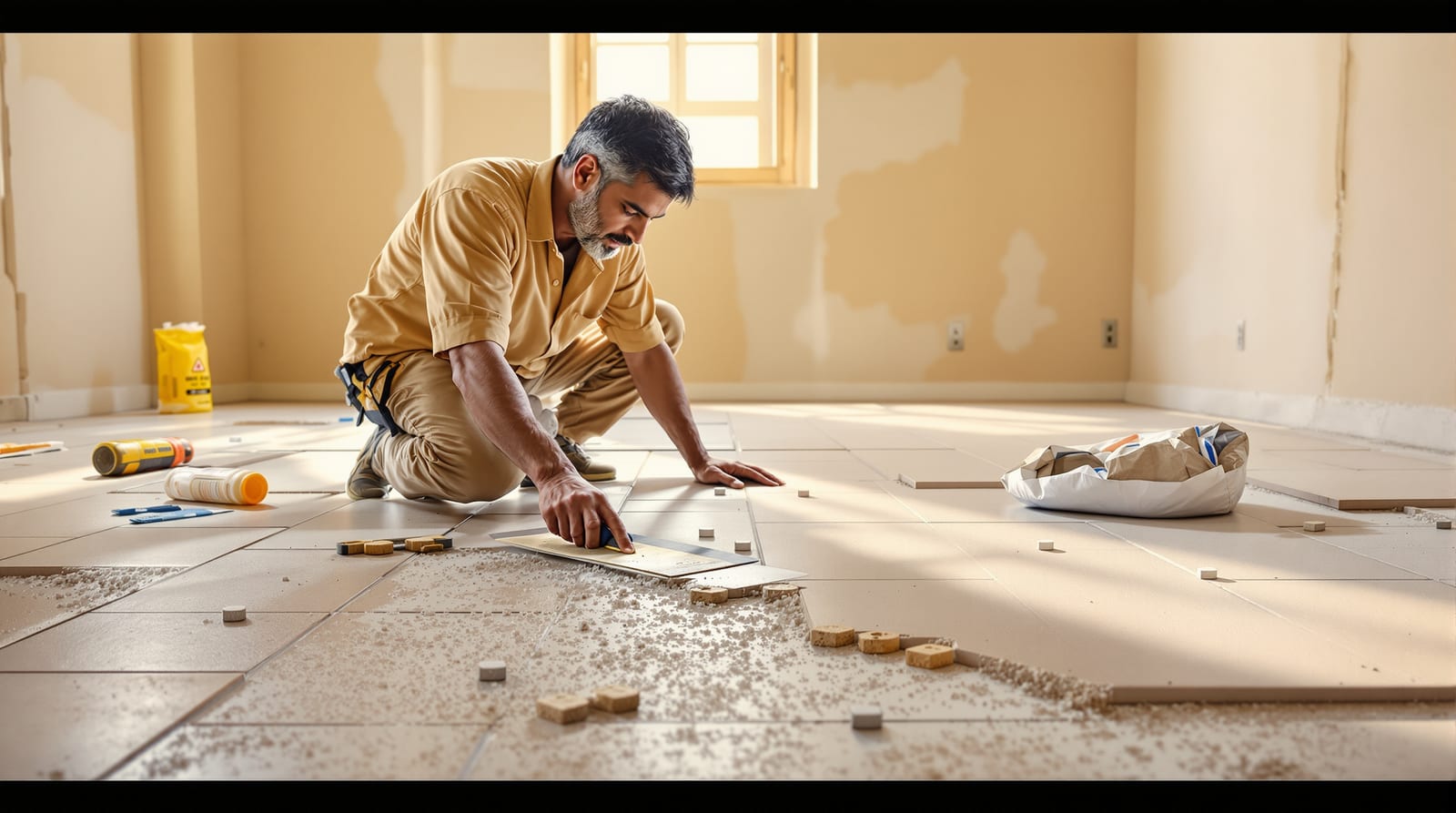
Flooring Labour Cost in India 2026: Laying Charges per Sq Ft by Material & City
The labour-only picture for laying flooring in India in 2026 — what tiling, stone, wood, vinyl and epoxy laying costs per square foot by method and by city tier, what a labour quote does and doesn't include, daily-wage versus per-sq-ft contracts, and how to stop being overcharged.
When a flooring quote lands in your inbox it usually arrives as one fat per-square-foot number, and the most expensive mistake an Indian homeowner makes is assuming that number is mostly the tile or the stone. A surprising slice of it is labour — the skilled hands that lay, align, level, grout and polish your floor — and that slice swings widely by material, by method and by which city you are building in. This guide pulls the labour out of the bundle and shows you what laying alone should cost per square foot in 2026, so you can read a quote line by line and know whether you are paying a fair rate or being quietly overcharged.
Why labour deserves its own number
On most Indian floors the material dominates the bill, but labour is rarely trivial and on some jobs it is the larger share. A plain vitrified tile bought from the Morbi belt might cost ₹45–70 per square foot as material, while the labour to lay it well can be ₹25–45 — so labour is a third to half of the installed cost. On a thick Italian marble floor the material dwarfs the labour, but the labour itself is high in absolute terms because marble demands a skilled mason, a mortar bed and post-laying polishing. On an epoxy or microcement floor there is barely any "material" you can see and almost the entire cost is specialist application. So the labour line is never a rounding error, and treating it as one is how builders and contractors pad a quote.
There is a second reason to isolate labour. Material prices you can verify yourself — a tile box has an MRP, a granite yard quotes a slab rate, the flooring cost per square foot in India guide gives you benchmarks. Labour is opaque. It varies by the fitter's skill, the city's wage level, the complexity of your layout and how badly the contractor wants the job. The only way to judge it is to know the going laying rate for your material and method, which is exactly what the tables below give you.
Labour rate by material and method
The single biggest driver of laying labour is the material and the method it demands. A click-lock vinyl plank that a two-person crew floats over a flat floor in a day is cheap to lay; a mortar-bed marble floor that one master mason sets slab by slab and then polishes is expensive. The table below is labour-only — no material, no adhesive, no GST — in indicative 2026 rupees per square foot. Treat these as national mid-range numbers; metros run higher and tier-2 towns lower, which the city section adjusts for.
| Material / method | Laying labour ₹/sq ft (indicative) | Why it costs what it does |
|---|---|---|
| Ceramic / vitrified tile — adhesive (thin-set) | 25–45 | Fast, clean, needs a flat base; the mainstream method |
| Ceramic / vitrified tile — traditional mortar bed | 20–40 | Cheaper rate but slower; suits uneven old floors |
| Large-format tiles / slabs (800x1600 mm and up) | 45–80 | Two-plus people per tile, levelling clips, high lippage risk |
| Indian marble — mortar bed + setting | 40–70 | Skilled mason, heavy slabs, fine joints |
| Italian / imported marble — laying only | 50–90 | Premium care, tight joints; polishing extra |
| Granite slab flooring | 35–65 | Heavy, precise cutting and setting, edge work |
| Kota / Tandur / natural stone (rough) | 25–45 | Mortar bed; cheaper stone but still a mason's job |
| Laminate — floating (click) | 18–35 | Quick crew job over a flat, dry base |
| Engineered / solid wood — floating | 25–45 | Click or tongue-and-groove, underlay, careful trims |
| Engineered / solid wood — glue-down or nail | 45–80 | Slow, skilled, adhesive or nailing to subfloor |
| Vinyl / LVT / SPC — click float | 18–35 | Fast; flatness of base is the main constraint |
| Vinyl sheet — full glue-down | 25–45 | Adhesive spread, welded seams, more skill |
| Epoxy flooring (self-level, multi-coat) | 60–150+ | Almost all specialist application; coats, curing, finish |
| Microcement / IPS-style | 80–180+ | Hand-applied artisan finish, multiple layers |
A few honest caveats sit behind this table. Large-format tiles and slabs carry a labour premium precisely because they are unforgiving — one badly set 1200x600 tile shows lippage across the whole room, so a competent crew charges more and earns it. Wood splits sharply by method: floating click floors are near vinyl rates, but a glued or nailed hardwood floor is among the dearest labour on this list. Epoxy and microcement break the per-square-foot logic entirely because they are specialist trades, often priced as a turnkey number where labour, material and equipment blur together. For the installed all-in figures behind these labour rates, the flooring installation cost calculator lets you stack material on top, and the broader flooring cost in India 2026 picture sits one level up.
The chart below shows the rough mid-point of laying labour by method, so you can see at a glance where the money goes.
How city tier changes the rate
Laying labour tracks the local cost of living, so the same tile costs more to lay in Mumbai than in Indore for no reason other than where the mason has to live. As a rule, the big metros run a clear premium and tier-2 cities sit below them. The table below is a labour-only multiplier guide for adhesive-set vitrified tiling, the most common job; other methods scale similarly.
| City tier | Examples | Tile laying labour ₹/sq ft | Notes |
|---|---|---|---|
| Top metros | Mumbai, Delhi-NCR, Bangalore | 35–60 | Highest wages; Mumbai dearest, scarce skilled crews |
| Large tier-2 | Pune, Hyderabad, Chennai, Kolkata, Ahmedabad | 20–40 | Solid skilled-labour pool; competitive rates |
| Tier-2 / tier-3 | Jaipur, Indore, Coimbatore, Nagpur, Lucknow | 18–35 | Lower living costs pull labour down |
| Small towns / rural | District towns, semi-urban | 15–30 | Cheapest, but specialist (epoxy, large-format) crews scarce |
Two practical points hide in this table. First, the metro premium is real but it buys you depth — in Mumbai or Bangalore you can find a crew that has laid 1200x2400 mm slabs a hundred times, whereas in a small town that specialist may have to be brought in from a metro, erasing the local saving. Second, adhesive itself is a separate cost the contractor adds on top of laying labour, typically ₹12–30 per square foot depending on the adhesive grade and how thick a bed the floor needs; do not let it be folded silently into the labour line. City-by-city installed numbers, including local labour, live in the dedicated pages such as flooring cost in Mumbai, and the head-to-head view is in city-wise flooring cost comparison in India. The city flooring cost calculator applies a local multiplier for you.
What a labour quote includes — and what is extra
The most common overcharging trick is not a high rate; it is a low headline rate with everything billed as an extra. Before you accept a per-square-foot labour figure, pin down what it covers. A fair, complete tiling-labour quote should usually include laying the tiles, cutting at edges and around fixtures, basic levelling with spacers, and cleaning up. The items below are the ones that quietly migrate to a separate bill — agree on each one in writing.
| Item | Often included | Often charged extra | Typical extra |
|---|---|---|---|
| Laying / setting the tile | Yes | — | — |
| Cutting at edges and cut-outs | Usually | Sometimes for complex layouts | Per cut or lump sum |
| Adhesive / cement-sand mortar | No (material) | Yes | ₹12–30/sq ft adhesive |
| Skirting laying | Sometimes | Often | ₹15–35 per running ft |
| Grouting / pointing | Sometimes | Often | ₹6–15/sq ft |
| Surface preparation / levelling base | No | Yes | ₹15–40/sq ft if needed |
| Marble / granite polishing after laying | No | Yes | ₹25–60/sq ft (see polishing guide) |
| Debris removal / hauling | Sometimes | Often | Lump sum |
| Diagonal / herringbone / pattern laying | No | Yes | 20–40% labour premium |
The two that catch homeowners hardest are skirting and polishing. Skirting is billed per running foot, not per square foot, so it looks small until the whole house is measured. Polishing turns a "cheap" marble laying rate into an expensive floor — the laying is half the job, the marble polishing and care in India work is the other half, and floor polishing cost in India covers those numbers. Pattern laying — diagonal, herringbone, mixed sizes — carries a genuine 20–40 percent labour premium because it is slower and wastes more tile, so expect it and confirm it up front. For the related laying techniques behind these rates, see tile laying methods in India.
Daily wage versus per-square-foot contracts
There are two ways labour is priced in India, and choosing the right one for your job matters. A per-square-foot contract — the contractor quotes a rate and you pay for the area laid — is the safer default for most homeowners because the risk of slow work sits with the contractor, not you. You know your number going in, and a fast crew does not cost you more. A daily-wage arrangement — you pay each mason and helper a day rate — only makes sense for small, fiddly or unpredictable jobs: a single bathroom, a patch repair, an irregular space where measuring area is awkward, or restoration where pace is impossible to predict.
| Basis | Typical 2026 rate | Best for | Risk to you |
|---|---|---|---|
| Per square foot (contract) | As per material tables above | Whole rooms, full homes, standard layouts | Low — slow work is the contractor's problem |
| Daily wage — skilled mason (mistry) | ₹800–1,500/day (metros higher) | Repairs, patches, tricky small areas | High — you pay for slow days |
| Daily wage — helper (beldar) | ₹500–900/day | Support to the mason | Bundled into crew cost |
| Turnkey (labour + material + supervision) | Material + labour combined | Hands-off owners, full projects | Medium — hard to audit the split |
A skilled tiling mason in a metro can lay roughly 100–200 square feet of standard tile in a good day, less for large-format or stone, so you can sanity-check a daily-wage job against the per-square-foot rate and refuse to pay for a crew that suddenly works at half speed. For turnkey quotes, the danger is the blurred split — insist the contractor breaks out labour from material so you can compare it against these benchmarks. The flooring installation cost calculator helps you rebuild a turnkey number from its parts.
How to avoid being overcharged
Knowing the rate is half the battle; the other half is making the quote legible. The habits below consistently save Indian homeowners money on labour.
- Get the labour line broken out. Refuse a single bundled per-square-foot figure. Ask for tile laying, adhesive, skirting, grouting, polishing and base prep as separate lines so you can compare each against the tables here.
- Confirm what "laying" includes. Cutting, edges, cleaning and basic levelling should be in the laying rate; get that in writing before work starts.
- Price skirting and polishing separately. They are the two items most often slipped in as costly extras. Measure your running feet of skirting yourself.
- Match the contract to the job. Per-square-foot for whole rooms; daily wage only for small or unpredictable work, with a sanity-check against area output.
- Get two or three quotes for the same scope. Labour is opaque; competing quotes for an identical, line-itemised scope expose the outliers fast.
- Watch the pattern premium. Diagonal, herringbone and mixed-size layouts genuinely cost more labour — agree the premium up front, do not discover it on the final bill.
- Don't pay full advance. Stage payments against progress; hold a final tranche until grouting, polishing and clean-up are done and inspected.
- Inspect for lippage before you settle. Bad laying shows as uneven tile edges; the flooring installation mistakes in India guide lists what to check before releasing the final payment.
A final framing point: cheaper labour is not always cheaper. A mason who underbids and then lays a large-format floor with visible lippage costs you the entire floor when it has to be ripped up. The labour rates in this guide are the ones competent crews charge; quotes far below them usually mean inexperience, a hidden-extras game, or corners that will surface as cracked, hollow or uneven tiles within a year.
Frequently asked questions
What is the labour cost to lay tiles per square foot in India in 2026?
For standard ceramic or vitrified tiles laid with adhesive, expect roughly ₹25–45 per square foot of labour in most cities, rising to ₹35–60 in the top metros (Mumbai, Delhi-NCR, Bangalore) and dipping to ₹18–35 in tier-2 and smaller towns. Large-format tiles cost ₹45–80 to lay because they need more hands and levelling clips. These figures are labour only — adhesive (₹12–30/sq ft), skirting, grouting and base preparation are usually charged on top.
Is flooring labour cheaper in tier-2 cities than metros?
Yes, generally by a meaningful margin — tier-2 cities like Jaipur, Indore or Coimbatore typically run ₹18–35 per square foot for tile laying versus ₹35–60 in Mumbai, Delhi-NCR or Bangalore, because labour tracks local living costs. The catch is specialist work: epoxy, microcement and very large-format slabs need crews that may have to be brought in from a metro, which can erase the local saving for those jobs.
What does a tile-laying labour quote usually not include?
The laying rate normally covers setting, edge cutting, basic spacer levelling and clean-up. It usually does not include adhesive or mortar (a material cost), skirting (billed per running foot), grouting, surface or base preparation, marble and granite polishing after laying, or debris removal. Pattern layouts like diagonal and herringbone carry a 20–40 percent labour premium. Always get these as separate, written line items.
Should I pay flooring labour per square foot or per day?
Per square foot is safer for whole rooms and full homes — you know your number and slow work is the contractor's problem. Daily wage (about ₹800–1,500 for a skilled mason, ₹500–900 for a helper in 2026, metros higher) only makes sense for small repairs, patches or irregular spaces where measuring area is awkward. For daily-wage jobs, sanity-check output: a skilled mason lays roughly 100–200 sq ft of standard tile a day.
How can I tell if I am being overcharged for flooring labour?
Compare the labour line against the material-and-method table here, insist on a broken-out quote rather than one bundled figure, and get two or three quotes for an identical line-itemised scope — outliers stand out immediately. Watch the usual hidden extras: skirting, polishing, base prep and pattern premiums. But beware quotes far below the benchmark too; they often signal inexperience or corners that surface as lippage and hollow tiles within a year.
Export this guide
Related Guides — Deep-dive reading
Flooring Cost Comparison Across Indian Cities 2026: Installed ₹/Sq Ft by Material
A single cross-city reference comparing installed flooring rates across Mumbai, Delhi-NCR, Bangalore, Hyderabad, Chennai, Pune, Kolkata, Ahmedabad and Jaipur — vitrified, granite, marble, wood/laminate and vinyl, plus laying labour — and why each city differs.
Flooring & SurfacesHow to Lay Floor Tiles in India: Complete Step-by-Step Guide
A practical, mason-grade walkthrough for tiling an Indian home floor — base check, dry layout, adhesive vs mortar bed, leveling, lippage and grouting.
Flooring & SurfacesThe Truth About Cost Per Square Foot
Why a ₹/sqft interior quote is the most misleading number in Indian home costing — and how to convert it into a real BOQ
Cost & MoneyRelated Tools — Try Free
Flooring Cost Calculator
Estimate the all-in cost of a floor — material, laying, wastage, skirting and GST — by area and material.
Flooring CalculatorMarble Flooring Cost Calculator
Estimate installed marble-floor cost — material, laying, grinding and polishing, sealing, wastage and GST.
Flooring CalculatorFlooring Installation Cost Calculator
Estimate the labour and consumables to lay a floor — tiling, stone, wood, vinyl or epoxy — by area and method.
Flooring Calculator