
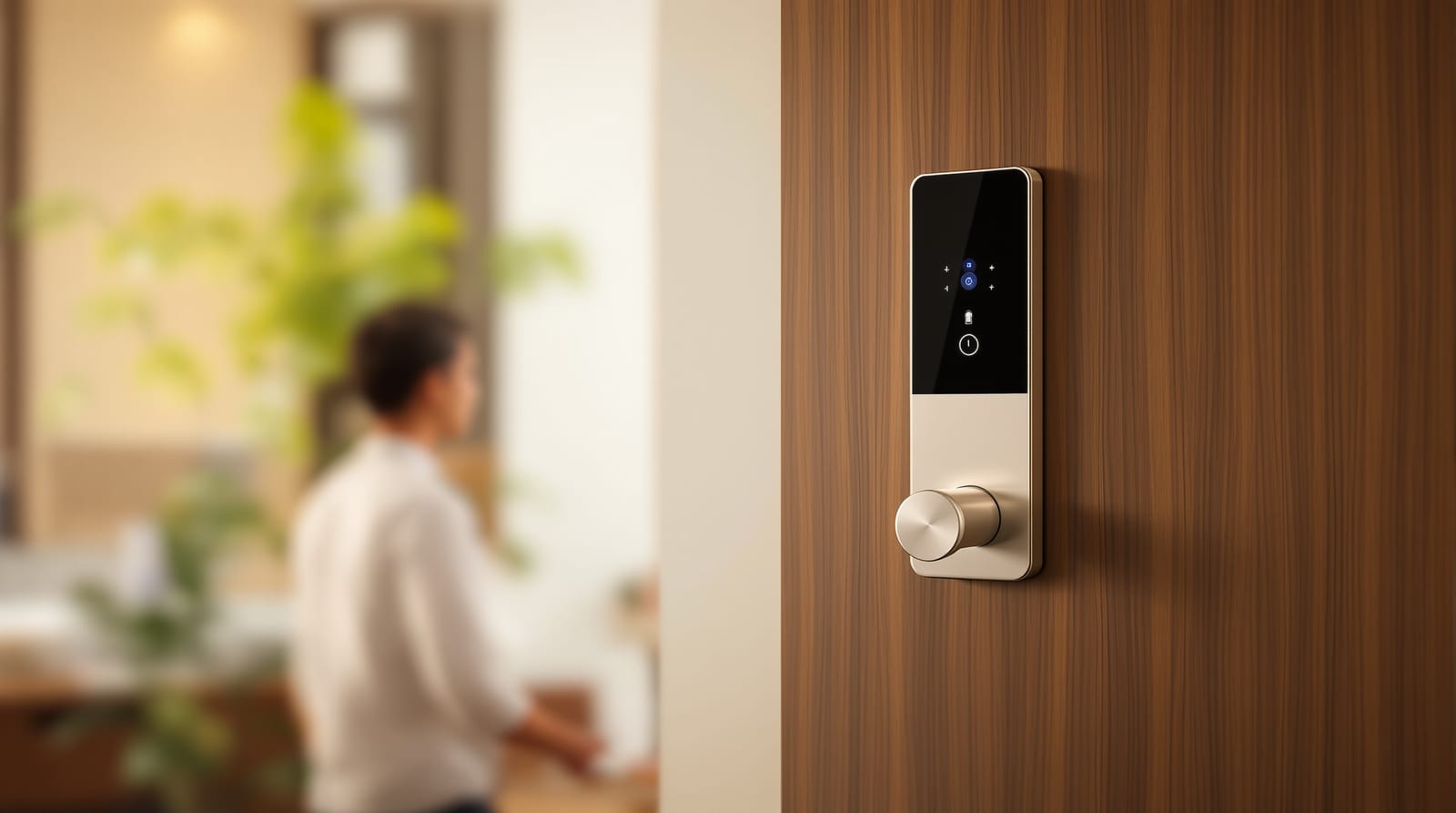
Face Recognition Door Lock for Indian Homes: 2D vs 3D, Anti-Spoofing & Cost
How face-recognition door locks actually work in Indian homes, why 3D/IR beats 2D, what they cost, and the honest trade-offs versus fingerprint.
You walk up to your door with two bags of vegetables in one hand and a sleeping child in the other, and it simply opens. That is the promise of a face-recognition door lock, and it is genuinely the most natural way a door has ever unlocked. But the same convenience hides a sharp fork in the road: a cheap lock that reads a flat photo as your face is worse than no smart lock at all, while a well-engineered 3D/infrared unit is a serious upgrade. This guide separates the two, in Indian conditions and at Indian prices.
If you are still deciding between modalities, start with the overview in our biometric door locks guide, then compare fingerprint door locks head-to-head. This page goes deep only on face recognition.
How a face-recognition door lock actually works
Every face lock does three things: it captures an image of your face, converts it into a mathematical template (a string of numbers describing the geometry of your features), and compares that template against the faces you enrolled. It never stores a "photo" it can show anyone; it stores numbers. The unlock decision happens in well under a second.
The make-or-break difference is how the face is captured. There are two families, and the gap between them is enormous.
2D face recognition uses an ordinary camera and reads a flat picture of your face. It is cheap, and it is also the modality that has embarrassed budget locks for years, because a flat picture can be fooled by another flat picture: a printed photo, a phone screen, even a sharp social-media selfie held up to the lens.
3D face recognition builds a depth map of your face. The two common methods are structured light (the lock projects an invisible dot pattern and measures how it distorts over your nose, cheeks and brow) and Time-of-Flight / IR depth (it measures how long infrared light takes to bounce back from each point). Because a printed photo is flat, it has no depth, so a 3D system rejects it. This is the same leap that smartphones made when they moved from camera face-unlock to dedicated depth sensors.
For a door lock in India, treat 3D or infrared depth sensing as the baseline you actually want. A 2D-only face lock is a convenience toy, not a security device.
2D vs 3D/IR: the comparison that matters
| Feature | 2D face lock | 3D / IR depth face lock |
|---|---|---|
| How it sees | Flat camera image | Depth map (structured light / ToF) |
| Photo/screen spoof resistance | Poor — can be fooled | Strong — flat surface rejected |
| Video / mask spoof resistance | Very poor | Good (needs liveness detection too) |
| Low-light / night unlock | Weak; needs ambient light | Strong — IR works in darkness |
| Works with sunglasses/changed look | Hit and miss | More tolerant |
| False-accept risk (wrong person) | Higher | Lower |
| Typical India price band | ₹8,000-15,000 | ₹15,000-30,000+ |
| Verdict for a main door | Avoid as primary | Recommended |
Indicative pricing, varies by city, vendor and GST (+18%). Treat any lock that does not explicitly state IR/depth or liveness detection as a 2D unit until proven otherwise.
Anti-spoofing and liveness: the question to ask before you pay
"3D" alone is not enough. The feature that defeats a determined attacker is liveness detection (anti-spoofing): the lock's ability to tell a live human from a photo, a video on a phone, or a printed mask. Good systems combine depth (a mask is flat-ish, a photo is fully flat) with infrared signatures (a real face reflects IR very differently from paper or a screen) and sometimes micro-motion cues.
When you shop, ask the vendor three direct questions and get answers in writing:
- Is the face sensor 2D or 3D/IR? If they cannot answer, walk away.
- Does it have active liveness / anti-spoofing against photo and video? Ask for the specific claim, not "it's smart."
- What is the certified or stated false-acceptance rate? Reputable units quote one; vague brands do not.
A practical Indian test before final payment: hold up a clear printed photo of an enrolled person and a phone video of them. The lock must refuse both. If it opens for either, it is not protecting your home.
Low-light, night and the Indian doorway
A surprising amount of door use happens in poor light: the unlit lobby of an apartment, a power cut, a late return after dinner, the harsh shadow of a midday sun behind you. This is where infrared earns its premium. IR illumination lets a 3D/IR lock read your face in total darkness without a glaring white LED in your eyes, and it is unbothered by backlight.
Two India-specific cautions. First, mount the lock so the sensor is not in direct, blazing afternoon sun for hours, which can wash out a camera and heat the unit. A small porch overhang or recessed entrance helps. Second, dust and monsoon grime on the lens degrade recognition; a 10-second wipe during your monthly door check (see our door maintenance guide) keeps accuracy high.
Inline diagram: what's inside the sensor module
The key takeaway from the module layout: on a good lock, the matching happens inside that processor block, and the template never leaves the door. That single design choice is what separates a privacy-respecting lock from a worrying one.
Enrolment and multiple faces
Enrolling a face takes under a minute per person: you stand at a comfortable distance and slowly turn your head left, right, up and down so the lock captures your geometry from several angles. Better locks let you add a second capture in glasses or with a different hairstyle so daily-life changes do not lock you out.
For an Indian household this is a real strength. A joint family with grandparents, parents, children and a regular domestic help can each get their own enrolled face, and many locks log who opened the door and when. That audit trail is genuinely useful: you know when the kids reached home from school, or when help arrived. Practical enrolment tips:
- Enrol every regular resident, and re-enrol a child every several months as their face changes.
- Keep capacity in mind: most home locks store 20-100 faces, plenty for a family but check the spec.
- Set up at least one non-biometric backup user (PIN or key) before you rely on faces day to day.
Privacy and where your face data lives
This is the question that should weigh as much as price. A face is not a password; you cannot change it if it leaks. So the single most important privacy question is: does the face template stay on the lock, or does it go to a company's cloud server?
Prefer on-device storage, where your face template lives only in the lock's chip and the match happens locally. Be far more cautious with locks that upload face data to a manufacturer's cloud, especially brands with no clear India data policy. Ask the vendor plainly: is face data stored on the device or in the cloud, and in which country? Many app-connected locks send notifications and logs to the cloud while keeping the biometric template local; that is the acceptable middle ground.
India's data-protection landscape (the Digital Personal Data Protection Act, 2023) treats biometric data as sensitive, but enforcement of consumer hardware is still maturing, so you are largely protecting yourself by choosing the right product. A camera at your door also raises a neighbour-and-passer-by question: a lock that records video of everyone in the corridor is different from one that only matches enrolled faces on approach. If your lock pairs with a camera or video door phone, point it at your own threshold, not shared common areas.
Backup access: the non-negotiable
Every biometric lock must have a way in when biometrics fail, the battery dies, or a guest needs entry. Face recognition can be defeated by an injury, a full beard you have just grown, or simply a flat battery, so backup is not optional. Good face locks stack several fallbacks:
| Backup method | Use case | Watch-out |
|---|---|---|
| PIN keypad | Daily fallback, guests | Wipe smudges; use anti-peep random-prefix entry |
| Physical key (mechanical override) | Total power/electronics failure | Keep a key off-site; cheap cylinders pick easily |
| Mobile app / Bluetooth | Remote unlock, e-keys for guests | Depends on phone and network |
| RFID card / fob | Elderly, domestic help, kids | Can be lost; deactivate instantly if so |
| Emergency 9V terminal | Jump-start a dead lock to open with PIN | Carry a spare battery |
Insist on at least a mechanical key override and a PIN. A lock with face-only access is a lock-out waiting to happen during an Indian power cut.
Cost in India: what the premium buys
Face recognition sits at the top of the smart-lock ladder. As a rough map (indicative, +18% GST, varies by city and vendor; fitting on a standard door is usually modest if the door is sound):
| Tier | Typical price | What you get |
|---|---|---|
| Budget face (2D) | ₹8,000-15,000 | Camera face-unlock, weak spoof resistance — avoid as primary |
| Mid 3D/IR | ₹15,000-22,000 | Depth sensing, night IR, PIN + key + app, on-device template |
| Premium 3D + liveness | ₹22,000-30,000+ | Strong anti-spoofing, fast match, video, multi-user logs, sturdy build |
For comparison, a good fingerprint or multi-mode smart lock often lands lower, and Wi-Fi-connected smart locks span a wide band depending on features (see Wi-Fi smart locks). To model a full install for your door, use our smart lock cost calculator and check the door itself is solid first with the door security rating tool.
Brands an Indian buyer will encounter include Godrej, Yale, Qubo (Hero), Ozone, Hettich and Hafele in the smart-lock space, alongside several imported and online-only labels. Stick to brands with local service, because a biometric lock with no India support is a paperweight the day it misbehaves.
Honest pros and cons vs fingerprint
Face recognition's real advantages are hands-free use (a genuine gift when your arms are full or your hands are wet from cooking), speed, and a hygienic no-touch action. Its honest weaknesses, against fingerprint, are these: it costs more; cheap 2D versions are easy to spoof; performance dips in extreme backlight or if the lens is dirty; and it raises sharper privacy questions because a camera at your door is more invasive than a fingerprint pad.
Fingerprint, by contrast, is cheaper, mature, and harder to fool with a casual attack, but it struggles with the very Indian realities of wet, oily, henna-stained, cracked or worn fingertips, and it requires a deliberate touch. Many households land on a multi-modal lock that offers face plus fingerprint plus PIN plus key, so each member uses whatever works best for them. If you want that route, read the biometric overview and pair it with a structurally sound door, because the strongest lock on a flimsy door leaf and frame is a false comfort.
Frequently asked questions
Can a face-recognition door lock be fooled by a photo?
A cheap 2D lock often can. A 3D/IR lock with liveness detection rejects a flat photo and a phone-screen video because they have no real depth and the wrong infrared signature. Before buying, test it with a printed photo of an enrolled person; it must refuse to open.
Does a face lock work at night or during a power cut?
A 3D/IR model with infrared illumination works in total darkness without a blinding light. During a power cut the lock runs on its own batteries; keep them charged, carry a spare, and make sure you also have a PIN and a mechanical key as backup.
Where is my face data stored, and is it safe?
On well-designed locks the face is stored as a mathematical template inside the lock's own chip and never leaves the door. Avoid locks that upload your face to an unclear overseas cloud. Always ask the vendor whether storage is on-device or cloud, and choose on-device.
Is face recognition better than fingerprint for an Indian home?
Neither is strictly better. Face wins on hands-free, hygienic, fast entry and works for fingers that are wet, henna-stained or worn. Fingerprint is cheaper, mature and a touch harder to spoof casually. A multi-mode lock with face, fingerprint, PIN and key suits most families.
What happens if the lock stops recognising my face?
Recognition can drift after a big change in appearance, an injury, or a dirty lens. Wipe the sensor, and if needed re-enrol your face. This is exactly why you should always keep a working PIN and a physical key override, set up before you rely on the lock daily.
Export this guide
Related Guides — Deep-dive reading
Fingerprint Locks in India (2026): How Biometric Door Locks Really Work, and Their Honest Limits
How a fingerprint sensor reads a finger and matches it to enrolled templates, the genuine appeal of nothing to carry, and the wet-finger, elderly, privacy and backup realities every Indian buyer must weigh before choosing one.
SecurityFingerprint vs PIN Lock (2026): Which Keyless Entry Suits Your Indian Home?
A neutral head-to-head between the two most common keyless ways to open a smart lock in India — a fingerprint (biometric) and a PIN (code) — across convenience, everyday reliability in Indian conditions, who can use each, security, and privacy, ending in the honest verdict that you rarely have to choose.
SecuritySmart Lock vs Traditional Lock in India (2026): Which Should Guard Your Door?
An honest, even-handed head-to-head for Indian homes — keyless convenience, e-keys and remote access on one side, simple key-in-hand reliability with no power dependence on the other — ending in a clear verdict by household, and one rule both must obey: never trap anyone inside.
SecurityRelated Tools — Try Free
Door Security Rating Calculator
Score your main door out of 100 across leaf, frame, lock and hardware — and see the top upgrades.
Security ToolCCTV Cloud vs Local Cost Calculator
Compare cloud CCTV subscription against a local NVR + HDD — upfront, 5-year total, monthly fee and break-even.
Cloud vs LocalVideo Door Phone Cost Calculator
Pick class, monitors, install stage and extras and get an indicative price band, the often-forgotten install and backup costs, the annual running cost and a five-year total for a home video door phone.
Cost Calculator