
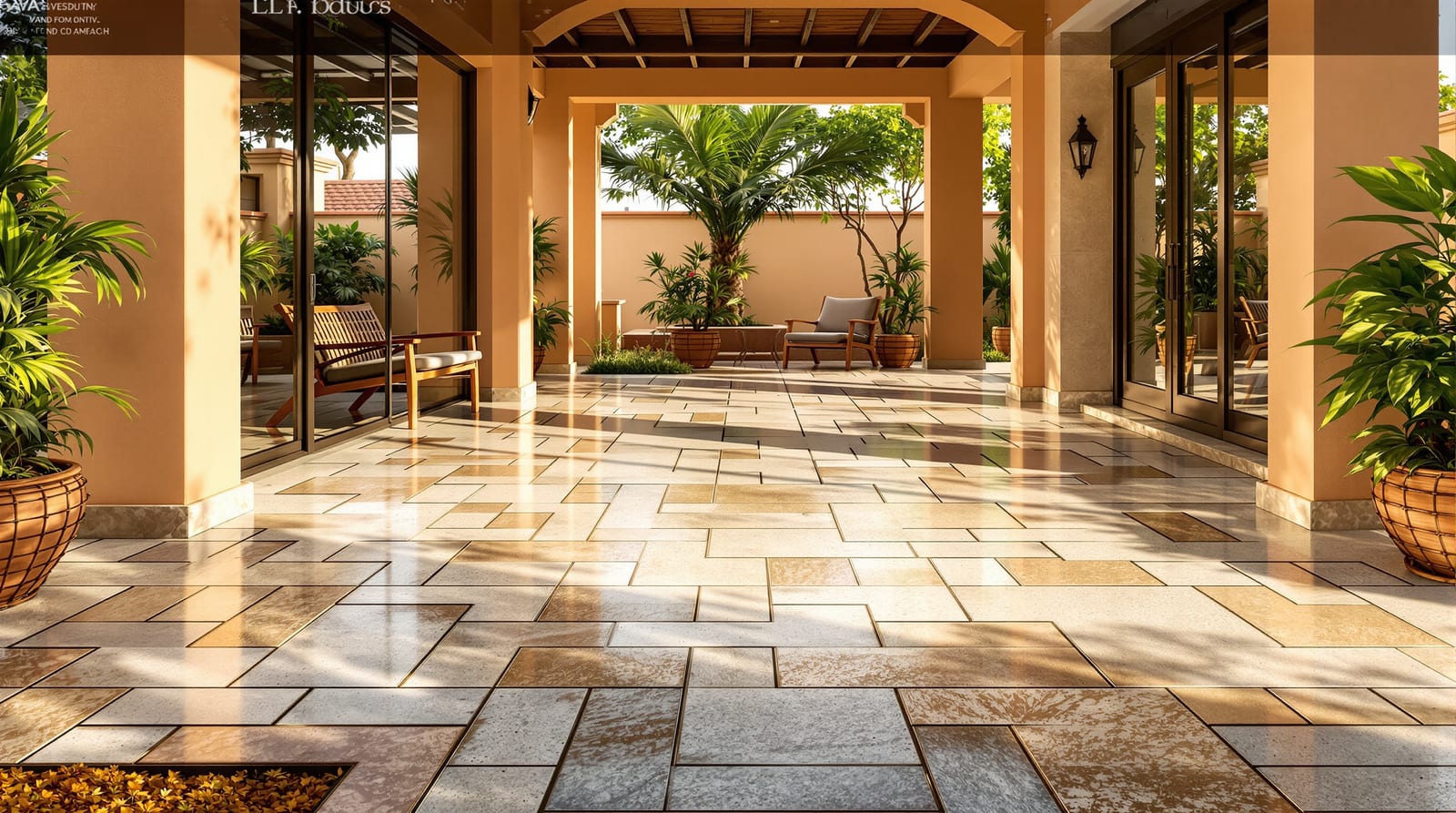
Concrete Floor Finishes in India: Stamped, Stained, Broom, Salt, Trowel & Exposed Aggregate Options
The full menu of decorative concrete floor finishes beyond plain grey — stamped, acid-stained and coloured, broom, burnished trowel, salt and stencilled — with what each looks like, where it suits, anti-skid options and costs of ₹80–350 per sq ft.
Plain grey concrete is only the starting point. The same slab that ends up as a dull car-park apron can, with the right surface treatment, become a stamped stone-look patio, a deep ox-blood stained living-room floor, a grippy broom-finished ramp or a soft mottled industrial-chic interior — at a fraction of the cost of cut stone or tile. The finish is chosen and applied in the last few hours of the pour, and it changes everything: look, grip, durability and price.
This guide walks the full menu of decorative concrete floor finishes used in India — what each one looks like, where it suits, how slip-resistant it is, what it costs at ₹80–350 per sq ft, and how to keep it sealed and sound.
Why concrete finishes matter
A concrete floor is one monolithic pour. Unlike tiles or stone, there are no grout lines to fail, no pieces to lift, and no slow piece-by-piece laying. But raw, screeded concrete is plain, dusty and prone to staining. The "finish" is whatever you do to the top surface — texture it, colour it, imprint it, polish it or wash it — to turn a structural slab into a wearing, decorative floor.
These finishes split into two broad families. Texture finishes (broom, salt, trowel, exposed aggregate) change the surface roughness, mainly for grip and look. Colour and pattern finishes (stamped, stained, integrally coloured, stencilled) change appearance, often mimicking stone, brick or wood. Most real Indian projects combine the two — a stamped pattern with an integral colour, or a broom-finished driveway tinted to hide tyre marks. The advantage in India is cost and speed: your regular mason pours the slab, a specialist applies the decorative treatment, and the result is seamless and tough underfoot and under tyres.
The decorative concrete finishes, one by one
Stamped (imprinted) concrete
Stamped concrete presses textured rubber or polyurethane mats into the fresh, coloured surface to emboss a pattern — random flagstone, ashlar slate, cobblestone, brick, even timber planks. A release agent (often a second contrasting colour) is dusted on first so the imprint reads with realistic shading. The finished floor mimics expensive stone or brick paving but is a single seamless pour with no joints to weed up. It is the most popular decorative finish for Indian driveways, porches, patios and pool surrounds because it looks premium for far less than real stone.
The catch: the smooth, sealed relief surface can become slippery when wet, so use an anti-slip additive in the sealer for ramps and pool decks. Stamping also needs an experienced crew working fast before the slab sets.
Acid-stained and water-stained concrete
Staining colours the concrete chemically rather than coating it. Reactive acid stains (metallic salts in a mild acid) react with the lime in the concrete to produce permanent, translucent, mottled, marbled colours — earthy browns, ambers, blue-greens and charcoals that look like aged leather or weathered stone, every floor unique. Water-based stains give a wider, more predictable colour palette without the acid reaction. Stains penetrate, so they will not chip or peel like paint. This finish has become the signature look of industrial-chic interiors, cafes, studios, showrooms and lofts across Indian cities.
Staining works best on a sound, clean, unsealed slab; old contaminated concrete takes colour unevenly. After staining, the floor is neutralised, cleaned and sealed.
Integrally coloured concrete
Here pigment (iron-oxide or synthetic colour) is mixed into the wet concrete itself, so the colour runs all the way through the slab rather than sitting on top. Chips and wear do not show a grey scar underneath. Integral colour is often combined with stamping or a broom finish to give a consistent base shade — terracotta, buff, charcoal, grey-green — and is the most fade- and wear-resistant way to colour concrete. It is the same iron-oxide family used in red-oxide and IPS floors.
Broom finish
The simplest and cheapest texture: while the concrete is still plastic, a stiff broom is dragged across the floated surface to leave fine parallel grooves. Those grooves give genuine grip in the wet, which is why the broom finish is the default for outdoor paving, ramps, parking aprons, service yards and footpaths all over India. It is plain and utilitarian rather than decorative, but it is the most reliable anti-skid concrete finish and costs the least. Tint it with integral colour to lift the look.
Trowelled and burnished (power-floated) concrete
Repeated trowelling — by hand or with a power trowel — compacts and smooths the surface into a dense, hard, slightly reflective sheen without grinding or polishing. A burnished or power-floated finish is the seamless, soft-sheen grey beloved of modern minimalist interiors, lofts and showrooms. It is smoother and slicker than a broom finish (so not for wet outdoor areas) but tougher and less dusty than raw concrete. It sits a step below true mechanically polished concrete, which grinds the surface to a gloss.
Salt finish
While the concrete is fresh, coarse rock salt is broadcast and pressed into the surface, then washed out once the slab has set — leaving a field of small, shallow, pock-marked craters. The result is a subtly textured, anti-skid surface with a speckled look, popular for pool decks, patios and pathways where bare feet need grip but exposed aggregate would be too rough. It is gentler underfoot than broom or exposed aggregate and reads as decorative rather than utilitarian.
Exposed aggregate
The concrete is cast or seeded with decorative pebbles and chips, then the top cement skin is washed off to reveal the stones — a coarse, very grippy, durable outdoor surface for driveways, pool decks and paths. Because it is a finish in its own right with a deep set of choices, Studio Matrx covers it fully in exposed aggregate flooring; treat it as the rugged, anti-skid end of the concrete-finish menu.
Stencilled and engraved concrete
Stencils (paper or adhesive) are laid on the fresh surface before colour or release agent is applied, masking grout-line patterns to create the look of laid tiles, bricks or pavers without imprinting. Engraving cuts patterns and joints into a cured, coloured slab with a saw or router. Both give crisp, custom geometric or paver-look patterns for entrances, courtyards, logos and feature floors, and can be combined with staining for a designed, one-off result.
The sampler below shows how the same grey slab reads under different finishes — from a smooth burnished interior to a stamped stone pattern, a broom-textured path and a salt-finished deck.
Finish, look, cost and best use
The table compares the main decorative concrete finishes at a glance. Costs are indicative all-in ranges (material plus the decorative labour over a poured slab; varies by city, vendor and pattern complexity; add 18% GST; the structural slab and sub-base are extra).
| Finish | Look | Indicative ₹/sq ft | Anti-skid (wet) | Best use |
|---|---|---|---|---|
| Broom finish | Plain grey, fine grooved | ₹80–140 | Excellent | Driveways, ramps, paths, yards |
| Salt finish | Speckled, lightly pitted | ₹100–180 | Good | Pool decks, patios, walkways |
| Trowelled / burnished | Smooth, soft sheen | ₹120–250 | Poor–moderate | Industrial-chic interiors, lofts |
| Integrally coloured | Through-body colour, any texture | ₹110–220 | Depends on texture | Coloured driveways, patios, interiors |
| Stencilled / engraved | Tile, brick or paver pattern | ₹150–300 | Moderate (sealed) | Entrances, courtyards, feature floors |
| Acid / water stained | Mottled, marbled, translucent colour | ₹150–320 | Moderate (sealed) | Industrial-chic interiors, cafes, showrooms |
| Stamped / imprinted | Mimics stone, slate, brick, wood | ₹150–350 | Moderate; slick if over-sealed | Driveways, patios, porches, pool surrounds |
| Exposed aggregate | Pebbles and chips proud of surface | ₹80–250 | Excellent | Driveways, pool decks, paths |
Use the Studio Matrx polished concrete cost calculator to size a quote for a ground or burnished interior, the flooring cost calculator for the wider job, and the anti-slip rating selector to confirm the finish suits a wet or sloping zone.
Durability and sealing
Concrete finishes are among the longest-lived floors when done right — a sound slab with correct control joints and a maintained sealer can last decades, indoors and out. Three things govern longevity:
- The slab and joints. Decorative finishes are only as good as the concrete beneath. A properly compacted sub-base, damp-proof membrane, reinforcement and sawn or tooled control joints (to manage shrinkage cracking) matter more than the surface treatment. This is general concrete-flooring practice and is covered by IS 1443 for laying and finishing cement-concrete flooring; in-situ cement floors such as IPS follow IS 2571.
- Sealing. Bare concrete and stains are porous and will absorb oil, leaf tannins, hard-water marks and food spills, and the surface can dust. A penetrating sealer (silane/siloxane) soaks in and is best for outdoor grip; a film-forming sealer (acrylic, polyurethane or epoxy) sits on top, deepens colour with a wet look or gloss, and protects interiors. Reseal outdoor decorative concrete roughly every 2–4 years, and interiors every 3–5 years or when the sheen dulls. Stamped and stained floors in particular need their sealer maintained to keep the colour rich.
- Climate. In India, full sun bleaches surface coatings, the monsoon tests grip and stains, and dark integral colours absorb terrace heat. Pick integral or stained colour over surface paint for fade resistance, prefer textured finishes outdoors, and on hot terraces weigh a light colour or a dedicated heat-reflective treatment.
A patch on decorative concrete rarely matches perfectly, so cracks and damage are hard to hide — which is the main maintenance trade-off against tiles you can swap out.
Anti-skid options for outdoor and wet areas
Slip resistance is the single most important decision for any outdoor or wet concrete floor in India, where monsoon, pool splash-out and bathroom water are facts of life. From grippiest to slickest:
- Exposed aggregate and broom finish are the most reliably anti-skid — coarse stone texture or fine grooves give genuine traction; ideal for ramps, driveways and pool decks (DIN slip ratings around R11–R13 territory).
- Salt finish gives moderate, comfortable grip — grippy enough for pool surrounds and patios but gentler on bare feet.
- Stamped, stained and trowelled finishes are smoother and rely on the sealer. For these in any wet zone, specify an anti-slip additive (fine polymer or aluminium-oxide grit) mixed into the topcoat, and avoid high-gloss sealers, which make a wet surface dangerously slick.
- Burnished interiors are deliberately smooth and slick — keep them dry-interior only.
For a deeper treatment of wet-area grip and remedial treatments, pair this with the Studio Matrx guide on anti-slip flooring for wet areas.
Where each finish suits in India
For driveways and parking, choose broom finish, integral colour or stamped (with anti-slip additive) for looks. For patios, porches and courtyards, stamped or stencilled gives a stone-look at low cost, and salt finish suits barefoot zones. For pool decks, salt finish or exposed aggregate win on cool, anti-skid comfort. For industrial-chic interiors, lofts, cafes and showrooms, acid-stained or burnished/trowelled concrete delivers the seamless, characterful grey-and-mottle look; if you want a higher gloss, step up to mechanically polished concrete, and for a softer, putty-smooth interior surface consider microcement, which the cluster covers separately. For entrances and feature floors, stencilled, engraved and stained finishes allow custom patterns and logos.
Cross-links and where this fits
This guide is part of the Studio Matrx flooring cluster. For the bigger picture of alternative and seamless floors, start with the specialty flooring guide. To go deeper on the two closest relatives, see polished concrete flooring and exposed aggregate flooring. For the traditional in-situ cement floor, read IPS flooring, and for outdoor surfaces overall, the outdoor flooring guide. To price a job, use the polished concrete cost calculator.
Frequently asked questions
What is the cheapest decorative concrete floor finish?
A coloured broom finish is the most economical decorative option, at roughly ₹80–140 per sq ft over a poured slab. It adds integral colour and a grippy texture for very little over plain grey concrete. Stamped, stained and stencilled finishes cost more because they need specialist crews, patterns and multiple colour and sealer coats.
Is stamped concrete slippery when wet?
It can be. The smooth, sealed relief surface of stamped concrete is more slippery when wet than broom or exposed-aggregate finishes. For driveways, ramps and pool surrounds, ask your applicator to mix an anti-slip additive (fine grit) into the topcoat sealer and to avoid a high-gloss finish. A textured anti-slip stamp pattern also helps.
How long do concrete floor finishes last?
A decorative concrete floor on a sound slab with proper control joints and a maintained sealer can last several decades. The finish itself rarely fails; what needs upkeep is the sealer, which should be refreshed every 2–4 years outdoors and 3–5 years indoors. Integral colour and chemical stains last far longer than surface paint because they are part of, or react with, the concrete.
Can I apply a decorative finish to an existing concrete floor?
Some finishes can be retrofitted. Acid or water stains, engraving, a bonded micro-topping or a thin stampable overlay can be applied to a sound, clean, unsealed existing slab. Cast-in finishes such as salt finish, broom finish, integral colour and seeded exposed aggregate generally need fresh concrete. A specialist should assess the existing slab first, as contamination and old sealers prevent stains and overlays from bonding.
What is the difference between stained concrete and painted concrete?
Stain penetrates and either reacts chemically (acid stain) or soaks into the surface (water stain), so it cannot chip or peel and gives translucent, mottled, natural-looking colour. Paint and epoxy coatings sit on top as a film that can wear, chip and peel under traffic. For a durable, characterful industrial-chic interior, staining is the more lasting choice.
Export this guide
Related Guides — Deep-dive reading
Exposed Aggregate Flooring in India: Method, Aggregate Choices, Cost & Pros and Cons
Concrete cast with decorative pebbles and chips, then surface-washed to reveal the stones, gives a tough, anti-skid, seamless finish for driveways, pool decks, paths, parking and courtyards at ₹60–180 per sq ft — here is how it is made, the aggregate options, costs and trade-offs.
Flooring & SurfacesAnti Slip Flooring for Bathroom and Wet Areas in India: R-Ratings, Finishes and Genuinely Safe Tile Choices
How to choose genuinely safe flooring for bathrooms, kitchens, balconies, pools, entrances and elderly- or child-friendly homes — the R-rating system, finishes that grip wet feet, anti-skid natural stone, slope to drains and the tiles to avoid.
Flooring & SurfacesPatio Flooring in India: Best Decks & Outdoor-Seating Floors for Weather, Grip & Looks
How to floor a patio, deck or outdoor lounge in India so it shrugs off UV and monsoon, grips wet feet, stays barefoot-friendly and still looks like a place you want to entertain.
Flooring & SurfacesRelated Tools — Try Free
Polished Concrete Cost Calculator
Estimate polished or decorative concrete floor cost by area and finish — polished, stamped, stained or microtopping.
Flooring CalculatorDriveway Flooring Cost Calculator
Estimate driveway surfacing cost — paver blocks, exposed aggregate, stamped concrete, cobblestone or grass paver.
Flooring CalculatorFlooring Cost Calculator
Estimate the all-in cost of a floor — material, laying, wastage, skirting and GST — by area and material.
Flooring Calculator