
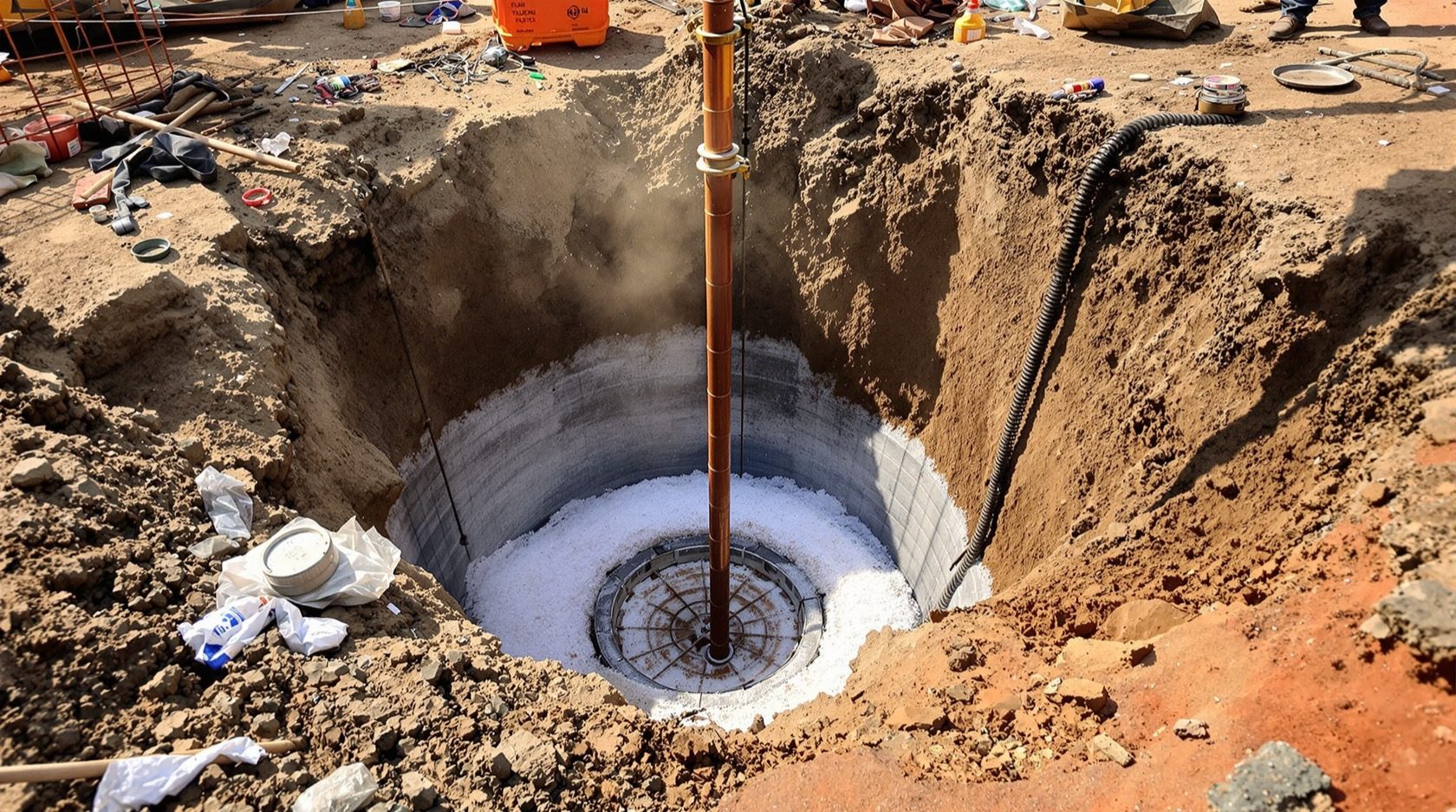
Types of Earthing: Pipe, Plate & Chemical Compared
The physical ways a home is earthed — the traditional pipe and plate electrodes and the modern maintenance-free chemical earthing rod. How each works, what it costs, where each suits the soil, and why low earth resistance, not the type alone, is what matters.
Earthing works by connecting your installation to the ground through an earth electrode, and there are several ways to build that electrode. The traditional pipe and plate earthing have served for decades; the modern chemical (maintenance-free) earthing rod has become popular for its consistent low resistance. This guide compares the methods — but leads with the point that matters most: it is not the type that makes earthing good, it is the low, tested earth resistance it achieves in your particular soil.
It is a companion to the home earthing guide and sits under the protection layers guide.
The safety line. Earthing type, design and installation are a licensed electrician's decision, made to IS 3043 : 2018 against your soil and load. This guide helps you understand the options and ask informed questions; it is not an installation guide. The electrode must be installed and its resistance tested by a professional.
First principle: it is the resistance that matters
Whatever the type, an earth electrode has one job: to present a low resistance path to the general mass of earth, so fault current flows freely and trips the protection. That resistance depends on the electrode and the soil — dry, rocky or sandy soil has high resistivity and needs a better or deeper electrode; moist, loamy soil earths easily. So the right earthing for a home is whatever achieves a low, measured earth resistance in that soil — which is why the electrician tests it rather than assuming a type is enough.
A "chemical earthing" that tests poorly is worse than a simple pipe earthing that tests well. The number on the earth tester is the truth; the type is just the means.
Pipe earthing
A galvanised iron (GI) or copper pipe is buried vertically in an earth pit, surrounded by alternating layers of charcoal and salt (to hold moisture and lower resistance), with an arrangement to pour water in and keep the soil around it moist.
- Pros: simple, proven, economical, easy to maintain by watering.
- Cons: resistance rises if the soil dries out, so it needs periodic watering and occasional attention; performance varies with season.
- Best where: reasonable soil with a way to keep the pit moist.
Plate earthing
A GI or copper plate is buried flat, deep in the ground (traditionally with charcoal and salt around it), giving a large contact area with the soil.
- Pros: large surface area, good and stable earthing, long-established.
- Cons: needs a deep, larger excavation; more material; also benefits from moisture.
- Best where: where a good, durable electrode is wanted and digging depth is available.
Chemical (maintenance-free) earthing
A modern earthing rod — a metal (often copper-bonded) pipe filled with a conductive compound, surrounded in the pit by a back-fill compound (BFC) that absorbs and retains moisture and keeps resistance low.
- Pros: consistently low resistance, stable across seasons, little routine maintenance (hence "maintenance-free"), compact installation.
- Cons: higher upfront cost; quality varies by product; "maintenance-free" still means it should be inspected and tested, not ignored forever.
- Best where: difficult or dry soils, and where consistent low resistance and low upkeep are worth the extra cost — increasingly the default for new homes.
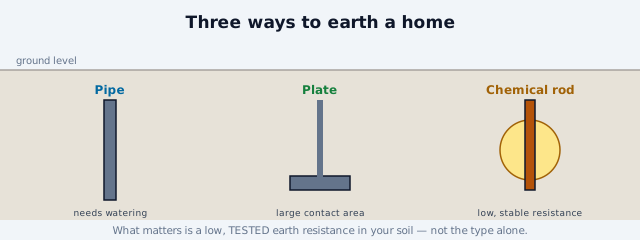
Comparison
| Method | Electrode | Maintenance | Resistance stability | Relative cost |
|---|---|---|---|---|
| Pipe | GI/copper pipe | Periodic watering | Varies with soil moisture | Low |
| Plate | GI/copper plate | Occasional | Good | Medium |
| Chemical rod | Filled rod + back-fill | Low ("maintenance-free") | Consistently low | Higher |
Multiple electrodes are often connected together (in an earth grid) to achieve a low enough resistance, especially in poor soil or for larger installations — another reason the electrician's measurement drives the design, not a single product choice.
What an owner should insist on
- The earthing is designed and installed to IS 3043 by a competent electrician.
- The earth resistance is measured with an earth tester and recorded — not assumed.
- The electrode suits the soil (a difficult soil may need a chemical rod or multiple electrodes).
- The earth pit is accessible for inspection and testing.
- Copper or copper-bonded electrodes and conductors where longevity matters, and sound, corrosion-resistant connections.
The one-line answer
A home can be earthed with a traditional pipe electrode (cheap, needs watering), a plate electrode (large area, durable), or a modern chemical/maintenance-free rod (consistently low resistance, low upkeep, higher cost) — but the type matters less than the outcome: a low, measured earth resistance in your actual soil. Let a licensed electrician choose and size the electrode to IS 3043, and above all insist that the earth resistance is tested and recorded, because the number on the earth tester, not the name of the method, is what keeps you safe.
Where to go next
- Why earthing matters: Home Earthing Guide.
- The whole safety picture: Layers of Electrical Protection.
- Lightning's earth path: Lightning Protection Guide.
- The system it protects: Residential Electrical Systems.
References
- IS 3043 : 2018, Code of Practice for Earthing (Second Revision), Bureau of Indian Standards.
- IS 732 : 2019, Code of Practice for Electrical Wiring Installations, BIS.
- National Electrical Code of India, SP 30 : 2023, BIS: https://www.bis.gov.in/
Earthing methods and their suitability are indicative and depend heavily on local soil; the electrode type, design and installation must be chosen and the resistance tested by a licensed electrician to IS 3043. Verify any standard's status via the BIS catalogue before relying on it.
Export this guide
Related Guides — Deep-dive reading
Residential Electrical Systems: The Complete Guide for Indian Homes
How the electricity in an Indian home actually works — from the utility supply and meter through the distribution board, circuits, wiring, earthing and protection, to lighting, safety, energy efficiency, smart controls, solar and backup — written so a homeowner can understand, plan and judge it, and know exactly where a licensed electrician must take over.
Electrical & WiringHow to Choose a Security System (2026): The Master Buying Guide for Indian Homes and Buildings
The mental model that ties the whole buying decision together: start from your own risk, not a product; build the layers your situation actually needs; make the big architecture choices (wired vs wireless, local vs cloud, DIY vs professional); tell real product quality from marketing; and choose a vendor you can trust.
SecurityCopper vs CPVC Pipes: Which to Use in India (2026)
A fair, India-first head-to-head: copper is the premium, decades-lasting, heat-proof metal that needs a skilled brazier and costs a fortune; CPVC is the cheaper, corrosion-proof, DIY-friendly plastic that has become the default modern Indian supply pipe. Cost, lifespan, heat, install skill, water quality, theft — and a clear verdict by use-case.
PlumbingRelated Tools — Try Free
Electrical Safety & Load Audit
Home electrical audit — 10 categories, 65+ checkpoints across earthing, RCCB, MCB, wiring, switchboards, appliance circuits, DG/inverter backup.
Safety AuditEarth Conductor Size Calculator
Find the minimum protective (earth) conductor size for a circuit from its phase conductor size, using the standard IS 732 / IEC 60364 rule.
ElectricalMaterial Decision Framework (M-Score)
Score 30+ Indian construction materials across cost, durability, climate fit, maintenance, and sustainability.
Materials