
RERA Buyer Rights: A Homeowner's Guide (2026)
What RERA actually gives you as a home buyer -- registered projects, sale on carpet area, an escrow rule that curbs fund diversion, defined possession dates with delay compensation, a defects-liability period, and a real complaint route -- plus how to check a project on your state RERA portal before you pay a rupee.
Buying a home from a builder used to be an act of faith. You paid against a glossy brochure, hoped the "super built-up" maths was honest, hoped possession arrived somewhere near the promised year, and had little recourse when it did not. The Real Estate (Regulation and Development) Act, 2016 -- RERA -- was written to shift that balance toward you, the buyer. This guide explains, in plain language, the rights RERA gives a homeowner and, just as important, how to check a project on your state RERA portal before you commit.
This is a plain-language explainer, not legal advice. RERA is a central law, but every state and union territory frames its own rules, runs its own portal, and sets its own fees, timelines and forms -- so the specifics differ by state and keep evolving. Read your rights here, verify the project yourself on the official state portal, and for a dispute or before signing any agreement, take a property lawyer. This guide helps you know what to look for; it does not replace professional advice.
What RERA is, in one line
RERA is the law that regulates real-estate projects and agents to protect buyers -- by forcing developers to register projects, disclose the truth, ring-fence your money, commit to a dated possession, and answer to a regulator when they default.
What RERA protects a buyer from
Before the rights, it helps to see the old problems RERA was built to curb. Nearly every buyer horror story falls into one of these buckets.
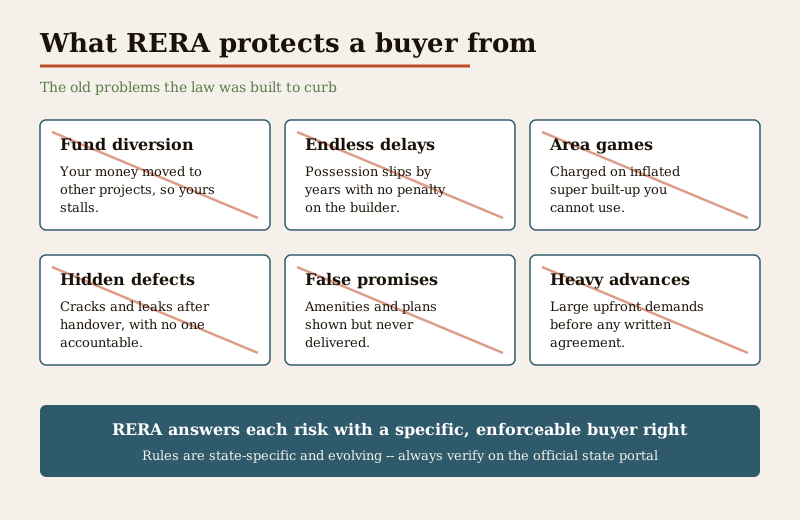
- Fund diversion -- money you paid for your tower being siphoned to fund the builder's other projects, so yours stalls.
- Endless delays -- possession slipping by years with no penalty on the builder.
- Area games -- being sold and charged on inflated "super built-up" area you cannot actually use.
- Hidden defects -- cracks, leaks and failures appearing months after you move in, with no one accountable.
- False promises -- amenities, plans and approvals shown in the brochure that never materialise.
- Heavy upfront demands -- being asked for a large advance before any written, registered agreement protects you.
Your key rights under RERA
RERA answers each of those risks with a specific, enforceable right. These are the protections a homeowner buying in a promoter-built project should expect.
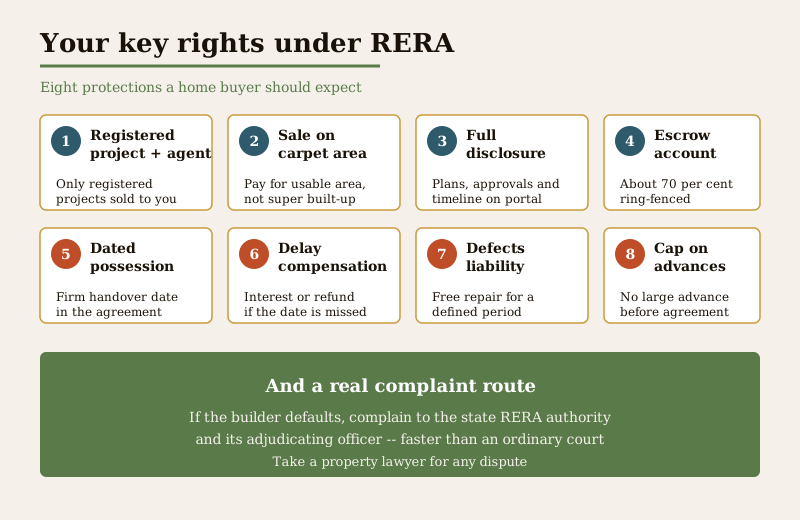
Registered project and agent. Above a small size threshold, a project must be registered with the state authority before it is marketed or sold, and the agent selling it must be registered too. An unregistered project you are being sold is itself a red flag.
Sale on carpet area. RERA mandates pricing and sale on carpet area -- the usable floor area within your walls -- not the opaque "super built-up" figure that once padded prices. This single change makes what you pay per square foot honest and comparable. (The area concepts sit alongside the wider building regulations and compliance rules.)
Full disclosure. The builder must file, and the portal must display, the project's sanctioned plans, layout, the list of approvals and their status, the completion timeline, and the promoter's track record -- so you buy on facts, not a brochure. Understanding what approvals a project needs is covered in the list of approvals and NOCs before construction.
Your money is ring-fenced. A defined share of the amounts collected from buyers for a project -- commonly 70 per cent -- must be kept in a separate escrow account and used only for that project's land and construction cost. This is the rule that most directly curbs the fund-diversion that once stalled thousands of homes.
A dated possession, with compensation for delay. The agreement must state a specific possession date. If the builder misses it, you are entitled to compensation -- typically interest on the money you have paid, for every month of delay -- or, if the delay is unreasonable, to withdraw and get your money back with interest.
A defects-liability period. For a defined period after handover (commonly five years in many states), the builder must repair structural defects and poor workmanship at no cost to you. Once you have possession, an occupancy certificate is the document that confirms the building is legally fit to occupy -- ask for it.
A cap on advances. The builder cannot demand a large advance -- commonly more than 10 per cent of the cost -- before a written agreement for sale is signed and registered. You get a contract before you hand over serious money.
Access to the regulator. If the builder defaults, you are not left to the ordinary courts alone -- you can complain to the state RERA authority and its adjudicating officer.
| Your key RERA right | What it means for you as a buyer |
|---|---|
| Project and agent registration | Only registered projects and agents may be marketed to you; check the registration number |
| Sale on carpet area | You pay for usable area within your walls, not inflated super built-up |
| Full disclosure | Sanctioned plans, approvals, timeline and promoter record are on the public portal |
| Escrow (about 70 per cent) rule | Your money is ring-fenced for your project, curbing fund diversion |
| Dated possession | The agreement states a firm handover date |
| Delay compensation | Interest or refund if the builder misses the promised date |
| Defects-liability period | Free repair of structural and workmanship defects for a defined period |
| Cap on advances | No large advance (commonly over 10 per cent) before a registered agreement |
| Complaint and adjudication | A regulator and adjudicating officer to hear buyer complaints |
How to check a project on your state RERA portal before buying
Every right above depends on one habit: verify the project yourself before you pay. Each state runs its own official RERA portal where registered projects and agents are searchable. Do not rely on the builder's screenshots -- go to the source.
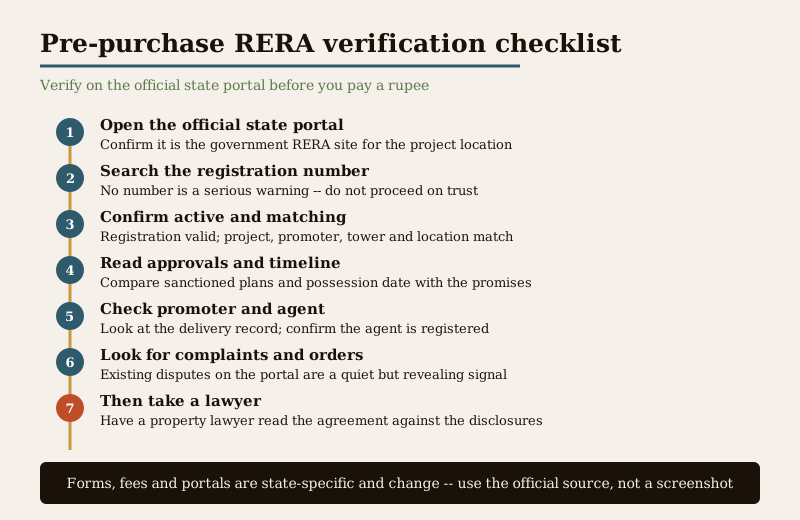
1. Open the official state portal. Find your state or union territory's RERA website -- the authority that regulates real estate where the project is located. Confirm it is the government site.
2. Search the registration number. The builder should give you the project's RERA registration number. Search it on the portal; if there is no number, treat that as a serious warning.
3. Confirm it is active and matches. Check that the registration is valid, not lapsed, and that the project name, promoter, location and tower match what you are being sold.
4. Read the approvals and timeline. See the sanctioned plans, the list and status of approvals, and the declared completion date -- and compare them with the builder's promises.
5. Check the promoter and agent. Look at the promoter's other projects and their delivery record, and confirm your agent is registered.
6. Look for complaints and orders. Many portals publish complaints filed and orders passed against a project or promoter -- a quiet but revealing signal.
7. Then take a lawyer. Before signing the agreement for sale, have a property lawyer read it against the portal disclosures.
| Pre-purchase RERA check | Why it matters |
|---|---|
| Official state portal, not a screenshot | Screenshots can be edited; the portal is the record |
| Valid registration number | An unregistered project cannot lawfully be sold to you |
| Details match the project | Guards against a number borrowed from a different phase |
| Approvals and plans on file | Confirms the project is legally cleared, not just launched |
| Declared possession date | Becomes your reference point for any delay claim |
| Promoter delivery record | Past delays predict future ones |
| Registered agent | An unregistered agent is a compliance gap |
| Complaints and orders | Existing disputes are a warning worth heeding |
If the builder defaults: the complaint route
When a builder breaks a RERA promise -- misses possession, changes the plan, or fails to fix defects -- you can file a complaint with the state RERA authority, which routes it to an adjudicating officer for a decision and any compensation. The process is meant to be faster and cheaper than a civil suit, but the details, forms and fees are state-specific. This is the point to engage a property lawyer, who can frame the complaint and represent you.
What RERA does not cover
RERA regulates promoters and their projects -- builders selling flats, plots or developments to the public. It does not govern an individual homeowner building their own house on their own plot. If you are buying land and self-building, RERA is not your protection; your safeguards are clean title, the right approvals, and a proper contract with your builder -- see how to buy a residential plot and the buying land hub. Small projects below the state size threshold, and projects that already had a completion certificate before RERA came in, may also fall outside registration -- another reason to verify status on the portal rather than assume.
Key takeaways
- RERA is the law that regulates builders and agents to protect home buyers -- register, disclose, ring-fence money, commit to a date, answer to a regulator.
- Your core rights: a registered project and agent, sale on carpet area, full disclosure, an escrow rule that curbs fund diversion, a dated possession with delay compensation, a defects-liability period, a cap on advances before agreement, and a complaint route.
- Always verify the registration number and disclosures on your official state RERA portal before you pay -- not on the builder's screenshots.
- RERA mainly covers promoter-built projects, not an owner self-building on their own plot.
- Rules, portals, fees and timelines are state-specific and evolving -- take a property lawyer for any dispute or before signing.
References
- The Real Estate (Regulation and Development) Act, 2016, Ministry of Housing and Urban Affairs: https://mohua.gov.in/
- Central RERA information portal, Ministry of Housing and Urban Affairs.
- Your state or union territory Real Estate Regulatory Authority portal (search "RERA" with your state name for the official government site).
- Related: Building Regulations and Compliance, List of Approvals and NOCs Before Construction, Occupancy Certificate Explained.
Rights, thresholds, escrow shares, defect-liability periods and possession-delay remedies described here are indicative of how RERA commonly works and vary by state and over time. This is general information, not legal advice -- verify on the official state RERA portal and consult a property lawyer before acting.
Export this guide
Related Guides — Deep-dive reading
RERA Guide for Homebuyers & Architects
Rights, Compliance, Disputes & Remedies Under India's Real Estate Regulation Act
ConstructionCommon Approval Mistakes That Delay Projects in India
The avoidable errors that stall building-plan sanction and possession, and how first-time builders can sidestep each one
Building Regulations & ComplianceHow to Evaluate a Builder Floor Before Buying
The due-diligence checklist for builder floors — title, construction quality, layout and red flags
Home PlanningRelated Tools — Try Free
Pre-Possession Inspection Checklist
Inspect your flat before registration — 10 categories, 70+ checkpoints across legal, carpet area, structure, finishes, and deviations.
Homebuyer ChecklistRERA Carpet Area Calculator
Convert carpet, built-up and super built-up area, find the loading factor, and compare flats on the real price per usable square foot.
Carpet AreaConstruction Approval Checklist — 24-Stage Tracker
Track every approval, permit, and NOC from land title to occupancy certificate across 24 stages.
Approvals