
Door U-Value Guide: W/m²K Explained (India 2026)
What a door's U-value means, the typical W/m²K bands by door type, how it is measured, and how ENS and ECBC use it in India.
A door's U-value is the single most useful number for judging how well it keeps heat from passing through. Formally the thermal transmittance, it is measured in watts per square metre per kelvin (W/m²K) and tells you how much heat flows through one square metre of the door for every degree of temperature difference between inside and outside. The rule is simple and absolute: lower is better. A door at 1.4 W/m²K leaks roughly half the heat of one at 2.8 for the same opening. In India's air-conditioned homes — across hot-dry, warm-humid, composite, temperate and cold zones — the door U-value is what decides how much of your cooling (or heating) bleeds out through the opening, and it is the figure the Eco-Niwas Samhita and ECBC ultimately want you to control. This guide is the spec deep-dive: what the number means, the typical bands by door type, how it is tested, and how to drive it down.
What U-value actually measures
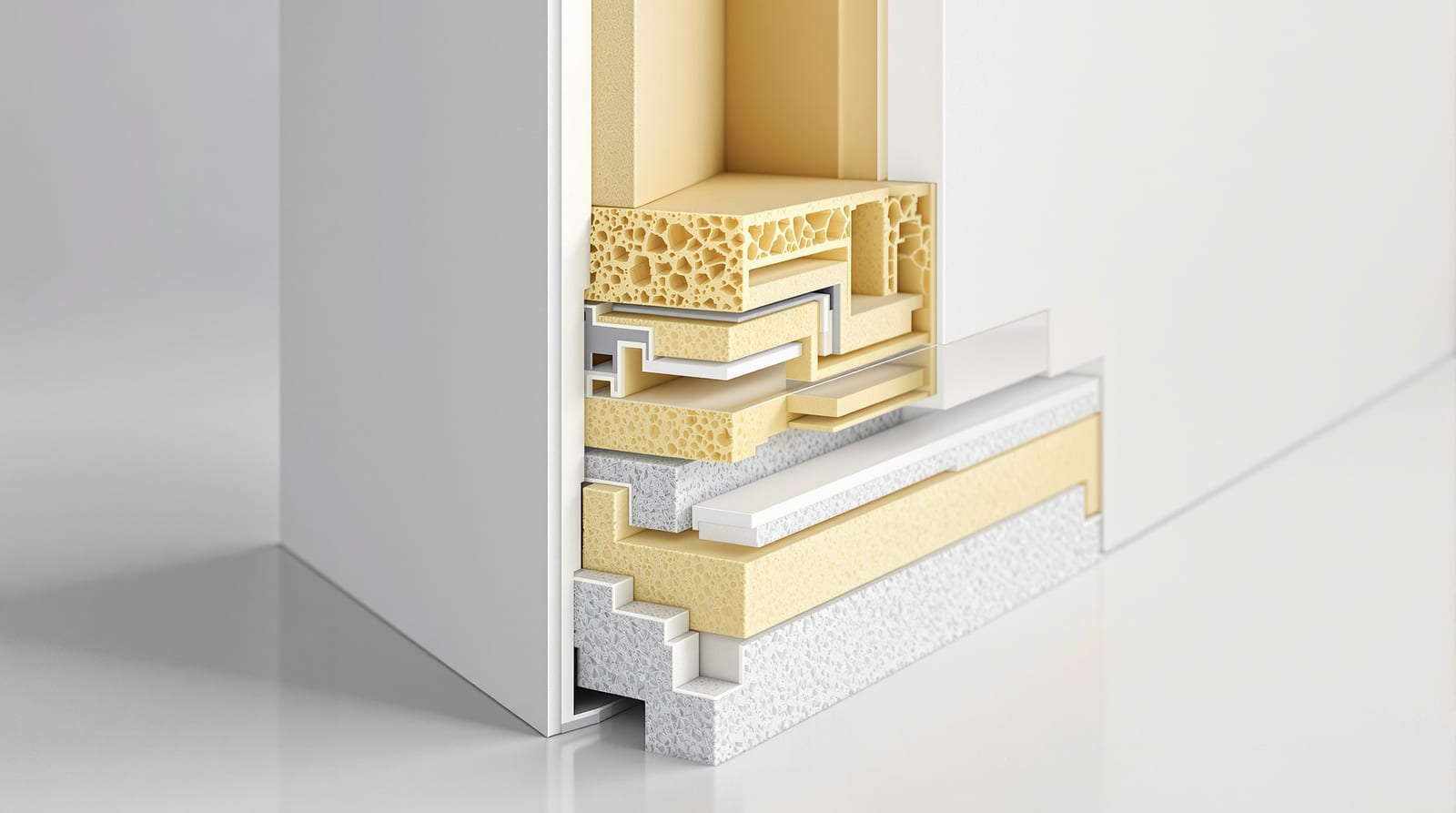
U-value is the inverse of thermal resistance. Where insulation is rated by R-value (resistance — higher is better), the assembled element is rated by U-value (transmittance — lower is better), and U is simply 1 divided by the total R of all the layers plus the inside and outside surface films. A door is a composite element — leaf, core, glazing, frame, seals and the air films either side — so its U-value is a whole-assembly figure, not a property of the timber or aluminium alone.
Three things follow from that. First, the core dominates: an insulating foam or honeycomb core can halve the U-value of an otherwise identical leaf. Second, the frame and junctions matter — a brilliant leaf in a conductive aluminium frame with no thermal break performs far worse than its leaf U-value suggests. Third, glazing changes everything: a single-glazed door panel can wreck the whole assembly, while a double-glazed insulated glass unit (IGU) brings it back. Always ask whether a quoted figure is the leaf-only U-value (Uₚ) or the whole-door U-value (Uₑ, leaf plus frame) — the whole-door number is what ENS and ECBC compliance use.
Typical door U-values by type
The table below gives indicative W/m²K bands for common Indian door types. Treat them as rules of thumb for early specification, not certified values — the actual figure depends on core, glazing ratio, frame and seals, and should come from the manufacturer's tested data or EPD.
| Door type | Typical U-value (W/m²K) | Rating | Notes |
|---|---|---|---|
| Single-glazed door (clear, no break) | 5.0–7.0 | Poor | Glass + conductive frame; avoid in AC homes |
| Solid timber door (hardwood, 35–45 mm) | 2.0–3.0 | Moderate | Denser/thicker = lower; teak mid-range |
| Hollow / flush internal door | 2.5–3.5 | Moderate | Air gap helps a little; not an external choice |
| Aluminium door, no thermal break | 5.0–7.0 | Poor | Metal conducts heat; needs a break |
| Aluminium door, thermal break + IGU | 1.8–2.8 | Good | Polyamide break transforms the figure |
| Double-glazed / IGU door (timber/composite) | 1.5–2.8 | Good | Argon fill + Low-E pushes to the low end |
| uPVC door (insulated, multi-chamber) | 1.2–1.8 | Very good | Hollow chambers trap air; strong all-rounder |
| Insulated / foam-core door (PU or EPS core) | 1.0–1.8 | Very good | Best opaque option; FRP or steel skin |
| Passive House certified door | 0.8–1.0 | Excellent | Ultra-low, airtight, thermal-bridge-free |
Two patterns stand out. Insulated foam-core and multi-chamber uPVC doors are the strongest opaque performers, often beating solid timber by a wide margin. And glazing is double-edged: a single pane is the worst thing on the list, but a good IGU with Low-E coating and argon fill is competitive with the best opaque doors while letting in daylight. For hot India, pair a low U-value with a low SHGC (solar heat gain coefficient) so the glass also rejects radiant heat, not just conducted heat. See solar heat gain doors for that balance.
How U-value is measured
U-value is established by test, calculation, or both. The hot-box method (ISO 12567-1 for doors and windows, or ASTM C1363) puts the door between a warm chamber and a cold chamber, holds a steady temperature difference, and measures the heat flow through it — the most direct, reliable figure. Where testing every variant is impractical, the U-value is calculated to ISO 10077 (frames and glazing) or ISO 6946 (opaque elements) by summing the thermal resistances of each layer and adding the standard inside (Rₛᵢ ≈ 0.13) and outside (Rₛₒ ≈ 0.04) surface films.
For compliance, what matters is the whole-door U-value at a standard size, including the frame and a representative glazing fraction. Be wary of a centre-of-panel figure quoted as if it were the door U-value — it ignores the worse-performing frame and edges and flatters the product. A credible manufacturer will state the test standard, the sample size, and whether the value is Uₚ (leaf) or Uₑ (whole door).
What ENS and ECBC require
India's energy codes do not usually set a single hard U-value limit for a door in isolation — they fold the opening into an envelope performance target. The Eco-Niwas Samhita (ENS) 2018, the residential building energy-conservation code from BEE, works through the Residential Envelope Transmittance Value (RETV) for the walls-and-openings envelope, plus a thermal transmittance ceiling for the roof. A door's U-value (and its glazed area and SHGC) feed into that whole-envelope calculation, so a high-U door has to be compensated for elsewhere. The ECBC 2017 does the same for commercial buildings, prescribing maximum U-values and SHGC for the opaque and fenestration envelope by climate zone, and BEE star labelling rates whole-building energy performance.
The practical takeaway for a specifier: a lower door U-value buys you headroom in the RETV or ECBC envelope budget and makes BEE-rated or green-building compliance easier. It is rarely a standalone pass/fail, but it is always a lever. See door energy rating for how these figures roll up into a rating, and door thermal performance for the full envelope picture.
How to lower a door's U-value
The moves below are roughly in order of impact. None of them is exotic; together they can take a door from "poor" to "very good."
| Design move | Effect on U-value | When it matters most |
|---|---|---|
| Specify an insulated core (PU/EPS foam) | Large reduction | Opaque external doors |
| Add a thermal break to aluminium | Large reduction | Metal doors in AC homes |
| Use double-glazed IGU, not single | Large reduction | Glazed doors |
| Add Low-E coating + argon fill | Moderate reduction | Glazed doors, hot zones |
| Choose multi-chamber uPVC frame | Moderate reduction | uPVC systems |
| Reduce glazing area / raise opaque ratio | Moderate reduction | Where daylight allows |
| Seal perimeter + threshold (air-tightness) | Cuts effective heat loss | All external doors |
| Detail out thermal bridging at frame/junction | Cuts bridging + condensation | All assemblies |
Two of these deserve emphasis. A thermal break — a polyamide strip splitting the inner and outer aluminium — is non-negotiable on metal doors in air-conditioned Indian homes, because bare aluminium conducts heat straight through; see thermal break doors. And air-tightness multiplies the benefit of a low U-value: a well-insulated door that leaks conditioned air around an unsealed perimeter never delivers its rated performance, so pair the U-value work with door air-tightness detailing. Watch the junctions too — door thermal bridging at frames and reveals both wastes energy and risks surface condensation.
To size the comfort and energy payback of a specific U-value for your project, run the numbers through the door U-value calculator, then translate the saving into rupees with the door energy savings calculator. For the product options that hit the low bands, see thermal insulated doors, and anchor the whole decision to the complete door guide.
Frequently asked questions
What is a good U-value for a door in India?
As a rule of thumb, aim for 1.8 W/m²K or lower for an external door in an air-conditioned home, and below 1.5 if you are chasing a green-building or near-passive standard. Insulated foam-core doors, multi-chamber uPVC and thermally broken aluminium with an IGU all reach this band; a single-glazed or unbroken metal door at 5–7 W/m²K does not and should be avoided.
Is a lower or higher U-value better?
Lower is better, always. U-value measures heat that passes through, so a low number means the door insulates well and loses less of your conditioned air. Do not confuse it with R-value, which is resistance — there, higher is better. They are inverses of each other.
Does the frame affect the door's U-value?
Yes, significantly. The whole-door U-value (Uₑ) includes the frame, edges and junctions, and a conductive frame — especially aluminium without a thermal break — can drag down an otherwise good leaf. Always check whether a quoted figure is the whole-door value or just the centre-of-panel or leaf-only number, which flatters the product.
How is a door's U-value tested?
Most reliably by the hot-box method (ISO 12567-1 or ASTM C1363), which measures real heat flow across a known temperature difference. Where testing is impractical, the value is calculated to ISO 10077 or ISO 6946 by summing the thermal resistances of every layer plus the standard inside and outside surface films. A credible supplier will state the standard and the sample size.
Do ENS and ECBC set a maximum door U-value?
Not usually as a single hard limit for the door alone. ENS 2018 folds the door into the residential envelope through the RETV, and ECBC 2017 sets envelope U-value and SHGC limits by climate zone for commercial buildings. A lower door U-value gives you headroom in that whole-envelope budget and makes BEE and green-building compliance easier.
Export this guide
Related Guides — Deep-dive reading
Energy-Efficient Facades in India: How the Building Skin Cuts Your Cooling, Heating & Lighting Bills
How a building facade drives cooling, heating and lighting energy in India, the three levers of solar-heat-gain control, insulation and daylighting, U-value, SHGC, VLT and WWR in plain terms, ECBC and Eco-Niwas expectations, and real Indian green buildings.
Building FacadesDoor Thermal Performance: U-Value & Heat Loss (India 2026)
How doors gain and lose heat in Indian homes, what U-value really means, and what makes a door thermally good enough to cut your AC bill.
Home Doors & EntrancesEnergy Efficient Windows Explained: The Whole-System Guide for Indian Homes
Treat the window as an energy device — frame, glass, seals, shading, install and rating — and learn why low SHGC and shading beat chasing a cold-climate U-value in hot India.
Windows & GlazingRelated Tools — Try Free
Window Energy Savings Calculator
Compare standard glazing vs Low-E and DGU windows — annual cooling savings, 10-year savings and payback.
Window CalculatorGreen Building Window Compliance Tool
Check your window design against Eco-Niwas Samhita — WWR, VLT, SHGC and U-value pass or fail.
ENS Pre-checkWindow Cost Calculator
Estimate window price plus installation by type, frame material, size, glass and quantity.
Window Calculator